Showing posts with label White Island. Show all posts

Friday, 27 September 2024

The Wreck of the SS Tasman

Located off Matata, the low lying Rurima Islands or Rurima Rocks, were brought to the attention of Tauranga’s residents by the Bay of Plenty Times on 12 May 1921. At 4.25 a.m. on the 11th, the Northern Steamship Company steamer Tasman struck a reef near the south-western rock while steaming to Whakatane. The passengers and crew were saved, but the ship was lost along with all cargo and mail. The passengers and crew came ashore without their luggage and personal effects at Matata and Pikowai in three lifeboats, before being transported in trucks to Tauranga.[1]

The Northern Steamship Company vessel SS Tasman

Built in Auckland in 1903, the 179-ton kauri and iron steamer was 102 feet in length and powered by 280hp compound engines.[2] Placed on the Auckland to Whakatane run by the company, the SS Tasman was a regular sight at Tauranga’s Victoria Wharf between 1909 and 1921. There, it offloaded and took on new passengers, freight and mail, as well as coal for its boilers.

A Nautical Inquiry into the wreck of the SS Tasman held at the Auckland Magistrates Court the following month, expressed focused on four issues:

  • The chief officer Mr. McManus was on watch and in charge of the Tasman with Captain William John Grigg also on the bridge when the vessel struck.
  • Though the weather was squally, it was possible to see the higher points of the Rurima Group and also Whale Island. The vessel struck an island which could be seen at the time the accident occurred.
  • When the steamer struck on the south-west point of the Rurima Group, there was about three miles of shore room between the shore and where the incident occurred.
  • The course was a perfectly well-known one and had been run in perfect safety for the last 50 to 60 years and the Tasman was jammed for time to catch the bar at Whakatane.
The Rurima Islands
The SS Tasman struck a reef on the south-west corner of the Rurimu group

In evidence, Captain Grigg stated that he had been master of that steamer about three or four months before May 11. He had also been master of the Tasman at different periods and had originally been chief mate of the Tasman for close on three years. During that time the steamer had been wholly engaged in the Auckland to Whakatane trade. He had also been master of other vessels in the Northern Company’s fleet.

On the night of the disaster, he had kept a course close inside Mayor Island, which was passed at about 10 o'clock. He had followed his usual course, which he had always found a safe one, inside Whale Island. When passing Motiti Island the weather was clear, with no sea and just a medium breeze.

He was below when the mate called him at ten minutes to four, and told him they were close to Matata light, which was then just for'ard of the starboard beam. At this time, they were about two miles off Matata. As several other “objects” were in view, and Grigg "took a shot" at them over the steering compass, but took no other steps to place them accurately.

While the weather then was ‘fairly clear’ overhead, they were surrounded by black clouds. The wind was fresh, with squalls at times, from the S.S.W. Shortly after, the mate observed that the land was a little closer and altered the course half a point to the southward. A few minutes later the Tasman struck. The time was then within a few minutes of 4.25. He thought the vessel struck at the south-west corner of the Rurima Group.

According to the mate, the vessel did not seem to rest on the reef for any appreciable time, and backed her off, he steered straight for the mainland. SS Tasman sank scarcely a mile off Rurima.

Captain Grigg stated that he could have gone outside Whale Island that night, but there was smoother water on the inside. Mr. McManus, he said, had been his chief mate all the time he was on the run, and he had found him perfectly reliable as a navigator.[3]

A coastal steamer at Victoria wharf 1810s

On 9 June, the Nautical Court of Inquiry found that the SS Tasman was off her proper course when it struck one of the Rurima rocks and was wrecked. The first officer was adjudged negligent in not ascertaining his correct distance off' the land at Town Point (Maketu). The court also found that Captain Grigg, the ship’s master:

[D]id not exercise good judgment when deciding what distance the vessel was off the land at Matata. The court was further of the opinion that when the chief officer drew the master’s attention to the ship’s closeness to the Rurima rocks, the master, in sending a message to the officer on the bridge to alter the course a quarter of a point to the south, was not taking sufficient precautions for the safety of the vessel.[4]

Despite being found guilty of negligence and fined 20 and 10 pounds respectively towards the costs of the inquiry, Grigg and McManus did not lose their certificates.[3] Evidence had been put before the court that, in the vicinity of White Island, the needle of the compass would be liable to be deflected by the magnetic disturbance which existed at the time the grounding occurred.[5]

Sinking just 30 minutes after its initial grounding, the remains of the SS Tasman - the boiler, part of the hull and the engines - lie in 27 meters of water between the Rurimas and Matata.

End Notes
[1] Bay of Plenty Times, 12 May 1821: 3.
[2] Rurima Island, Wikipedia, https://en.wikipedia.org › wiki › Rurima Island
[3] Auckland Star, 6 June 1921: 7.
[4] New Zealand Times, 10 June 1921: 5.
[5] Ibid: 10 June 1921: 5.

Illustrations
[1] H. Winkelmann, SS Tasman 1903-1921, Auckland Weekly News, 19 May 1921, Auckland Council Libraries - Kura AWNS-19210519-43-01
[2] Photographer unknown, Rurima Islands, Wai 46 # A3, Te Rangahau Whenua Raupatu O Ngati Awa Report to Department of Conservation, 25 July 1992: 15.
[3] Frederick Radcliffe, Postcard, Tauranga, Victoria Wharf, 1910s. Accession number 0846/08. Tauranga Heritage Collection

Monday, 18 April 2022

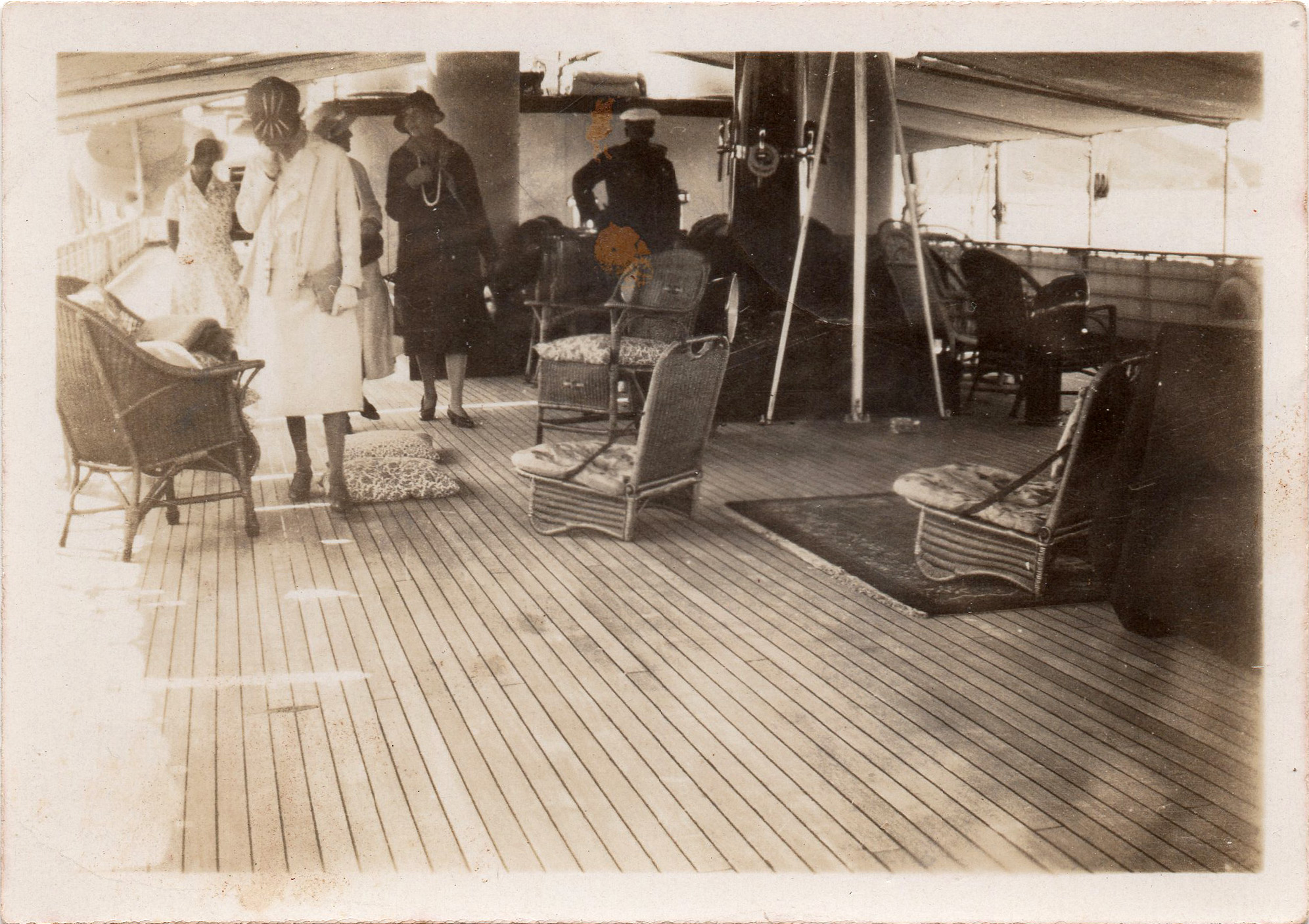
The Nahlin

 “This is the snap I took of Lady Yule’s yacht the Nahlin”
Snapshot photograph from private collection

On February 2 1932 people who happened to have been in Pilot Bay would probably have hardly believed their eyes as a beautiful steam yacht sailed into Tauranga Harbour. She was met by the Harbourmaster Mr A. Dickson who guided her to her anchorage near the big sand hill south of the Railway Wharf at the Mount. As she drew fifteen feet it was not possible to bring her up to the town.

The yacht was the Nahlin, owned by Lady Yule who was the widow of the late Sir David Yule, a wealthy Calcutta jute merchant. Attended by fifty crew, Lady Yule and her daughter Gladys were the only passengers. Both keen fisherwomen they were visiting New Zealand for our deep sea fishing season.

Lady Yule's yacht, the Nahlin, in Tauranga Harbour, Mauao in the background, 2 Feb 1932
Tauranga City Library Photographic Collection, Ref. 04- 575

At that time the Nahlin, who was first commissioned in 1930, was one of the most luxurious yachts in the world. She weighed 1600 tons, could do 17 and a half knots and was a gleaming picture of white and gold with a buff funnel. Nahlin is a native American word meaning fleet of foot and beneath the bowsprit she had a striking figurehead representing an Indian Chief.

Each deck had luxurious saloons furnished with brocade and tapestry upholstered lounges and the yacht’s interior was panelled in light oak. There was a well stocked library, a fully equipped gym and about a dozen bathrooms, beautiful blooms grew in pots throughout the yacht.

“This is taken on board the Nahlin by Phyl Hartley. Can you pick Mrs Mcmillan, she is the one in black with her hand holding her necklace. It is a marvellous yacht I believe.”
Snapshot photograph from private collection

Lady Yule obviously had a soft spot for birds and other animals as there were dozens of brightly coloured cages hanging round the upper and lower decks containing squawking parrots and chirping canaries. Dogs, cats and monkeys were among the other pets on board. (What would today’s Customs would have made of that?)
 
While the Nahlin was anchored in Tauranga Harbour, Lady Yule and Gladys visited Rotorua, plus Tauranga and the surrounding district. According to the Bay of Plenty Times (4 Feb) “His Worship the Mayor, Mr B.C. Robbins, Mr J.C. Green, Chairman of the Harbour Board, Mr C. Lowe, Harbour Board Secretary and Mr Geo. West visited Lady Yule on the Nahlin and were very hospitably entertained.’’ I wonder if their wives were invited, as no mention is made of them?

Mayor Island (Tuhua), Tauranga. Postcard published by Mirrielees (No. 19)
Collection of Justine Neal

Swordfish at Mayor Island (Tuhua)
Courtesy of Tauranga Heritage Collection, Ref. 019/08

On February 5th the Nahlin sailed to Tuhua/ Mayor Island where the ladies were hoping to test the sword fishing grounds.

White Island (Whakaari) from Wilson Bay, Bay of Plenty, N.Z.
Hand-coloured postcard published by Tasman Photo, c. 1960s
Collection of Justine Neal

Early on the morning of February 6th the yacht left for a day trip to Whakaari (White Island). Mr West sailed with them in order to conduct them on a tour of the island. This marked the end of their short stay in Tauranga and, after  returning to their anchorage that afternoon, the Nahlin set sail for Napier.

Luxury yacht Nahlin purchased by King Carol of Rumania from Lady Yule. The vessel at Whangaroa on its New Zealand cruise, Auckland Weekly News Supplement, 11 Aug 1937
Image courtesy of Auckland Libraries Heritage Images, Ref. AWNS-19370811-56-3

Postscript: I wondered why the name Nahlin sounded familiar then I read this report from the Bay of Plenty Times (19 November 1937.) King Carol of Roumania purchased the yacht from Lady Yule in 1937. The previous year, after being redecorated and refitted the yacht was lent to the Duke of Windsor – then King Edward VIII – for his Mediterranean cruise in August 1936. The paper fails to mention his sailing companion, a certain Wallis Simpson and we all know how that story ended.

For those of you with a soft spot for beautiful boats you might like to know that the Nahlin is still sailing. She has been fully restored and is now owned by Sir James Dyson, whose name also has a familiar ring.

References
TheGuardian.com
Wikipedia
Papers Past, Bay of Plenty Times, 19 November 1937, 4 February 1932, 5 February 1932, 3 February 1932, 13 January 1932

Friday, 14 August 2020

American Whaling Vessels and John B. Williams

Early Sailing Vessels and Visitors to Tauranga – Part IX
American Whaling Vessels and John B. Williams


American whaling ships were prominent among the 2000 vessels known to have visited tribal New Zealand before the Treaty of Waitangi in 1840. During their typical two year whaling voyages, these large vessels, which averaged 340 tons, not only reprovisioned at main trading ports like the Bay of Islands, Kapiti Island and Akaroa. Competing with English, French and colonial Australian vessels also seeking provisions, they also stood off every populated cape and peninsula and entered every bay and safe harbour to trade with Maori.

From the mid-1820s, smaller colonial Australian whaling-gun trading vessels like the Haweis, John Dunscombe and Prince of Denmark anchored off Motiti Island or entered Tauranga Harbour to trade with Ngai Te Rangi. Yankee whalers were also regular visitors to the Bay. One vessel stood off Whakatane to take on provisions and Maori sailors including the Ngati Awa warrior Hemi Paraone Te Waiwe. Another, with a large cargo of oil and whale bone, was driven ashore and wrecked to the east of Maketu as late as 1838. The cargo was plundered and the surviving crew enslaved by local tribes. Intriguingly, Ngai Te Rangi informed the missionary leader Henry Williams in 1825 that they had helped unload barrels from a large vessel within Tauranga harbour. This unidentified vessel (not the missionary vessel Herald which visited in 1826), was the first European vessel known to have visited Tauranga. The barrels likely contained rum, gunpowder or whale oil, the latter being a trade item prized by Maori.

A ship driven ashore on the New Zealand coast. In 1838, an American whaler with a cargo valued at US$10,000 was driven ashore during a fierce storm and wrecked in the Bay of Plenty
The American sailor John B. Williams of Salem, Massachusetts visited New Zealand and the Bay of Plenty aboard the whaler Tybee during 1832-1833. Later appointed by President Tyler as United States Consul at the Bay of Islands, Williams compiled a journal during his residence between 1842 and 1844. A combination of first hand observations, hearsay, fact and opinion, William’s journal nevertheless provides one of the first detailed pictures of the Bay of Plenty and its Islands, following Captain Cook’s first cursory description in 1779.
“The seacoast is mostly sand with bard [barred] harbours, only capable for small vessels to enter. The natives of these places were very treacherous often seizing small vessels and detain[ing] them taking property to a large amount. Should a vessel be so unfortunate as to get aground, going in or out of either of those places she is free for plunder and considered a lawful prize.

Of the Islands in the Bay of Plenty the first or northernmost one is Mairs [Tuhua or Mayor] Island, or Tuhua], high, sandy & covered with wood with a population of 200 natives subsisting chiefly on fish and mutton birds. When they are fearful of their enemies they retire to a flat top hill which is composed of loose rocks etc. These they tumble down on their enemies (that attempt to attack them) with great vengeance & effect. This island was formerly volcanic, having a large lagoon in the centre, doubtless has been the crater.

The next or inner island in the Bay is Flat Isld [Motiti] a little south of Touranga, is at present uninhabited, capable of cultivation, fine land of rich soil but no harbours. A small vessel can anchor between the island and the main, however the holding ground is not good being rocky bottom,

[An Island] known by the appelation of Moutohora lays about 7 miles from the mainland, highly elevated and one part is on fire, immense quantities of sulpher can be had (large cargoes). Around its shores are found excellent fish, and the natives frequently go from the main for that purpose. It has been noted and remarkable for black whale in great numbers. Whaling parties have been fitted out at very great expense, and often in danger of losing all their property. One season one whaling party was unsuccessful and came away leaving their property to whomsoever might think proper to use it. A rock about the size of a whale boat lies between Mair Island and Flat Island in a direct line between the two about midway."

Moutohora or Whale Island, Bay of Plenty

Williams journal casts light on the large sulphur deposits on Moutohora as well as the resident shore whalers.
"Fourth Island, so called, White Isld [Whakaari], has a volcanoe which is constantly burning, and issuing from it a very great smoke, which is often noticed to increase before a gale. It has a very large crater in the centre, running in from the east side. The level of the mouth of this crater is not more than 4 feet from the level of the sea. Here are to be found many kinds of variegated stones, with sulphur in large quantity. Pumice stone is also floating about the island, which must have been thrown out. It would be impossible for any person to remain on this island any great length of time (say a few hours) as the smell of sulphur is so exceedingly strong. The north part is covered with a scrub, and very bold water around the island, one or two small pyrimid rocks lay at some distance from it

1843. Touranga is said to be finest part of New Zealand; in this vicinity said to be a fine country and much level land about the sea coast, the soil very fertile. Potatoes & Corn are to be found in great abundance. And more flax has been dressed by its natives than by any others on the coast. 150 tons was procured for the Sydney market. Of late they have commenced salting pork.

Wood is very scarce, the plains are covered with nothing but fern, the hills being a great distance back, from where they are obliged to get wood. If indolence prevails they gather whatever may come in their way on the sea shore. Pipe clay is plentiful, covered with a very heavy black sand.

The Fishermen (natives) are very expert at Touranga, leaving early in the morning and returning late at night with a very great variety of fish, which that Bay is so much noted for its great variety. The whole of the long range of New Zealand Coast is abundantly supplied with beautiful fish.”
Of interest to modern day local fishermen, Williams included in his description of ‘beautiful fish’: hapuka, sting ray, flounder, snapper, kahawai, mullet, gurnard, tarakihi, crayfish and eel.

References
Bentley, Trevor, Pakeha Slaves, Maori Masters: The Forgotten Story of New Zealand’s White Slaves, New Holland, Auckland, 2019.
Mair, Gilbert, Reminiscences and Maori Stories, Brett, Auckland, 1923: 2.
McNab, Robert, From Tasman to Marsden: A History of Northern New Zealand from 1642 to 1818, Wilkie and Co, Dunedin, 1914.
Williams, John, B; The New Zealand Journal, 1842-1844 of John B. Williams of Salem, Massachusetts, Peabody Essex Museum, Salem, 1956: 39-45.

Images
Cuthbert Clarke, ‘The beaching of the French corvette L’Alcmene’, B-030-009. Alexander Turnbull Library, Wellington.
'Moutohora or Whale Island, Bay of Plenty.' Image provided courtesy of East Bay Aviation and White Island Flights.

Saturday, 19 October 2019

Peter Densem 1917-2019

Peter in a Fleet Air Arm dive-bomber cockpit. Densem Private Collection
Peter Alex Densem was born in Tauranga on 9 May 1917 in The Palms, a nursing home on the east side of Cameron Road between 8th and 9th Avenues. The parents of Peter and his two siblings, Rod and May, were Mary and Peter Densem, who had a confectionery and tearooms on The Strand. The Densem family lived at No.28 Durham Street and in that house, Peter grew up and from it he went to his first teaching jobs and then to war.

Alongside his lifelong friend Alf Rendell, Peter began his education at the Tauranga District High School (now Tauranga Primary School) in Cameron Road between Arundel Street and Fifth Avenue in February 1923. Peter chose a professional course when he entered the standards, gained the highest educational standard, matriculation, in the fifth form and planned to leave school, uncertain of what career to pursue. To earn money immediately, he managed, in late 1937, to get a job with the Bay of Plenty Times. While engaged in this work he met his teacher, Mrs Mackle, who enquired what he was doing. On being told she advised Peter that teacher training colleges were being re-opened and suggested he return to school for another year and study for the “D” teaching certificate. This he did, and in 1939 he entered the Auckland Teachers’ Training College.

Peter’s first permanent job was at a new one-room sole-charge school at Pehiri, 50 kilometres west of Gisborne in the Urewera hinterland. While teaching during the early World War Two years Peter also completed Royal New Zealand Air Force (RNZAF) courses. The roll at Pehiri School had grown to 19 pupils when he entered the RNZAF in 1941. After completing a basic training course with the RNZAF in New Zealand with the intention of becoming a pilot, Peter had a change of course. The service had discovered that he was a good mathematician, and at that time the Royal Navy’s Fleet Air Arm (FAA) was desperately short of competent navigators.

Peter flew first in a Swordfish open-cockpit biplane torpedo-bomber and then in the Barracuda, a monoplane torpedo/dive-bomber, from which he progressed to the more powerful and faster American-built torpedo-carrying Grumann Avenger, equipped with a power-operated gun turret. His service included a tour in Trinidad flying cover over convoys far out into the Atlantic Ocean. A forced landing in an Albacore at Trinidad’s Piarco airport wiped the wings off his aircraft and left Peter with a badly-injured leg. After recovering in a London hospital, he served in the aircraft carriers HMS Furious, Indefatigable and Formidable. Peter was among the Barracuda crews whose mission it was to sink the mighty German battleship Tirpitz. So great was the sudden change in air pressure as the Barracudas dived almost vertically on their target, he suffered permanent damage to one ear-drum.

After the war Peter married Christine, a Scots girl he met while overseas, and bought a house at the east end of First Avenue, planting out the land around it with native trees. The situation appealed particularly because it overlooked a beach, the harbour and his boat mooring. After Christine died in 1959 he lived there with his mother and sister May.

Home from the war, Peter with his Tauranga Primary School class. Densem Private Collection
Returning to his teaching career Peter attended a short course at the teachers’ training college, completed a B.Sc. degree in biology and began work at Tauranga Primary School and then as deputy headmaster at Tauranga Intermediate when that school opened in February 1958. He was appointed first headmaster of Arataki Primary School at Mount Maunganui when it opened in February 1963 and was the second headmaster at Otumoetai Intermediate School in 1967, a year after it opened. Peter retired from Otumoetai Intermediate in 1975.

It was in the 1930s that Peter became interested in boats. Peter’s first craft, in association with his brother, Rod, was the 12ft 6ins centre-boarder Koa, with a flat bottom and clinker sides. In 1934 they bought the 16ft Doreen. An open clinker boat, they put a cabin on Doreen and sailed her all around the Tauranga Harbour. After the war Peter had a variety of craft. He had Sanda, a 28ft motor-sailer of English design, built by Percy McIntosh in Fraser Street, Tauranga, in the late 1940s. Peter bought Jeanette from Phyllis Dumbleton and sold her to Captain George Carter, later Tauranga harbourmaster.

He obtained the 30ft launch Anne-Michelle in exchange for Whangaroa, a 34ft sloop-rigged motor-sailer, and next owned the 24ft launch Tauhara, the last launch built by Henry Geros (later of Tauranga) in W.G. Lowe’s Auckland yard. Then came Peter’s last yacht, the 30ft Koanui, built by Barwick Harding at Pyes Pa. His last boat was Ngako, a 16ft clinker launch built by Percy Vos in Auckland, bought in 1979 and kept on the foreshore beneath his house at the east end of First Avenue. Peter used his boats to good effect when he was appointed an honorary wildlife ranger for the coastal islands, thereby continuing an interest in fauna and flora established with Bernard Sladden over many years. He and Sladden had cruised regularly from White Island to Great Barrier, monitoring the Raurimus, Plate, Mayor and Cuvier Islands, the Mercuries and the Aldermen.

Lifelong friends Peter Densem and Alf Rendell, January 2016. Fiona Kean Private Collection
In 2003 Peter moved to Althorpe Village where he and his tabby cat Katie had a much-loved townhouse with a view of Mauao. In 2017 Peter celebrated his 100th birthday and was surrounded by many family, friends and formers students who gathered to acknowledge the significant impact he had had on their lives.

Peter will be greatly missed by all who knew him.

Taken from Max Avery’s article on Peter Densem and Alf Rendell which featured in the November 2017 edition of the Bay of Plenty Historical Review

Friday, 13 September 2019

Charles Spencer (1854-1933) – Part III – Serving the Community

S.S. Taupo, as she lies on the Rocks at Stoney Point, Tauranga Harbour
Photographed at low water on the afternoon of April 9th [1879], by Charles Spencer
Albumen print mounted on printed card, Tauranga City Library, Ref. 05-445

The s.s. Taupo ran aground on Stoney Point Reef in the entrance to Tauranga Harbour on 18 February 1879. Several attempts were made to raise her off the rocks over the next two years, eventually succeeding on 2 March 1881, although she sank a few weeks later off Tuhua while being towed to Auckland. This large format photograph by Charles Spencer was supposedly taken on 9 April – although the year wasn’t specified, it is likely to have been in 1879, three weeks after the accident, and only a week after Spencer’s arrival in Tauranga.

Portrait of (back row) Edward Ker Mulgan and Everard F. Buckworth,
(front row) William Tuthill and George Noble Gair
Carte de visite by Charles Spencer, Tauranga, April-June 1879, with annotations on verso
Alexander Turnbull Library, Ref. PA2-1686
G.N. Gair arrived from Wellington on 25 May 1878 to take up the position of manager of the local Bank of New Zealand branch. Having purchased a farm and an allotment in the Quarter Acres, he quickly became involved in the local scene, being appointed to several committees, engaging in amateur dramatics, and endearing himself by playing a prominent role in fighting a fire which broke out in a shed on the Town Wharf in late September. He was Treasurer of the Tauranga Cricket Club, and no doubt a frequent player. He participated in Tauranga’s annual St Patrick’s Day Regatta in March 1879. Sadly, he took his own life on 26 June 1879. The names of Mulgan, Buckworth and Tuthill appear frequently in the newspapers of that period in connection with cricket, boating and horse racing, and it seems likely that the carte de visite above celebrates one such event. It was taken by Spencer soon after his arrival in Tauranga, probably in his tent adjacent to Wrigley’s Brewery. Other carte de visite portraits in an identical format by Spencer held at the Alexander Turnbull Library depict other Tauranga personalities, including John E Grace and Fred Clarke, and were probably also taken c.1879-1880.

Lake at White Island, partially dry, c.1882-1884
Glass plate positive by Charles Spencer (Series # 107)
Auckland Library Sir George Grey Collection, Ref. 1285_09999

In November 1882, March 1883 and again in February 1884 Spencer made trips to Whakaari (White Island), partly to take photographs, but also to evaluate the prospects of extracting sulphur, to be used in the manufacture of fertilizer and sulphuric acid. In May 1883 he accompanied a survey party to Karewa Island, and brought back not only some exposed glass plates but some specimens of tuatara which he displayed in his shop window.

Children at a Maypole Dance, probably at the Temperance Hall, Tauranga
Cabinet card albumen print attributed to Charles Spencer, 25 February 1886
Tauranga Heritage Collection, Ref. 0569-08

In March 1884, when the Governor visited, he captured both the reception given him at Whareroa Marae and the subsequent speeches celebrations along the Strand from an upstairs window. During a Maypole Dance conducted on 25 February 1886:
“Mr Charles Spencer succeeded in taking a couple of photographs of the group, which we doubt not will appear in due course with the impress of this gentleman’s well known finish and prove to many a pleasant souvenir of the Wesleyan Gift Auction.”
It is almost certain that the cabinet card illustrated above is one of these photographs, even though it does not have Spencer’s name on it. At the same event there was a magic lantern show, “at which will be shewn a number of well-known views,” probably also conducted by Spencer.

Sailing Regatta in Tauranga Harbour, c. mid- to late 1880s
Carte de visite albumen print attributed to Charles Spencer
Tauranga Heritage Collection, Ref. 0572-08

Likewise this carte visite photograph of small yachts competing in a regatta on Tauranga Harbour, with the Papamoa Hills visible on the skyline, was almost certainly by Spencer. A regatta was held annually in Tauranga in mid-March, although there were smaller meets as well. Spencer donated prizes for the regatta comprising sets of his photographs of the Hot Lakes in 1887 and 1889, and it is possible that the above view was taken on one of those two occasions.

Charles Spencer was elected to the Borough Council in May 1887, but failed in his bid for the Mayoralty in December that year.

(to be continued)