Showing posts with label Tauranga Archives. Show all posts

Thursday, 6 February 2025

Exciting donation of natural history illustrations to Te Ao Mārama - Tauranga City Libraries

 From Tauranga City Library’s archives

Small in stature and slight of frame; Arnold Henfrey Watson led a demanding outdoor life. New Plymouth born in 1882, he moved to Australia for a few years, droving in New South Wales and later in Tasmania, where his grandparents resided. Returning to New Zealand, he took up farming in Shannon, bush-felling in Hawkes Bay, and shepherding on large stations in the Gisborne region. He and his brother Spencer broke in a large block of undeveloped land in the Pongakawa Valley, Te Puke. They felled a rimu and built a homestead from split slabs and shingles, far from the nearest road and neighbour. A keen observer of the natural world he had a love of sketching and painting what he observed.

With the onset of World War I, he travelled to the Rotorua recruiting office to enlist, where he was drafted into the Auckland Mounted Rifles before being transferred to the 15th NZ Company of Imperial Camel Corps in Egypt and Palestine. During his service, he participated in key campaigns across the Sinai and Palestine regions, secretly documenting the landscapes and wildlife through sketches in a series of diaries, against army regulations. Some of his illustrations made their way into the ‘Kia Ora Coo-ee’, the magazine produced in Cairo for ANZAC troops in the Middle East. Stumpy, the camel assigned to him, featured in at least one of these. These diaries make up part of Ams 294 and until recently were the only artistic records we had of his. 

Arnold aboard Stumpy

Arnold aboard Stumpy, Te Ao Mārama - Tauranga City Libraries Photo 11-168

The passionate natural historian he was, he continued to capture detailed watercolours of insects, spiders, and fish after successful fishing trips later in life.  The illustrations reveal his efforts to capture each species' local and scientific names, a difficult task in the 1930s to 1950s.  Modern marine biology students might be interested in his observation of local species during that time. His family cherished these natural history illustrations but they were nearly lost when a fire broke out within a moving van between Wellington and Christchurch. The works survived, but not without sustaining some smoke damage. 

Arnold's grand-daughters at the Tauranga Archive in 2024 with Heritage Specialist Harley Couper

Arnold's granddaughters at the Tauranga Archives with Heritage Specialist Harley Couper, in 2024.

In April 2024, two of 'Bang’s' granddaughters, as he was affectionately known, donated a significant collection of his natural history illustrations to our archive. These are now part of Ams 507, which was digitised in September of 2024. 

"Sepioteuthis bilineata", an older name for "Sepioteuthis australis", commonly known as Ngū, the Southern Reef Squid or Southern Calamari


1 of 79 colour illustrations on card featuring various butterfly and moth specimens collected mostly in the Bay of Plenty

Arnold Henfrey Watson retired to Mount Maunganui when his asthma made it difficult to keep working.  He died suddenly in 1960 while swimming at Puru near Thames. 


By Te Ao Mārama - Tauranga City Libraries Heritage and Research Team: Harley Couper

Sources: 


 This archival collection was digitised in September 2024 and is located on Pae Korokī. For more information about this and other items in our collection, visit Pae Korokī or email the Heritage & Research Team: Research@tauranga.govt.nz


Tuesday, 3 September 2024

The Mystery of the Monmouth Cannons Part 3: The Return of Captain Black

From Tauranga City Library’s archives

A monthly blog about interesting items in our collections.

This post follows on from The Mystery of the Monmouth Cannons Part 1 and Part 2, so be sure to check them out for the full backstory.

Te Tapihana cannon, Monmouth Redoubt, 2024.
Private Collection, Te Ao Mārama - Tauranga City Libraries.
While transcribing Private George Crabbe's manuscript (see August's blog post on George Crabbe) we uncovered a crucial missing puzzle piece concerning the history of the Te Tapihana cannon, and its connection to the early Danish trader Phillip (Hans) Tapsell. 

George A Crabbe, (1840 - 1905).
Image courtesy of N. Wilson, Crabbe Collection, Tauranga Heritage Collection.

According to Crabbe's account, in early January of 1868, a schooner named Fortune arrived in Ōpōtiki carrying one of the old cannons belonging to Hans Tapsell of Maketū. The militia promptly got their hands on the gun and brought it ashore, 
where it was used for many years. Later, the gun was taken to Tauranga by a Captain Turner, though Crabbe does not provide a date for this.

Excerpt from Scrapbook compiled by Crabbe family (p. 21). George Alfred Crabbe, date unknown.
Te Ao Mārama - Tauranga City Libraries, ref Ms 112/3.

This story accords with what we already know of Te Tapihana’s history, in which Captain Archibald Campbell Turner had acquired the cannon from a military officer in Ōpōtiki during the New Zealand Wars (BOPT, April 6th, 1914, p. 4). But Crabbe’s account provides us with more than just the connection to Captain Turner.

Captain A. C. Turner N.Z.M.. c. 1900.
Puke Ariki Heritage Collection, ref PHO2011-2311.

In Part 2 we talked about the sale of two Tapsell cannons by Retreat Tapsell to a ‘Mr. Black’ of Tauranga (likely early trader Thomas Black), in early May of 1864. As it happens, the name of Black’s vessel was the Fortune (DSC, 12 May 1864, p. 4).

Could this be the same Fortune that arrived in Ōpōtiki with the Tapsell gun nearly four years later? It certainly seems so, as shipping records place Captain Black onboard the schooner Fortune in Ōpōtiki at the time (NZ Herald, Jan 18th, 1868, p. 2). 

View, Waioeka River and Wharves, Ōpōtiki. Creator and date unknown.
Te Whare Taonga ō Taketake, Whakatāne Museum Collections and Research, ref 42434. 

Since Black had reportedly purchased the cannons as ballast for his vessel, it is very plausible that Te Tapihana had remained onboard the Fortune from the time of it's purchase in 1864, until it's reappearance in Ōpōtiki in 1868. If our theory is correct, it would support the long-held belief that Te Tapihana was part of Phillip Tapsell's battery of 'big guns' at Maketū Pā.

Maketū Pā, Bay of Plenty. Watercolour by Major General Horatio Robley, 1865.
Collection of Museum of New Zealand Te Papa Tongarewa, ref 1992-0035-826.

To learn more about Tapsell's battery of big guns, click here.

For more about George Crabbe and his first-hand account of the New Zealand Wars, click here.

Sources:   

 'Local and General'. (1914, 6 April). Bay of Plenty Times, 42(6097), p. 4.

'Maketū. (From our own Correspondent.) May 5'. (published 1864, 12 May). Daily Southern Cross, p. 4.

'Shipping Intelligence'. (1868, 18 January). New Zealand Herald, 5(1303), p. 2.

Crabbe, George Alfred. (n.d.). Scrapbook relating to Aotearoa land wars history, Māori culture, fauna/ flora/ reptiles, and sketch of Orākau pā. Collection of Te Ao Mārama - Tauranga City Libraries, ref Ms 112/3, pp. 21-22.

Tuesday, 6 August 2024

A 1st Waikato Private recalls the Battle of Te Ranga (June 21 1864)

 From Tauranga City Library’s archives

A monthly blog about interesting items in our collection

A new account of the massacre at Te Ranga in June of 1864 has recently come to light in Tauranga. Charles Alfred Crabbe, who lived on Cameron Road near the corner of Sixth Avenue at the end of the 19th century, left behind a collection of papers which made its way into the library archives almost 100 years later. Within this collection are the memoirs of his father, a Private George Alfred Crabbe, who served with the 1st Waikato Regiment during the New Zealand Wars. Crabbe the senior’s manuscript is now close to 150 years old, and the passage of time has taken with it some of these pages. In an effort to preserve further loss, the manuscript spent several months with a professional archives conservator between 2020 and 2021, before being digitised and returned. It is now part of Ms 112/3 where it remains mixed into other historic notes by his son, Charles Crabbe. 

Private George Crabbe of the 1st Waikato Regiment offers us a detailed, first-person account of his experiences and perspective during the New Zealand Wars in the 1860’s.  Despite the first seven pages of the manuscript being lost to time, we see the regiment's arrival at Tauranga and follow their movements, battles, and daily life as they engage in military operations. Private Crabbe details key engagements, beginning (for us) with the Battle of Te Ranga, and moving on to skirmishes in Maketū and Ōpōtiki. Crabbe's account of the Battle at Te Ranga is provided below. 

As the Private recounts the challenges of engagements with Māori forces, his manuscript reveals the British and colonial forces' efforts to assert control over Māori land, often using scorched earth tactics. Crabbe paints a stark picture of the harsh realities of the New Zealand Wars, acknowledging the resilience and bravery of Māori, while being simultaneously oblivious to the horror inflicted at the hands of the colonials. 

George Crabbe details the strategies used to fortify positions and the grim outcomes of battles, noting the significant loss of life among Māori defenders. He recounts the pursuit of Te Kooti, who had recently escaped from imprisonment on the Chatham Islands and was leading a determined resistance movement against colonial forces and their Te Arawa allies. Private Crabbe’s account documents Te Kooti's strategic acumen and the mobilization of his followers, which posed a substantial challenge to the colonial military.

Private Crabbe provides a distinctly Pākehā settler perspective which is disturbing, yet illuminating. All who resist colonisation are "Hauhaus”, rebels and perpetrators of dreadful acts. None are depicted as free people defending their homes and livelihoods. Similarly, the scorched earth burning of kāinga is recounted without empathy or embarrassment, but simply as dispassionate strategic particulars. To younger generations, the days when history serves as a nation's singular mythic fable are fading. Today, we squint our eyes a little, read between the lines, uncover a more nuanced version of events, and examine the context. The complexities of history require us to acknowledge not just one perspective but the voices and experiences of all.

History, after all, doesn't disappear; it accumulates. Every time we pull out our wallets or consider our children's future, we are face to face with the long tail of history.

Crabbes account of the Battle at Te Ranga

The General left for his Head Quarters at Auckland, and the command of the district devolved on Colonel Greer of the 68th. During Col. Greer's time we were kept continually at drill, besides during our ordinary duties of guards and piquets. Our regiment had not had such an opportunity up to this time of becoming proficient in drill & on account of its various companies having been stationed at different posts. During the middle of June reports were brought in by the Defence Force which was engaged keeping a good look out that the Maoris were showing in force in the neighborhood and late at night on the 16th of the month, the reconnoitering party reported that a large number of Maoris were near the river Wairarapa transporting supplies. This news resulted in an order being given after tattoo for a march out in the morning.

The expedition consisted of a small party of Artillery with one Armstrong gun, and portions of the 68th, 43rd, and 1st Waikato Regiments, and the Mounted Defence Force; the whole under the commanding officer Colonel Greer. When the party had proceeded about a mile and a half beyond the Gate Pah, the videttes were fired upon, but our men soon drove in the Māori piquets to the Te Ranga trenches, where the Maoris had made extensive earthworks.

The Artillery with their gun were placed on the rise in front of the Māori trenches. Two companies of the 43rd flanked the right in heavy fern on the slope of a gully. The Mounted Defence to dismount and flanked the left until relieved by a company 68th; while the remaining portions of the 68th. and 43rd. supported our party of the 1st. Waikatos formed the attacking party. The Armstrong gun was shortly removed to flank the trenches on the left.

 While firing was going on here a dog belonging to the Artillery, was wounded by a bullet. He howled fearfully, and such is a soldier's nature, ever ready to extract amusement from any passing event, that the dog fixed the attention of our men in every part of the field for several minutes.

The firing was kept up for about 3 hours when a general advance was sounded, and a splendid charge was made without a waver, against the trenches in the teeth of a galling fire, although we of the 1st. Waikatos had been placed behind the Imperial companies for their support, yet such was the eagerness of the Waikatos that we were up and into the trenches pell mell along with the Imperials. The affair was soon over, the Maoris being completely routed; but they fought bravely and offered a stubborn resistance for the time with their inferior weapons, mostly old fowling-pieces, spears and long-handled tomahawks.

The Maoris lost heavily in the assault. About 120 or 130 were found dead in and about the trenches besides those that were shot in the swamps when retreating. The loss of our side was only 10 killed and something over 30 wounded. The latter were brought back to our camp, early in the afternoon.

The following day a strong party went out to the scene of the previous day's conflict for the purpose of burying the enemy's dead. Our slain were brought into camp and the day following received decent burial in the cemetery near the mission station, by the side of those who had lost their lives at the storming of the Gate Pā. I think we had buried 125 Maoris in the Te Ranga trenches, (and this number, with those 15 afterwards found in the swamps) would bring the total Maori loss up to quite 180.

Archdeacon Brown read the burial service in the Maori language over the bodies of the Maories, and he delivered an address to us over the grave, speaking in high terms of their bravery, and the humanity of the chief Rawiri, who was among the slain. This chief was laid by himself wrapped in a blanket at the head and corner of the trench. The rest of the Maoris who were buried in one common grave, were almost naked, some few in the Maori fighting garb, a small mat around the loins.

George Alfred Crabbe, 1st Waikatos, in Te Ao Mārama Tauranga City Libraries Ms 112/3


By Tauranga City Libraries Heritage and Research Team: Harley Couper

Sources: 


This archival collection has been digitised and is available to view on Pae Korokī. For more information about this and other items in our collection, visit Pae Korokī or email the Heritage & Research Team: Research@tauranga.govt.nz

Tuesday, 4 June 2024

The Mystery of the Monmouth Cannons: Part 2

From Tauranga City Library’s archives

A monthly blog about interesting items in our collections.

Tawakeheimoa cannon, Taumatakahawai Pā (Monmouth Redoubt) c. 1920s.
Collection of Te Ao Mārama - Tauranga City Libraries, Pae Korokī ref 09-082

Last month we talked about a letter written by Colonel G. Arnold Ward, Former Mayor of Tauranga, regarding the unknown origins of the old guns in the Monmouth Redoubt. If you haven't read it already, you can check it out here. In this month's blog post we will delve deeper into the intriguing history of the two Napoleonic era carronades - Tawakeheimoa and Te Tapihana.

Tawakeheimoa, the larger of the two cannons (pictured above), is believed to have once belonged to the early Danish trader Phillip Tapsell (Kean, 2018, p. 20). Tapsell was famous for his battery of twelve 'big guns,' which he used to defend his trading station at Maketū Pā - though this defense was short-lived. In 1836, an attack by Ngāti Hauā and Ngāi Te Rangi led to the successful capture of the pā and the destruction of Tapsell's trading station (Matheson, 1989, p. 2).

Phillip Tapsell and daughter Kataraina, c. 1870s.
Image courtesy of Alexander Turnbull Library, Steffano Webb Collection (PA-Group-00370),
ref: 1/1-008958-G.

As for the fate of Tapsell's battery following the attack, we are provided with varying accounts. In his memoirs, Tapsell states that following the fall of Maketū Pā, the victors spiked the guns and threw them into the Kaituna River (Adams, 2021, p. 154).

Sketch map of country around Waihī Estuary and Maketū Pā (A), shows location of Tapsell's store (B), Kaituna River, and Te Tumu Pā (I). Creator unknown, 1840. 
Image courtesy of  Alexander Turnbull Library, ref MapColl-832.16a/[187-?]/Acc.1848


Interestingly, an alternate version of events reported by the Daily Southern Cross claims that six of the guns were taken by Ngāi Te Rangi to fortify Te Tumu Pā. However, they were soon recaptured by Te Arawa, except for one gun, which had already been taken to Tauranga (Daily Southern Cross, 12 May 1864, p. 4).

One of twelve 'Tapsell' guns 'Te Haupapa', Wreck of the Falcon Memorial, Maketu.
Image courtesy of Ministry for Culture and Heritage, credit Lynton Diggle, 2009.

While we might initially be more inclined to accept Tapsell's first-hand account over any other, the second version of events does seem to have some credibility to it, owing to an altercation which occurred in 1864.

According to the Daily Southern Cross, the sale of two big guns to a Mr. Black of Tauranga (likely early trader Thomas Black) by Retreat Tapsell (eldest son of Phillip Tapsell) had prompted complaints from Ngāti Kererū, who considered the guns to be taonga, and their property (for further explanation see Bentley, 2013, p. 23-4). One of these guns was reportedly "Tawake hei moa", the other was one which had been found "lying in the water" (Daily Southern Cross, 12 May 1864, p. 4). A meeting was called to discuss the sale; however Black sailed off with the guns before the situation was able to be resolved.

Tawakeheimoa after it was relocated to the Tauranga Historic Village and District Museum, 1986.
Image courtesy of Tauranga Heritage Collection, ref 0460/08

At some point thereafter, Tawakeheimoa came into the possession of A. W. Burrows, who likely purchased it from Mr. Black. Burrows kept the gun in his private collection until his death in 1899, after which it was gifted to the Tauranga Borough Council for public exhibition in the redoubt (Tauranga District Council, 2004, p. 9).

But what about the other Monmouth cannon?

Te Tapihana cannon, Taumatakahawai Pā (Monmouth Redoubt) c. 1956-57.
Collection of Te Ao Mārama - Tauranga City Libraries, Pae Korokī ref 09-075

The smaller carronade donated by Captain A. C. Turner, locally known as Te Tapihana, has also been attributed to Tapsell's battery due to its similarity to the other Tapsell guns (Matheson, 1989, p. 9); however this identification is much less certain. In fact, evidence points more towards a military provenance. A note published in the Bay of Plenty Times in 1914 mentions that Captain Turner received the gun from a military officer in Ōpōtiki during "the Māori War period" (BOPT, April 6th, 1914, p. 4). Additionally, the crown stamp on the cannon's barrel indicates that it was produced for military use (Ward, 1914).

Te Tapihana, Monmouth Redoubt, 2024.
Private Collection, Te Ao Mārama - Tauranga City Libraries.

Of course, these details do not exclude the possibility that Te Tapihana once belonged to the early Danish trader, and the evidence has only raised further questions. Unfortunately, we may never know for sure.

Bethlehem School pupils at Redoubt, 1961.
Collection of Te Ao Mārama - Tauranga City Libraries, Pae Korokī ref gca-2396

For more background on Tapsell's battery and the whereabouts of the other guns, check out this article by Alister Matheson here. 

Sources:

    Adams, J. (2021). Events in the Life of Phillip Tapsell. Oratia Books.

    Bentley, T. (2013). Tribal Guns and Tribal Gunners: The Story of Māori Artillery in 19th Century New Zealand. Willsonscott Publishing International.

    
Matheson, A. (May 1989). Tapsell’s Big Guns. Journal of Tauranga Historical Society, No 37. Pp. 1-11.

    'Maketu. (From our own Correspondent.) May 5'. (published 1864, 12 May). Daily Southern Cross, p. 4.

    'Local and General'. (1914, 6 April). Bay of Plenty Times, 42(6097), p. 4.

    Tauranga District Council. (2004). Tauranga Historic Village Museum, Tauranga, New Zealand: Souvenir Book: Take a Walk in Living History. Tauranga District Council Publisher.

    Ward, G. A. (21 March, 1914). "Old guns in redoubt". [Letter from Colonel G. Arnold Ward to the Town Clerk, Tauranga]. Collection of Te Ao Mārama - Tauranga City Libraries, VF CCR. 

Tuesday, 7 May 2024

The Mystery of the Monmouth Cannons: Part 1

From Tauranga City Library’s archives

A monthly blog about interesting items in our collections.

Postcard, Taumatakahawai Pā (Monmouth Redoubt) c. 1910s.
Collection of Te Ao Mārama - Tauranga City Libraries, Pae Korokī ref 06-519

While sorting through our files relating to the 1990 Monmouth Redoubt restoration project, we came across this original letter dated 21st of March 1914 (also published in the Bay of Plenty Times) from Colonel G. Arnold Ward, Former Mayor of Tauranga, regarding the origin of the old guns in the Monmouth Redoubt.

Letter from Colonel Arnold G. Ward to the Tauranga Town Clerk, 1914.
Collection of Te Ao Mārama - Tauranga City Libraries, VF CCR.

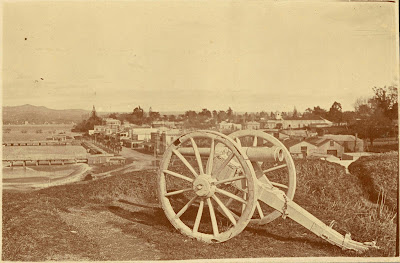
In his letter to the Tauranga Town Clerk, Ward recounts the history of the six guns displayed in the redoubt, comprising of four field guns that “had done good service here in the Maori war”, as well as two much older cast muzzleloader guns.

The four “field guns” were 6-pounder rifled breech-loading Armstrong guns, two of which may have been present at the Battle of Pukehinahina (Gate Pā) (Osborne, 2014, para. 5). Following their years of service with the militia and later the Armed Constabulary (whose headquarters had been located on the redoubt), the guns had been made obsolete and placed into storage by the Defence Department - until 1899 when Mayor Ward requested that they be returned to Tauranga and displayed in the Monmouth Redoubt, as part of an initiative to convert the site into a public reserve (Kean, 2019, p. 13-15).

Print, Photographic, Armstrong Gun, Monmouth Redoubt, Tauranga, c. 1910s.
Image courtesy of Tauranga Heritage Collection, ref 0488/08

The two older guns mentioned by Ward were cast iron Napoleonic war cannons (more specifically carronades) dating to the early 1800s, which had been gifted to the Tauranga Borough Council in 1899 by Captain A. C. Turner and Mr. A. W. Burrows, in order to “add interest to the redoubt”. However, Ward admits, “their history I do not know and do not think their former owners knew it either”. 

Munitions on display at Taumatakahawai Pā (Monmouth Redoubt), Tauranga c. 1910s.
Collection of Te Ao Mārama - Tauranga City Libraries, Pae Korokī ref 10-161

Unlike the Armstrong guns, neither of the cannons had any known connections to the redoubt. The Burrows cannon, named Tawakeheimoa (named after the eldest son of Ngāti Kererū), is now confirmed to be one of early trader Phillip Tapsell’s twelve “big guns” used to protect his trading station at Maketu Pā, until it's capture in 1836 (Kean, 2018, p. 20). Indeed, in his letter Ward points to Tapsell as a possible original source of the Burrows gun (Ward, 1914).
Cannon, Tawakeheimoa.
Image courtesy of Tauranga Heritage Collection, ref 0017/99

The cannon donated by Captain Turner, known today as Te Tapihana, is also suspected to have come from Tapsell’s battery due to its similarity to the other Tapsell cannons (Matheson, 1989, p. 9). However, its provenance is by no means certain, since accounts about what happened to Tapsell's battery following the capture of Maketū Pā vary, making it difficult for us to verify the history of the guns (see Matheson, 1989, for a full discussion). 

One of the other cannons from Tapsell's battery, Maketū, c. 1970s.
Collection of Te Ao Mārama - Tauranga City Libraries, Pae Korokī ref 06-137 

During restoration efforts at the redoubt in the 1990s there was some discussion as to whether the cannons ought to remain in Tauranga or be sent back to Maketū (Hansen, 1998, letter). In the end the council opted to keep the cannons, as by that point in time they had become an important part of Tauranga's history (Matheson, n.d., personal communications).

Te Tapihana Cannon, Monmouth Redoubt, 2024.
Private Collection, Te Ao Mārama - Tauranga City Libraries. 

These days only Te Tapihana remains on display in the redoubt. Tawakeheimoa now resides in the care of the Tauranga Heritage Collection, as do three of the Armstrong guns – the remaining Armstrong gun can be found on display at the National Army Museum in Waiouru.

6-Pounder 3-cwt Armstrong RBL Gun Barrel, carriage is a modern reconstruction.
Display depicts a scene from the Battle of Pukehinahina (Gate Pā).
Image courtesy of National Army Museum, Waiouru.

Stay tuned! The mysterious history of the Tapsell cannons will continue in next month's blog post.

For more images of the Monmouth cannons in the Library Archives click here. 

Sources:

    Hansen, N. G. (30 January 1998). Letter to Tauranga District Council. Old Carronades at the Domain and on Monmouth Redoubt. Tauranga City Council Records (unpublished).

    Kean, F. (2018). Illustrated Historical Overview, Monmouth Redoubt, Lot 247, Section 1, Tauranga Town. Tauranga Heritage Collection (unpublished).


    Matheson, A. (n.d.). Personal communication. Old Carronades in the Domain & Redoubt (and Historic Village). Tauranga City Council Records (unpublished).

Ward, G. A. (21 March, 1914). "Old guns in redoubt". [Letter from Colonel G. Arnold Ward to the Town Clerk, Tauranga]. Collection of Te Ao Mārama - Tauranga City Libraries, VF CCR. 

Tuesday, 5 March 2024

Moana in the archives

From Tauranga City Library’s archives

A monthly blog about interesting items in our collections.

In 2024, to capture the "beauty, variety and importance of the estuaries, beaches, harbours, and sea, that make up Tauranga Moana", curator Ellie Smith brought together artworks from local contemporary artists, as well as three public collections. These were:  the Tauranga Art Gallery Collection, Te Ao Mārama - Tauranga City Libraries (Archive), and the Civic Art Collections. The exhibition was/is held in the temporary exhibition space on Devonport Road between February 17 and June 3. It was/is titled "Tauranga Moana Waterscapes: 1800s - Present".

Here are the eight small works that Te Ao Mārama - Tauranga City Libraries contributed from our archives.

Two small watercolours from Emma Vogan. 

Emma moved to Tauranga aboard the Lady Jocelyn, in 1881 as a seventeen-year-old.  

View from Bon Repos garden (1884)

Tauranga City Libraries Art 21-014
On reverse, "Matapihi Welcome Bay, Kōpukairoa, Maungatapu. View from corner 5th Ave & Devonport Road lots 133 - 135. Lionel Adams remembers the gum tree - at high water mark. The Adams house, Taupororo was on opposite corner"


Beach at Waikareao estuary (1892)


Tauranga City Libraries Art 21-021

You can see more of Emma's work in the Emma Vogan Collection here. 


Four small watercolours from Ethel Louisa Macmillan.

Ethel's watercolours date from a later period than Emma Vogans, around 1920 to 1949. She was born in India, raised in England, and immigrated to Katikati in her late twenties. She later moved with her husband into Tauranga and they were both very active in the community. Her husband, the Hon. Charles Edward Macmillan later became Mayor and MP for Tauranga. Their daughter Ethel Urania Macmillan donated a large sum of money to the Tauranga Art Gallery. 

View from Macmillans farm, Pāpāmoa

Tauranga City Libraries Ams 80/11/14
Handwritten on rear "View from Papamoa farm (Macmillans) towards Mount Maunganui."


View from Macmillans farm


Tauranga City Libraries Ams 80/11/16
Handwritten on rear "View from G. E. Macmillan farm in Tauranga."


Moturiki and Motuotau, Mount Maunganui

Moturiki and Motuotau, Mount Maunganui
Tauranga City Libraries Ams 80/11/36
Handwritten on rear "Moturiki & Motuotau Mt Maunganui by Ethel Macmillan."


Looking over the Mission cemetery towards Mauao

Tauranga City Libraries Ams 80/11/36
Handwritten on rear "Looking over the Mission cemetery towards Mauao by Ethel Macmillan."


There are over 50 paintings in the Ethel Macmillan watercolours on Pae Korokī visible here. 

The last two works lent to the Art Gallery are from an unknown soldier during the colonial invasion. He was present at pivotal moments including the siege of Maketū, the battle of Pukehinahina and the massacre at Te Ranga in the 1860s.


Entrance to Tauranga harbour

Tauranga City Libraries Art 21-032
"The Mount - Tauranga Maunganui Heads." Original handwriting on rear "Entrance to Tauranga Harbour."


Te Papa, Tauranga

Te Papa, TaurangaTauranga City Libraries Art 21-033
"C.L. Greers house, Tauranga Hospital, H.M.S. ship Herrier, C.L. Harrington house." 


All fifteen of the works can be viewed on Pae Korokī here. 

As an archivist, it is lovely to see our humble pieces out from their safe acid-free boxes in the climate controlled archive, and for a short period of time, 'in the wild' so to speak.  "Tauranga Moana Waterscapes: 1800s - Present," curated by Ellie Smith, bridges past and present through art, showcasing the natural and historical beauty of our Moana. Emma Vogan's and Ethel Louisa Macmillan's watercolours as well as those of an unknown soldier sit humbly alongside larger (and more capable) pieces but they nevertheless add a little gravitas and highlight the importance of preserving our heritage.


Tuesday, 3 October 2023

The oldest book in the Library

 From Tauranga City Library’s archives

A monthly blog about interesting items in our collection

The earliest dated book in the Library’s collections is a Latin edition of the Bible in four parts, published in 1585 by Henry Middleton of London .The title is so long I can’t fit it into this blog without using up most of our ideal word count - this is a link to it in our online catalogue – and I suggest you use Google Translate to turn the Latin title into English.


The four parts are:

  1. Translation of the Old Testament from Hebrew into Latin by John Immanuel Tremellio (Tremellius) and Francisco Junio (Franciscus Junius) (his son-in-law).
  2. "The books generally called apocrypha, rendered in Latin… by Francisco Junio".
  3. "The books of the New Testament [translated into Latin] from the Syriac language by the same Tremellio".
  4. The same books “translated from the Greek into Latin by Theodoro Beza [Théodore de Bèze]”.

We are checking our old accession records to find out where and when we got the volume, so far without success. When did Robert Squires own the volume? Where?

During the early 1990s it was one of the volumes described by an incomplete project to list all the pre-1801 books in Australia and New Zealand. This notes that the copy is “imperfect” – the collective title page, the title for Part 1, and pages 401-424 are missing; the binding appears to be nineteenth century and very worn. It was well-used, and perhaps not so well looked after in later life. Today it is kept in a clamshell box made of acid-free, archival card, stored in a space with constant temperature and humidity to give it the best chance for a stable future.


All three of the translators were notable Reformed Protestant scholars, theologians and teachers – Beza co-founded the Genevan academy in 1559 with John Calvin and was its first rector. When Calvin died in 1564 Beza (de Bèze) succeeded Calvin as chief pastor of the Geneva church until his own death in 16051.

This combination of translations of the Old and New Testaments was published many times, and in many cities in Europe, up until the eighteenth century. It was used as a reference for the King James Version in English, published in 1611, for use by the church in Britain2. Since most missionaries to New Zealand were from Protestant churches, this may be how the volume travelled to New Zealand. 


By Tauranga City Libraries Heritage and Research Team : Leslie Goodliffe

Sources: 

1. Theodore Beza. Britannica Library. Retrieved 26 July 2023.

2. Rester, Todd M. (2011). "Translator's Introduction". Journal of Markets and Morality. 14 (1): 237–241. Retrieved 26 July 2023 (via Wikipedia’s entry on Franciscus Junius (the elder).


For more information about this and other items in our collection, visit Pae Korokī or email the Heritage & Research Team: Research@tauranga.govt.nz


Tuesday, 7 March 2023

Norman Blackie's Tauranga in 16mm

 From Tauranga City Library’s archives

A monthly blog about interesting items in our collection

In 1983 my family bought a large VCR player. It was a gift from the future, as far as this 13-year-old was concerned. Painfully shy, I relished the thought of watching a movie that didn't require my going out in public. All I needed to do was wait a year and then bring it home to watch on the family 20-inch TV. 

The same year I recall my geography class laughing at the teacher as he struggled with a large reel film projector. On that sunny afternoon, watching an underpowered projector struggle to cast its dreary educational film onto a dirty white sheet stapled to the classroom wall, we pimply few exchanged knowing smiles behind his back. 

"Reel films are a joke", said those smiles. The future was VHS. 

This learned judgement was despite the jammed tapes, rogue marmite sandwiches, impossible operating instructions and unimpressive picture resolution (240 lines vs an equivalent of up to 400 lines for the old 16 mm reels). Sure reels only had mono sound, were large and unwieldy and couldn't be paused, but they had primarily lost the format wars based on convenience more than anything. VHS tapes were just smaller and easily mass-produced. The market had spoken. 

1983 was also the year the light of Tauranga resident, Norman Wakefield Blackie, flickered and failed after 84 years. Norman had been an avid videographer, capturing much of the public life of Tauranga from the 1940s to the late 1970s. 18 of his films had been gifted to Tauranga City Libraries and by 1985, the then archivist Jinty Rorke was making enquires about local "Reel to VHS" services. The reels were to be deposited with the National Film Archive, the predecessor to Ngā Taonga, Sound and Vision, where they sit today. 

Odine and Norman Blackie (via a grand-daughter on Facebook)

Fast forward and these 16 mm reels have had a new lease on life. Tauranga City Libraries recently requested Ngā Taonga undertake to restore and digitise all 18 of Blackie's reels in their care, and the results are incredible.  The digital files they created are truly beautiful. They're sharp, correctly coloured and free from all the limitations of underpowered bulbs, dirty lenses, and those old sheets from the spare bedroom.  What immediately grabbed my eye was the size of the crowds in the background. They line the streets and fill the squares, despite a population just 10% of our current. Yet Norman doesn’t often focus on these crowds, their size is nothing unusual for him. For Norman it is the spectacle itself; the floats, the costumes, the games, the beauty queens and marching girls. It seems when something is happening, half of Tauranga comes out to cheer on the other half participating.

The footage is wonderfully showcased in a beautifully nostalgic and optimistic two-minute tribute by Ngā Taonga here, and below.


Today, you can see the entire footage on Pae Koroki here, and on Ngā Taonga here. 

Sources: 


This archival collection has been digitised and is available to view on Pae Korokī. For more information about this and other items in our collection, visit Pae Korokī or email the Heritage & Research Team: Research@tauranga.govt.nz