Showing posts with label Courts. Show all posts

Friday, 31 March 2023

Tauranga Courthouse Update

Map of the ‘Town of Tauranga’ created by George Pulman in 1864-1865
The two buildings circled in red have been identified as accommodating the Magistrate’s Court prior to 1874
Image courtesy of Auckland Libraries Heritage Collections Map 4498-4

In my November 2022 blog about Tauranga courthouses, I commented that the original site of the Magistrate’s Court was unknown – to me at least[i]. As is often the case with research, information comes to light when you’ve stopped looking for it and I can now report that the Magistrate’s Court in Tauranga was held in two further locations before the erection of the Government Building in 1874.

George Clarke (1798-1875), his wife Martha and their thirteen children, c. 1868, probably at Waimate North
It is likely that both Hopkins and Henry Clarke will be in this photograph
09-117

Oddly this information was gleaned from a court case brought by the Tauranga Town Board against Hopkins Clarke, Clerk of the Resident Magistrate’s Court, and brother of Henry Tacy Clarke, who was the Resident Magistrate in Tauranga during the 1860s and early 1870s. The Board was trying to obtain £5 15s in unpaid rates for a building Hopkins Clarke was occupying. Clarke claimed that, as the house and land was owned by the Government and used for Government purposes, he should be exempt:

“I shall be able to produce witnesses to prove that since I have been residing in that house it has been used as a Court house and also as a Government store ... there is a room used as a Court house, with a bar across for keeping the public from the bench; that bar is still in existence.”[ii]

The plaintiff also called several witnesses, including Ebenezer Norris, a member of the Town Board. Norris maintained that, although court cases had at one time been held in the building, it was his belief that it wasn’t during Hopkins Clarke’s residence. This is supported by a statement which appeared in the Bay of Plenty Times in September 1872:

“The old Mission school house is now converted into public offices. Here one will find Telegraph, Post, and Public Works Offices; also, Resident Magistrate’s Court.”[iii]

So, it appears that both the Resident Magistrate’s dwelling and the Mission school house, better known as the Native Institute, were used as the town’s first courthouses.[iv]

Resident Magistrate’s house on the left and Native Institute on the right
Photograph taken from Tauranga Town Wharf circa 1870s

Resident Magistrate’s house visible beyond the Bank of New Zealand on Wharf Street, circa 1880s
This house would be later be moved to a corner of the site to accommodate the Town Hall


References


[ii] Bay of Plenty Times, Volume II, Issue 187, 20 June 1874.

[iii] Bay of Plenty Times, Volume 1, Issue 8, 28 September 1872.

[iv] The Bench found in favour of the defendant Hopkins Clarke “The plaintiff has failed to show that the tenement on which recovery of rates issued is not in the occupation of the General Government of the colony.” Bay of Plenty Times, Volume II, Issue 189, 27 June 1874.

Friday, 18 November 2022

"Prosperity to this building and to Tauranga"

Property at 30 Monmouth Street in the process of demolition to make way for Court House development, August 2022
Image by Fiona Kean, Private Collection

If you haven’t been to town lately it’s worth a trip to see the Monmouth and McLean Street block. The site has been cleared for a new courthouse development, which was announced this time last year and is expected to be completed by 2026. Estimated to cost 150 million dollars, it will be the third official site for court facilities in Tauranga - the site of the Magistrate’s Court prior to 1874 is currently unknown. 

The first Government Building located on Willow Street between Harington and McLean Streets
Silver gelatin print by T.E. Price, 1900
Image courtesy of Tauranga Heritage Collection, Ref. 0323/08

The first Government Building in Tauranga opened in 1874 and included the Magistrate’s Court, Post Office and Council Chambers. When the foundation stone was laid by Mrs Wrigley, a prominent resident who had been living in Tauranga since 1863, she broke a champagne bottle on it and declared ‘prosperity to this building and to Tauranga’.[i] Unfortunately, the prosperity was short lived, as this fine wooden building burnt to the ground in November 1902 taking all the town’s court records with it. As a side note, it appears that after the fire a free-standing Court House planned for Tauranga did not eventuate.

Proposed Tauranga Court House, No. 1 block plan from elevation and section A.B., No. 2 Two side elevations and outbuildings, Tauranga, J. Campbell
Image courtesy of Archives New Zealand, PWD 20303

The replacement building on the same site, was opened in 1906 and included the magistrate court on the first floor along with a Clerk’s office and two library rooms. A correspondent in the New Zealand Herald had this to say about the building:

“Now that the Tauranga Post Office is outwardly completed, those who believe that again things are not precisely what they should be, have abundant justification for their belief. Without attempting to criticise the weird type of architecture displayed – if it is a type – it will suffice to briefly allude to the position of the new building. One fact immediately strikes the observer, namely, that the back, not, the front, is turned towards the town, and that the most ornamental portion has been made to face a dead, solid wall of brown earth, nearly as high as itself.”[ii] 

Now referred to as the ‘Old Tauranga Post Office’, this was the second Government Building on the site. The men in the photograph are believed to be the Post Office staff around the time of opening
Postcard by unidentified photographer, 1906
Image courtesy of Tauranga Heritage Collection, Ref. 0174/09

Considering the town’s population growth in the following decades it is surprising that this building would serve the judiciary for more than 60 years. In 1965 a new courthouse was erected on the corner of Harington Street and Cameron Road. It was opened in November by the Minister of Justice Mr J. R. Hanan in front of a large crowd. In 1998 an ‘upgrade’ made the building unrecognisable and several leaks since 2016 led to the claim that the ‘original build was incredibly rough’, something the contractors of the day would no doubt dispute. [iii]  Hopefully in the future the facilities to be built on the new site will get better reviews than the courthouses of the past.

Tauranga Courthouse, corner of Harington Street and Cameron Road October 1966
Image courtesy of Gale Collection, Tauranga Heritage Collection, Ref. 0005/20/1196


[i] Bay of Plenty Times, Volume II, Issue 171, 25 April 1874.

[ii] New Zealand Herald, Volume XLIII, Issue 13107, 21 February 1906.

[iii] Bay of Plenty Times, Justice Minister: Leaky Tauranga courthouse needs replacing.

Friday, 12 November 2021

Shipwreck on Karewa

Portrait of the ship Taranaki, Carte de visite copy photo of painting
Collection of Alexander Turnbull Library, Ref. PA2-2797

The 327 tons SS Taranaki, owned by the Union Steamship Company and captained by James Malcolm, left Auckland at 4:30pm on the 28th of November 1878 with thirty-four crew and seventy-five passengers, including many women and children. Due to fog she was anchored between Great Mercury Island and Tapepe point from 11:45pm until 3:00am. Heavier fog set in after the ship was underway again and, when abreast of Slipper Island, she was moved towards the east away from land and a lookout was kept. The weather was calm in the morning, but still very foggy, and the passengers were up early, waiting for breakfast, which was late.  According to the distance run, taken from the log, at 8.05 am the vessel should have been 12 miles off Karewa Island. The second mate was on watch at 8:50am when Malcolm, who was on the bridge, saw breakers. He signaled full steam astern, then hard to starboard, just as the passengers were trooping down to breakfast. Only a few were seated when they felt the ship’s engines reverse, then almost immediately the vessel struck and bumped four times over the rocks. Sea flooded the engine room, and Malcolm ordered going slowly ahead, so as not to sink in deep water.

They found themselves in a small inlet, with rocks either side, and the bowsprit almost touching the precipice which rose around 300 feet ahead. While the sea was calm, a large swell caused the vessel to bump heavily, but as the water was shallow, the vessel was not in danger of slipping into deep water. At 10:30 am a boat with the mate and purser was dispatched to take news of the wreck to Tauranga. The ship, valued at 18,000 to 19,000 pounds, was partially insured with several companies.

SS Taranaki at Picton, c 1870s
Silver gelatin print by unknown photographer
Collection of Tauranga City Library, Pae Koroki Ref. ms-33-5-118

The first boat to take passengers ashore was lowered in five minutes, and within twenty minutes all four boats were in the water. However, it was three-quarters of an hour after they struck the rocks that the first boat with women and children left for the landing spot. Ashore with the passengers went bread, butter, jam, fruit, and lemonade, as Karewa Island had no water. Everyone was relieved no lives had been lost and there were no injuries. By afternoon the Taranaki had heeled 45 degrees to port. The crew and a passenger, Tauranga barrister Oliver Macey Quintal, saved the luggage and mail. The Bay of Plenty Times reported that he worked indefatigably like a Trojan. The second and third stewards (the Warren twins) and Samuel Westlake, who was off a training ship, were commended for swimming through a port to reach the luggage, whereas sluggish passengers had refused to carry their own portmanteaux. At low water, when it was possible to enter the saloon, the linen and silver was saved. The mate and the purser, who had rowed several miles to deliver news of the wreck, stopped at the pilot station at Mount Maunganui, where the Harbourmaster Captain Hannibal Marks assisted and delivered them to Tauranga in the pilot boat.

Ship Rowena at an unidentified wharf
Collection of Hamilton City Library, Ref. HCL_06579

It was 4:00 pm when two cutters, the Lancashire Lass and the Waretai which brought water, arrived by the wreck at Karewa Island. Captain Malcolm had ordered the boat crews to take the passengers to the cutters, but then the Staffa and the Rowena appeared, which took the rescued luggage and the passengers to Tauranga. Malcolm stayed overnight with the remaining crew and the cutters, and by 8:00 am next morning, the Taranaki had split; her fore part was hanging on rocks, the after part had sunk. He ordered one cutter to cruise and pick up floating packages.

On the 3rd December, five days after the Taranaki was wrecked, it was a Bank holiday and the Staffa took 20 passengers out to view the wreck. An easterly swell churned the insides of those on board, so basins, brandy and water were in demand. Near Karewa Island they saw floating timber, and on the north side of the island was a mass of debris. The ship's remains were on the rocks. When the after part sank in deep water, it took the engines with it. The foremast still stood, but it shook when a man ascended it. The fore hold was gutted and the keel had curled, due to the hull rolling on the rocks. Some of the men were landed to board the wreck and collect cords of rope and ship’s gear. It was thought floating debris would be cast ashore on Panepane Beach.
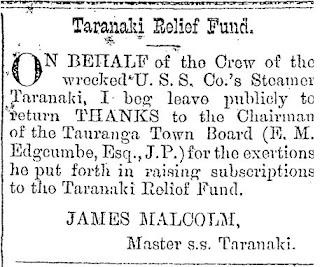
The Bay of Plenty Times, 3 December 1878
Courtesy of Papers Past

For the Inquiry, H.W. (Herbert William) Brabant, the Resident Magistrate, was assisted by nautical assessors Captain Clayton and Joseph Ellis. Mr. McKellar, who appeared for the Marine Department, cross-examined Malcolm. The crew and some passengers, including Quintal, gave evidence. Marks, who had worked on the coast for 38 years, gave his knowledge of wind currents and tides. The court's judgment was that the engines should have been slowed and soundings made. The chief officer Mr. Holm was reprimanded for not properly keeping his log. There was compass error and the officer's ignorance of the distance run was due to clock error or error in reading the clock. Malcolm’s ticket was not suspended, but he was ordered to pay costs of £25.10 shillings. Several men, among them Edward Mortimer Edgcumbe, chairman of the Town Board, collected donations. Fifty-seven pounds was presented with a letter of thanks to Malcolm and the crew which confirmed their confidence in Malcolm's ability was undiminished. They would be only too pleased to sail under his charge in the future.

This was not the first time the Taranaki had been wrecked. In 1868 she hit a rock in Tory Channel and was towed to Bowden’s Bay, but sank at the entrance and drifted into deeper water. Thirteen months later, thanks to a group of Wellington residents and some remarkable engineering for the time, she was raised.

References

Bay of Plenty Times, 30 November 1878: 3, 6, 7, 10 and 28 December 1878. (More than one reference in each paper)
Index to the NZ Section of the Register of All British Ships 1840-1940 (inclusive). Watt, M.N., Morris Netterville (1892) compiler. Tauranga Library. Nga Wahi Rangahou Sladden

Friday, 23 July 2021

Wiremu "Bill" Ohia, 1922-1992

Bill Ohia talking to Ernest Bush, former Society Journal editor, at Papamoa Hills
35mm film negative. Photograph taken for Bay of Plenty PhotoNews, No 69, 30 May 1970, p.57
Image courtesy of Pae Koroki, Ref. pn-7646

Bill was a man who was very aware of the history of his ancestors in Tauranga Moana and consequently extremely socially active all his 70 years in Waitao. He was one of the older sons of the twelve children of Hone Ohia, who farmed in close proximity to three marae belonging to Ngati Pukenga iwi.

Bill was born in the Te Puke Maternity Annexe, as was his only child Rahera. He attended the Pāpāmoa Native School (which later became Pāpāmoa Māori School and is now Te Kura Kaupapa Māori ō Otepou). When the school was Pāpāmoa Māori School, Bill’s daughter Rahera was a pupil there and his wife Hinemanu (a McLean of Tainui Descent from the Waikato) a teacher there. While Rahera was attending Tauranga Girls’ College, Bill served on the Tauranga Girls College Board of Governors.

Bill was a keen scuba diver who, if he wasn’t tied up with other things, went diving every weekend for kaimoana and often took his cousins, nephews and nieces along to teach them about the sea. Bill, by this time, was also farming in Waitao and he helped set up and run the Rangataua Young Farmers Club. Bill was the first Māori town supply farmer in the area.

Tauranga Moana Trust Board's Original Fund-raising Committee, 1953. (Left to Right) T. Te Kani, F.N. Pinfold, I. Tangitu, W. Ohia, R.G. Faulkner (inset) Tom Peek
Image courtesy of the Tauranga Moana Trust Board

The Tauranga Moana Māori Trust Board was formed after the iwi and hapū of Tauranga sought to make it known what had transpired between their ancestors and the Crown to enable colonial settlement of the area, and the establishment of Tauranga. It was the culmination of the work of a number of people over many years, including Bill, Turi Te Kani, Bob Falconer (then Director of the Department of Māori Affairs), Fred Pinfold and Ike Tangitu. The Trust Board was created to receive compensation from the Crown for lands that had been taken through confiscation. Bill was the inaugural chairman of this trust board, a position he retained for many years.

He was also the chair of the Waikato Maniapoto District Maori Council and a member of many other Maori organisations in the Western Bay of Plenty. One of these was the Tauranga Maori Cultural and Promotional Committee an initiative begun with Archie Clark, the city’s Public Relations Officer at the time. Apart from Bill and Hinemanu, that committee included Turi Te Kani, Charlie Kuka, Tim Smith, Sonny and Moira Rolleston and others.  The aim of the committee was to give voice to Māori cultural and civic aspirations. This committee started the annual National Māori Cultural Championships which many years later became Te Matatini.

Bill was a member of the Trotting Club (he owned race horses), the Aero Club (he was a pilot as was his brother Monty and Uncle, Barney Kahotea) and the Rotary and Lions Clubs (he was community-minded). So he was of many diverse networks. Through their contacts, he and his wife were part of a group who trialed a Māori Radio station based at the 17th Ave Historic Village which at the time was under the directorship of Noel Nicholls. Later, Bill became the inaugural Chair of Aotearoa Māori Radio, when the government of the day agreed to set aside part of the AM frequency for Maori Radio.

Tauranga Moana Trust Board's Fund-raising Committee, 1955. (Back Row) J. Foster, P. Rewiti, W. Ohia. (Front Row) F.N. Pinfold, I. Tangitu, C.H.D. Porter
Image courtesy of the Tauranga Moana Trust Board

According to Rahera her Dad, Noel Nicholls, "Uncle Turi, Uncle Charlie and others" (all of whom were determined that everyone should know the full history of the area) were part of a group who negotiated to get permission to clear Mauao of its dense scrub cover so that evidence of early Maori occupation was visible. She was roped in with others to trek to the summit most weekends to clear the scrub. The road to the summit was then created by Jack and Roger Prince with their heavy machinery, and when it was all done she and her father and Alan Clarke (a teacher from Mount Maunganui College) identified, measured and recorded all the pā sites there. This was all designed to make the Māori history of the area visible for all and to stimulate people’s curiosity so that they might want to know more.

Bill Ohia talking to the Tauranga Historical Society on the Papamoa Hills
35mm film negative. Photograph taken for Bay of Plenty PhotoNews, No 69, 30 May 1970, p.57
Collection of Tauranga City Library, Nga Wahi Rangahu. Image courtesy of Pae Koroki, Ref. pn-7638

In the 1980s, Bill moved from farming to orcharding and he grew kiwifruit, avocados, boysenberries and apples. The exposure to the kiwifruit industry led him and Turi Te Kani (also an orchardist, but at Matapihi) to champion Māori ownership of their own packhouse, so they began Te Awanui Hukapak, a symbol of their independence and the commercial intent and capability of Māori communities.

Bill Ohia receives his Queen's Service Order from the Governor General, Sir Paul Reeves, in 1988
Image courtesy of Rahera Ohia

Bill played a number of roles in the evolution of Tauranga and was awarded the QSO in 1988.

Turi died under tragic circumstances in around 1990, and sadly his long time and close friend Bill died in equally tragic circumstances in 1992. They were each mourned by thousands at Matapihi and Waitao respectively.