Tauranga’s Early Maritime Traders,
Part 1
An adventurous Yorkshireman
from the ancient English port town of Whitby, John Lees Faulkner had originally
been transported to New South Wales as a teenaged convict. He first arrived and
settled at the Bay of Islands in 1832. Having trained as a convict shipwright
at the Port McQuarie Dockyard, he soon built and began sailing his own vessel
to the Bay of Plenty to trade with Maori at Tauranga. According to The Bay of Plenty Times of 9 Sept 1882:
Mr Faulkner’s object in coming to this district was ostensibly to obtain
supplies to ship to the Bay of Islands which was one of the principal resorts
for whalers in the South Seas. There were few Pakeha then present, but among
the resident missionaries was Archdeacon Brown.
In 1840, Faulkner settled in Tauranga
and established a trading store near Otumoetai Pa on land belonging to his wife
to be Ruawahine of Ngai Tukairangi, a hapu of Ngai Te Rangi. From this base,
close to the harbour entrance he supplied Maori with general trade goods,
particularly agricultural implements, in exchange for cargoes of maize, flax
and kauri gum. Sometimes accompanied by Ruawahine, he sailed these cargoes to
the Bay of Islands and, from 1841, to the newly established Auckland settlement.
During the 1840s and 1850s, Faulkner continued to build boats for himself, local
Pakeha traders and several Maori rangatira at Tauranga. Noted for his integrity
by both Pakeha and Maori, he was appointed Tauranga postmaster in 1860.
 |
John Lees Faulkner, Tauranga ship
builder and trader (1807-1882)
Tauranga
Library image collection Ref. 00-208 |
During the 1860s, Faulkner owned or part owned three
trading vessels which, mainly crewed by local Maori sailors, regularly
transported cargo and passengers between Tauranga and Auckland: the Maxwell
(1862-63), the schooners Jane, 37 tons (1865-71) and the topsail schooner
Tauranga, 61 tons (1863-72). A
typical mid-sized schooner of the era, the Jane did not carry square
rigged topsails above its foremast as did the Tauranga. Otherwise, its sail
configuration was identical, with a schooner’s distinctive bow and bowsprit, two
try sails carried on the foremast, a foresail and mainsail.
A swift and very busy vessel, the Jane ran
military dispatches to and from Auckland during the mid to late 1860s, and
delivered commissariat stores to British and colonial military forces at
Tauranga and Opotiki. On the 10th March 1865, the Jane carried
news to Auckland, confirming rumours that the Rev Carl Volkner had been killed
at Opotiki by militant followers of the Pai Marire faith. In June 1865, the Jane’s
then master, Captain Sellars, sailed to Auckland with the bereaved Mrs Volkner
and her two daughters.
 |
A 35-ton, New
Zealand built schooner, the Governor Grey
Watercolour painting by Charles Heaphy, late 1840s
Whanganui Regional Museum, Ref. 1910.2.1 |
No images of the 37-ton Jane have survived. This 1860s sketch of
the 35-ton New Zealand built schooner Governor
Grey however, gives a fair indication of the Jane’s size and sail configuration.
Major Charles Heaphy, ‘The Governor
Grey’, in Baille, Herbert, ‘Episodes of the Maori War’, in Transactions and
Proceeding of the Royal Society of New Zealand, Vol. 53, 1921: 32.
The diverse commercial cargoes that the Jane’s
skippers delivered to Auckland make interesting reading. Recorded in the Port
of Auckland’s ‘Shipping Intelligence’ reports, published in contemporary
newspapers, examples include:
16 October 1865.
- From Opotiki, Tauranga, Mercury
Bay with sawn timber, 8 passengers.
1 October 1866
- The schooner Jane. Faulkner,
master, with a cargo of kauri gum.
8 January1867.
- The Jane schooner, Faulkner, 37
tons, with sheep from East Coast.
15 February 1868.
- The Jane schooner from Tauranga
with hides, tallow and passengers.
24 February 1868.
- From Tauranga, 1 horse, 1 cow,
a quantity of produce, and 25 passengers.
7 December 1868.
- The Jane schooner, from
Tauranga with cattle and passengers.
11 February 1869.
- The Jane Schooner, Moller, master,
with fruit etc.
The return cargoes
that the Jane delivered to Tauranga’s settlers and its more substantial British
and colonial military population included wine, ale, spirits, groceries,
drapery, flour, general cargo, sundries, and passengers. The Jane also
shipped cargoes of timber (presumably kauri) and sundries to Hawke’s Bay. During
1870, the Jane’s voyages to Auckland became less frequent and ceased
altogether in 1871. An article in the Daily Southern Cross on 22
September 1869, explained:
The schooner ‘Jane,’ Captain Moller, whose trips [to
Auckland] are as regular as the clock, came in again as is usual on his eighth
day, deeply laden with stores. She leaves again this evening. We understand
that the owner of the ‘Jane,’ Mr J. L. Faulkner, intends to put the schooner
‘Tauranga’ in the berth, as a regular packet between there and Auckland in
place of the ‘Jane.’ Captain Moller is to have charge of her.
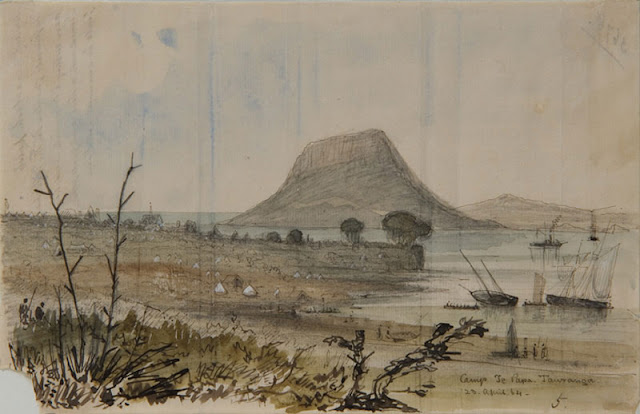 |
| Military camp at Te Papa with sailing
craft and a steamer, 1864 |
E. A. Williams (c.1824 – 1898), Camp
Te Papa, Tauranga, 1864, watercolour, pen & ink on paper: 136x201mm,
given by Dr H. D. Skinner, Dunedin, 1948. Hocken Collections Uare Taoka o
Hākena, University of Otago, 75/100.
The Jane had several masters
during the 1860s including Faulkner himself, Captains Moller and Sellars, and
Faulkner’s sons Jarvis and Christopher. The brothers had initially learned
their seacraft by sailing the family’s 16-ton cutter Bella on its runs between
Tauranga and Maketu. From 1866, Christopher regularly sailed the Jane on
trading voyages between Gisborne and Auckland, before sailing his father’s
largest schooner Tauranga, which shipped considerably larger cargoes between
Tauranga and Auckland.From the 1860s, in the face of
contrary winds which could delay them for days on end, sailing vessels were
increasingly towed clear of Tauranga Harbour by local or visiting steam vessels.
As the New Zealand-wide construction of steam powered vessels large and tiny accelerated
during the 1870s, the glory days of Tauranga’s commercial sailing vessels were
done. The number of familiar ‘sails’ readily recognized by residents as they
entered the harbour dwindled and most of Tauranga’s picturesque commercial
sailing ships soon passed from sight.
Whether Faulkner sold the aging Jane
to Maori or Pakeha buyers or if it joined the old sailing hulks, abandoned and quietly
decaying in the mangrove backwaters of Tauranga Harbour is unknown. The final Auckland
Shipping Intelligence report to mention the vessel simply read: ‘5 May 1871.
The Jane schooner, Faulkner, 37 tons, from Tauranga’.
The dominant figure in Tauranga’s
early commercial maritime history, John Lees Faulkner died in 1882 at the age
of 75 years. On the 9th of September that year, the Bay of Plenty
Times described him as ‘a man of few words, naturally reserved, but of a
kind, rough, genial-hearted disposition, ever ready to render assistance to his
neighbours. Mr Faulkner's name will not be easily forgotten, for he was
universally respected, and we may safely assert was without equal’.
Sources
Auckland Star, 17 August, 1911: 8.
Bay of Plenty Times, 9 September1882: 2.
Daily Southern Cross, 22 September 1869: 3.
Gifford, W.H. and H.B. Williams, A Centennial
History of Tauranga, A. H. and A.W. Reed, Matamata, 1940, Capper Reprint,
Christchurch, 1976.
Green, Julie, John
Lees Faulkner (1807-1882), Tauranga Historical Society
Rorke,
Jinty, John Lees Faulkner 1810-12? - 1882, Trader, Shipbuilder, Farmer in The
Dictionary of New Zealand Biography, Volume One, W.H. Oliver (ed.), Bridget
Williams Books and Department of Internal Affairs, Wellington, 1990: 118-119.


