Showing posts with label Postcards. Show all posts

Sunday, 25 May 2025

Hopukiore

Ocean Beach and Hopukiore (Mt Drury) from Mauao, Mount Maunganui, c. early 1950s
Postcard, unidentified publisher, collection of Justine Neal

Hopukiore, at 40 metres high is much smaller than its famous counterpart, Mauao but it’s history is just as fascinating. From the late 1500’s the Ngati Tauaiti had a marae there, along with another marae on Moturiki. The name Hopukiore means to catch kiore (rats), the bones and the teeth of which were used for carving chisels and tattooing instruments. The area was used as a carving school and a wahi tapu (sacred site) for ta moko (traditional tattooing).

Ocean Beach, Mt. Maunganui, c. 1970s-1980s
Postcard published by Pictorial Publications Ltd, Hastings
Collection of Justine Neal

On the eastern side of Hopukiore there are at least five caves, some of which are known to have been used for burials. The 1820 battle fought between Ngapuhi and Ngaiterangi resulted in a large number of deaths for the Ngaiterangi. Te Waru’s (Ngaiterangi) chivalrous treatment of Te Morenga (Ngapuhi) after the battle led to peace between the two tribes and the Ngaiterangi dead were honoured with burial in the caves of Hopukiore.

East Cave, Hopukiore, 2025
Photograph by Justine Neal

The caves were also used by the men of the 80th Regiment under Major Bunbury when they were sent from Auckland to deter hostilities between Arawa and Ngaiterangi, occupying the hill from December 1842 to March 1843. One cave was enlarged and shelves installed for munitions storage and a door was fitted. Another two caves were used for general storage and a bakehouse.

Hopukiore (Mt Drury) and Mauao, from Marine Parade, Mt Maunganui, c. 1950s
Collection of Tauranga Libraries, Pae Korok
ī Ref. Photo 99-028

In the 1980’s two young local boys were amusing themselves using old boxes to slide down the slopes of Hopukiore,  After a while, as they happened to have a small torch with them, their attention turned to the caves and they decided to do a little exploring. On entering the cave it felt cold and damp, the floor was hard packed dirt and there was enough headroom to walk. The cave narrowed, then came a shoulder height drop but they were still able to walk down to the next level. The cave narrowed again, it appeared to be solid rock in front of them but the torch showed that in one place the rock overlapped leaving a narrow gap to squeeze through. There was no way an adult could manage it but the boys thought they would be able to. At that moment they had a couple of choices and sensibly decided the way back was the safest one.

In 1853 Hopukiore was given the extra name of Mount Drury, named after Commander Byron Drury who arrived in Tauranga in 1852 on board the H.M.S Pandora to complete a coastal survey of the Bay of Plenty started in 1848.

Hopukiore (Mt Drury) from the quarry on Moturiki, Mount Maunganui, 1921
Postcard by unidentified publisher
Tauranga Heritage Collection, Ref. 0197/08

In 1913 a railway line that had been built to the railway workshops (situated between Salisbury Avenue and Rata Street) was continued up the main street, curving round the northern end of Hopukiore to service the quarry on Moturiki. A crushing plant had been built on the foreshore of Hopukiore to deal with the stone coming from the quarry.

The big swing at Mount Drury (Hopukiore) playground, Mt Maunganui, January 1967
120-format film negative, published in Bay of Plenty Times, 13 Jan 1967
Collection of Tauranga Libraries, Pae Korok
ī Ref. Photo gca-14286

Mrs. Gilchrist in the book ‘A History of Mount  Maunganui’ by Don Cunningham remembers the Public Works picnics:

“When they got the rail through a bit they would have open carriages with seats across and you’d come down to the Mount from Te Puke. The railway line went right along where the Main Road is now. We would all get off at the foot of Mount Drury on a platform and then take our picnic baskets into the big pine trees.”

Tunnel of the Mt Drury (Hopukiore) Railway Line, Mt Maunganui, December 1966
Crop of 120-format film negative, published in Bay of Plenty Times, 28 Dec 1966
Collection of Tauranga Libraries, Pae Korok
ī Ref. Photo gca-14079

From 1960 to 1975 there was a miniature railway as part of a children’s playground. There was a man-made tunnel that it went through at the base of Hopukiore and that’s where it lived. There were doors at each end that were kept locked when it wasn’t in use. It only used to run in the summer. Since 2008 there has been a playground on the western side of the reserve.

Mount Drury Tower (Hopukiore), Mt Maunganui, February 1963
120-format film negative, published in Bay of Plenty Times, 26 Feb 1963
Collection of Tauranga Libraries, Pae Korok
ī Ref. Photo gca-4488

In 1958 the Harbour Board Signal Station was erected on the summit of Hopukiore, the ideal place with its sweeping views out to sea. It served as a communication tool for navigation and relaying important information to the ships. It has been inoperative for many years now and at the present time only the signal station mast and a shed remain on the site.

Hopukiore (Mount Drury) with Soundshell, taken from Moturiki (Leisure Island), c. 1970s
Silver gelatin snapshot print by unidentified photographer
Tauranga Heritage Collection, Ref. 0040/25

In 1967 a Soundshell was built on the flat surface at the base of Hopukiore on the Moturiki side. The seating was provided by man-made terraces or by spreading a towel or a blanket on the grassy slopes. It proved very popular with locals and visitors alike, and was regularly used for concerts and events, such as the Miss Mount Maunganui contest on New Year’s Day. The Soundshell was demolished in 1999 and the area reverted back to grass.

Mount Maunganui 5,000 Club junior pageant at the Soundshell,January 1967
120-format film negative, published in Bay of Plenty Times, 4 Jan 1967
Collection of Tauranga Libraries, Pae Korok
ī Ref. Photo gca-14153

In 1978 the Council decided to extend the Grace Avenue frontage of Hopukiore by buying the small cottages that had been built there. These worker’s cottages were relics of the days when Moturiki had been quarried by the Railways Department and coincidentally several of them came on the market at this time and others were obviously reaching the end of their useful life.

Radio mast and shed, Hopukiore, 2025
Photograph by Justine Neal

The Council employed a land agent whose job was to enquire from the landowners if they were interested in selling. Unfortunately, he rather overstepped his job description by threatening them that if they did not sell the Council would take the land under the Public Works Act. Eventually the cottages were acquired by the Council and the land incorporated into the reserve. It just took a little bit longer and without the help of that particular land agent.

References

2019 Tauranga Reserves Management Plan
Tauranga City Library
Tauranga Heritage Collection
Explore Tauranga

The Weekend Sun, 22 February 2013
Sunlive, 10 May 2021
A History of Mount Maunganui, compiled by Bruce Cunningham & Ken Musgrave, 1989

Sunday, 16 February 2025

Brain Watkins House Garden Party – A Special Milestone


Mr and Mrs B.C. Julian examining a family postcard album on the front steps of Brain Watkins House at the Tauranga Historical Society’s inaugural Garden Party in December 1979
Photograph by the Bay of Plenty Times photographer, published 3 Dec 1979
Courtesy of
Korokī33738

In November the Society hosted visitors to the Brain Watkins House and garden as part of the biennial Bay of Plenty Garden & Art Festival, the second time we have done this instead of our usual Garden Party. What members and visitors alike probably didn’t appreciate was that the occasion happened to be the 45thanniversary, almost to the day, of our first Garden Party on 1 December 1979.

Willie Watkins and Elva Brain, c. August 1965
Photo Brain Watkins House Collection

The home of Elva Brain and Willie Watkins on the corner of Cameron Road and Elizabeth Street was left to the Society earlier that year as a bequest in Elva’s will and the garden party was an opportunity for members and guests to inspect the house and gardens which are still the Society’s home, and an important focus of our activities. More than 150 members and their guests attended, many in Victorian costumes, including then Mayor Eric Faulkner with his wife Connie, MP for Tauranga, Keith Allen, film and television actress Pat Evison, and visitors from historical societies in Hamilton, Whakatāne and Te Awamutu. We retain strong links with the Whakatāne & District Historical Society in our joint publication of the Historical Review, the Bay of Plenty Journal of History.

Wooden half hull model by Joseph Brain, Brain Watkins House Collection

Guests had an opportunity to view the rooms of the home containing not only the existing furnishings in a setting reminiscent of earlier decades, but also mementoes collected over a century. On display were old family photographs and documents, including Joseph Brain’s will, plans of his engineering projects around Tauranga, early photographs of the house, cups won at sailing regattas and even prizes won by Elva when a schoolgirl.

Elva Brain in the arms of her mother Kate, with her four older sisters, on the steps of their home, c. early 1890s
Carte de visite photograph, Brain Watkins House Collection

Elva was born in 1891 the house which her father Joseph Brain had built a decade earlier, and she lived in it for most of her life. She and her sister Bessie inherited the property when her mother died, and she became the sole owner after her sister died in 1957. The layout of the rooms and their contents have changed little since 1979, the Society choosing to preserve and maintain the look and feel of the early New Zealand home, with all its idiosyncrasies.

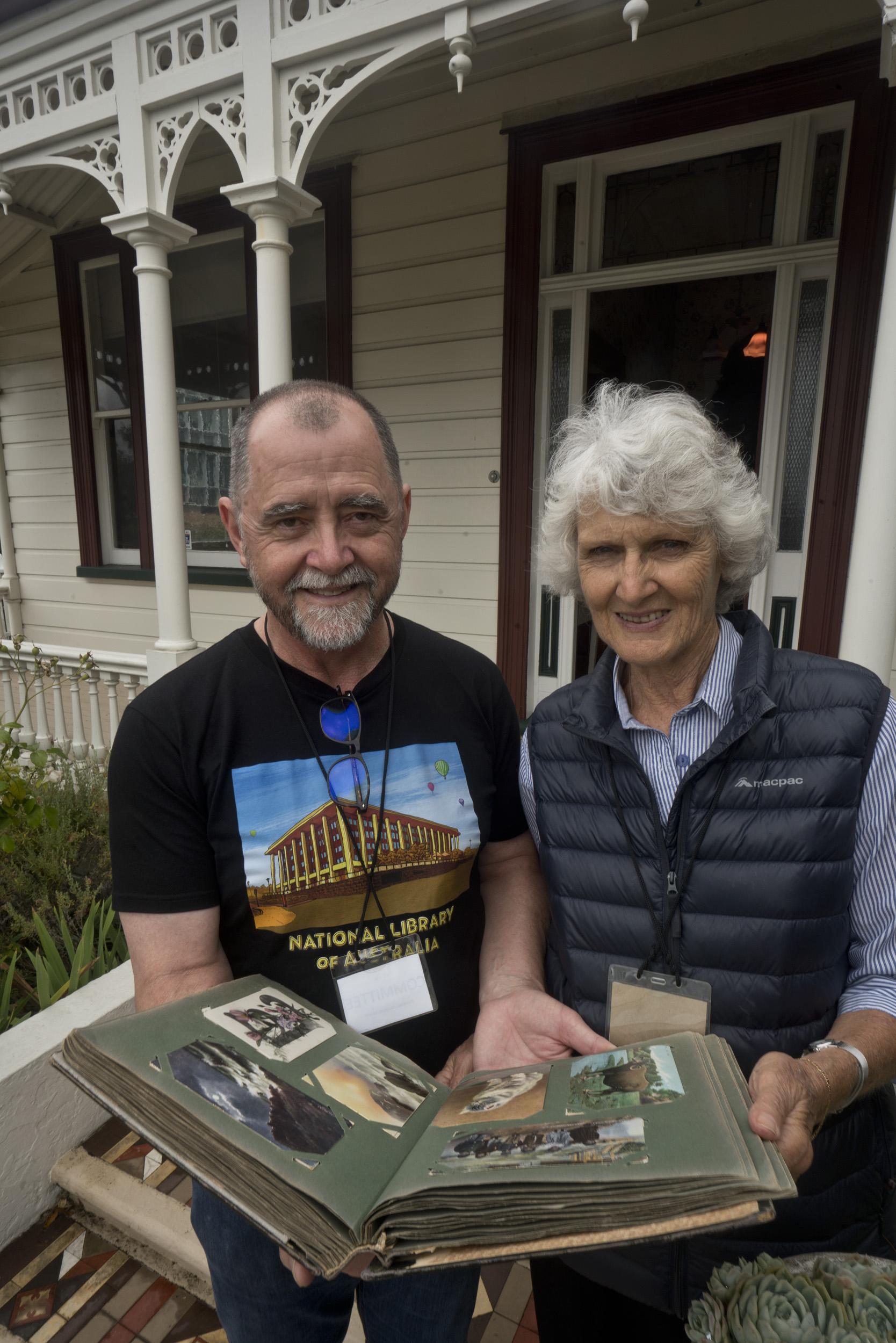
Brain Watkins House guides Leslie Goodliffe and Glennis Smith with the Brain family postcard album which featured in the 1979 Garden Party photo, 16 Feb 2025
Photo: Brett Payne

We also look after the more ephemeral contents of the house, such as the postcard album pictured in the photograph. Our conservation plan is currently being updated and our volunteer team not only show visitors around the house, but keep up an ongoing monitoring of the house’s condition. With the assistance of both the Tauranga Heritage Collection and the Tauranga Library’s Archives, the Society is in the process of conserving and digitising many of the house’s artifacts, and ensuring that they are cared for in the most appropriate physical and environmental conditions.

Friday, 22 November 2024

Matakana Island

Pilot Bay from above, Mauao and Matakana Island
Colour postcard, photographed by Bob Ricketts, Old Grumpy’s Gallery, Mt Maunganui
Collection of Justine Neal

Matakana Island is a mixture of white, sparkling sand, pine forest, farmland and a peaceful harbour. It is the third largest island by area in the North Island and the 15thlargest within New Zealand waters. The island’s long, white sandy beach is popular with surfers and is also a nesting place for the New Zealand dotterel/tuturiwhatu, a threatened shorebird.

Matakana Island and the Tauranga Harbour from the Bowentown Heads, June 2023
Photograph by Justine Neal

The island is 24 kilometres long and rarely more than 3 kilometres wide. It is New Zealand’s largest barrier island. Its development, together with that of the tombolo (a narrow strip of land, usually made of sand or gravel, that connects an island to the mainland or another island) adjoining Mauao and Bowentown Heads, formed Te Awanui/Tauranga Harbour, a 200 square kilometre estuarine lagoon.

Matakana Island, northern channel and Mauao from the Bowentown Heads, June 2023
Photograph by Justine Neal

The island has been continuously populated for centuries by iwi who are mostly associated with Ngai Te Rangi.

Nine year-old trees, Matakana Island
Unmounted silver gelatin print by unidentified photographer
Te Ao Mārama - Tauranga City Libraries Ams 12/4/5

The island has two distinct parts, 5,000 acres of farm and orchard land on the inner harbour and 10,000 acres of forest covered coastal land.

Wharf at Matakana Island
Unmounted silver gelatin print by unidentified photographer
Te Ao Mārama - Tauranga City Libraries Ams 12/4/4

The 1920’s saw the development of a pine forest through private plantings. In 1949 the first logging crew went into the forest. The first 30 year old plantings were used for the post and poles market. In 1951 Bunn Brothers Ltd. took up the island’s pine milling rights.

S.S. Ngakuta clearing the Tauranga Heads, View from the Mount, c. 1916-1922
Real photo postcard, photographed by John Welsh, published by Frank Duncan & Co. for A.J. Mirrielees, Tauranga
Collection of Justine Neal

My postcard shows part of Matakana Island as a low-lying sand bar in pre-forestry days. The SS Ngakuta was built in 1913 and owned by the Blackball Coal Co. She was designed and equipped as a collier but carried other cargoes including fruit from Pacific Island ports. From 1922 she was leased to the United Steam Ship Co. and purchased outright by them in 1942. She was sold to ship breakers in 1952.

References

Wikipedia

NZ Ship and Marine Society

National Library of New Zealand

Bay of Plenty Regional Council

Friday, 23 August 2024

The Eiffel Tower

Eiffel Tower Brewery (J. Chocqueel & Co.), Tauranga, 1912-1913
Real photo postcard by unidentified photographer
Collection Tauranga City Libraries, Pae Korok
ī Ref. 99-1149

Paris has its Eiffel Tower but how many people know that Tauranga had its own Eiffel Tower, albeit a brewery with French connections. The brewer was Joseph Marie Barthelemy Chocqueel who was born in Bergues, France in 1881, where he learned his trade as a brewer. Joseph was in New Zealand by 1906 to join his older brother Andre, who had settled in the Waikato area. Joseph married Madeleine Marie Demasure on the 24 June 1906 and the couple had three children born during their time in New Zealand. In 1908 both brothers became naturalized New Zealand citizens. Before coming to Tauranga, Joseph had successfully owned the Three Star Brewery in Old Farm Road, Hamilton which he had sold to Edward Cussen in 1910.

On 22 May 1912 Joseph arrived in Tauranga to make arrangements for setting up a new brewery. He had chosen a site at the corner of Durham Street East and Hamilton Street South. Messrs Schreiber and Johanson won the contract for the erection of the brewery premises. The building was to be two storeys high with a ground area of 1200-1400 square feet. Constructed of wood and iron it was to be built on a solid concrete foundation. On 12 June 1912 Joseph wrote to the council applying for an entrance to be made to 34 Durham Street and for the street to be graded and levelled with the front entrance.

“Eiffel Tower Pale Ale” advertisement by J. Chocqueel & Co., Tauranga
Published in the Bay of Plenty Times, 18 September to 2 December 1912
Courtesy of Papers Past

By 23 August 1912 the work had been completed. The building consisted of two main floors, with several small rooms built in tiers above the second floor. On the ground floor there were five rooms: a bottling room, main cellar, bottle washing room, engine room and a coal storage room. The boiler house and office were detached. The second floor was made up of two rooms and twenty-four feet above this floor was the room for the heating vat. This vat was connected to the municipal water supply by pipes and the water was heated by steam pipes connected to the boiler. Pipes took the hot water throughout the whole building.

Directly under the heating vat was the mash tun, a vat in which malt is mashed with temperature-controlled water. After the mash had been treated it was filtered through the perforated bottom of the tun into the boiling vat, twelve feet over the second floor, where the hops were added and boiled. The hot liquid was then moved to a strainer, leading to the refrigerator where the liquid was chilled to the required temperature. Next stop on the journey was the fermenting tun on the second floor where, after a certain period, the beer was drawn off, ready for its final treatment from the brewer in the main cellar. The main cellar was capable of holding two thousand gallons of liquor. The bottling room was fitted with the latest machinery. Next door was the washing room with massive concrete tubs for washing and spraying the bottles.

Birds Eye View, Tauranga, with Eiffel Tower Brewery in foreground (Talma Photo 27)
Real photo postcard published by Michael McMahon (The M. McM. Series)
Collection of Justine Neal

Joseph and his partner Mr C.A. Brabant, who had been the local agent for the Northern Steamship Company and was now to manage the commercial side of the business, declared that the ale and stout brewed at the Eiffel Brewery would be the best table beer brewed in the Dominion. It was made using the old French method without the addition of sugar, glucose or any chemical additive. During September 1912 their first ale and stout went on sale and from there on they advertised regularly in the Bay of Plenty Times.

13 December 1912
“Here’s Luck!” Eiffel Tower Pure Beer. Brewed without chemicals. At all Hotels – Chocqueel and Co. Brewers and Bottlers. Tauranga.


14 Mar 1913. Eiffel Tower Beer is Pure Beer.

It is brewed without chemicals of any description.

It is made from the best malt and hops, and lovely mountain water.

It can be drunk at any time and does not give you that gassy, heady feeling.

If you are run down it will do you good.

Eiffel Tower Is Pure Beer.

Chocqueel and Co. Brewers and Bottlers Tauranga.

On March 28, 1913 Mr. J. Brown, auctioneer offered the Eiffel Tower Brewery, including land, plant and stock for sale. Mr. G. A. Brabant bought it for £700. On March 31 1913 a further article pointed out that Chocqueel and Brabant’s partnership had been dissolved. The business would still continue but be known as Tauranga Brewery, Brabant & Co., Brewers and Bottlers. An expert brewer was shortly expected from the South.

On April 7, 1913 the following advertisement appeared in the Bay of Plenty Times:

House and Section For Sale.
Messrs Wilson and Robbin have been favoured with instructions from Mr. Chocqueel (who is leaving the district) to sell as above. Six roomed house and section Cameron Rd; Launch ‘Yvonne’ 24 feet long, 3½ horse power Zealandia engine, sails etc. together with new dinghy. Also: New ‘Brinsmead’ piano. Note – The House and Section can be had on very easy terms. Piano on view at owner’s house.

Sad news was to follow in the Auckland Weekly News on 24 December 1914.

CHOCQUEEL. Killed in action, Mr. Marcel Chocqueel, brother of Andre Chocqueel of Hamilton, at the battle of Betheny on 17 September 1914. Mr. Joseph Chocqueel, formerly a resident of Tauranga and Hamilton is among the missing at the fighting round Diksmuide.

References

Ancestry.com
Papers Past
Tauranga City Library
Auckland Weekly News
Waikato Times, The Dead Tell Tales, 17 November 2014
New Zealand Marriages, 1836-1956

Friday, 28 June 2024

Mary Humphreys, Photographer: Part 6

The Heyday of Real Photo Postcards (1907-1909)
continued from Part 5

Group of men standing on steps of Post & Telegraph Office, Tauranga, c. Nov-Dec 1906
Real photo postcard photographed and published on Empire cardstock, attributed to Mary Humphreys
Posted as a Christmas card by postmaster C.E. Nicholas, 18 Dec 1906
Collection of Tauranga Heritage Collection, Ref.
0162/09

In early October 1905 Mary Humphreys announced to the residents of Tauranga that she was now able to take pictures of “residences, grounds and similar subjects” and print them in real photo postcard format at 6 shillings per dozen, or sixpence apiece.[i] While the use of pre-printed postcard stock meant they were substantially cheaper than the loose and mounted prints which had been readily available until then, for general scenic views they could not compete against collotype-printed postcards produced in large numbers by German printing firms and sold in local outlets such as stationers T.S. Duncanson and T.E. Wayte, and later Guiness Brothers and Miss Lacey’s Bazaar, for 1d to 2d each.

Senior Team, Kopana Hockey Club (Maud Nina Stewart at far right of front row), c. late 1906
Real photo postcard photographed and published on Empire cardstock, attributed to Mary Humphreys
Posted by H.S.B. at Onehunga to Miss Stewart, Tauranga, 24 Dec 1906
Collection of Tauranga Heritage Collection, Ref.
0349/21

Short production turnaround times and their suitability for limited print runs, however, meant that postcards were ideal for commissioned views, particularly those which included identifiable people, buildings or activities. Despite straying into territory traditionally served by studio photographers as “outwork”, and for which she now competed with a newly arrived photographer, Thomas Price’s brother-in-law Robert Meers,[ii] Humphreys was increasingly successful in this regard.

”Regatta day at Mount, 9th Nov 1906, O.L. Amy 1st in launch race”, Tauranga Harbour entrance
Real photo postcard photographed and published on Kodak Austral cardstock by Mary Humphreys
Collection of Steve Vergeest

Although newspaper reports rarely noted the format in which individual commissions were being produced, from 1906 onwards she was kept busy photographing weddings,[iii] society events, sports teams,[iv] the post office staff, business premises, visiting politicians,[v] a sewing bee,[vi] a picnic party, and even a yacht race in Tauranga harbour.

Family group seated on veranda of “Hightrees”, Tauranga, c. Nov-Dec 1908
Real photo postcard photographed and published on Empire greetings cardstock by Mary Humphreys
Posted by Harold Shearman of Tauranga to Mrs Annie Nordell, Eketahuna, 14 Dec 1906
Collection of Steve Vergeest

For the festive season Mary used a variety of devices to allow her postcards to be used more specifically as Christmas greetings cards. An advertisement placed in the Bay of Plenty Times for the week from 11-15 October 1909 stated:

“PHOTOGRAPHIC CHRISTMAS CARDS for Home and absent friends. Mrs HUMPHREYS is prepared to execute the above. Orders left at Mr Duncanson's or Mr Wayte's attended to.” [vii]

In December 1908 Harold Shearman, then a clerk at the Post Office and occupant of prominent Tauranga residence High Trees, sent a postcard commissioned from Mary Humphreys, on Empire cardstock pre-printed with a floral scroll design and the message “With Best Wishes”, picturing himself with “wife & Co” seated on the veranda of their home.
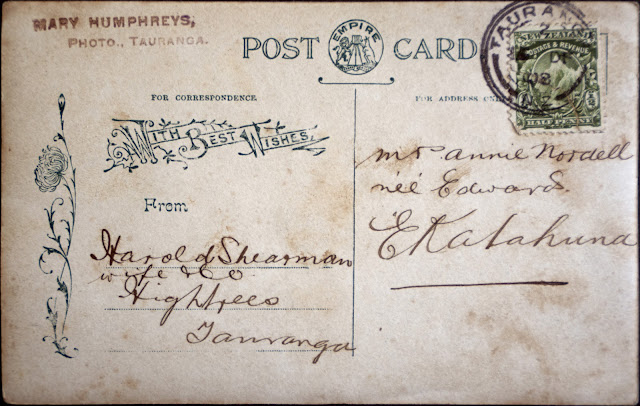
Empire cardstock pre-printed with greetings message and handstamped, “Mary Humphreys, Photo., Tauranga”
With half-penny “Aoraki” postage stamp, postmarked Tauranga, 14 December 1908
Collection of Steve Vergeest

A similar postcard with a slightly different “Compliments of the Season” design was sent at Christmas 1908 by Nurse Mary Chappell, a registered midwife and proprietor of The Palms Nursing Home,[viii] showing a woman in nurse’s uniform standing on the veranda of “The Palms” (Tauranga City Libraries Pae Koroki Ref. 07-075).

Empire cardstock pre-printed with greetings message and handstamped, “Mary Humphreys, Photo., Tauranga”
Inscribed, “Mrs Chappell, Tauranga … Xmas 1908
Collection of Tauranga City Libraries, Pae Korok
ī Ref. 07-075

“Veterans and returned troopers who took part in the ceremony to unveil a new obelisk at Tauranga commemorating soldiers and sailors who fell during the New Zealand Wars”, 11 Jul 1909
Photographed by Mary Humphreys, published in The New Zealand Graphic and Ladies Journal, 21 Jul 1909
Collection of Auckland Libraries, Ref.
NZG-19090721-0018-04

In July 1909 the editor of the Bay of Plenty Times reported:

“Mrs Humphreys secured a nice series of photographs of the recent ceremony of unveiling the monument in the Military Cemetery, and the pictures are now available in post card and other forms.” [ix]

This was the unveiling of the 1st Waikato Militia Memorial, a monument to the soldiers of that regiment that had fallen at Pukehinahina forty-five years earlier, at the Mission Cemetery (Ōtamataha Pā).[x] An unattributed photograph of veterans and others present at the ceremony, and a photo of the “new obelisk” (Auckland Library Ref. NZG-19090721-0018-08), were published in the New Zealand Graphic on 21 July.[xi] That they were in fact taken by Mary Humphreys is known because postcard prints of at least two of the same images with Mary Humphreys’ stamp exist, held in a private collection and at Tauranga Library (Pae Korokī Ref. 99-097). She also sent copies of these postcards to Major General Robley in the UK, a gesture which ultimately resulted in generous donations from a group of his friends for maintenance of the cemetery.[xii]

Tauranga Gas Works, c. August 1909
Real photo postcard photographed and published on Empire cardstock by Mary Humphreys
Collection of Tauranga City Libraries, Pae Korok
ī Ref. 01-569

In August 1909 she was on hand for the inauguration ceremony of the long awaited Gas Works, and “afterwards took a photograph of the gathering”.[xiii] The postcard view above was perhaps on a different occasion, but is likely to have sold in some numbers. She likewise produced commissioned views of various business premises in Tauranga, including those of P. Munro, a general merchant and land agent on the Strand (private collection), and F.H. Hammond, baker and grocer on Willow Street (Tauranga Heritage Collection 0172/09).

“From the Mount, Tauranga, 1/1/12. GAW. 96C” View of Mt Maunganui and Hopukiore from the slopes of Mauao
Real photo postcard, possible attribution to Mary Humphreys
Collection of Tauranga City Libraries, Pae Korok
ī Ref. 03-446

In October 1909 a series of postcards promoting the development of the East Coast Railway were commissioned by G.A. Ward, member of the Chamber of Commerce and newly elected president of the Tauranga Railway League.

“The following particulars relating to the East Coast railway have been prepared by Mr G.A. Ward … and issued by the League to accompany the photographic post cards of the East Coast railway and connecting lines to Pokeno and Rotorua, which are to be distributed immediately …” [xiv]

Later views in this numbered series, identified with the monogram “GAW” as part of the titling, include a view of the railway line from the Moturiki Island quarry to the Railway Wharf at the southern end of Waikorire (Pilot Bay) in January 1912 (number 96C, shown above, perhaps one of a panorama), and one of the opening of the Tauranga-Te Puke railway in October 1913 (number 100, private collection). Although contemporary newspaper reports don’t state who the photographer was, it seems likely that Mary Humphreys was responsible, as similar titling was used by her for other postcard views from that time period.

“Summer breakers at the Mount, Tauranga, N.Z.”, taken on Mauao’s base track, c. 1910-1911
Silver gelatin print mounted on album page, photograph attributed to Mary Humphreys
Tauranga Heritage Collection, Captain Mee Album Ref.
0032/12

An album of photographs presented by Ward to Captain F.T. Mee, master of the SS Clan Ross, then the biggest steamer to visit the port of Tauranga, by the Tauranga Chamber of Commerce in May 1911, includes 43 photographs of the Tauranga district, most of which were taken by Mary Humphreys, some over a decade earlier.[xv] Four of them have the same style of titling, with G.A. Ward’s monogram on the corner.

“Ocean Bay, The Mount, Tauranga, N.Z.” View from Moturiki, dated 11 January 1910
Lightly hand-tinted real photo postcard, photograph by Mary Humphreys
Collection of Justine Neal

Many of these views were published as postcards on a variety of pre-printed postcard stock, either with or without her hand-stamp neatly placed in the top left corner of the address side. As early as 1909 Humphreys was using Kodak Austral cardstock, replaced from around 1916 by Kodak Ltd. “K” cardstock.

Mary Humphreys postcard on early Kodak Austral cardstock, used Jan 1910
Collection of Justine Neal

“The Karaka Walk, The Mount, Tauranga, N.Z.” View of Waikorire from Mauao base track, c. 1906-1910
Real photo postcard, photographed by Mary Humphreys
Collection of Steve Vergeest

Mary Humphreys postcard on later Kodak Austral cardstock
Collection of Steve Vergeest

Her commercial output appears to have almost ceased by the outbreak of war in late 1914, although she was still listed as a photographer in Wise’s New Zealand Post Office Directory for 1915. A few postcards were used postally after that time, but most had probably been published in earlier years. The specific reasons for her retirement from the photographic scene is unknown, although Robert Meers did increase his postcard output at around this time. In July 1913 he “remove[d] to commodious premises lately occupied by T.E. Price” on the Strand,[xvi] and in October formed a partnership with recently arrived photographer Mick McMahon offering “all classes of photographic work”.[xvii] While Meers is thought to have concentrated predominantly on studio portraits, McMahon is known to have been very active in his outdoors work. Although the partnership lasted less than a year, both of them continued to be active in Tauranga after it was dissolved in May 1914.[xviii] The competition for customers in a market which declined rapidly after the outbreak of war may just have proved too stiff for Mary Humphreys.

She had achieved a great deal in the space of a mere fifteen years. After mastering the technological and artistic aspects of photography, she had developed a full portfolio of very competent views throughout the region. She embraced the opportunities offered by the newly developed technology of half-tone reproduction, and formed business relationships with several national newspapers. She was a pioneer of the local postcard industry, and produced a substantial number of views – probably several hundred – documenting not only the countryside but also numerous local events. Her known postcards are keenly sought after by local collectors, but plenty of work still needs to be done on the origins of images from that era, and more unattributed photographs may well prove to have been taken by her.

Mary Humphreys died in Tauranga on 7 January 1946. Her obituary in the Bay of Plenty Times noted:

“Tauranga loses one of its oldest and most respected residents … She took an active part in all social activities in Tauranga and was a keen supporter of the Church of England, the Mission to Seamen and all patriotic affairs during the two wars. She was also one of the early supporters of the Barnardo [sic] homes. Mrs Humphreys was well known throughout New Zealand for artistic work and needlework. She will be missed by a large circle of friends in Tauranga and elsewhere.”

Acknowledgements

The research carried out for this series of articles on the elusive and enigmatic Mary Humphreys would have been impossible without access to several private and public photograph and postcard collections. I’m very grateful to several individuals, namely Geoff Willacy, Brian Ducker, Justine Neal, Steve Vergeest and Debbie McCauley, who have very generously allowed me to peruse their collections, and in some cases take photographs or scans of the postcards, and shared their thoughts gained from years of research. Likewise, I appreciate the staff at Tauranga Library Archives and Tauranga Heritage Collection, who afforded me unfettered access to their public collections. Previous research published by Justine Neal, Shirley Arabin, Geoff Willacy (Historical Review, Vol 63 No 2, p42-47) and Debbie McCauley (ref) has also been very useful.

References

[i] Mary Humphreys, “Photographic Post-Cards. Advertisement,” Bay of Plenty Times, October 9, 1905, Volume 31 Issue 4810 edition.

[ii] Brett Payne, “Tauranga Photographers: Robert Walter Meers,” Tauranga Historical Society (blog), June 12, 2015, http://taurangahistorical.blogspot.com/2015/06/tauranga-photographers-robert-walter.html.

[iii] “Weddings. Rusling-Rodgers,” Bay of Plenty Times, April 11, 1906, Volume 31 Issue 4885 edition.

[iv] “Untitled [Mrs Humphreys’ Photograph of Tauranga City Junior Football Team],” Bay of Plenty Times, September 6, 1905, Volume 31 Issue 4796 edition.

[v] “Trip to Papamoa,” Bay of Plenty Times, April 7, 1909, Volume 37 Issue 5342 edition.

[vi] “Sale of Work,” Bay of Plenty Times, October 29, 1906, Volume 35 Issue 4970 edition.

[vii] Mary Humphreys, “Photographic Christmas Cards. Advertisement,” Bay of Plenty Times, October 11, 1909, Volume 38 Issue 5420 edition.

[viii] Justine Neal, “‘The Palms’ Licensed Maternity Nursing Home,” Blog, Tauranga Historical Society (blog), June 28, 2013, https://taurangahistorical.blogspot.com/2013/06/the-palms-licensed-maternity-nursing.html.

[ix] “Local and General [Ceremony Unveiling Monument in Military Cemetery],” Bay of Plenty Times, July 19, 1909, Volume 37 Issue 5384 edition.

[x] Manatū Taonga — Ministry for Culture and Heritage, “Tauranga 1st Waikato Militia NZ Wars Memorial,” New Zealand History, May 29, 2024, https://nzhistory.govt.nz/memorial/tauranga-1st-waikato-militia-nz-wars-memorial.

[xi] “‘Lest We Forget’ - The Victims of the Maori War,” The Weekly Graphic and New Zealand Mail, July 21, 1909, Volume 43 Issue 3 edition.

[xii] “Local and General [Mrs Humphreys Received Letter from Robley],” Bay of Plenty Times, October 18, 1909, Volume 38 Issue 5423 edition.

[xiii] “Progress. The New Gasworks. Inauguration Ceremony,” Bay of Plenty Times, August 18, 1909, Volume 37 Issue 5397 edition.

[xiv] “Railway Reasons,” Bay of Plenty Times, October 11, 1909, Volume 38 Issue 5420 edition.

[xv] Mary Humphreys and Thomas Edward Price, Captain Mee Album, May 1911, Photograph album, Silver gelatin prints, 230mm (height), 290mm (width), 40mm (depth), May 1911, Tauranga Heritage Collection, https://view.taurangaheritagecollection.co.nz/objects/26940/photograph-album.

[xvi] “Untitled [Photographer R.W. Meers Removed to New Premises],” Bay of Plenty Times, July 2, 1913, Volume 41 Issue 5978 edition.

[xvii] Robert Walter Meers and Michael Patrick McMahon, “Partnership Notice. Advertisement,” Bay of Plenty Times, October 29, 1913, Volume 41 Issue 6030 edition.

[xviii] Brett Payne, “Mick McMahon and the Talma Studio - Part 1,” Tauranga Historical Society (blog), July 10, 2020, http://taurangahistorical.blogspot.com/2020/07/mick-mcmahon-and-talma-studio-part-1.html.