Showing posts with label 1970s. Show all posts

Friday, 9 October 2026

Movie Memories

 After attending the Tauranga Historical Society’s October meeting, where Brian Ducker gave an entertaining and illuminating presentation on fan mail sent by New Zealanders to Hollywood stars in the early to mid-twentieth century, and hearing the questions it prompted from fellow attendees, I found myself delving into Tauranga Museum’s collection to discover what it might reveal about the region’s own film history.

Among the collection’s treasures are more than two hundred and fifty movie posters spanning the 1930s to the 1970s. The films represented include Crime Over London (1936), Nothing Sacred (1937), Tarzan and the Slave Girl (1950), Dr No (1962), The Sound of Music (1965), Planet of the Apes (1968), The Horror of Frankenstein (1970), and The Rocky Horror Picture Show (1975).


Just two of the more than 250 movie posters in the Tauranga Museum collection, ranging from Crime Over London (1936) to The Rocky Horror Picture Show (1975). Collection of Tauranga Museum (0051/11, 0723/10).


These posters come from local cinemas and illustrate a time when moviegoing was a very popular form of entertainment in the Western Bay of Plenty. At least six theatres operated in the district, including the Regent, Town Hall and Odeon theatres in Tauranga, the Plaza Picture Theatre in Katikati (originally known as “Everybody’s Theatre”), the Capitol Theatre in Te Puke, and the Regent Theatre on Victoria Road, Mount Maunganui. Originally built as a dance hall in the 1920s, the theatre was first known as Arcadia Hall before being converted into a cinema.


Plaza Picture Theatre in Katikati circa late 1940s. Image courtesy of Western Bay District Library.

Like fan mail, movie posters have become highly collectable, though for different reasons. Created to promote films in cinema lobbies, they were never intended for public sale. Their scarcity, artistic value, and nostalgic appeal are among the reasons they are so sought after today. The collection also includes other forms of film advertising, such as lobby cards and smaller window cards, which were used to promote films both inside and outside cinemas.


A window card advertising Wonder Man (1945) and a lobby card for Serpico (1973), starring Al Pacino. Collection of Tauranga Museum (0179/11/1, 0128/09).

While these posters are eye-catching, the programme posters produced for theatres such as the Regent and Town Hall offer the clearest glimpse into the cinema-going experience of the day, revealing the sheer number and variety of films available to audiences. 


A programme of films showing at the Regent Theatre and Town Hall, Tauranga, in August 1934. The two theatres operated as Tauranga Theatres Ltd. and were part of the Robert Kerridge theatre empire. Collection of Tauranga Museum (0001/21).

Together, these posters and programmes do more than advertise films. They preserve memories of nights at the pictures, of theatres that have long since disappeared, and of a time when the arrival of the latest Hollywood production was an event anticipated by communities across the Western Bay of Plenty.

Acknowledgement

Thank you to Brian Ducker for sharing his wonderful collection of stamps, envelopes, letters and postcards.  A philatelist collects and studies stamps and postal history; a deltologist collects and studies postcards.


Friday, 11 September 2026

An Architour of some of Tauranga’s older homes

 Recently, and in conjunction with Gerry Hodgson, a retired local architect, Tauranga Historical took a group of fifteen people on a most interesting trip around the northern end of Te Papa peninsula. We viewed houses from the roadside and learnt about the differing styles of home building in New Zealand from earliest European settlement to modern times.

The Elms Te Papa.  Image: Julie Green

Our first stop was of course the Georgian/Regency/Colonial example in Mission Street.  The Elms Te Papa was built predominantly by hand with local materials. Gerry pointed out its symmetrical design with a well-lit central foyer, matching twin dormer windows and the absence of a verandah —unusual for this style of house, so it may have been the personal preference of its first occupants, the Brown family. It was completed in 1847 by missionary carpenters, with doors and windows made on site, and hand- polished glass imported from Moravia for the many small window panes. The roof originally had kauri shakes but early in the 20th century they were covered with corrugated iron.

Gerry Hodgson on the front veranda at Brain Watkins House.  Image: Julie Green

Next we arrived at the front of Brain Watkins House at 233 Cameron Road — a Victorian Square Villa. This is still somewhat symmetrical in style with a central corridor and a wide verandah trimmed with ornate fretwork. Probably built to a standard plan from a sale catalogue, it was constructed by local shipwright and civic contractor Joseph Brain in 1881 for his wife and four daughters. The kauri used in its construction was transported here from Coromandel in one of his small scows.  The house was extended around 1900 as Joseph’s family had grown: a fifth girl was born in 1891. 

Edwardian house, Arundel Street.  Image: Julie Green

Gerry confessed to knowing little about the history of the next home we visited, in Arundel Street.  He called it an Edwardian house: the earlier fashion for symmetry having lessened in favour of a bay window on one side and a verandah extending around two sides or more. It was interesting, however, to note that the fretwork decorating the facade is almost identical to the 1880s Brain Watkins House, even though this one dates to 1910. It also features finials on the gable ends and little overlapping tiles above the bay window. 

“The Old White House” in Second Avenue. Image: Julie Green

Very close by in Second Avenue is the location of a Californian Bungalow or Ranch home, built in 1906 using large posts and beams. It has almost a Japanese flavour, and Gerry pointed out the presence of great ventilation features in the ceiling spaces included in the design. The present owners have chosen to replace the corrugated iron with textured malthoid tiles when reroofing.

The two aspects of 186 Devonport Road.  Images: Julie Green

A short walk around the corner and down a hedge-lined drive brought us to this 1932 English Revival stucco home off Devonport Road. The front and back facades are quite different.  The street side of the house features large Tudor-style beams. On the other side, facing the harbour and a large front lawn, a vestibular verandah is constructed within the main frame.

The street entrance, 186 Devonport Road.  Image: Julie Green

After a short break for a snack next to the WWII memorial at Memorial Park, we had to retreat to our vehicles due to heavy rain. Driving to the other end of the reserve, we parked next to the QEII sports pavilion and looked across to the rise where Fraser Street and Eleventh Avenue meet. There, in 1972, a Gerry Hodgson-designed-home, featuring a cantilevered verandah, was built with cedar and brick. It is presently owned by another architect who invited its designer over for a cup of tea not long after purchasing this truly NZ-style home.

Exterior and interior, 40 Fraser Street.  Images: Gerry Hodgson


Friday, 30 January 2026

A to Z of Tauranga Museum: B is for Bathing Suits


Image courtesy of Tauranga Museum, Robert Gale Collection, 0005/20/539

As the Bay of Plenty summer continues to be hot and locals and visitors alike flock to the coast, it’s hard to miss how deeply beach culture is woven into our identity. From sun-soaked days on Mount Maunganui beaches to the salty breeze off Te Awanui, these experiences have shaped our city’s character for generations. The Tauranga Museum holds a treasure trove of artifacts that tell this story.


Gifted by Tauranga Historical Society, Tauranga Museum, 0230/11

Its collection captures the essence of seaside leisure: beach umbrellas for shade, surf boards for thrill-seekers, picnic baskets for family outings, and even a bottle of Q-tol – the once-popular lotion that soothed sunburn long before we understood the importance of sunscreen.

                                1930s swimsuit, made in England.               Early 1980s Expozay, made in Tauranga.
                                       Tauranga Museum, 0151/16                           Tauranga Museum, 0032/14

But the real stars of the collection might be the bathing suits. With 83 suits spanning more than a century, this collection charts the evolution of beachwear - from modest woollen costumes to sleek Lycra designs. Many of the suits reflect not only innovation in materials and design but also changing attitudes toward fashion and freedom of expression.

For example, the museum holds two Jantzen swimsuits that were manufactured in Wellington by A.J. Coleman Ltd under licence from the American brand.  They were the height of style in their respective decades. During the 1930s and 40s, new fabrics emerged, sleeves vanished, and bold colours became the norm – as seen in a striking bright blue swimsuit:

1930s-1940s Jantzen swimsuit. Tauranga Museum, 0019/00

 Moving forward to the 1970s, and designers were embracing Lycra, a revolutionary fabric that allowed for greater flexibility and comfort. This floral swimsuit illustrates the shift toward vibrant patterns and figure-hugging styles that defined the decade:

1970s Jantzen swimsuit. Tauranga Museum, 0266/11


Friday, 21 November 2025

 A to Z of Tauranga Museum - A is for apron

Charlie Haua outside his blacksmith shop in Grey Street. Late 1960s.

Image: Tauranga Museum.

It feels fitting to begin our Tauranga Museum artifact alphabet with a blacksmith apron once worn by Charlie Haua. In 1969, Charlie’s tools and equipment were acquired by the Tauranga Historical Society, forming the foundation of the museum’s collection. Although the Rotorua Museum offered a higher price, Charlie accepted the Society’s offer of £500, as he wanted his blacksmith shop to remain part of our story. “I’ve been at it all my life ... this is a dying trade, and I could not sell out. There is a great deal of old stuff here – material that you would not find in many places.”

Charlie Haua’s apron.

Image: Tauranga Museum

Born in 1903, Charlie came from a well-known and respected Tauranga family. He was the grandson of Anaru Haua (son of Watene and Merepokowai), and the son of James Haua and Mary Hearling. Charlie attended Tauranga District High School until 1919 and was a gifted all-round sportsman. He competed in rowing, rugby, hockey, sailing, athletics, gymnastics, and was a key figure in the local sporting community. He was the first captain of the Cadet Old Boys Rugby Football Club and went on to represent the Bay of Plenty in 1929. Later, he was made a life member of the Tauranga Rugby Association, a reflection of his long-standing contribution to the sport in this region.

Tauranga Football Representatives, 1925. Charlie Haua is pictured at the far right of the front row in this team photograph, taken by local photographer Robert Rendell.

Image: Tauranga Museum

After finishing school, Charlie Haua became the town’s most well-known and longest-serving blacksmith, dedicating an impressive 49 years to the trade. Even in retirement, Charlie and his blacksmith shop remained at the heart of the community, becoming a star attraction at the museum in Durham Street and then at the Historic Village and District Museum, which opened on Seventeenth Avenue in 1975.

Charlie Haua making a horseshoe for the bride and groom. Early 1970s.

Image: Tauranga Museum.

Charlie generously volunteered countless hours, captivating visitors with his skill and bringing the museum to life. His handcrafted miniature horseshoes became popular souvenirs, with thousands sold to help fund the museum’s development. In recognition of his remarkable contribution to the community, Charlie was awarded the British Empire Medal in 1976. 

Nellie Haua (left) and Charlie Haua. The person on the right is currently unidentified.

Image: Te Ao Mārama - Tauranga City Libraries Photo 03-047

Source:

‘A to Z of Tauranga Museum’ is a regular feature of the Friends of Tauranga Museum newsletter. To subscribe to this free newsletter and join the Friends group, visit:

https://tauranga.syd1.qualtrics.com/jfe/form/SV_3lapiU8ES1FUlMO

Sunday, 25 May 2025

Hopukiore

Ocean Beach and Hopukiore (Mt Drury) from Mauao, Mount Maunganui, c. early 1950s
Postcard, unidentified publisher, collection of Justine Neal

Hopukiore, at 40 metres high is much smaller than its famous counterpart, Mauao but it’s history is just as fascinating. From the late 1500’s the Ngati Tauaiti had a marae there, along with another marae on Moturiki. The name Hopukiore means to catch kiore (rats), the bones and the teeth of which were used for carving chisels and tattooing instruments. The area was used as a carving school and a wahi tapu (sacred site) for ta moko (traditional tattooing).

Ocean Beach, Mt. Maunganui, c. 1970s-1980s
Postcard published by Pictorial Publications Ltd, Hastings
Collection of Justine Neal

On the eastern side of Hopukiore there are at least five caves, some of which are known to have been used for burials. The 1820 battle fought between Ngapuhi and Ngaiterangi resulted in a large number of deaths for the Ngaiterangi. Te Waru’s (Ngaiterangi) chivalrous treatment of Te Morenga (Ngapuhi) after the battle led to peace between the two tribes and the Ngaiterangi dead were honoured with burial in the caves of Hopukiore.

East Cave, Hopukiore, 2025
Photograph by Justine Neal

The caves were also used by the men of the 80th Regiment under Major Bunbury when they were sent from Auckland to deter hostilities between Arawa and Ngaiterangi, occupying the hill from December 1842 to March 1843. One cave was enlarged and shelves installed for munitions storage and a door was fitted. Another two caves were used for general storage and a bakehouse.

Hopukiore (Mt Drury) and Mauao, from Marine Parade, Mt Maunganui, c. 1950s
Collection of Tauranga Libraries, Pae Korok
ī Ref. Photo 99-028

In the 1980’s two young local boys were amusing themselves using old boxes to slide down the slopes of Hopukiore,  After a while, as they happened to have a small torch with them, their attention turned to the caves and they decided to do a little exploring. On entering the cave it felt cold and damp, the floor was hard packed dirt and there was enough headroom to walk. The cave narrowed, then came a shoulder height drop but they were still able to walk down to the next level. The cave narrowed again, it appeared to be solid rock in front of them but the torch showed that in one place the rock overlapped leaving a narrow gap to squeeze through. There was no way an adult could manage it but the boys thought they would be able to. At that moment they had a couple of choices and sensibly decided the way back was the safest one.

In 1853 Hopukiore was given the extra name of Mount Drury, named after Commander Byron Drury who arrived in Tauranga in 1852 on board the H.M.S Pandora to complete a coastal survey of the Bay of Plenty started in 1848.

Hopukiore (Mt Drury) from the quarry on Moturiki, Mount Maunganui, 1921
Postcard by unidentified publisher
Tauranga Heritage Collection, Ref. 0197/08

In 1913 a railway line that had been built to the railway workshops (situated between Salisbury Avenue and Rata Street) was continued up the main street, curving round the northern end of Hopukiore to service the quarry on Moturiki. A crushing plant had been built on the foreshore of Hopukiore to deal with the stone coming from the quarry.

The big swing at Mount Drury (Hopukiore) playground, Mt Maunganui, January 1967
120-format film negative, published in Bay of Plenty Times, 13 Jan 1967
Collection of Tauranga Libraries, Pae Korok
ī Ref. Photo gca-14286

Mrs. Gilchrist in the book ‘A History of Mount  Maunganui’ by Don Cunningham remembers the Public Works picnics:

“When they got the rail through a bit they would have open carriages with seats across and you’d come down to the Mount from Te Puke. The railway line went right along where the Main Road is now. We would all get off at the foot of Mount Drury on a platform and then take our picnic baskets into the big pine trees.”

Tunnel of the Mt Drury (Hopukiore) Railway Line, Mt Maunganui, December 1966
Crop of 120-format film negative, published in Bay of Plenty Times, 28 Dec 1966
Collection of Tauranga Libraries, Pae Korok
ī Ref. Photo gca-14079

From 1960 to 1975 there was a miniature railway as part of a children’s playground. There was a man-made tunnel that it went through at the base of Hopukiore and that’s where it lived. There were doors at each end that were kept locked when it wasn’t in use. It only used to run in the summer. Since 2008 there has been a playground on the western side of the reserve.

Mount Drury Tower (Hopukiore), Mt Maunganui, February 1963
120-format film negative, published in Bay of Plenty Times, 26 Feb 1963
Collection of Tauranga Libraries, Pae Korok
ī Ref. Photo gca-4488

In 1958 the Harbour Board Signal Station was erected on the summit of Hopukiore, the ideal place with its sweeping views out to sea. It served as a communication tool for navigation and relaying important information to the ships. It has been inoperative for many years now and at the present time only the signal station mast and a shed remain on the site.

Hopukiore (Mount Drury) with Soundshell, taken from Moturiki (Leisure Island), c. 1970s
Silver gelatin snapshot print by unidentified photographer
Tauranga Heritage Collection, Ref. 0040/25

In 1967 a Soundshell was built on the flat surface at the base of Hopukiore on the Moturiki side. The seating was provided by man-made terraces or by spreading a towel or a blanket on the grassy slopes. It proved very popular with locals and visitors alike, and was regularly used for concerts and events, such as the Miss Mount Maunganui contest on New Year’s Day. The Soundshell was demolished in 1999 and the area reverted back to grass.

Mount Maunganui 5,000 Club junior pageant at the Soundshell,January 1967
120-format film negative, published in Bay of Plenty Times, 4 Jan 1967
Collection of Tauranga Libraries, Pae Korok
ī Ref. Photo gca-14153

In 1978 the Council decided to extend the Grace Avenue frontage of Hopukiore by buying the small cottages that had been built there. These worker’s cottages were relics of the days when Moturiki had been quarried by the Railways Department and coincidentally several of them came on the market at this time and others were obviously reaching the end of their useful life.

Radio mast and shed, Hopukiore, 2025
Photograph by Justine Neal

The Council employed a land agent whose job was to enquire from the landowners if they were interested in selling. Unfortunately, he rather overstepped his job description by threatening them that if they did not sell the Council would take the land under the Public Works Act. Eventually the cottages were acquired by the Council and the land incorporated into the reserve. It just took a little bit longer and without the help of that particular land agent.

References

2019 Tauranga Reserves Management Plan
Tauranga City Library
Tauranga Heritage Collection
Explore Tauranga

The Weekend Sun, 22 February 2013
Sunlive, 10 May 2021
A History of Mount Maunganui, compiled by Bruce Cunningham & Ken Musgrave, 1989

Monday, 3 March 2025

Putt’s Ponies, Bethlehem

Darren Beard sits on Peanuts, one of the miniature horses at Bethlehem, being held by Mr A. M. Putt
120-format film negative, published in the Bay of Plenty Times, 1 Sep 1972
Te Ao Mārama - Tauranga City Libraries, Pae Korokī Ref. gca-20903

I came across these images recently and it brought back great memories of pony riding when I was about twelve years of age and a wannabe horsey girl. A lovely man, Mr Putt and his family had several miniature horses on their property in Bethlehem Road in the 1970s (and possibly even before my time) and for a small fee we could be led or let loose depending on the rider’s ability and experience. Both my mother and grandmother took us children (four girls) for a treat on more than one occasion.

Woman rides one of Mr A. M Putt's miniature horses at Bethlehem
120-format film negative, published in the Bay of Plenty Times, 1 Sep 1972
Te Ao Mārama - Tauranga City Libraries, Pae Korokī Ref. gca-20900

In these images you can see the homestead in the background and the trees surrounding it. For those readers familiar with the Bethlehem Town Centre, the trees behind the house are still there — between Liquorland and Patrick’s Pies. They are well established natives and I am delighted they were retained by the developers. The whole site was for some years a kiwifruit orchard owned by the Thompson Brothers and also for quite a period just bare land awaiting the development.

Friday, 21 February 2025

Beazley's Pre-Cut Houses

Construction of Beazley Homes’ admin block, Hull Road, Mt Maunganui, November 1966
120-format film negative, Published in the Bay of Plenty Times, 9 Nov 1966
Collection of Te Ao Mārama - Tauranga City Libraries, Pae Korok
ī photo gca-13802

In 1950 local father and son home builders, Barry and Fred Beazley, began expanding throughout the North Island. By 1961 they were in the South Island and a year later the company Beazley Homes Ltd. came into being with its head office at Hull Road, Mount Maunganui.

Aerial view of Beazley Homes’ yard, Hull Road, Mt Maunganui, c. October 1966
35mm-format film negative, Unpublished Bay of Plenty Times photograph
Collection of Te Ao Mārama - Tauranga City Libraries, Pae Korok
ī photo gcc-11112

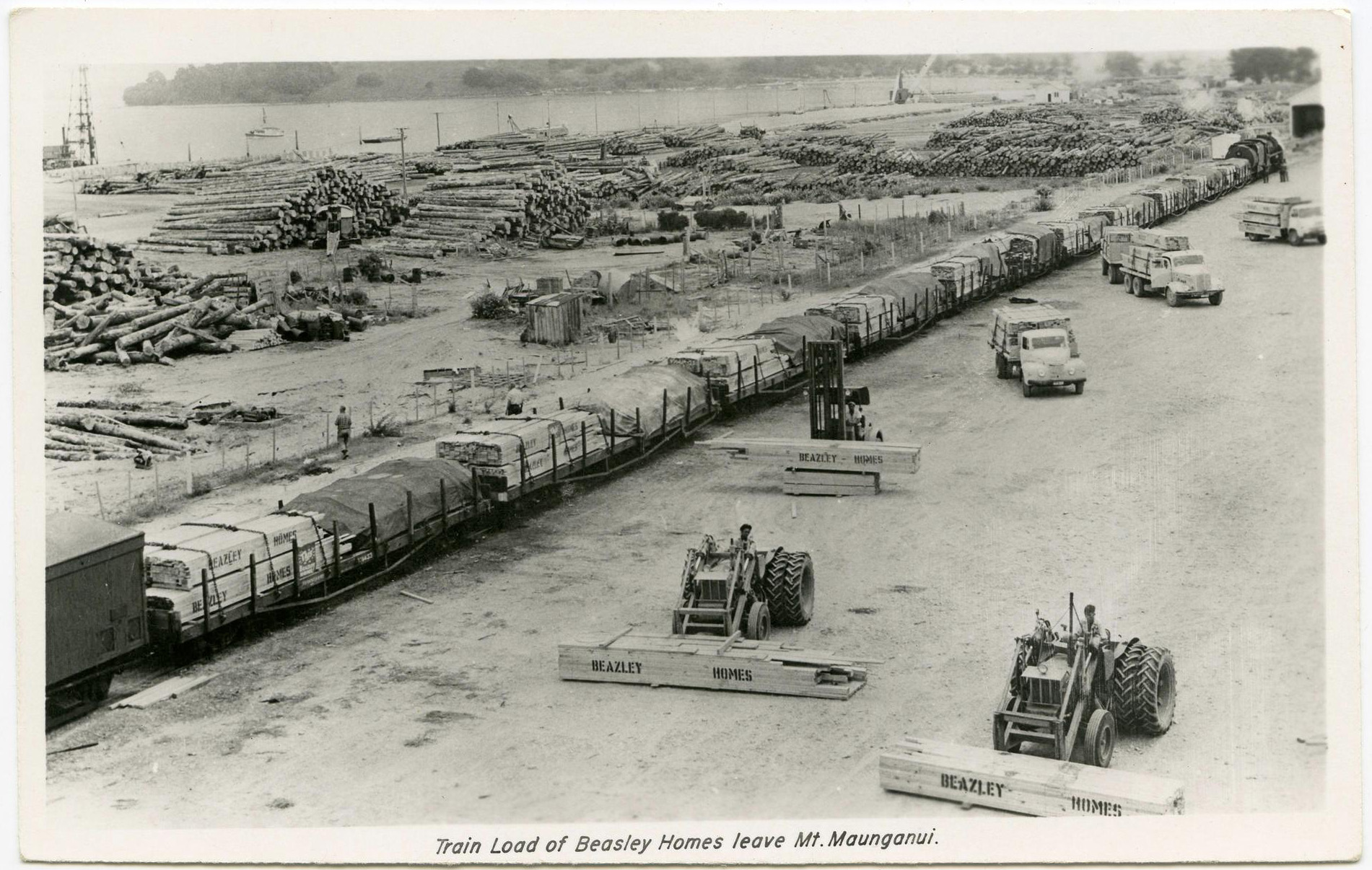
They occupied a large block of land which included the timber yard, Mount Timber and Hardware, the truss plant, the moulding shed and the pre-cut division. The main entrance to the yard was off Hull Rd. The company was known for its pre-cut timber frames that could be sent all round New Zealand and the Pacific.

Train load of Beasley [sic] Homes leave Mt Maunganui
Black-and-white postcard (140 x 88 mm), publisher unknown
Tauranga Heritage Collection, Ref. 0039/11

The pre-cut division was staffed with approximately twenty people; one quantity surveyor, three draughtsmen and seventeen others whose job it was to set out the plates and frames, cut the roofs and studs and pack up each completed house lot.  A train came in to the rail siding each day to pick up the wagons loaded with the pre-cut houses. Forty went out each week to franchise builders from Whangarei to Wellington.

Beazley Homes Ltd brochure, c. 1970s
Tauranga Heritage Collection, Ref. 0390/24/1-28

In 1974 all the plans and quantities had to be changed from imperial measurement to metric – a massive job as every measurement on the plans were affected. As a cost saving exercise Beazleys decided to change all inside walls from 4x2 to 3x2 and so all the plans and quantities had to be changed again. After six months it was discovered that 3x2 walls couldn’t keep the studs straight so the plans had to be changed back again.

Beazley Home exhibit at Trades Fair, October 1966
(Detail) 120-format film negative, Published in the Bay of Plenty Times, 11 Oct 1966
Collection of Te Ao Mārama - Tauranga City Libraries, Pae Korok
ī photo gca-13393

The completed houses left Beazleys like giant flat packs and were loaded onto ships at the wharf for the Maldives, Papua New Guinea and Australia. The pre-cut houses sent to Australia were destined for miner’s homes at Mt. Tom Price and a hundred at a time went to Weipa in far north Queensland. One delivery of a hundred arrived there without the kitchens, there was a ‘slight delay’ as the kitchens caught up with the rest of the houses. Hurricane bolts were sent for each corner of the house to prevent the houses from being blown apart during a cyclone.

Pre-built Beazley Homes Ltd. accommodation unit for export market on back of truck, 1977
Fletcher Holdings Archives, Ref. P9006/6

Beazleys sold out to Fletchers in 1973. Pre-cut houses have been replaced by pre-nailed frames and the pre-cut roofs with trusses.

Sources

Fletcher Trust Archives
www.nzherald.co.nz
Pae Korokī Tauranga City Library
Selwyn Neal
Tauranga Heritage Collection

Friday, 18 October 2024

C.F Washer and Sons and Sam Snowden’s Spring Street Service Station (Part 2)

Guest article by John Green (continued from Part 1)

Sam Snowden felt there was room for another motor business in the downtown area and set up on the corner of Durham and Spring Streets (now the site of our first parking building). He was the agent for International and sold trucks and bulldozers as well as benzine (petrol) and other oil products.

Sam Snowden’s Spring St Service Station, 1940s
Collection of Te Ao Mārama Tauranga City Libraries, Pae Korokī Ref. 03-457

All service stations seemed to sell benzine from multiple manufacturers, eg. Big Tree, Plume, Shell, Texaco, Europa, Atlantic.

The modernised stuccoed Snowden Garage with flat, undated
Black-and-white silver gelatin print (92 x 148mm) by Alf Rendell, Tauranga
Tauranga Heritage Collection Ref. 0181/15, Tauranga Museum

Much later the workshop was extended and a second storey flat was added to the building.  Former employee Alan Jones remembers Sam coming into the workshop on cold days and lighting his forge to warm the place.  We believe the Snowdens (possibly the two sons) also had a car rental business across the road next to their tractor showroom and parts department.

Garage of C.F. Washer Ltd, Willow Street, 1937
Copy negative of mounted print, copied for Bay of Plenty Photo News, No 93, 7 Mar 1970
Collection of Te Ao Mārama Tauranga City Libraries, Pae Korokī Ref. pn 6546

Washer’s Garage, Willow Street, c1950s
Black-and-white silver gelatin print (96 x 150mm) by Alf Rendell, Tauranga
Tauranga Heritage Collection Ref. 0186/15, Tauranga Museum

Meanwhile back at Washers expansion was underway, they now had the corner section for the sale of fuel and the side building was the service area. The name was changed to C.F. Washer and Sons and they became distributors for Vauxhall, Bedford and Chevrolet.

The final form of C. F. Washer and Sons, 1970
Black-and-white 35mm-format negative, published in Bay of Plenty Photo News, No 93, 7 Mar 1970
Collection of Te Ao Mārama Tauranga City Libraries, Pae Korokī Ref. pn 6534

Their buildings covered many square yards and included a truck workshop on Hamilton Street, lube bay, parts department, showroom and another service centre in the original 1922 building facing Willow Street.

Washer’s Resale Cars, Cameron Road
Copy negative of loose print, copied for Bay of Plenty Photo News, No 93, 7 Mar 1970
Collection of Te Ao Mārama Tauranga City Libraries, Pae Korokī Ref. pn 6548

Washers also dealt in used vehicles. If you look closely, you may recognise this building as part of present day Kale Print and a back corner of the Brain Watkins House is visible.

Charlie Washer, September 1964
Black-and-white 120-format negative, publ. Bay of Plenty Times, 30 Sep 1964
Collection of Te Ao Mārama Tauranga City Libraries, Pae Korokī Ref. gca-7412

Over the decades a lot of car brands went out of production and many of the oil companies had amalgamated. Boron (additive) was a sales gimmick for Caltex.

Sources

Tauranga 1882-1982 —The Centennial of Gazetting Tauranga as a Borough, Edited by Alan Bellamy. Published by TCC, 1982

Personal memories of the writer and Alan Jones, a former employee of Sam Snowden.

Images

Thanks to Tauranga City Libraries for their amazing collection of images on Pae  Koroki, and to Fiona Kean and the team at the Tauranga Heritage Collection for permission to use two of their images, including those taken by the late Alf Rendell