Showing posts with label Brain Watkins House. Show all posts

Friday, 11 September 2026

An Architour of some of Tauranga’s older homes

 Recently, and in conjunction with Gerry Hodgson, a retired local architect, Tauranga Historical took a group of fifteen people on a most interesting trip around the northern end of Te Papa peninsula. We viewed houses from the roadside and learnt about the differing styles of home building in New Zealand from earliest European settlement to modern times.

The Elms Te Papa.  Image: Julie Green

Our first stop was of course the Georgian/Regency/Colonial example in Mission Street.  The Elms Te Papa was built predominantly by hand with local materials. Gerry pointed out its symmetrical design with a well-lit central foyer, matching twin dormer windows and the absence of a verandah —unusual for this style of house, so it may have been the personal preference of its first occupants, the Brown family. It was completed in 1847 by missionary carpenters, with doors and windows made on site, and hand- polished glass imported from Moravia for the many small window panes. The roof originally had kauri shakes but early in the 20th century they were covered with corrugated iron.

Gerry Hodgson on the front veranda at Brain Watkins House.  Image: Julie Green

Next we arrived at the front of Brain Watkins House at 233 Cameron Road — a Victorian Square Villa. This is still somewhat symmetrical in style with a central corridor and a wide verandah trimmed with ornate fretwork. Probably built to a standard plan from a sale catalogue, it was constructed by local shipwright and civic contractor Joseph Brain in 1881 for his wife and four daughters. The kauri used in its construction was transported here from Coromandel in one of his small scows.  The house was extended around 1900 as Joseph’s family had grown: a fifth girl was born in 1891. 

Edwardian house, Arundel Street.  Image: Julie Green

Gerry confessed to knowing little about the history of the next home we visited, in Arundel Street.  He called it an Edwardian house: the earlier fashion for symmetry having lessened in favour of a bay window on one side and a verandah extending around two sides or more. It was interesting, however, to note that the fretwork decorating the facade is almost identical to the 1880s Brain Watkins House, even though this one dates to 1910. It also features finials on the gable ends and little overlapping tiles above the bay window. 

“The Old White House” in Second Avenue. Image: Julie Green

Very close by in Second Avenue is the location of a Californian Bungalow or Ranch home, built in 1906 using large posts and beams. It has almost a Japanese flavour, and Gerry pointed out the presence of great ventilation features in the ceiling spaces included in the design. The present owners have chosen to replace the corrugated iron with textured malthoid tiles when reroofing.

The two aspects of 186 Devonport Road.  Images: Julie Green

A short walk around the corner and down a hedge-lined drive brought us to this 1932 English Revival stucco home off Devonport Road. The front and back facades are quite different.  The street side of the house features large Tudor-style beams. On the other side, facing the harbour and a large front lawn, a vestibular verandah is constructed within the main frame.

The street entrance, 186 Devonport Road.  Image: Julie Green

After a short break for a snack next to the WWII memorial at Memorial Park, we had to retreat to our vehicles due to heavy rain. Driving to the other end of the reserve, we parked next to the QEII sports pavilion and looked across to the rise where Fraser Street and Eleventh Avenue meet. There, in 1972, a Gerry Hodgson-designed-home, featuring a cantilevered verandah, was built with cedar and brick. It is presently owned by another architect who invited its designer over for a cup of tea not long after purchasing this truly NZ-style home.

Exterior and interior, 40 Fraser Street.  Images: Gerry Hodgson


Sunday, 16 February 2025

Brain Watkins House Garden Party – A Special Milestone


Mr and Mrs B.C. Julian examining a family postcard album on the front steps of Brain Watkins House at the Tauranga Historical Society’s inaugural Garden Party in December 1979
Photograph by the Bay of Plenty Times photographer, published 3 Dec 1979
Courtesy of
Korokī33738

In November the Society hosted visitors to the Brain Watkins House and garden as part of the biennial Bay of Plenty Garden & Art Festival, the second time we have done this instead of our usual Garden Party. What members and visitors alike probably didn’t appreciate was that the occasion happened to be the 45thanniversary, almost to the day, of our first Garden Party on 1 December 1979.

Willie Watkins and Elva Brain, c. August 1965
Photo Brain Watkins House Collection

The home of Elva Brain and Willie Watkins on the corner of Cameron Road and Elizabeth Street was left to the Society earlier that year as a bequest in Elva’s will and the garden party was an opportunity for members and guests to inspect the house and gardens which are still the Society’s home, and an important focus of our activities. More than 150 members and their guests attended, many in Victorian costumes, including then Mayor Eric Faulkner with his wife Connie, MP for Tauranga, Keith Allen, film and television actress Pat Evison, and visitors from historical societies in Hamilton, Whakatāne and Te Awamutu. We retain strong links with the Whakatāne & District Historical Society in our joint publication of the Historical Review, the Bay of Plenty Journal of History.

Wooden half hull model by Joseph Brain, Brain Watkins House Collection

Guests had an opportunity to view the rooms of the home containing not only the existing furnishings in a setting reminiscent of earlier decades, but also mementoes collected over a century. On display were old family photographs and documents, including Joseph Brain’s will, plans of his engineering projects around Tauranga, early photographs of the house, cups won at sailing regattas and even prizes won by Elva when a schoolgirl.

Elva Brain in the arms of her mother Kate, with her four older sisters, on the steps of their home, c. early 1890s
Carte de visite photograph, Brain Watkins House Collection

Elva was born in 1891 the house which her father Joseph Brain had built a decade earlier, and she lived in it for most of her life. She and her sister Bessie inherited the property when her mother died, and she became the sole owner after her sister died in 1957. The layout of the rooms and their contents have changed little since 1979, the Society choosing to preserve and maintain the look and feel of the early New Zealand home, with all its idiosyncrasies.

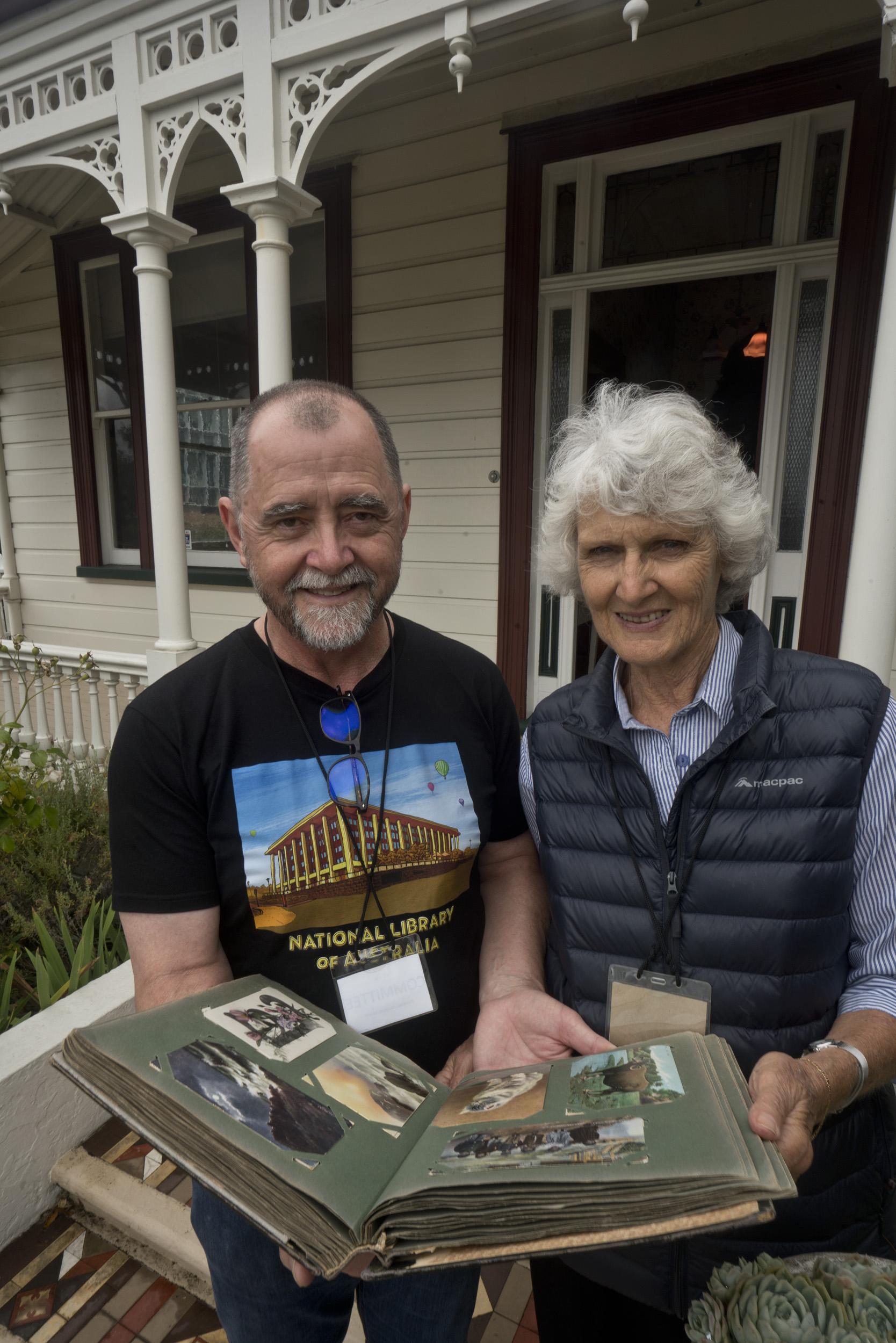
Brain Watkins House guides Leslie Goodliffe and Glennis Smith with the Brain family postcard album which featured in the 1979 Garden Party photo, 16 Feb 2025
Photo: Brett Payne

We also look after the more ephemeral contents of the house, such as the postcard album pictured in the photograph. Our conservation plan is currently being updated and our volunteer team not only show visitors around the house, but keep up an ongoing monitoring of the house’s condition. With the assistance of both the Tauranga Heritage Collection and the Tauranga Library’s Archives, the Society is in the process of conserving and digitising many of the house’s artifacts, and ensuring that they are cared for in the most appropriate physical and environmental conditions.

Friday, 25 October 2024

Just a Material Girl

Attending a conference for Conservators of Cultural Materials, Tauranga Historic Village 

ERCO tote

Even the promotional material on offer at the 2024 conference of NZCCM - https://nzccm.org.nz/ - was something of a revelation to one of the newest members of the society (me).  ERCO, one of the sponsors for the conference, offered, in a high-quality and stylish tote bag, two equally stylish, impeccably designed magazine-type pamphlets intended to describe “the encounter between artwork and collector… a special moment that deserves qualitative, individual light…” 

The intensity so often present in GLAM [1] sector language was, refreshingly, not often used in the papers put forward over the following two days.  Nevertheless, the underlying commitment and concerns expressed by those describing their own encounters with items as various as a silk embroidery of Queen Alexandra, the dendroglyphs on Rēkohu (Chatham Island), whāriki (fine woven mats) recovered after the devastating Cyclone Gabrielle flood at Rangatira Marae [2], and the sailing vessel Edwin Fox, “a large – very large – composite object” stood alongside the practical realities and continual compromises needed to solve problems, do no (or as little as possible) harm, and – invariably – find ways to pay.

Putting a price on the survival of cultural objects is, of course, the most materialistic attitude of all.  However agonising it is when matters are taken away from human agency – as when the expected protection of a shipping container storing harakeke raranga and other taonga proved inadequate to meet the fury of Cyclone Gabrielle (“Swept away – now on its way to China” co-presenter Dr Rangi Te Kanawa was told) – it seems even worse when the costs of preservation are deemed to be too much for the owner to bear.  No doubt this is a factor explaining the abiding popularity of the TV programme, The Repair Shop, where small items of immense sentimental value are lovingly re-created - apparently at no cost - to a condition that satisfies (we only ever see the success stories, of course) the owner.

In a stimulating juxtaposition of engineering and conservation, Dr Kepa Morgan offered his Mauri-ometer [3], “a useful alternative to other decision support tools including cost benefit analysis” to attempt to establish the value of, well, almost anything that has ecosystem, cultural, community and economic dimensions – characteristics of most memory institutions, often vexingly considered only for their economic viability.

Compared with the coyness within the Repair Shop barn, money is often front-of-mind in the Baumgartner Fine Art Restoration studio, based in Chicago.  American respect for paying for the best (expertise as well as artwork) is a consistent and often overt aspect of Julian Baumgartner’s practice.  But not this time.  As is evident in his video [4], this overlooked artifact seems to have been an uncosted part of a job lot – the memories associated with it as faded as the object itself.

Baumgartner still shot

 “We don’t own them – we merely care for them, for the next generation,” Julian muses as he prepares to unveil what museum-trained conservators might regard as a rather over-done exhibit.  (You will have to watch the video for the full before-and-after effect.)  But the dawning delight of the inheritor of Aunt Vi’s framed wedding photograph, and the plausible possibility that the framing workshop made this as a one-off, special tribute to her, are important elements of what we here in Aotearoa would call the mauri of this object.

The NZCCM conference offered some rather more low-key, local insights into “the complex reality of private conservation practice” from two practitioners, one at the start of her career, the other heading her own business, Heritage Preservation and Field Support Solutions [5] (the name says a lot), based in Taranaki.  The talk was headlined, “Balancing Ethics and Efficiency” – two poles of a useful continuum that might assist in the still-not-quite-settled debate on the Tauranga Museum project.  The Mauri-ometer, of course, introduces a few other factors.

Friends of the Museum newsletter front page

For a very long time now, the Tauranga Heritage Collection has had only very limited exposure on the cultural and community fronts.  Kept in strictly regulated storage conditions, conservation efforts limited to gentle cleaning with de-ionised water and cotton swabs (and only on some items), reliant on conservation assessments by trained professionals in selecting and preparing objects for eventual exhibition, challenges await these artifacts.  Mostly they are best preserved by being left cold and in the dark.  Hardly conducive to a joyous, special encounter in a carefully chosen quality of light.


Silk top hat and cotton lace collar from Brain Watkins House

Like the one-time Edwin Fox Society [6], (and, since 2023, the Marlborough District Council [7]) the Tauranga Historical Society has its own large, composite object to care for.  Brain Watkins House is both beloved and unique, and complex and expensive to maintain.  (It might be fun to assess it against the Mauri-ometer.)  Even the two very small objects pictured above carry their own mauri.  The collar, showing few signs of wear, will now never be put to its purpose of adorning a blouse for a special occasion.  The silk hat undoubtedly went on the imposing head of the respected shipbuilder and stoneworker Joseph Brain, but will never be worn again.  As a result of the NZCCM conference, I am left to ponder whether, even though they are cherished as collection items, the joy has left them.

References

[1] Acronym for Galleries, Libraries, Archives and Museums – also sometimes called “memory institutions”.

[2] For a fuller account (and illustrated) of the catastrophic effects of, and community response to,  Cyclone Gabrielle at the Rangatira Marae, see Jamie Tahana, https://www.nzherald.co.nz/kahu/cyclone-gabrielle-rangatira-marae-whanau-salvaging-precious-taonga/UHIJC4PLMZBG5GF4DFT4BA72NA/

[4] Baumgartner, J. “Wither [sic or (maybe) pun intended] the Heirloom?” https://www.youtube.com/watch?v=U4Fr7YGpvXw

Friday, 18 October 2024

C.F Washer and Sons and Sam Snowden’s Spring Street Service Station (Part 2)

Guest article by John Green (continued from Part 1)

Sam Snowden felt there was room for another motor business in the downtown area and set up on the corner of Durham and Spring Streets (now the site of our first parking building). He was the agent for International and sold trucks and bulldozers as well as benzine (petrol) and other oil products.

Sam Snowdens Spring St Service Station, 1940s
Collection of Te Ao Mārama Tauranga City Libraries, Pae Korokī Ref. 03-457

All service stations seemed to sell benzine from multiple manufacturers, eg. Big Tree, Plume, Shell, Texaco, Europa, Atlantic.

The modernised stuccoed Snowden Garage with flat, undated
Black-and-white silver gelatin print (92 x 148mm) by Alf Rendell, Tauranga
Tauranga Heritage Collection Ref. 0181/15, Tauranga Museum

Much later the workshop was extended and a second storey flat was added to the building.  Former employee Alan Jones remembers Sam coming into the workshop on cold days and lighting his forge to warm the place.  We believe the Snowdens (possibly the two sons) also had a car rental business across the road next to their tractor showroom and parts department.

Garage of C.F. Washer Ltd, Willow Street, 1937
Copy negative of mounted print, copied for Bay of Plenty Photo News, No 93, 7 Mar 1970
Collection of Te Ao Mārama Tauranga City Libraries, Pae Korokī Ref. pn 6546

Washer’s Garage, Willow Street, c1950s
Black-and-white silver gelatin print (96 x 150mm) by Alf Rendell, Tauranga
Tauranga Heritage Collection Ref. 0186/15, Tauranga Museum

Meanwhile back at Washers expansion was underway, they now had the corner section for the sale of fuel and the side building was the service area. The name was changed to C.F. Washer and Sons and they became distributors for Vauxhall, Bedford and Chevrolet.

The final form of C. F. Washer and Sons, 1970
Black-and-white 35mm-format negative, published in Bay of Plenty Photo News, No 93, 7 Mar 1970
Collection of Te Ao Mārama Tauranga City Libraries, Pae Korokī Ref. pn 6534

Their buildings covered many square yards and included a truck workshop on Hamilton Street, lube bay, parts department, showroom and another service centre in the original 1922 building facing Willow Street.

Washer’s Resale Cars, Cameron Road
Copy negative of loose print, copied for Bay of Plenty Photo News, No 93, 7 Mar 1970
Collection of Te Ao Mārama Tauranga City Libraries, Pae Korokī Ref. pn 6548

Washers also dealt in used vehicles. If you look closely, you may recognise this building as part of present day Kale Print and a back corner of the Brain Watkins House is visible.

Charlie Washer, September 1964
Black-and-white 120-format negative, publ. Bay of Plenty Times, 30 Sep 1964
Collection of Te Ao Mārama Tauranga City Libraries, Pae Korokī Ref. gca-7412

Over the decades a lot of car brands went out of production and many of the oil companies had amalgamated. Boron (additive) was a sales gimmick for Caltex.

Sources

Tauranga 1882-1982 —The Centennial of Gazetting Tauranga as a Borough, Edited by Alan Bellamy. Published by TCC, 1982

Personal memories of the writer and Alan Jones, a former employee of Sam Snowden.

Images

Thanks to Tauranga City Libraries for their amazing collection of images on Pae  Koroki, and to Fiona Kean and the team at the Tauranga Heritage Collection for permission to use two of their images, including those taken by the late Alf Rendell