Showing posts with label Tangata Whenua. Show all posts

Friday, 23 February 2024

Mary Humphreys, Photographer - Part 4

The Postcard Craze Arrives in Tauranga (1904-1907)
(continued from Part 3)

New Zealand’s first pictorial postcard, addressed to Mrs Maxwell, The Elms, postmarked 22 Dec 1904
Chromolithographic print, published in December 1897 by the NZ Post & Telegraph Department
Collection of The Elms Foundation, Ref. 2009.0418.12

Pictorial postcards started to appear in New Zealand from 1897, and the first cards that used photographic, as opposed to artist-drawn, images were probably produced from 1899.[i] Muir & Moodie of Dunedin joined the fray in 1901 – views from their extensive catalogue of Burton Brothers plates were printed in Germany at very modest cost using the collotype process, which facilitated the addition of multiple blocks of colour to produce striking chromolithographic images.[ii] Postcard collecting fever took off in New Zealand around 1902 to 1903: Tauranga stationer Thomas Duncanson’s Novelty Depot was selling New Zealand postcards in December 1902,[iii] including pictorial postcards a year later.[iv]

“Tauranga, N.Z.” (No. 41), taken c. 1904 by an unidentified photographer, postmarked 12 Nov 1904
Panoramic postcard published by Harding & Billing for T.S. Duncanson (Tauranga)
Collection of Tauranga City Library, Pae Korokī Ref. 99-796

In mid-December 1904 Duncanson introduced “a fine view of Tauranga on panoramic letter card,” a three panel, fold out half-tone reproduction view – this may have been the first “picture postcard” of Tauranga.[v] The scene is almost identical to that published by Mary Humphreys in the Weekly Press three years earlier,[vi] albeit the Post Office had burnt down in the interim, but T.E. Price had a similar view published in the Auckland Weekly News in April 1899 (AWNS-18990407-07-0), so this could conceivably have been taken by either of them, or indeed someone else altogether.

Panoramic Photographic Pictures, Tauranga & Vicinity
Booklet of half-tone photographic views, published by T.S. Duncanson, 1905
Collection of Tauranga City Library, Pae Korok
ī Ref. 05-039

“Public School”, Tauranga, 1905 (from Panoramic Photographic Pictures)
Unidentified photographer, published by Brett Publishing Co. (Graphic Series) & T.S. Duncanson
Collection of Tauranga City Library, Pae Korok
ī Ref. 05-075

By October 1905 Duncanson had published a far more elaborate “book of panoramic views” of Tauranga by an unidentified photographer – cover displayed above – which were half-tone prints, but not postcards.[vii] The images were marked “Graphic Series. Protected – C.B. & Co., Ltd. 1.9.05” which suggests that they were produced by the Brett Publishing Co. and marketed by Collins Bros. & Co., Ltd., but doesn’t provide any further clues as to who the photographer was.

Town Wharf and Strand, Tauranga, Postmarked Rotorua 29 November 1905
Half-tone postcard print on generic cardstock, by unidentified photographer and publisher
Collection of Justine Neal

By May 1905 Thomas Wayte’s Fancy Goods Depot on the Strand had postcard albums in stock[viii] and he was publishing his own postcard views within a matter of months, probably the half-tone black-and-white views of Tauranga’s harbour and waterfront by an unknown photographer that were being posted overseas from the Bay of Plenty in time for Christmas that year. These include “Town Wharf and Strand” and “Low Tide, Tauranga Harbour”.
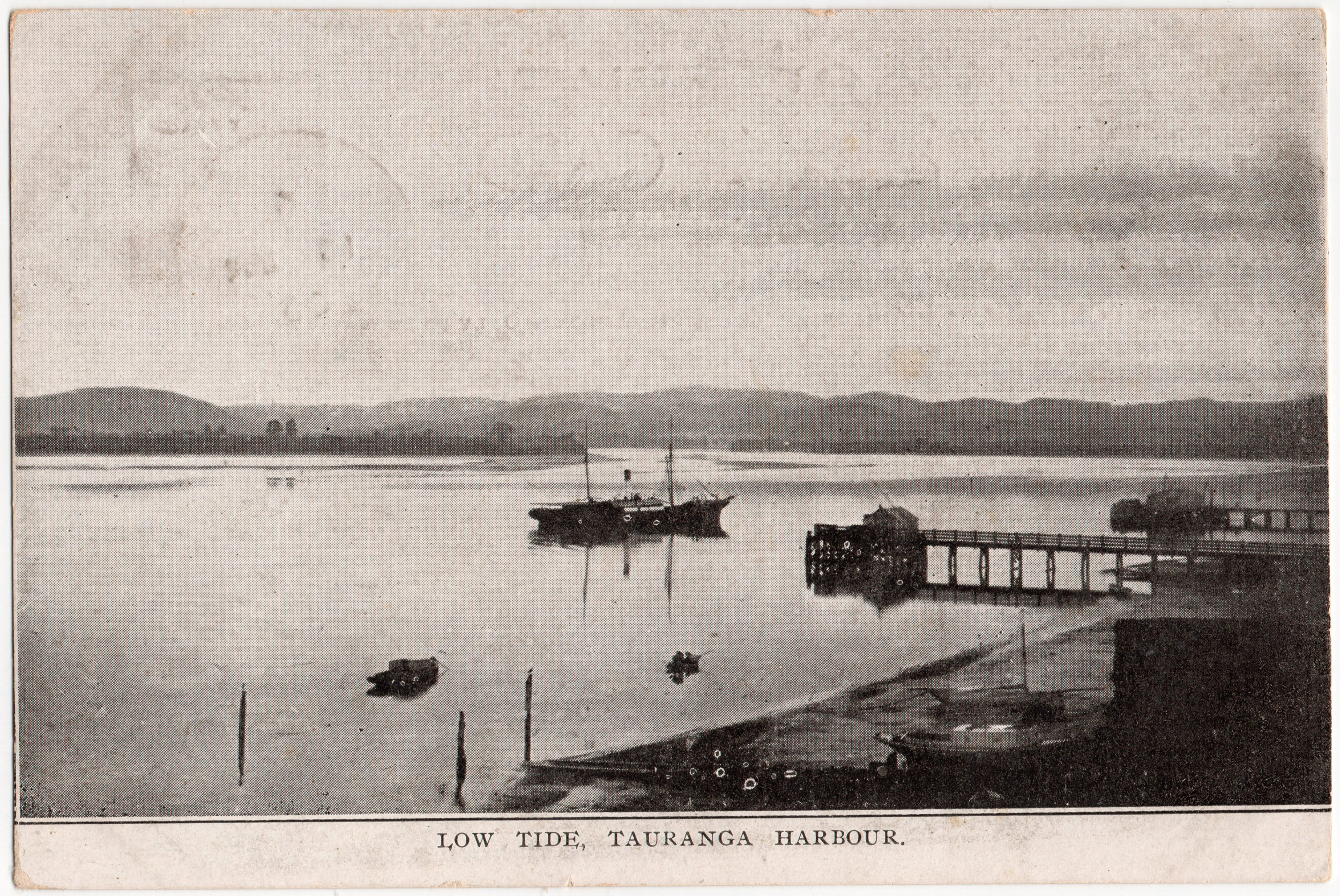
“Low Tide, Tauranga Harbour”, Postmarked Tauranga 10 March 1906
Half-tone postcard print on generic cardstock, by unidentified photographer and publisher
Collection of Justine Neal

Advertisement, Bay of Plenty Times, 9 October 1905[ix]

By late 1905, with a shop on Wharf Street, Mary Humphreys had built up a substantial catalogue of views of Tauranga and this new format became an obvious outlet for her. The Bay of Plenty Times reported:

“Now that photographic post-cards are not only a fashionable, but very agreeable way of communicating with one's friends, in any part of the world, many will be glad to learn that Mrs M. Humphreys, of this town, is taking pictures of residences, grounds and similar subjects, for clients, for transference to postcards and is quoting the same at 6s per dozen cards. In view of the usual coming Christmas and New Year greetings to friends, especially across the sea, it will be well to place orders early.”[x]

Back of Empire Coralyte postcard stock (brown ink), collection of Brian Ducker

Packet for Empire Coralyte Bromide Postcards, Matt.
Collection of Powerhouse Museum, Ref.
97/92/14-33/4

It is possible that Humphreys had already been producing postcards on smaller scale prior to this date, although perhaps only for personal purposes, since very few early examples have been found. A postcard on Empire postcard stock printed with brown ink – not used postally – which was commercially available from the Empire Works Co. of Sydney as early as September 1902,[xi] is known depicting men on a bush excursion. Some of them are are wearing naval caps and uniforms and may be crew of the H.M.S. Lizard, which visited Tauranga in April 1903, and whom she is known to have photographed.[xii]

First Avenue, Tauranga, postmarked Tauranga 10 Apr 1907
Hand-coloured real photo postcard (Empire cardstock), photographed by Mary Humphreys, bef. 1907
Collection of Brian Ducker

The earliest real photo postcard produced by Humphreys that this author has seen which can be reliably ascribed a date of use (April 1907) is a hand-coloured view of First Avenue, Tauranga. The photographer placed her camera and tripod at the intersection with Cameron Road and pointed it east down the then tree-lined avenue towards Devonport Road; three young girls, one holding an umbrella, stand in the foreground. If the girls include Mary’s daughters, which seems likely, their apparent ages would suggest of roughly 1905 to 1906 for the photograph.

Back of Empire Coralyte postcard stock (green ink)
Collection of Tauranga City Library, Pae Korok
ī Ref. 99-687

View of Tauranga’s Strand and waterfront from the Redoubt, c. 1901-1902
Mounted half-plate print photographed by Mary Humphreys
Collection of Tauranga City Library, Pae Korok
ī Ref. 99-352

More commonly found are Mary’s real photo postcards on Empire cardstock printed with green ink; one of them includes a slightly cropped version of this view of Tauranga’s waterfront. It must have been taken prior to the replacement of the wooden seawall with a concrete one in 1902, and possibly on the same occasion as a street level view shown in a previous article (Ref. 99-1182).

Tauranga Maoris Preparing Christmas Dinner (A.G. Series No 107 C),
Photographed by Mary Humphreys, colour collotype print published by T.S. Duncanson
Collection of Justine Neal

In January 1907 T.E. Wayte advertised “colour postcards of N.Z. scenery.”[xiii] A couple months of later, not to be outdone, T.S. Duncanson announced that he was “issuing a new series of postcards of Tauranga and district … comprising views of the Wairoa Rapids; First Avenue, Tauranga; Wairoa Bridge; Post Office; and a group showing Tauranga Maoris preparing Christmas dinner. A further series in colours will shortly be issued.” These came out as the A.G. Series, printed by the collotype process in Germany, with scenes numbered from 103 to 108 - coloured versions had a “C” suffix – and, although she wasn’t acknowledged, they were all produced from photographs taken by Mary Humphreys.

The inclusion of a view of the new Post Office, only completed in March-April 1906, implies that Duncanson’s order could not have been placed before then, although it included at least one view which had previously been published by Humphreys as early as October 1901 (#104 Wairoa or Ruahihi Rapids). Although many extant A.G. Series postcards are postally unused, postmarks on those that were sent through the post indicate their use between May 1907 and September 1909. Alan Jackson, in his introduction to early New Zealand postcard history, believes that minimum printing orders would have been about 500 cards of a single image, and that there was a turnaround of some three months between placement of the order and delivery.[xiv] The story behind the “A.G. Series” is unknown, but it seems likely that orders from multiple clients were combined. A.G. Series 101 was a view of T. Johnstone's pharmacy on the corner of Manners & Willis streets in Wellington,[xv] but no others are known.

Back of A.G. Series postcard stock, chromo printed in Berlin (Collection of Justine Neal)

Judging from the number that have survived, this series of postcards was very popular. The next article in this series (Part 5) will look at further series of Mary Humphreys’ images that were published by Wayte and Duncanson, and how she partially met the growing demand by issuing her own real photo postcards using newly taken views.

References

[i] William Main and Alan Jackson, “Wish You Were Here”: The Story of New Zealand Postcards (New Zealand Postcard Society, 2005).

[ii] Alan Jackson, “Early History of the Picture Postcard in New Zealand,” in Post Marks: The Way We Were - Early New Zealand Postcards, 1897-1922 (Auckland, New Zealand: Kowhai Media Ltd, 2015), pp15-21.

[iii] Thomas Sanderson Duncanson, “Christmas and New Year Trade. Advertisement,” Bay of Plenty Times, December 5, 1902, Volume 29 Issue 4383 edition.

[iv] Thomas Sanderson Duncanson, “At the Novelty Depot. Advertisement,” Bay of Plenty Times, December 4, 1903, Volume 31 Issue 4533 edition.

[v] Thomas Sanderson Duncanson, “Novelty Depot. ’Xmas, 1904. Advertisement,” Bay of Plenty Times, December 14, 1904, Volume 31 Issue 4688 edition.

[vi] Ward, “Tauranga: The Capital of the Bay of Plenty.”

[vii] Thomas Sanderson Duncanson, “Tauranga Going Ahead. Advertisement,” Bay of Plenty Times, October 13, 1905, Volume 31 Issue 4812 edition.

[viii] Thomas Edward Wayte, “Wayte’s ‘Fancy Goods’ Depot. Advertisement,” Bay of Plenty Times, May 22, 1905, Volume 31 Issue 4751 edition.

[ix] Mary Humphreys, “Photographic Post-Cards. Advertisement,” Bay of Plenty Times, October 9, 1905, Volume 31 Issue 4810 edition.

[x] “Untitled [Mrs Humphreys Making Postcards],” Bay of Plenty Times, October 6, 1905, Volume 31 Issue 4809 edition.

[xi] “Intercolonial News,” The Australasian Photographic Review 9, no. 9 (September 21, 1902): 269–70.

[xii] “Untitled [H.M.S. Lizard Arrives in Port].”

[xiii] Thomas Edward Wayte, “Untitled Advertisement [Coloured  Post-Cards of N.Z. Scenery],” Bay of Plenty Times, January 11, 1907, Volume 35 Issue 5000 edition.

[xiv] Jackson, “Early History of the Picture Postcard in New Zealand.”

[xv] T Johnstone’s Pharmacy, Corner Manners & Willis Streets Wellington NZ, c 1907, Lithographic postcard, Postcard, c 1907, Alexander Turnbull Library, Wellington, New Zealand, https://natlib.govt.nz/records/22899967.

Friday, 22 December 2023

Mary Humphreys, Photographer: Part 1 - 1899

“A peep of Tauranga Harbour, N.Z.” attributed to Mary Humphreys, c. 1900-1906
Polychrome collotype printed postcard, published by T.S. Duncanson, March 1907 (A.G. Series 103C)
Collection of Justine Neal

Mention the name Mary Humphreys to a collector of Bay of Plenty postcards and their eyes will light up. Her output in the roughly two and a half decades that she was in business was nothing like that of ubiquitous nationwide publishers such as Frederick Radcliffe, Henry Winkelmann and Frank Duncan, but a fair number of printed, real photo and hand-coloured cards have survived in private and institutional collections. It is arguably for her postcards that she is best known, but what has hitherto perhaps not been sufficiently researched is her photographic activity prior to joining the postcard frenzy around 1905.

Potential reasons for this relative obscurity emerge when one tries to research these early images. The publication of an article – Mary Humphreys: Aspects of her interesting life – in a November 2015 edition of the Historical Review,[i] a page on the now defunct Tauranga Memories Kete and an online article including an extensive timeline,[ii] provide details of her eventful life. Despite her name appearing intermittently in newspaper reports, her photographs published in newspapers were sometimes left uncredited, many of her photographs were produced under the imprints of other publishers, she rarely advertised, never had card mounts printed with her name – as was the norm of that time – only purchased a handstamp (Mary Humphreys, Photo.) around 1905 and often failed to use it. This creates some significant difficulties in the attribution of her work. Many prints have no such identifying marks, and need correlation with contemporary reports of events from newspapers or other contextual information. It is a painstaking process, but working through extant images in several private and institutional collections has been revealing.

Visit of Lord Ranfurly to Tauranga, 25 March 1899
Print mounted on album page, attributed to Mary Humphreys
Collection of Tauranga City Library,
Ref. 99-354

What may be the first known public record of Mary Humphreys taking photographs was during the welcome ceremony for governor Lord Ranfurly when he visited Tauranga on 25 March 1899. The Bay of Plenty Times reported:

“We have had the pleasure of seeing a number of photographs, taken by Mrs T. M. Humphreys, of the Governor's reception at Tauranga and the gathering on the Tennis Club's lawn in the afternoon. They are on sale at Mr Duncanson's and form a pleasant memento of the memorable event, being well taken and nicely finished.” [iii]

The photograph shown above is a print mounted in an album owned by Mary Humphreys, and was therefore almost certainly taken by her. A week later on 1 April Mary travelled to Auckland on board the steamer Waiotahi, and then on 8 April the New Zealand Graphic published four uncredited photographs of the Governor’s reception at Tauranga. Although none of these images appear elsewhere credited to Mary Humphreys, it is conceivable they were amongst those she took on that day. There was another photographer active during Lord Ranfurly’s visit. Thomas Price had two of his images published in the Auckland Weekly News Supplement on 7 April, and he is naturally another potential candidate for authorship of the NZ Graphic images.

04-481

It has been assumed that the death of her solicitor husband Thomas Mace Humphreys in May 1898, prompted her to take up photography to provide an income for her young family. On the face of it, this seems a reasonable deduction. In the six years since she had arrived in Tauranga with her husband and infant son, Mary had given birth to two daughters and became an active community member, participating in fund raising and other activities on the social calendar. Apart from working as a solicitor, her husband lent money “on good security at current rates of interest” and was a mining investor.[iv] Although she is listed with “domestic duties” in the 1896 electoral roll, during the Te Puke gold prospecting “boom” that year two mining claims were registered in her name, suggesting a more than passing familiarity with business matters.[v] Her widowed mother Mrs Adair was living with them so would presumably have been on hand to assist, and her husband’s intermittent illness for the last year of his life may have required her to assume more of the business administration. This, however, is speculative – in the manner of the day, women’s roles and contributions in such partnerships rarely received explicit acknowledgement. Within six months of becoming a widow Mary Humphreys announced that she had been appointed local agent for the Citizen Life Insurance Company, another intrepid step into the world of commerce.[vi]

Advertisement, Bay of Plenty Times, 18 October 1899

In November 1899 Mary took the bold step of opening a “studio” on the Strand to sell her photographs. It was situated next to the Tauranga Hotel and would no doubt have received brisk foot traffic in the run up to Christmas.

“Many who like to remind their friends at Christmas of their whereabouts in the world will be glad to bear that Mrs T.M. Humphreys intends opening a studio on the Strand to supply photographic Christmas cards and photos of local scenery, Maori life, etc., and will be prepared with all sorts and sizes in time for the November English mail. Having seen a great number of this artist's photos we are able to say, with confidence, that they are really excellent and have secured her commissions from several leading illustrated papers.”[vii]

“Maoris preparing a feast [at Whareroa] near Tauranga”AWNS-18991222-03-03

In October Humphreys had asked the A. & P. Society for, and was granted, “permission to erect a small tent on the Show Ground for the purpose of taking photos for certain illustrated papers.” [viii] This confirms that by then she had already developed a relationship with newspaper publishers, and indeed two of her Māori-themed images were published in the Auckland Weekly News Supplement in late December.

Maori pataka belonging to James King, curio dealer
Photographed by Mary Humphreys, 9 Nov 1899
Tauranga Heritage Collection, Captain Mee Album Ref. 0032/12/11

Wide interest in the images of tangata whenua possibly prompted another photo session in November, when she photographed an ornately carved pataka (storehouse) belonging to Tauranga curio dealer James King:

“On Thursday morning last Mrs Humphreys secured a photograph of the carved front of an ancient Maori pataka, or food store house, the property of Mr James King, curio dealer. The carvings are still clear and distinct though executed a number of years ago, in the days before metal tools of any sort were known here, and are fine examples of the old style of Maori workmanship. Mr King temporarily re-erected the front of the building for the purpose of having it photographed; the picture taken was very successful and would be very valuable to any student of Native art, the carved designs being very clearly defined.”[ix]

The extant views from this early period demonstrate that Mary had already mastered technical aspects of photography (operating what was probably a half-plate view camera), framing and composition of views, and developing and printing of exposed plates. She had quickly gained an eye for what constituted a good photograph, and it was clearly not something that she had taken up for the occasion. Perhaps she had already been exposed to the “mysterious art” of photography for some years. It is likely that the camera she used initially had originally been purchased by her husband, who is recorded as having taken photographs at a sporting event soon after their arrival in Tauranga in March 1894:

“During the polo match yesterday, Mr T.M. Humphreys took a photo of the two teams drawn up in a line with the band and spectators grouped round.”[x]

Photographic prints in an album created and owned by Mary Humphreys in the Tauranga Library Archives collection suggest that she may have been taking photographs as early as 1896.[xi]

By the end of 1899, she had set herself up as a photographer in a town which already had the well-established studio of Thomas E. Price and, although Price was investigating opportunities further afield and may have taken his eye off the ball, it would have been a fair question to ask whether the population of the town could support another. Photographers in the latter part of the 19th century generally fell into two camps: those who operated from a permanent, well-appointed portrait studio, usually close to the centre of a community that was large enough to provide an ongoing supply of customers and commissioned “out work”, and itinerants who travelled between smaller communities, often quite widely, seeking out trade where they could. Mary Humphreys is unlikely to have had sufficient capital to either purchase a studio or build a new one and, with a young family to support, could not contemplate being away from home for lengthy periods. However, she was determined to explore options that may not even have been envisaged just a few years earlier, such as the rapidly burgeoning demand for images by newspaper publishers, who were by then able to reproduce them cheaply using the halftone process.

In Part 2 of what is intended as a series of articles on Mrs Humphreys, we will follow her emerging career path into the 20th century.

References

[i] Justine Neal, Shirley Arabin, and Geoff Willacy, “Mary Humphreys: Aspects of Her Interesting Life,” Historical Review: Bay of Plenty Journal of History Vol 63, no. 2 (November 2015): pp42-47.

[ii] Debbie Joy McCauley, “Mary Humphreys (Née Henderson) (1865-1946),” Blog, Debbie McCauley, Author (blog), 2021, https://debbiemccauleyauthor.wordpress.com/biographies/mary-humphreys-nee-henderson-1865-1946/.

[iii] “Untitled [Mrs T.M. Humphreys, Photographs of Governor’s Reception],” Bay of Plenty Times, May 1, 1899, Volume 24 Issue 3841 edition.

[iv] Thomas James Mace Humphreys, “Money to Lend. Advertisement [T.M. Humphreys],” Bay of Plenty Times, January 25, 1897, Volume 24 Issue 3503 edition.

[v] “Application for Special Claim. Advertisement [Mary Humphreys],” Bay of Plenty Times, September 14, 1896, Volume 22 Issue 3449 edition.

[vi] “Untitled [Mrs T.M. Humphreys, Local Agent for Citizen Life],” Bay of Plenty Times, December 9, 1898, Volume 24 Issue 3785 edition.

[vii] “Untitled [Mrs T.M. Humphreys to Open Studio on Strand],” Bay of Plenty Times, October 18, 1899, Volume 24 Issue 3913 edition.

[viii] “A. & P. Society. Inward Correspondence [Mrs T.M. Humphreys],” Bay of Plenty Times, October 23, 1899, Volume 24 Issue 3915 edition.

[ix] “Untitled [Mrs Humphreys Photographs Pataka],” Bay of Plenty Times, November 13, 1899, Volume 24 Issue 3924 edition.

[x] “Untitled. [Mr T.M. Humphreys Photographs Polo Teams],” Bay of Plenty Times, March 2, 1894, Volume 22 Issue 3087 edition.

[xi] Mary Humphreys, Mary Humphreys Photo Album, n.d., n.d., Photo Album Box 4, Tauranga City Libraries Archive, accessed December 19, 2023.