Showing posts with label Tauranga City Libraries. Show all posts

Tuesday, 2 December 2025

Joyce West, Tauranga writer

 From Tauranga City Library’s archives

A monthly blog about interesting items in our collection

In the reference section of Te Ao Mārama - Tauranga City Libraries, there is a a dedicated collection in honour of esteemed Tauranga writer, Joyce Tarlton West (1908-1985). 

While working full-time as an accountant - writing only at night, over a four-decade career, Joyce West produced a series of detective novels (with Mary Scott), articles and poems for periodicals, and eight children's outdoor adventure books which garnered global popularity. 

Joyce started writing in her teens and had stories published in the New Zealand Herald and the Weekly News. She wrote her first novel, Sheep Kings, while living at the family farm in Oropi, in 1936. Her 1953 novel, Drover's Road, was rejected by 13 publishers before being accepted by  J. M. Dent & Sons, Ltd, London.  It would go on to be used in New Zealand schools as an English curriculum literary text.

A black-ink illustration on p. 63 of  'Cape Lost' (1963), one of many that are Joyce West's own work.

Much of the inspiration for Joyce's childrens' stories came from her own childhood. She and her siblings did their secondary schooling by correspondence as her parents were both school teachers, who taught at remote schools in Northland, Taupō and the East Coast.  Her books have countryside settings,  depicting the rural places where she was raised.   Joyce told the Bay of Plenty Times, "I specialise in a type of nostalgia writing... I write childrens' books because I had such a pleasant childhood in an environment so differerent from ours today." (1974, p.9).


Joyce West, with her award-winning book, 'The Sea Islanders', and the contract from Walt Disney Productions, 1974.
Te Ao Marama - Tauranga City Libraries photo gcc-26441

The Sea Islanders, published in 1970, was a particularly successful work. It featured in the BBC series Jackanory,  airing in five parts in September, 1971. Walt Disney Productions bought the rights to the book, though a screen adaption  was never made. 

A copy of 'The Sea Islanders' translated into Danish, in the Joyce West Collection at the library.

Following Joyce's death in 1985, the library sought to recognise her contribution to children’s literature through the establishment of the Joyce West Collection; a reference collection created to preserve and celebrate excellence in New Zealand children’s literature, and provide a resource for those interested in the field of New Zealand children’s writing in years to come. Initially beginning with a copy of each of Joyce's books, the collection grew through the annual addition of award-winning titles donated by the Bay of Plenty Children’s Literature Association (now Bookrapt), an organisation of which Joyce was a foundation member and patron. With help from the Friends of the the Library, the library continues to expand this collection by adding titles that include New Zealand Book Award winners and noteworthy authors from the Bay of Plenty region and beyond.

A signed copy of 'Drover's Road' with a 'Joyce West Memorial Collection' plate in the front of the book.


References

Bay of Plenty Times. (1974, October 26). Author gets TV showing.

Gilderdale, B. (1982). A sea change: 145 years of New Zealand junior fiction. Longman Paul.

Gilderdale, B. (1991). Introducing twenty-one New Zealand children's writers. Hodder & Staunton.


For more information about these and other items in our collection, visit Pae Korokī or email the Heritage & Research Team: research@tauranga.govt.nz


Written by Michelle Bradbury from the Heritage & Research Team, Te Ao Mārama - Tauranga City Libraries.

Tuesday, 7 January 2025

Making hay while the sun shines

 From Tauranga City Library’s archives

A monthly blog about interesting items in our collection

Activities in January can include putting New Year resolutions into practise, summer swims, camping holidays, and haymaking - so here are a few snapshots from the archives of local farms and families haymaking and haybales.

In 1926 it was 'blazing weather' when Ethel Louisa and Charles Edward Macmillan were haymaking on their farm 'Yatton Rise', at St George's Hill, Fraser Street.

Te Ao Mārama - Tauranga City Libraries Ams 80/11/40

Ethel noted in pencil on the back of her watercolour. Fifty-six of her watercolours are viewable online in Pae Koroki, many of places around Tauranga 1920-1949.


Haymaking techniques have changed over the years - we wouldn't usually now see a stack as high as the one on Armstrongs' Te Puna farm in 1938.

Te Ao Mārama - Tauranga City Libraries Photo 01-263

The Gasson's were all wearing hats with wide brims when they were baling hay with a stationary baler on Tilby's Arawa farm, Ōtūmoetai (Matua) in the 1940s.

Te Ao Mārama - Tauranga City Libraries Photo 99-1277

In 1961 it was a team effort to unload hay bales on Matapihi Farm, this image taken by the Bay of Plenty Times, and part of our Gifford-Cross collection.

Te Ao Mārama - Tauranga City Libraries Photo 99-1277

Local farmer and chairman of the Te Puke branch of Federated Farmers, Mr T.B. (Rex) Benner, of Pongakawa was in the news on 29 November 1967 for inventing an 'ingenious' device to gather hay and mechanically toss the bales onto the trailer.  After three years development, trial and error, he had registered at the Patents Office and a firm in Morrinsville was starting manufacture. While demonstrating the prototype to the Bay of Plenty Times, he described the New Years Eve that had inspired the invention - while friends were all enjoying a New Years party, him and his wife had milked 120 cows, then were in the fields until midnight with aching backs from 'lifting up hay bales the hard way to beat the weather'.

Te Ao Mārama - Tauranga City Libraries Photo 99-1277

Not all haymaking was for farming purposes, the Bay of Plenty Grand Prix racetrack relied on haybales to stop careening cars on corners. The Mount News publishing this photograph of J. Murphy's Anglia in hay bales on 16 January 1967 - check out the spectator stand.

Te Ao Mārama - Tauranga City Libraries Photo gcc-5838

Although these are all local snapshots, they'll be familiar to people in other regions, as summer haymaking was similiar across the motu (country).

Tuesday, 5 December 2023

December activities and communications

From Tauranga City Library’s archives
A monthly blog about interesting items in our collection

As Aotearoa heads towards Christmas holidays, December can be a month of parties...

Bethlehem School Christmas party - Photo gcc-5596

picnics...

Christmas day 1937 - Photo 01-259

 and parades...

Christmas procession, Katikati - Photo gca-2812

In the 1960s December was an especially busy time for the Post Office - look at all the Christmas mail in these Bay of Plenty Times photographs - do you think one of the workers will be heading for the rugby field after work?

Post Office Christmas rush - Photo gcc-5553

Christmas mail, Tauranga Post Office - Photo gca-2784

The Ethel Macmillan watercolours in Tauranga City Libraries Archives includes a Christmas card she painted of Mauao.

Mauao - Christmas card - Ms 80/11/2


These archival items have been digitised and added to Pae Korokī. For more information about other items in our collection, visit Pae Korokī or email the Heritage & Research Team: research@tauranga.govt.nz

Written by Kate Charteris, Heritage Specialist at Tauranga City Library.


Tuesday, 7 November 2023

Jones & Company

From Tauranga City Library’s archives

A monthly blog about interesting items in our collection

More often than not at the library, we receive research enquiries that pique our interest and we end up making discoveries and connections within the library that we would not otherwise have known about.  This is exactly what happened in this instance, where a member of the Jones' family sent us an email enquiring about a particular building at 107 Grey Street, Tauranga.  This led to much ‘ferreting about’ in the archives, and hence, an interesting story evolved.

At 143 Thirteenth Avenue, Tauranga is Hillsdene Chapel, a faithful replica of early colonial architecture, housing Jones & Company, funeral directors.  It was named Hillsdene in recognition of the history of the former estate on which it stands.


Jones & Company - Image capture: Feb 2010 Copyright 2023 Google

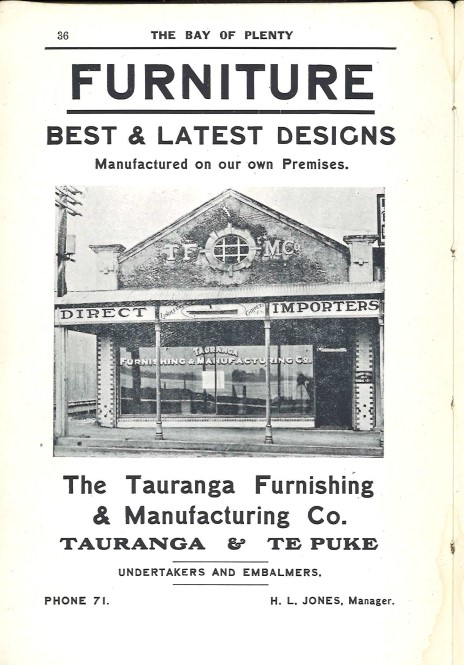
Hard to believe the business was established back in 1909, although it was not entirely recognisable then as the same business it is today. Somewhere along the way the name of the business changed, as did the owners and even its founding trade as furniture manufacturers.

In 1909 the Jones family set up business on the Strand as “Furniture Makers & Upholsters”.  The business soon moved to premises in Hamilton Street and in 1910 formed the company ‘Tauranga Furnishing and Manufacturing Company’.  A newspaper article in the Bay of Plenty Times states: “Amongst the most attractive premises in town are those occupied by the Tauranga Furnishing and Manufacturing Company in Hamilton Street.”

Advertisement - Bay of Plenty Times 11 October 1911

Mr Hugh L. Jones was the company director in those days and he employed over five staff, as he had expanded his casket making to a funeral business.  The  funeral directors wore top hats and tail coats and the horses that pulled the hearse were hired from a local stable in Spring Street, where the old Post Office building is.

By 1913 the Jones family had moved to a much larger and grander building at 21 Devonport Road, which these days is where the temporary library, He Puna Manawa is located.


21 Devonport Road - Tauranga City Libraries 993.42 SETT (Sladden Collection)

The premises had a large workshop which enabled the Tauranga Furnishing and Manufacturing Company to produce a large range of furniture – as well as wooden caskets.  The furniture making side of the business remained in Devonport Road until 1945 when it was taken over by Babington Bros.


Babington's Furnishings - Photo pn-3149

Mr H. E. (Bill) Jones, Hugh’s son, took over as manager of the funeral side of the business and another son, Frank, entered the business about 1946.  In 1938, Jones and Company, as it was then known, built the distinctive Spanish styled building at 107 Grey Street and the funeral parlour moved there.  It was situated just in front of Charlie Haua’s blacksmith business and there were very few shops surrounding it in those days.

107 Grey Street c. 1950s - Photo 02-156

The Grey Street building, with its attractive facade, became quite a landmark in Tauranga and for many years its location was ideal for the funeral business.  The business remained in the Jones family until March 1980, when it was purchased by brothers, Dave and Jim McMahon, however they retained the Jones and Company name.


Jones & Co. Chapel c. 1940 - Photo 03-354

By 1983 Jones and Company had outgrown the building on Grey Street and they moved to ‘Hillsdene’ in 13th Avenue. The Grey Street building was sold to new owners and it still stands today as an iconic reminder of Tauranga’s past, although it currently has a “For Lease” sign in the window giving it a rather forlorn appearance.  People may recognise it most recently as the Versaille Restaurant, which operated on Grey Street for a number of years.


Versaille Restaurant at 107 Grey Street 2015 - Tauranga City Libraries Photo 15-331

Sources: 

Friday, 25 August 2023

Tauranga in Colour - 1900s to 1970s

Hand-coloured Photography in Tauranga Moana
Part 2 - 1900s to 1970s (contd. from Part 1)

Town Wharf, Tauranga, Tourist Series (931), c. 1910s-1920s
Hand-tinted real photo postcard by Henry Winkelmann, Auckland, published by Frank Duncan & Co.
Courtesy of Tauranga Heritage Collection, Ref.
0302/15

The advent of picture postcards in New Zealand from 1897 heralded a huge opportunity for photographers. Lithographically printed cards based on engravings were soon replaced by colour views based on photographs, which could be printed for very modest cost in Germany. Kodak and other manufacturers started supplying paper specifically designed for postcards in the early 1900s, giving rise to a plethora of real photo postcards (RPCs) that could be hand-tinted with watercolours. The outbreak of war interrupted supplies of cheap lithographically printed cards, and the hand-tinted RPCs quickly became much more common while other printers struggled to keep up with demand and to compete pricewise. [13][14]

Herries Arch, The Strand, c. 1941
Hand-coloured silver gelatin print, by unidientified photographer/colourist/publisher
Courtesy of Tauranga City Libraries, Pae Korok
ī Ref. Photo 03-577

Between the wars, by which time the postcard-collecting craze had abated somewhat [15], postcard publishers started to produce sets of smaller scenic prints packaged in tourist-oriented envelopes. These were often deckle-edged, and some were hand-coloured, like this slightly garish view of the familiar Herries Arch.

The Strand Gardens, Tauranga, c. 1935-1936
Full-plate mounted photographic print by Alfred H. Rendell, hand-coloured by Marjorie West
Courtesy of Tauranga Heritage Collection, Ref.
0087/10

Alf Rendell produced many local street views before and after he took over his father’s business in 1938, including this view of The Strand Gardens, easily dated by the late 1930s cars parked along the street. As with all of his coloured photos, it was expertly finished by his older sister Marje. [16][17]

Mauao and Mount Maunganui township from Hopukiore (Mt Drury), c. 1946-1947
Hand-coloured postcard print by unidentified photographer/colourist, publ. as a calendar for 1948
Courtesy of Tauranga City Library, Pae Korok
ī Ref. Photo 03-462

Of the many postcard views existing of Mount Maunganui at the time when it was a sparsely populated community of holiday cottages, this hand-coloured view taken before 1948 seems to capture the vibe well. It was published as a calendar, with a “Greetings” message suggesting it may have been aimed at the summer tourist market.

Aerial view of Tauranga’s Central Business District, May 1947
Photographed and hand-coloured by Whites Aviation Ltd., Wellington
Courtesy of Tauranga City Libraries, Pae Korok
ī Ref. Photo 21-1327

The post-World War II years saw a boom in aerial photography, largely driven by the innovative firm of Whites Aviation Ltd, which almost single-handedly developed a new market for enormous coloured aerial landscape prints. They became so popular that, in the words of Hamish Keith, “the images … of mountains, rivers, farms and towns were a near-ubiquitous presence: in living rooms, boardrooms, waiting rooms and tea rooms.” [18][19][20] This view of downtown Tauranga is one of several that have hung in the Tauranga council offices over the last few decades, and now resides in the Library’s archived art collection.

Omokoroa Point, Tauranga, c. 1950s
Half-plate mounted photographic print by Alfred H. Rendell, hand-coloured by Marjorie West
Courtesy of of Robin Hicks, private collection

Alf Rendell joined the fray too, hiring the Tauranga Aero Club’s Tiger Moth and capturing views of a rapidly growing post-war Tauranga Moana, many of which have been reproduced in his and Fiona Kean’s book, Rendell’s Tauranga. [21] Occasionally he would receive commissions, such as this one from Alan Unsworth a developer who subdivided land in Omokoroa in the 1950s and provided framed hand-coloured aerial prints to all those who purchased plots. [22]

Oblique aerial photograph of house in Moffat Road, Bethlehem, c. mid-1950s
Hand-coloured silver gelatin print by unknown photographer and colourist
Courtesy of John & Julie Green, private collection

More specific low-level aerial shots were commissioned too. When John and Julie Green purchased their property on Moffat Road, Bethlehem in the late 1970s they found this hand-coloured photograph of the house and garden, taken post-1952, probably not long after it had been moved into the site, hanging on the wall and there it still hangs today.

Jean Cole née Henderson as bridesmaid for her sister’s wedding, 16 October 1954
Photographed and hand-coloured by Rupert Connell Studio, Devonport Road, Tauranga
Courtesy of Jean Cole, private collection

Studio photographers were still marketing hand-coloured black-and-white portraits in the late 1940s and 1950s. Lissa Mitchell illustrates her recent work on women photographers [23] with fine examples from the Iva Gordon Studio in Masterton (c. 1940-1945), the Swainson Studios in New Plymouth (c. 1947), the Nevill Studio in Dunedin (c. 1951), the Bettina and Margaret Lea Studios in Auckland (c. early 1950s). To this we can add Rupert Connell’s studio in Devonport Road, Tauranga [24] who specialized in bridal portraits. Jean Cole had her portrait taken there in 1954 and recalls:

“He had this photo in his display window for months, and I couldn't afford to buy it. My grandfather gave it to me as part of my wedding gift. It was taken on 16 Oct 1954 when I was bridesmaid for my sister.”

Mount Maunganui, N.Z., c. 1960s
Hand-coloured postcard by N.S. Seaward’s Studio, Broad Bay, Dunedin
Courtesy of Tauranga City Libraries, Pae Korok
ī Ref. Photo 99-027

The availability of inexpensive, and increasingly good quality, offset colour lithographic printing from the 1950s eventually led to the demise of hand colouring of postcards, but a few firms continued to produce them in moderate number into the 1960s, most notably the National Publicity Studios and N.S. Seaward.

Cinema advertising for Chas. Hartley, Draper and Munro Motors, c. 1920s
Hand-coloured lantern slides by Swinson and Barclay
Courtesy of Tauranga Heritage Collection, Refs.
0954/05/14 and 0954/06/4

Perhaps the last significant use of hand-coloured photography in New Zealand was in the form of cinema advertising slides. Although these two particular examples appear to be from the inter-war period, it is evident from the selection of lantern slides held by the Tauranga Heritage Collection that their use continued well into the 1970s.

This article, in two parts, has been written as part of a much larger and longer-term project researching the development hand-coloured photography in New Zealand. If readers have examples of such photos in their homes or family archives, or know of others who might, and are interested in sharing them, I’d be very keen to hear from you. Please email me at gluepot@gmail.com.

References

[13] Main, William (2007) Send Me a Postcard: New Zealand Postcards and the Story They Tell, Craig Potton Publishing, Nelson, 140p

[14] Haks, Leo, Dallimore, Colleen & Jackson, Alan (2015) Post Marks: The Way We Were – Early New Zealand Postcards, 1897-1922, Kōwhai Media, Auckland, 327p

[15] Main, William & Jackson, Alan (2005) Wish You Were Here: The Story of New Zealand Postcards, New Zealand Postcard Society, Wakefield, 126p

[16] Payne, Brett (2023) Tauranga Photographers: Alf Rendell, Tauranga Historical Society blog, 20 January 2023

[17] Kean, Fiona (2013) Alf Rendell, photographer, Tauranga Historical Society blog, 2 August 2013

[18] Alsop, Peter (2016) Hand-coloured New Zealand: The Photographs of Whites Aviation, Potton & Burton, Nelson, 417p

[19] Alsop, Peter (2020) Wonderland: The New Zealand photographs of Whites Aviation, Potton & Burton, Nelson, 175p

[20] Keith, Hamish (2016) Introduction to Hand-coloured New Zealand: The Photographs of Whites Aviation, by Peter Alsop, Potton & Burton, Nelson, p7

[21] Rendell, Alf & Kean, Fiona (2015) Rendell’s Tauranga: Historic Tauranga from Above, Paper Plus Tauranga, 156p

[22] Robin Hicks, personal communication, July 2023

[23] Mitchell, Lissa (2023) Women and Photography in Aotearoa New Zealand, 1860-1960, Te Papa Press, Wellington, 368p

[24] Payne, Brett (2021) Rupert Connell, Tauranga Historical Society blog, 25 June 2021

Friday, 18 August 2023

Early Tauranga in Colour – 1850s to 1900s

Hand-coloured Photography in Tauranga Moana
Part 1 – 1850s to 1900s

Portraits of Rev. Andrew and Euphemia Maxwell with children, c.1859
Twin hand-coloured cased ambrotypes, taken by unidentified photographer in Victoria, Australia
Courtesy of The Elms Foundation Image Collection, Pae Korok
ī Ref. 2008.003

Almost as soon as photography had been invented, the drawbacks of only being able to produce black-and-white images were being addressed by hand-colouring of the photographs, initially using dry powdered pigments, later with watercolour and oil-based colours. The earliest hand-coloured photographs to appear in New Zealand were probably daguerreotype and ambrotype portraits of family members taken elsewhere. Euphemia Maxwell brought the delicately coloured ambrotypes of her family, taken around 1859 in Victoria, with her when she emigrated to Wellington in 1865, and then to Tauranga in 1887 upon inheriting The Elms from her sister Christina Brown, widow of Rev A.N. Brown. [1] Their clothes and the tablecloth have been embellished with delicate red and blue washes, a slight blush has been added to the cheeks, and tiny spots of gold leaf have been used to highlight Andrew’s watch fob.

Portrait of Margaret Torrens Stewart, c. 1860s
Copy of hand-coloured albumen print by unidentified photographer, Co. Tyrone, Northern Ireland
Courtesy of Tauranga City Libraries, Pae Korok
ī Ref. 04-095

This hand-coloured portrait of Margaret, wife of Katikati settler George Vesey Stewart, was taken in Northern Ireland perhaps a decade before their arrival in 1875. [2] It reveals both a skilled photographer and a sensitive colourist with a touch for subtle shading.

Portrait of Rev. Alfred Nesbit Brown, c. 1872-1873
Hand-coloured carte de visite print taken by George Elgin Page, 256 Queen Street, Auckland
Courtesy of The Elms Foundation Image Collection, Pae Korok
ī Ref. 2008.0046

Reverend Alfred Brown himself was a frequent visitor to photographic studios, and in late 1872 or early 1873 had a portrait taken at the premises of George Page at 256 Queen Street, Auckland. [3] Supplementary flesh tones and grey shadows in the hair were roughly added, perhaps to compensate for over-exposure and poor contrast in the albumen-based carte de visite print.
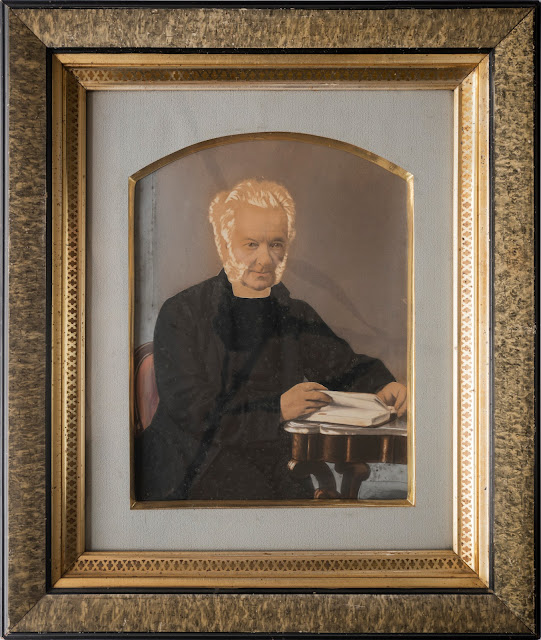
Portrait of Rev. Alfred Nesbit Brown, taken by Hemus & Hanna, Auckland, c. 1879-1880
Hand-coloured solar enlargement of cabinet portrait by Universal Copying Co., San Francisco, 1881
Courtesy of The Elms Foundation Collection, Ref. 1935.0016

The late 1870s brought an increasing availability of solar enlargements to New Zealand. In 1880 Tauranga photographer Charles Spencer was appointed agent for the Universal Copying Co. of San Francisco, who offered hand-coloured enlargements copied “from all kinds of family photos.” Brown commissioned an impressive enlargement of a cabinet portrait originally taken at Hemus & Hanna’s Auckland studio a year or two earlier. [4] It seems likely that a handsome coloured portrait of Spencer’s mother-in-law Jane Sellars née Faulkner, similarly matted and framed, was also produced using the services of the Universal Coyping Co.

Carte de visite portraits of Annie Meers, c. 1881-1883
Photographed by Clifford & Co., hand-colouring attributed to Annie Meers
Courtesy of
Tony Rackstraw (left) and Emily Campbell (right), private collections

Thomas and Annie Price arrived in Tauranga from Masterton in 1897 and opened a studio on The Strand, offering “copies, enlargements and all kinds of portrait work finished on the premises.” [5][6] Although theirs was a prolific studio, no coloured portraits from the Tauranga period have yet been located. However, Annie née Meers is known to have coloured photographs for the studio in Masterton, and probably trained as a retoucher and colourist at the studio of Clifford & Co (under the tutelage of Janet Clifford) in Dunedin, where the carte de visite portraits shown above were produced, and with her brother Robert Walter Meers in Christchurch. [8][9]

Group portrait of unidentified women wearing kaitaka and korowai, c. 1898-1905
Hand-coloured half-plate print (mounted) by Mary Humphreys, Tauranga
Courtesy of Tauranga City Libraries

Mary Humphreys, widow of Tauranga barrister Thomas Mace Humphreys, probably started taking photographs soon after her husband’s death in May 1898, as one of several income-generating projects which included opening a boarding house and becoming an insurance agent. In November 1899 she opened “a studio on The Strand to supply photographic Christmas card and photos of local scenery, Maori life, etc. … Prices from 6d to 1s 6d each.” [10][11] She also produced larger format prints, and offered hand-coloured versions, presumably for an additional premium.

Tauranga waterfront, c. 1890s-1900s, and a Bay of Plenty coastal view, c. 1920s-1930s
Lantern slide views by James Valentine & Sons (Scotland) and Bernard Sladden (Tauranga)
Images courtesy of eBay (left) and Tauranga City Libraries, Pae Korok
ī Ref. Photo bs-673

In the 1890s and early 1900s public lantern slide shows, which had been an intermittently popular form of entertainment for several decades, underwent a resurgence, with numerous monochrome and hand-coloured versions of New Zealand views being sold by both local and international publishers. Judea resident Bernard Sladden was an amateur photographer who created and coloured his own slides taken on trips in his yacht Severn around the Bay of Plenty coast, for shows which he presented to local audiences in the mid-1930s. [12]

Hand-coloured stereocard view, “Feast of Chrysanthemums” in Japan, c.1890s-1900s
Photographed by B.L. Singley and published by the Keystone View Company, U.S.A.
Collection of Western Bay Museum

Together with lantern slides, stereocards were imported in large numbers from international publishers, who produced enormous catalogues of views taken by an army of photographers worldwide. This example from Western Bay Museum which introduced the delights of Japan in spring time to a local family is typical of those owned and viewed in many private households in the first couple of decades of the twentieth century.

Portraits of unidentified woman (left) and Maysie Cussen in gavotte dress, c. 1890s-1900s
Hand-coloured lantern slides, probably done by amateurs
Courtesy of Tauranga Heritage Collection, Refs.
0181/07/9 and 0181/07/10

By the late nineteenth century sets of colours and brushes were widely available for purchase, enabling amateur photographers to colour their own photographs and, if the many rudimentary efforts seen of RPCs and lantern slides are anything to go by, it was a popular pastime.

Hunting party in the launch Sybil return to the wharf at Tauranga, c. 1914-1915
Hand-coloured silver gelatin print by unidentified photographer and colourist
Courtesy of Tauranga City Libraries, Pae Korok
ī Ref. Photo 12-034

Some, however, gained a significant degree of proficiency. This coloured view of a fowling party returning home by launch after a successful hunt around 1914-1915 shows a considerable level of skill, but may have been professionally commissioned.

Part 2 (to follow next week)

This article has been written as part of a much larger and longer-term project researching the development hand-coloured photography in New Zealand. If readers have examples of such photos in their homes or family archives, or know of others who might, and are interested in sharing them, I’d be very keen to hear from you. Please email me at gluepot@gmail.com.

References

[1] Moffat, Kirstine (2015) The Piano at the Elms, in The Lives of Colonial Objects (eds. A, Cooper, L. Paterson & A. Wanhalla), Dunedin: Otago University Press, pp. 81-86

[2] McCauley, Debbie (2022) Margaret Torrens Stewart (née Miller) (1835-1914), Debbie McCauley, Author blog

[3] Giles, Keith (?) Tokatoka Photographer, George Elgin Page, New Zealand Memories, p.8-10

[4] Payne, Brett (2019) Charles Spencer (1854-1933) – Part IV – Colour Portraits, Tauranga Historical Society blog, 15 Nov 2019

[5] Payne, Brett (2014) Visiting Price's Corner Studio on The Strand, Tauranga Historical Society blog, 3 Oct 2014

[6] Price, Thomas Edward (1898) Advertisement. Photography. T.E. Price’s Photographic Studio. The Bay of Plenty Times, Vol. XXIV, Issue 3670, p 3, 9 Mar 1898, on PapersPast

[7] Anon (2016) Masterton lensman at heart of scandal, Wairarapa Times-Age, 23 Mar 2016, on New Zealand Herald web site.

[8] Rackstraw, Tony (2020) Robert Clifford, on Early New Zealand Photographers and their Successors (blog)

[9] Rackstraw, Tony (2008) Robert Walter Meers, on Early New Zealand Photographers and their Successors (blog)

[10] Anon (1899) Untitled article, The Bay of Plenty Times, Vol. XXIV, Issue 3913, p. 2, 18 October 1899, on PapersPast

[11] Humphreys, Mary (1899) Advertisement. Photographic Christmas Cards – Local Views – Maori Scenes, The Bay of Plenty Times, Vol. XXIV, Issue 3915, p. 2, 23 October 1899, on PapersPast

[12] Anon (1936) Yacht Club Card Evening and Picture Entertainment, The Bay of Plenty Times, Vol. LXIV, Issue 12064, p. 2, 3 July 1936, on PapersPast