Showing posts with label Artillery. Show all posts

Friday, 30 October 2026

Ururoa, An Early Tauranga Visitor

 A tonne of ordnance crosses the Kaimai Range, 1832

Ururoa (the great white shark), also known as Rewharewha Te Koke, c. 1780–1861, was a prominent Ngāpuhi, Ngāti Kahu, and Te Tahawai rangatira (chief) of Whangaroa. A close relative and brother-in-law to the renowned Ngāpuhi musket general Hongi Hika, Ururoa led many taua or fighting expeditions alongside him during the 1820s, and following Hongi’s death in 1827, cemented his role as a leading rangatira at Whangaroa.

The artillery general Ururoa or Rewharewha Te Koke. [1]

An enthusiastic artilleryman, Ururoa joined Titore Takiri’s grand amphibious artillery expedition against the Tauranga iwi in December 1831. Ururoa’s Whangaroa contingent arrived at the Bay of Islands in waka taua carrying 140 musket-armed warriors and four 12-pound carronades from the Boyd which had been attacked at Whangaroa in 1809. Their arrival boosted the number of Titore’s toa or fighting men to 600 and the number of cannon and short barrelled carronades to ten.

To revenge Ngāpuhi’s previous reversals at Tauranga, Titore Takire and his rangatira assembled ten artillery pieces for their 1832 campaign [2]

Accompanied on the little schooner Karere (Messenger) by the Rev. Henry Williams and fellow missionaries, who hoped to end the fighting, the expedition comprising 80 waka and Māori-owned cutters entered the Hauraki Gulf in January 1832. Here, Ururoa’s taua and Ngāti Maru allies ascended the Waihou River by waka and laid siege to the great fortress of the Ngāti Haua people and their paramount chief Te Waharoa at Matamata.


Rev. Henry Williams’ schooner Karere (Messenger) accompanying Ngāpuhi’s 1832 amphibious expedition. Stowed in the hulls of the waka taua and Māori-owned sailing boats, their artillery pieces and munitions served as ballast.[3]

 Despite subjecting the pā and its inhabitants to musket and artillery fire during a 2–3-week siege, Ururoa’s artillerymen were unable to create a breach in the palisades that would allow his allied infantry to storm the fortress. Following a surprise foray by Te Waharoa’s warriors, who captured some Ngāpuhi who were crucified on his palisades, Ururoa raised the siege.

Urgently needing to reinforce Titore’s main fleet, in February 1832, Ururoa set out to take his force of 200 musketeers and his artillery train directly over the Kaimai Range to Tauranga Harbour by means of the centuries-old Wairere track

Like Ururoa’s artillery expedition, trading and missionary parties struggled to negotiate the vast Mangapouri swamp that surrounded Matāmata Pā on three sides.[4]

When traversing the Mangapouri swamp between Matamata and the Waihou river below the Kaimai Range, Ururoa’s men dragged and floated the artillery pieces and their munitions across in small waka. Described by the travelling botanist J. C. Bidwill in 1841 as ‘of a custard like consistency and of a light brown colour’, any heavily loaded warrior straying from the column immediately sank to his armpits and could be extracted only with the assistance of his comrades.

 After emerging from the quagmire and crossing the fast-flowing Waihou River, the Ngāpuhi camped that night below the dark, bush clad Kaimai Range, which rose abruptly 1,510 feet to the summit of Mount Wairere. Nearby, the rain-swollen Wairere Stream, a glistening silver beacon which marked the entrance to the track, thundered down from the heights.

The Waihou River, Kaimai Range and Wairere Falls 
A notoriously difficult mountain crossing to this day, the Wairere Track climbs steeply on the right of the falls, from the Matamata Plain to a high summit plateau at 1200 feet, before descending to the Te Puna Peninsula on Tauranga Harbour [5]

Placing their precious carronades at the centre of the column, the following morning, Ururoa’s taua began the steep ascent to the summit plateau. The gun captains distributed men along the length of the single haul rope attached to each carronade and sled while others were tasked to heave on the sides and ends of the gun sleds as opportunity offered. There were gradients where the toa on the haul ropes bent double with the strain and preserved their balance only by supporting themselves on their hands and knees. The upper section of the track was most difficult for it was slippery due to clouds settling on the tops. Here, the gun teams could catch their breath only by securing the carronades to trees.


A 12-pound carronade from the plundered Boyd. [6]
Favoured by Māori predatory raiders like Ururoa, who referred to them as pū repo (great guns), early 19th-century British 12-pounder carronades were short, smoothbore cast-iron naval guns. Requiring a crew of four, they were used by artillery chiefs to fire single gunstones or quantities of round stones when iron cannon balls and grapeshot were unavailable. With each gun weighing between 290 and 318 kgs and each iron ball 12-pounds (5.4kg), in February 1832, Ururoa’s gunners hauled more than 1.000 kgs or one metric ton of ordinance over the Kaimai Range to Tauranga.

At last, the carronades were dragged over the shoulder of the peak to the summit plateau, where Ururoa’s taua camped the night beneath a canopy of tawa, rimu, miro and many softwoods. At first light the column commenced the day-long crossing of the summit plateau. The deeply rutted track was muddy and overgrown in many places, requiring the gunners to slide the gunsleds over or beneath fallen trees and struggle through thickets of head-high fern, the carronades crashing after them. 

A waka used by Ngāpuhi to haul cannonballs at Ruapekapeka Pā, Northland in 1845. Ururoa used similar waka to haul his carronades and munitions over the Kaimai Range in 1832.[7]

Proceeding down the range after camping overnight on the eastern edge of the plateau, the carronades were slid down the track. Precipitous drops on either side of the ridge required all the strength of the anchor men; and sure footedness, and constant use of hand holds by the brake men using shrubs and trees to retain control. On the steepest sections, the stern ropes of the gunsleds were passed around a tree and slowly played out as the gun slid downhill. When the stern rope was nearly played out, the bow haulers snubbed the guns to trees on either side of the track to secure them, while the brake men made their way down the ridge to repeat the process.

The lower track provided glimpses of Tauranga Harbour, the Bay of Plenty coast and Ongarahu village on the Te Puna Peninsula. The expedition soon found the track levelling off and the forest opening out. The gruelling six-mile descent ended where a tiny tributary of the Pārapāra Sream crossed their path amid bright afternoon sunshine and low fern covered hills.

On 7 March 1832, Titore Takiri and Ururoa’s fleet of 80 waka taua and sailing boats moved down the harbour to besiege and bombard the Ngāi Te Rangi hapū defending Otūmoetai Pā.[8]

Ururoa’s taua subsequently attacked and dispersed the inhabitants of Ōngarahu and elsewhere on the Te Puna peninsula before mounting the carronades in the bows of plundered waka. His little fleet of waka pū repo reunited with Titore Takiri’s grand fleet at Matakana Island on Tauranga Harbour on 6 March 1832.

 Rev. Henry Williams noted that Ururoa’s taua had already engaged the Ngāi Te Rangi people at Otūmoetai Pā ‘in four or five severe engagements. The most recent had occurred that very afternoon when several artillery rounds were exchanged. Ururoa’s gunners subsequently participated in the historic artillery sieges of Otūmoetai and Maungatapu Pā - extraordinary and unique events in the military history of New Zealand.

Sources

Bentley, Trevor, Tribal Guns and Tribal Gunners, Wilsonscott, Christchurch, 2013: 85-95.

Bentley, Trevor, Early Maritime Tauranga, Vol. 1. Kererū Books, Tauranga, 2025: 103, 188-189, 217,

Bidwill, John, Rambles in New Zealand, W. S. Orr & Co., London, 1841: 78-79.

Gudgeon, T. W; Reminiscences of the War in New Zealand, Southern Reprints, Papakura, New Zealand,

1986: 127.

Matheson, Alister, Wairere Track: Ancient Highway of Missionary and Māori, Publicity Printing, Tauranga, 1975: 10, 13, 21, 24, 75, 30-32, 189, 220.

Wade, William, A Journey in the Northern Islands of New Zealand, George Rolwegan, Hobart, 1852: 131-132.

Williams, Henry, The Early Journals of Henry Williams, 1826-1840, (L. M. Rogers ed.), Christchurch, Pegasus Press, 1961: 107, 110, 133, 148, 243, 251, 440-441,

Williams, William, Christianity Among the New Zealanders, Seeley, Jackson, and Halliday, London, 1867: 158.

Woon, William, Reports from Select Committees on New Zealand, British Parliamentary Papers, Vol. XX, 1837-40, (680), 158.

Images

[1] Ururoa Rewharewha Te Koke (1780-1861), Wiki Tree, https://www.wikitree.com › wiki › Te_Koke-1

 [2] Titore Takiri, Sherrin, R. A. A.; Wallace, J. H.; edited by Thomson W. Leys. Early History of New Zealand: From Earliest Times to 1840. H. Brett, Auckland, 1890: 342.

 [3] Williams, Henry, ‘War canoes and Mission boats’ Sherrin and Lees, 1890: 150.

 [4] Williams, Henry, 1792-1867. [Williams, Henry] 1792-1867 ‘Passing through a swamp in New Zealand’. [London, Seelys, 1836]. Ref: PUBL-0031-1836-1. Alexander Turnbull Library, Wellington, New Zealand.

 [5] Merrett, Joseph Jenner, 1815-1854. [Merrett, Joseph Jenner] 1816-1854. View from the Banks of the Thames of the Fall of Wai Riri. Ref: PUBL-0076-090. Alexander Turnbull Library, Wellington, New Zealand.

 [6] Carronade, Carron Company; artillery maker(s); circa 1780; Scotland, cast iron. Dimensions Overall: 500mm (width), 350 mm (height), 1220 mm (length), 460kg (weight). Registration Number DM000143, Te Papa Tongarewa, National Library of New Zealand, Wellington.

 G[7] raham, David Henry, 1885-1965: Men alongside a waka used to sledge cannon balls at Ruapekapeka. Photographs of taonga Māori. Ref: 1/4-018228-G. Alexander Turnbull Library, Wellington, New Zealand.

 [8] Joseph Josenhans, ‘War Canoes’ in Illustrations of Missionary Scenes, An Offering to Youth, Mainz, Joseph Scholz, 1855. XII.

Tuesday, 3 September 2024

The Mystery of the Monmouth Cannons Part 3: The Return of Captain Black

From Tauranga City Library’s archives

A monthly blog about interesting items in our collections.

This post follows on from The Mystery of the Monmouth Cannons Part 1 and Part 2, so be sure to check them out for the full backstory.

Te Tapihana cannon, Monmouth Redoubt, 2024.
Private Collection, Te Ao Mārama - Tauranga City Libraries.
While transcribing Private George Crabbe's manuscript (see August's blog post on George Crabbe) we uncovered a crucial missing puzzle piece concerning the history of the Te Tapihana cannon, and its connection to the early Danish trader Phillip (Hans) Tapsell. 

George A Crabbe, (1840 - 1905).
Image courtesy of N. Wilson, Crabbe Collection, Tauranga Heritage Collection.

According to Crabbe's account, in early January of 1868, a schooner named Fortune arrived in Ōpōtiki carrying one of the old cannons belonging to Hans Tapsell of Maketū. The militia promptly got their hands on the gun and brought it ashore, 
where it was used for many years. Later, the gun was taken to Tauranga by a Captain Turner, though Crabbe does not provide a date for this.

Excerpt from Scrapbook compiled by Crabbe family (p. 21). George Alfred Crabbe, date unknown.
Te Ao Mārama - Tauranga City Libraries, ref Ms 112/3.

This story accords with what we already know of Te Tapihana’s history, in which Captain Archibald Campbell Turner had acquired the cannon from a military officer in Ōpōtiki during the New Zealand Wars (BOPT, April 6th, 1914, p. 4). But Crabbe’s account provides us with more than just the connection to Captain Turner.

Captain A. C. Turner N.Z.M.. c. 1900.
Puke Ariki Heritage Collection, ref PHO2011-2311.

In Part 2 we talked about the sale of two Tapsell cannons by Retreat Tapsell to a ‘Mr. Black’ of Tauranga (likely early trader Thomas Black), in early May of 1864. As it happens, the name of Black’s vessel was the Fortune (DSC, 12 May 1864, p. 4).

Could this be the same Fortune that arrived in Ōpōtiki with the Tapsell gun nearly four years later? It certainly seems so, as shipping records place Captain Black onboard the schooner Fortune in Ōpōtiki at the time (NZ Herald, Jan 18th, 1868, p. 2). 

View, Waioeka River and Wharves, Ōpōtiki. Creator and date unknown.
Te Whare Taonga ō Taketake, Whakatāne Museum Collections and Research, ref 42434. 

Since Black had reportedly purchased the cannons as ballast for his vessel, it is very plausible that Te Tapihana had remained onboard the Fortune from the time of it's purchase in 1864, until it's reappearance in Ōpōtiki in 1868. If our theory is correct, it would support the long-held belief that Te Tapihana was part of Phillip Tapsell's battery of 'big guns' at Maketū Pā.

Maketū Pā, Bay of Plenty. Watercolour by Major General Horatio Robley, 1865.
Collection of Museum of New Zealand Te Papa Tongarewa, ref 1992-0035-826.

To learn more about Tapsell's battery of big guns, click here.

For more about George Crabbe and his first-hand account of the New Zealand Wars, click here.

Sources:   

 'Local and General'. (1914, 6 April). Bay of Plenty Times, 42(6097), p. 4.

'Maketū. (From our own Correspondent.) May 5'. (published 1864, 12 May). Daily Southern Cross, p. 4.

'Shipping Intelligence'. (1868, 18 January). New Zealand Herald, 5(1303), p. 2.

Crabbe, George Alfred. (n.d.). Scrapbook relating to Aotearoa land wars history, Māori culture, fauna/ flora/ reptiles, and sketch of Orākau pā. Collection of Te Ao Mārama - Tauranga City Libraries, ref Ms 112/3, pp. 21-22.

Tuesday, 4 June 2024

The Mystery of the Monmouth Cannons: Part 2

From Tauranga City Library’s archives

A monthly blog about interesting items in our collections.

Tawakeheimoa cannon, Taumatakahawai Pā (Monmouth Redoubt) c. 1920s.
Collection of Te Ao Mārama - Tauranga City Libraries, Pae Korokī ref 09-082

Last month we talked about a letter written by Colonel G. Arnold Ward, Former Mayor of Tauranga, regarding the unknown origins of the old guns in the Monmouth Redoubt. If you haven't read it already, you can check it out here. In this month's blog post we will delve deeper into the intriguing history of the two Napoleonic era carronades - Tawakeheimoa and Te Tapihana.

Tawakeheimoa, the larger of the two cannons (pictured above), is believed to have once belonged to the early Danish trader Phillip Tapsell (Kean, 2018, p. 20). Tapsell was famous for his battery of twelve 'big guns,' which he used to defend his trading station at Maketū Pā - though this defense was short-lived. In 1836, an attack by Ngāti Hauā and Ngāi Te Rangi led to the successful capture of the pā and the destruction of Tapsell's trading station (Matheson, 1989, p. 2).

Phillip Tapsell and daughter Kataraina, c. 1870s.
Image courtesy of Alexander Turnbull Library, Steffano Webb Collection (PA-Group-00370),
ref: 1/1-008958-G.

As for the fate of Tapsell's battery following the attack, we are provided with varying accounts. In his memoirs, Tapsell states that following the fall of Maketū Pā, the victors spiked the guns and threw them into the Kaituna River (Adams, 2021, p. 154).

Sketch map of country around Waihī Estuary and Maketū Pā (A), shows location of Tapsell's store (B), Kaituna River, and Te Tumu Pā (I). Creator unknown, 1840. 
Image courtesy of  Alexander Turnbull Library, ref MapColl-832.16a/[187-?]/Acc.1848


Interestingly, an alternate version of events reported by the Daily Southern Cross claims that six of the guns were taken by Ngāi Te Rangi to fortify Te Tumu Pā. However, they were soon recaptured by Te Arawa, except for one gun, which had already been taken to Tauranga (Daily Southern Cross, 12 May 1864, p. 4).

One of twelve 'Tapsell' guns 'Te Haupapa', Wreck of the Falcon Memorial, Maketu.
Image courtesy of Ministry for Culture and Heritage, credit Lynton Diggle, 2009.

While we might initially be more inclined to accept Tapsell's first-hand account over any other, the second version of events does seem to have some credibility to it, owing to an altercation which occurred in 1864.

According to the Daily Southern Cross, the sale of two big guns to a Mr. Black of Tauranga (likely early trader Thomas Black) by Retreat Tapsell (eldest son of Phillip Tapsell) had prompted complaints from Ngāti Kererū, who considered the guns to be taonga, and their property (for further explanation see Bentley, 2013, p. 23-4). One of these guns was reportedly "Tawake hei moa", the other was one which had been found "lying in the water" (Daily Southern Cross, 12 May 1864, p. 4). A meeting was called to discuss the sale; however Black sailed off with the guns before the situation was able to be resolved.

Tawakeheimoa after it was relocated to the Tauranga Historic Village and District Museum, 1986.
Image courtesy of Tauranga Heritage Collection, ref 0460/08

At some point thereafter, Tawakeheimoa came into the possession of A. W. Burrows, who likely purchased it from Mr. Black. Burrows kept the gun in his private collection until his death in 1899, after which it was gifted to the Tauranga Borough Council for public exhibition in the redoubt (Tauranga District Council, 2004, p. 9).

But what about the other Monmouth cannon?

Te Tapihana cannon, Taumatakahawai Pā (Monmouth Redoubt) c. 1956-57.
Collection of Te Ao Mārama - Tauranga City Libraries, Pae Korokī ref 09-075

The smaller carronade donated by Captain A. C. Turner, locally known as Te Tapihana, has also been attributed to Tapsell's battery due to its similarity to the other Tapsell guns (Matheson, 1989, p. 9); however this identification is much less certain. In fact, evidence points more towards a military provenance. A note published in the Bay of Plenty Times in 1914 mentions that Captain Turner received the gun from a military officer in Ōpōtiki during "the Māori War period" (BOPT, April 6th, 1914, p. 4). Additionally, the crown stamp on the cannon's barrel indicates that it was produced for military use (Ward, 1914).

Te Tapihana, Monmouth Redoubt, 2024.
Private Collection, Te Ao Mārama - Tauranga City Libraries.

Of course, these details do not exclude the possibility that Te Tapihana once belonged to the early Danish trader, and the evidence has only raised further questions. Unfortunately, we may never know for sure.

Bethlehem School pupils at Redoubt, 1961.
Collection of Te Ao Mārama - Tauranga City Libraries, Pae Korokī ref gca-2396

For more background on Tapsell's battery and the whereabouts of the other guns, check out this article by Alister Matheson here. 

Sources:

    Adams, J. (2021). Events in the Life of Phillip Tapsell. Oratia Books.

    Bentley, T. (2013). Tribal Guns and Tribal Gunners: The Story of Māori Artillery in 19th Century New Zealand. Willsonscott Publishing International.

    
Matheson, A. (May 1989). Tapsell’s Big Guns. Journal of Tauranga Historical Society, No 37. Pp. 1-11.

    'Maketu. (From our own Correspondent.) May 5'. (published 1864, 12 May). Daily Southern Cross, p. 4.

    'Local and General'. (1914, 6 April). Bay of Plenty Times, 42(6097), p. 4.

    Tauranga District Council. (2004). Tauranga Historic Village Museum, Tauranga, New Zealand: Souvenir Book: Take a Walk in Living History. Tauranga District Council Publisher.

    Ward, G. A. (21 March, 1914). "Old guns in redoubt". [Letter from Colonel G. Arnold Ward to the Town Clerk, Tauranga]. Collection of Te Ao Mārama - Tauranga City Libraries, VF CCR. 

Tuesday, 7 May 2024

The Mystery of the Monmouth Cannons: Part 1

From Tauranga City Library’s archives

A monthly blog about interesting items in our collections.

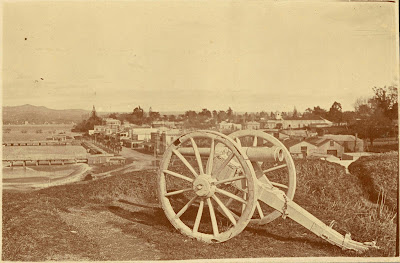
Postcard, Taumatakahawai Pā (Monmouth Redoubt) c. 1910s.
Collection of Te Ao Mārama - Tauranga City Libraries, Pae Korokī ref 06-519

While sorting through our files relating to the 1990 Monmouth Redoubt restoration project, we came across this original letter dated 21st of March 1914 (also published in the Bay of Plenty Times) from Colonel G. Arnold Ward, Former Mayor of Tauranga, regarding the origin of the old guns in the Monmouth Redoubt.

Letter from Colonel Arnold G. Ward to the Tauranga Town Clerk, 1914.
Collection of Te Ao Mārama - Tauranga City Libraries, VF CCR.

In his letter to the Tauranga Town Clerk, Ward recounts the history of the six guns displayed in the redoubt, comprising of four field guns that “had done good service here in the Maori war”, as well as two much older cast muzzleloader guns.

The four “field guns” were 6-pounder rifled breech-loading Armstrong guns, two of which may have been present at the Battle of Pukehinahina (Gate Pā) (Osborne, 2014, para. 5). Following their years of service with the militia and later the Armed Constabulary (whose headquarters had been located on the redoubt), the guns had been made obsolete and placed into storage by the Defence Department - until 1899 when Mayor Ward requested that they be returned to Tauranga and displayed in the Monmouth Redoubt, as part of an initiative to convert the site into a public reserve (Kean, 2019, p. 13-15).

Print, Photographic, Armstrong Gun, Monmouth Redoubt, Tauranga, c. 1910s.
Image courtesy of Tauranga Heritage Collection, ref 0488/08

The two older guns mentioned by Ward were cast iron Napoleonic war cannons (more specifically carronades) dating to the early 1800s, which had been gifted to the Tauranga Borough Council in 1899 by Captain A. C. Turner and Mr. A. W. Burrows, in order to “add interest to the redoubt”. However, Ward admits, “their history I do not know and do not think their former owners knew it either”. 

Munitions on display at Taumatakahawai Pā (Monmouth Redoubt), Tauranga c. 1910s.
Collection of Te Ao Mārama - Tauranga City Libraries, Pae Korokī ref 10-161

Unlike the Armstrong guns, neither of the cannons had any known connections to the redoubt. The Burrows cannon, named Tawakeheimoa (named after the eldest son of Ngāti Kererū), is now confirmed to be one of early trader Phillip Tapsell’s twelve “big guns” used to protect his trading station at Maketu Pā, until it's capture in 1836 (Kean, 2018, p. 20). Indeed, in his letter Ward points to Tapsell as a possible original source of the Burrows gun (Ward, 1914).
Cannon, Tawakeheimoa.
Image courtesy of Tauranga Heritage Collection, ref 0017/99

The cannon donated by Captain Turner, known today as Te Tapihana, is also suspected to have come from Tapsell’s battery due to its similarity to the other Tapsell cannons (Matheson, 1989, p. 9). However, its provenance is by no means certain, since accounts about what happened to Tapsell's battery following the capture of Maketū Pā vary, making it difficult for us to verify the history of the guns (see Matheson, 1989, for a full discussion). 

One of the other cannons from Tapsell's battery, Maketū, c. 1970s.
Collection of Te Ao Mārama - Tauranga City Libraries, Pae Korokī ref 06-137 

During restoration efforts at the redoubt in the 1990s there was some discussion as to whether the cannons ought to remain in Tauranga or be sent back to Maketū (Hansen, 1998, letter). In the end the council opted to keep the cannons, as by that point in time they had become an important part of Tauranga's history (Matheson, n.d., personal communications).

Te Tapihana Cannon, Monmouth Redoubt, 2024.
Private Collection, Te Ao Mārama - Tauranga City Libraries. 

These days only Te Tapihana remains on display in the redoubt. Tawakeheimoa now resides in the care of the Tauranga Heritage Collection, as do three of the Armstrong guns – the remaining Armstrong gun can be found on display at the National Army Museum in Waiouru.

6-Pounder 3-cwt Armstrong RBL Gun Barrel, carriage is a modern reconstruction.
Display depicts a scene from the Battle of Pukehinahina (Gate Pā).
Image courtesy of National Army Museum, Waiouru.

Stay tuned! The mysterious history of the Tapsell cannons will continue in next month's blog post.

For more images of the Monmouth cannons in the Library Archives click here. 

Sources:

    Hansen, N. G. (30 January 1998). Letter to Tauranga District Council. Old Carronades at the Domain and on Monmouth Redoubt. Tauranga City Council Records (unpublished).

    Kean, F. (2018). Illustrated Historical Overview, Monmouth Redoubt, Lot 247, Section 1, Tauranga Town. Tauranga Heritage Collection (unpublished).


    Matheson, A. (n.d.). Personal communication. Old Carronades in the Domain & Redoubt (and Historic Village). Tauranga City Council Records (unpublished).

Ward, G. A. (21 March, 1914). "Old guns in redoubt". [Letter from Colonel G. Arnold Ward to the Town Clerk, Tauranga]. Collection of Te Ao Mārama - Tauranga City Libraries, VF CCR.