Showing posts with label Cargo. Show all posts

Friday, 15 November 2024

The Wreck of the SS Manaia, 1926

Whakahau-Slipper Island lies two miles off the Coromandel Coast, four miles south-east of Tairua and some 100 miles from Auckland.

While carrying passengers and cargo during its regular Tauranga to Auckland run, the SS Manaia (Captain W. F. Norbury), ran aground on the southeastern point of Slipper Island on the night of Thursday 10 June 1926. Reefs in the vicinity had previously claimed The Northern Steamship Company’s auxiliary schooner Te Teko and the timber scow Surprise.

The SS Manaia aground near Slipper Island

Built at Dumbarton, Scotland in 1898, the Manaia was a well-known New Zealand coastal steamer of 1,159 tons. Formerly owned by the Union Steam Ship Company and named Rotoiti, it was bought and renamed by the Northern Steamship Company for its Auckland to Tauranga service. The steamer’s dimensions were: length, 220 feet; breadth, 33 feet and depth, 13 feet.

Steaming northwards through rain and mist, the Manaia struck at 11.30 p.m. with an impact described as ‘terrific’. Members of the crew were thrown from their bunks, there was some ‘mild panic’ among the passengers, but there were no injuries nor deaths during the subsequent rescue operation.

Whakahau-Slipper Island
Courtesy of New Zealand Herald, 16 April 2015

Observing the wreck at daylight from the coastal settlement of Tairua, eyewitnesses described the steamer as ‘about one mile off Slipper Island, well up on the reef behind a small rocky island’, and ‘broadside on and down in the stern, in a very exposed position’.

Carrying 55 passengers who had boarded at Tauranga’s Town Wharf at 8 p.m. the Manaia’s cargo was indicative of regions exports during the 1920s: 63 cases of fruit, 21 sacks of maize, 34 bales of flax, 21 bales of tow, 34 bales of sheepskins, four cases of bacon, a quantity of general cargo and a ‘fair-sized’ consignment of mail.

At 11.40 p.m. the Auckland Radio Station received signals from the Manaia’s radio operator, that it was ashore near Slipper Island, and was being held in place by her propellers. Captain Norbury advised that he was all right until morning, before later, asking for assistance when the weather became squally, and the Manaia began to bump heavily.

At 3 a.m. the Auckland authorities radioed the SS Ngapuhi, another Northern Company ship which was passing Kawau Island, on its way from Whangarei to Auckland. The Ngapuhi changed course and after steaming 70 miles in six hours, was standing near the Manaia, which was then ‘making water fairly fast’, through a hole in the bow.

The SS Ngapuhi
Auckland Libraries Heritage Collections JTD-19M-04168

A two masted timber scow and the Corey-Wright brothers launch Ellida from Tairua, were also soon on the scene, and at 9 a.m. the SS Rimu was dispatched from Auckland to provide additional assistance.

Captain Dorling kept the Ngapuhi’s lead line going, as he negotiated the foul ground and a line of sunken reefs between his ship and the stricken steamer. He noted that the Manaia was hard and fast on a reef extending out from the southeast point of Slipper Island, with the bow high on the rocks, her stern riding low in the deep water surrounding the reef.

During the rescue of the passengers, the seas were moderate and the weather clearing. A message at 10.22 from the Manaia, announced that the Ngapuhi had arrived and was taking the passengers off, and that two lifeboats had got away safely. A wireless message at noon stated that all passengers had been transferred to the Ngapuhi which reached Auckland shortly before 11p.m.

At Auckland, the male passengers praised the conduct of the women and children, as well as Captain Norbury and his officers - particularly the children, who were said to have ‘just stood by without a murmur.’

During salvage operations, which began after the Manaia had been written off by the Northern Company, all portable equipment and fixtures were removed, along with machine fittings. The only cargo not put aboard the Motu, one of the salvage vessels, was a few cases of fruit in the fore hold. When the Manaia’s stokehold and engine-room flooded, the crew of 36 left the wreck on the Motu. The SS Manaia gradually slipped off the reef and into deep water.
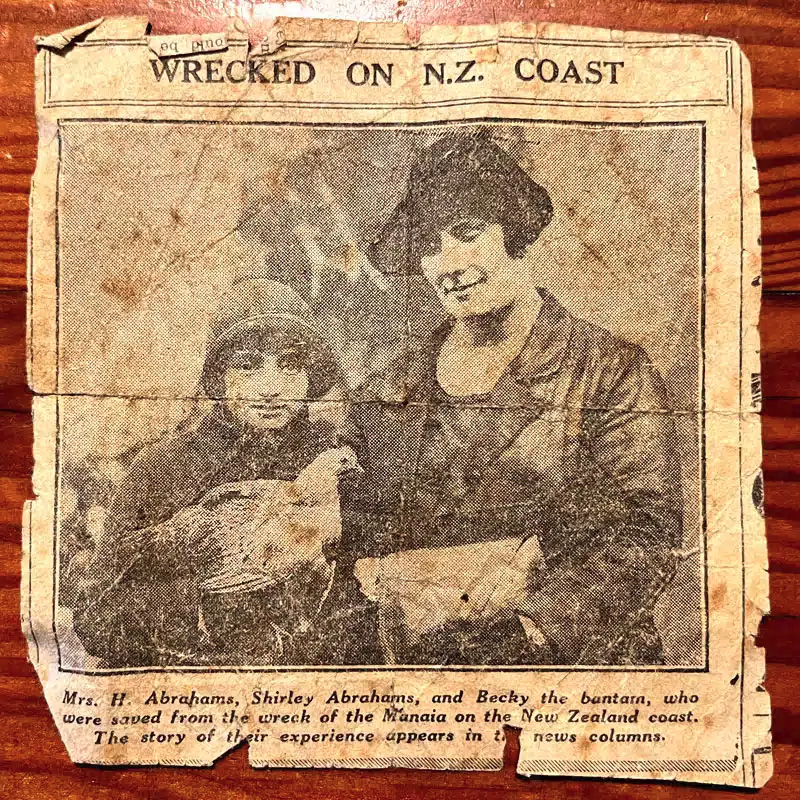
‘My mother, Shirley Abrahams, was the girl with the bantam rooster.’ – Kim White, 2022
Courtesy of Maritime Radio

Among the Manaia’s passengers were 24 members of the Stanley M’Kay Pantomime Company, which included a girl named Shirley Abrahams and her pet rooster Becky – the gift of an admirer in one of the towns visited by the company.  According to one report:

When the Manaia struck, the first thoughts of the young actress were of her pet. Forgetting her other treasures, she flew to Becky. He had been with her for over a year … He snuggled in the crook of her arm on board while awaiting the arrival of the Ngapuhi. Becky accompanied his owner in the lifeboat and was with her all the time on the Ngapuhi. Now he is on his way to Sydney with her on the Marama.

SS Manaia listing, before slipping into deep water

On 29 June, the Auckland Marine Court of Inquiry into the wreck found that the course set by Captain Norbury was a safe one - used without mishap by other steamer captains for many years. It found that like the steamer City of Winchester, which was crossing the Bay of Plenty at the time, the Manaia ‘had been carried inshore and off her course an abnormal distance … owing to a strong set inshore’. Norbury was held blameless, and his master’s certificate was returned.

In 1961 part of the steamer’s propeller was recovered by divers, by which time the ship had broken up and been under water for over 35 years. Today, the Manaia’s boiler and other equipment left behind on the reef and seabed make Manaia Reef a playground for snorkelers and scuba divers.

References

Bay of Plenty Times, 12 June 1926: 3, 14 June 1926: 3, 29 June 1926: 3.

Evening Post (Wellington), 11 June 1926: 8. 12 June 1926: 8, 14 June 1926: 10.

1926: SS Manaia strands on slipper Island, maritimeradio.org, https://maritimeradio.org › Distress

S.S. Manaia Ohimnemuri Regional History Journal. 40, September 2000, https://www.ohinemuri.org.nz › journals › s-s-manaia

Images

Sladden, Bernard, View of Northern Steamship Company SS Manaia on rocks, Slipper Island, wrecked on 10-Jun-1926. Ms 33/5/159. Te Ao Mārama, Tauranga City Libraries.

Slipper Island, New Zealand Herald. Privately owned island sells for more than $7m. NZME. 16 April 2015, nzherald.co.nz/business

Photographer unknown, SS Ngapuhi on Manukau Harbour. Ref. 4168. Auckland Council Libraries.

Photographer unknown. Wrecked on the New Zealand Coast, 1926: SS Manaia strands on slipper Island, maritimeradio.org, https://maritimeradio.org › Distress

Sladden, Bernard. View of SS Manaia wrecked off Slipper Island, 10 June 1926, Ms 33/5/206. Te Ao Marama, Tauranga City Libraries

Friday, 17 May 2024

Tauranga Railway Wharf Cargo Shed

by Guest Author Max C. Avery

For nearly 40 years the cargo shed on the Railway Wharf was the very busy hub of Tauranga’s mercantile marine commercial trading. It remains the only substantial architectural feature of the Tauranga water-front of the previous century - a reminder of bygone days when the wharf was crowded with sailing scows, coastal and trans-Tasman steamers and motor ships.

Railway Wharf, early 1930s
Real photo postcard, photographed and published by Robert J. Rendell
Tauranga Heritage Collection Ref. 0318/10

The shed had its origins in a 1919 proposal for development of the Port of Tauranga by engineer J. Blair-Mason, commissioned by the Tauranga Harbour Board (THB): “The construction of the quay proposed as part of the railway works at Tauranga should meet the needs of the coastal trade for some time to come, and allow for berthing a superior and large class of vessel,” the engineer surmised. At the time Tauranga had only the Town Wharf (off Wharf Street) and the Victoria Wharf (off Harrington Street), of which Blair observed: “None are adapted for berthing large vessels, or for the rapid handling of cargo and the quick dispatch of vessels.” With remarkable optimism and foresight, they recommended the construction of 9530 ft of berthage at Tauranga and 13,170 ft of berthage at Mount Maunganui.

Unidentified steamer arriving at the Railway Wharf, Tauranga, c. 1927-1935
Unmounted loose Velox print, postcard format, by unidentified photographer
Tauranga Heritage Collection Ref. 0692/08

However, the Public Works Department’s plan for a quay of about 710 ft at Tauranga prevailed. The East Coast Main Trunk Railway (ECMT) was then being built, and in February 1924 the bridge link to Matapihi was completed and the rails laid to the Town Wharf. Construction of the new wharf (which would be known as the Railway Wharf, as it carried a spur line from the ECMT) and the cargo shed began early in 1925 and was completed in 1927, although at first the wharf provided only 320 ft of berthage. The cargo shed, with sliding doors opening to the wharf on one side, and a landing for motor trucks on its Dive Crescent frontage, was a much-needed and much-utilised feature. When the last section of the ECMT (from Katikati to the Wairoa Bridge) was opened on March 28, 1928 the wharf went into full operation, with some cargo being transferred direct from ships’ holds to railway wagons, and other items into the shed or through to motor trucks, and vice versa.

“Dive Crescent – Situated at the north end of The Strand, is a hive of industry.”
Half-tone print used in Western Bay of Plenty Year Book, c. 1950s
Collection of John & Julie Green

Under the steady supervision of long-time wharfinger Jack Treweek, coasting vessels of all types, sailing scows, steamers, motor ships, and scows converted to mechanical propulsion, hailing from ports north and south, were found berths in order of their arrival. The masters of coasters like Clansman, Seagull, Kohi, Toa and Tuhoe had pilotage exemptions, and it was said they could smell their way up the Stella Passage in the dead of a dark and dirty night. All manner of general cargo, some bagged, boxed and baled, some in sacks and barrels, and drums, and individual items like machinery and motor vehicles, were hoisted onto the wharf using ship’s gear, for there were no wharf cranes. Steam and kerosene stationary engines hissed and banged as they turned the winches and capstans. The wharfies skilfully handled the ropes to land the cargo on big iron-wheeled trollies, to be trundled off to the cargo shed. There Jack Treweek, and the representatives of the Northern and Union Steam Ship Companies, if their ships were alongside, scanned cargo manifests and organised temporary storage in the cargo shed, or immediate onward carriage of goods.

“Three of a Kind: Aerial photo of the Company’s Hotunui, Nikau and Maunganui occupying the whole of the available berthage at Town Wharf, Tauranga, September 1955.”
Advertisement for The Northern Steamship Company Limited, mid- to late 1950s
Collection of John & Julie Green

Cargo over the railway wharf and through the cargo shed grew steadily. Until 1949 all imports were exclusively coastal in character and Tauranga’s wharf had never been busier. Ships were sometimes double-banked, awaiting a berth alongside the wharf. Tauranga Harbour board chairman Jock Reid reported a record 55,600 tons of cargo handled in 1953, and in June 1954 the New Zealand Herald surveyed Tauranga shipping and noted that that “Tauranga town wharf will remain the principal point for handling provincial and inter-island coastal cargo as well as a considerable tonnage of export timber, but further increased shed accommodation will be required.” However, the wharf and cargo shed were about to become victims of their own success, for in 1955 the chairman of the directors of the Northern Steamship Company was reported as saying that the inadequate port facilities at Tauranga were involving the company in losses on its provincial trades.

Railway Wharf, Dive Crescent, Tauranga, c. late 1960s
Loose silver gelatin print (90 x 128mm), photographed by Paul Anderson
Tauranga Heritage Collection Ref. 0063/15

By this time the Sleigh Line of Australia was sending its ships James Cook and Matthew Flinders to Tauranga to load cargoes of timber. L.B. Mckenzie and Bert Godfrey were busy pioneering this trade and Dive Crescent was becoming quite congested with New Zealand Lumber Company straddle trucks carrying packets of timber between road, rail and ship, while fork lifts handled exports from the Whakatane Board Mills. By 1957 the Northern Steamship Company was declaring that congestion was such that the company had to curtail its services to Tauranga.

Tauranga Railway Wharf Cargo Shed and warehouse,

The company was advised in June 1958 by the Tauranga Harbour Board that plans were in hand for the immediate construction of extra berthage space at the wharf, but it seems it was too little and too late. Load restrictions were placed on the deteriorating decking of the wharf, and the Mount Maunganui Wharf was then open and thriving. Within a few years the Northern Steamship Company flag would be only a memory at Tauranga. That situation applied also to most of the small coastal traders, as union activity saw them becoming increasingly uneconomic.

During the 1960s the trend in cargo handling was to bulk palletisation and containerisation. Individual items were carried by more efficient road transport, and with fewer general goods there was less need for the cargo shed. In March 1965 Poranui was the last NSS Company coaster to visit the Railway Wharf. The occasional cattle carrier called, the Wilson Portland Cement Company’s bulk carriers continued to be regular visitors, but they had no use for the cargo shed. Yet the wharf still provided a useful berth. When harbourmaster Captain H.A.C. Hodkinson took a 441 ft Liberty ship up the Stella Passage the occasion went into the record book as the longest ship to berth at the Railway Wharf. THB pilot Captain John Weston created a new and enduring record on June 26, 1968 when he berthed the 460 ft log carrier Kyotaku Maru at the war, but the cargo shed remained largely idle.

The construction of the Tauranga Harbour Bridge and its opening on March 13, 1988 sealed the fate of the Railway Wharf and the cargo shed. From that date nothing larger than trawlers and launches could navigate the harbour south of Sulphur Point due to the height restriction caused by the bridge. The Railway Wharf continued to deteriorate and was in part demolished, but the cargo shed, still sound and weather-tight after nearly 40 years as the hub of Tauranga’s maritime commerce, was hereafter used for a variety of social purposes.