Showing posts with label Tauranga Domain. Show all posts

Friday, 26 April 2024

Mary Humphreys, Photographer: Part 5

A Plethora of Publishers (1907-1912)

In 1905 and 1906 several local and national firms had published postcards depicting Tauranga scenes, including a series of black-and-white and colour collotype cards depicting scenes photographed by Mary Humphreys. They were printed in Germany, published by local stationer T.S. Duncanson in early 1907 and appear to have sold well.

“Post Office, Tauranga”, postmarked 20 December 1907
Black-and-white collotype print, photographed by Mary Humphreys, unidentified publisher
Collection of Brian Ducker

Another series of Tauranga scenic postcards, this time printed in Berlin by monochrome collotype, were published in late 1907, of which two views are known – although there may be others as yet unidentified. We can be sure that at least one of them – a new view of the second Tauranga Post Office – was taken by Mary Humphreys, since she later published it as a real photo postcard under her own name.

Back of Berlin Series postcard by Mary Humphreys, published c. 1907
Image courtesy of Brian Ducker

Although the publisher is not identified, it is possible that they were published and sold by Duncanson’s competitor T.E. Wayte. An advertisement which Mary Humphreys inserted in October 1909 showing her readiness to execute orders for the Christmas season clearly indicated that she had business relationships with both stationers.[i]

“Strand, Tauranga”, c. 1906-1907
Black-and-white collotype print, attributed to Mary Humphreys, unidentified publisher
Collection of Tauranga City Libraries, Pae Korok
ī Ref. 04-246

The other was a view of The Strand looking north, the pavements in front of the shops and the balconies above full of people, and unusually there is not a horse or wheeled vehicle in sight.

“The Basin at Mount, Tauranga,” c. 1907, attributed to Mary Humphreys
Black-and-white collotype print, published by T.S. Duncanson, November 1908
Collection of Brian Ducker

In November 1908 Duncanson announced the arrival of yet another series of eight new Tauranga views.[ii] These were printed using the collotype process in black-and-white in England rather than Germany, probably as a result of British political pressure discouraging trade with Germany at around this time. “Harbour” was a reissue of number 103 in the A.G. Series, while the views of “First Avenue” and “The Spit & Mount” were also issued by Mary Humphreys as real photo postcards and exist as prints mounted in albums. It can probably be assumed that Mary took the photographs for all eight views.

Back of English Series postcard by Mary Humphreys, published November 1908 by T.S. Duncanson
Image courtesy of Justine Neal

English Series of postcards published by T.S. Duncanson, Tauranga, November 1908

The craze in postcards had by then gripped New Zealanders – the reduction in postage for a postcard from a penny to a half-penny in December 1907 helped to fuel the rising demand.[iii] That month the Sydney general post office was forced to suspend delivery of postcards due to the sheer volume received – half a million cards weighing almost two tonnes.[iv] In New Zealand a peak was reached in 1909 with over eight million cards sent through the post.[v] Throughout the country it was an opportunity which photographers and postcard publishers were keen to exploit, and Tauranga was no exception.

Souvenir of Tauranga, view of Tauranga waterfront from the Redoubt
Multi-view fold-out postcard “booklet” published by T.S. Duncanson, c. 1912
Collection of Justine Neal

Ten views of Tauranga on multi-view fold-out, black-and-white collotype printing

Back of “Souvenir of Tauranga” postcard, phototyped in Saxony (Germany)

Some local postcards were still being printed in Germany as late as 1912. Although we have no posted or dated examples to indicate when it was used, this fold-out collotype-printed multi-view issued by Thomas Duncanson could not have been produced prior to 1912, when the Coronation Fire Brigade Station was built. In December 1912 Duncanson announced, “a new series of post cards, picturesque Tauranga views.”  It includes at least one view – “Harbour South Tauranga” – published as a real photo postcard on Kodak Austral cardstock with Mary Humphreys’ characteristic lettering used for the title “Tauranga N.Z.” on the front (below). Another view – “Wharf and Strand” was published around the same time in FGR’s “Humphries Series” (see below), and was also likely her photograph. Some or all of the others may also have been taken by her, but definite attributions have yet to be made.

Women seated on foreshore, The Strand, Tauranga, c. 1910-1912
Photograph attributed to Mary Humphreys, printed on Kodak Austral cardstock
Collection of Tauranga City Libraries, Pae Korok
ī Ref. 04-574

Tauranga, photographed by Mary Humphreys, c. 1908-1914
Real photo postcard, published by F.G. Radcliffe as “Humphries Series” No 7
Tauranga Heritage Collection, Ref.
0112/09

Sometime around 1911 to 1914 several of Humphreys’ photographs were released as real photo postcards under the “F.G.R.” imprint of prolific publisher F.G. Radcliffe, who operated from premises in Auckland between 1909 and 1923. Radcliffe used a number of photographers around the country, and often titled a series with the photographer’s name.[vi] In Mary’s case he made a mistake in the spelling of her name, resulting in the “Humphries Series”, numbered from 1 to 13 (although only four of these have so far been found).

Wairoa River and Bridge, photographed by Mary Humphreys, before October 1901
Real photo postcard, published by F.G. Radcliffe as “Humphries Series” No 13
Collection of Tauranga City Libraries, Pae Korok
ī Ref. 03-048

No 13 in the series is her view of the Wairoa River and bridge previously published in the Weekly Press (1901) and as a collotype postcard by Duncanson (1907). Mention has already been made of No 4, while No 7 was a south-easterly view over downtown Tauranga, also published by Humphreys herself as one of a four-part panorama.

Back of “Humphries Series” No 13, published by F.G. Radcliffe, c. 1911-1914

Collotype printed postcards from abroad and half-tone local printings were well suited to general scenic views, but more topical subjects with perhaps more limited demand were better served by real photo postcards, which had better definition and quick turnaround times. Photographs could be taken of events, for example, and small numbers of prints produced from them and be ready for sale on shop counters within a matter of days. In the next article (Part 6) we will see how Humphreys ventured into that market on her own account.

References

[i] Mary Humphreys, “Photographic Christmas Cards. Advertisement,” Bay of Plenty Times, October 11, 1909, Volume 38 Issue 5420 edition.

[ii] Thomas Sanderson Duncanson, “The Novelty Depot. ’Xmas Season, 1908. Advertisement,” Bay of Plenty Times, November 20, 1908, Volume 37 Issue 5285 edition.

[iii] “Untitled [Half-Penny Post Cards],” Bay of Plenty Times, December 16, 1907, Volume 36 Issue 5145 edition.

[iv] “Australian News. Sydney, Dec 28,” Bay of Plenty Times, December 30, 1907, Volume 36 Issue 5148 edition.

[v] Alan Jackson, “Early History of the Picture Postcard in New Zealand,” in Post Marks: The Way We Were - Early New Zealand Postcards, 1897-1922 (Auckland, New Zealand: Kowhai Media Ltd, 2015), pp15-21.

[vi] William Main and Alan Jackson, “Wish You Were Here”: The Story of New Zealand Postcards (New Zealand Postcard Society, 2005).

Friday, 14 May 2021

The Tauranga Bowling Club - Early Beginnings

The Bowling Green, Tauranga
Postcard by Rendell, Collection of Justine Neal

On the 21st April 1898 a meeting was held in Mr. Thomson’s office of those interested in bowling. Mr. Samuel was elected to the chair and in opening the proceedings said that every town of importance in the colony had its green where those of a social nature could meet and engage in one of the oldest English past times. He said the game of bowls promoted health and sociability and established friendships which lasted a life time, besides which there was a species of freemasonry amongst all the bowlers of the colony.

A committee of five were appointed and by July of that year a contract had been let for the formation of the bowling green which included maintenance during the season. It was reported in September that the bowling green was looking well and should be ready for use at the beginning of the season.

Tauranga Domain, Photograph by P. Browning
Postcard published by AH & AW Reed (SR615), Collection of Justine Neal

The great day of the opening was held on Thursday, 2nd February, 1899. By this time about forty gentlemen has intimated that they would become members. A large number of ladies and gentlemen assembled at the new green which was alongside the tennis court and had actually been leased from the tennis club. The first game which was closely watched by the visitors lasted a little over two hours. The condition of the green was stated to be more in favour of the beginners than experienced players as the unevenness of the surface prevented the bowls taking the proper bias while in many cases they ran off in a contrary direction to that intended. Complaints were also made about the heaviness of the ground which compelled players to use a good deal of strength to get their bowls to the jack.

The defects of the green were tackled in April, 1899 when it was levelled and top- dressed. However during the night someone sowed it with a mixture of cow grass and dock seed which led to a reward being offered for the conviction of the culprits.

On the 3rd November 1899 the Bay of Plenty Times reported that the Tauranga Bowling Club was favoured with beautiful weather for its opening yesterday. Mrs Westenra provided afternoon tea for a numerous gathering of ladies and gentlemen who apparently enjoyed the good fare, and a thoroughly enjoyable afternoon was spent.

Mrs Humphreys took several photos during the afternoon of the players and assembled guests.

References
Tauranga 1882-1982.
Papers Past, Bay of Plenty Times 1899.

Friday, 7 May 2021

The Tauranga Transit Camp, 1944-1956

(by a contributer who wishes to remain anonymous)

In 1943 an aerial survey was done of New Zealand, I believe, by American airmen, and the maps are available online. The Domain (or High School Reserve, as it was formerly known) at the northern end of Cameron Road appears as two large open grassed fields with the outline of an athletic track, much as it is today.

The 1959 version is very similar to the 1943 image, apart from more trees growing on the cliff above Takitimu Drive. Many people may not know the story of the ‘camp’ that sprang up there to help relieve a post-war housing shortage in this region. It was established by our City Council in 1944/45 using ex-army huts from the racecourse and air force ones from the aerodrome. The intention was to provide very temporary accommodation for returned servicemen and their families. (In October 1948 the BOP Times reported it would be gone in 12 months.)

At its peak there were 80 homes and the need for this facility extended for many years due to a shortage of materials to build state houses, and the influx of displaced persons from overseas during the 50s.

Photograph of the Te Papa peninsula by Alf Rendell
Courtesy of the Tauranga Heritage Collection

There was a large mess hall and a boiler house where the washing could be done and a hot shower obtained. The accommodation was extremely basic, with single men’s quarters and some 2- and 3-roomed huts with running water and a stove. There were also ‘flats’ in a long row. Many of the structures were roofed with malthoid only and were rather leaky.

Residents established gardens, put up gates and fences, and there was a certain camaraderie in being part of the Transit Camp. Some residents wrote in 1947 and suggested that Wilkinson Park may be a better name, after the Mayor of the day. but this idea was not adopted.

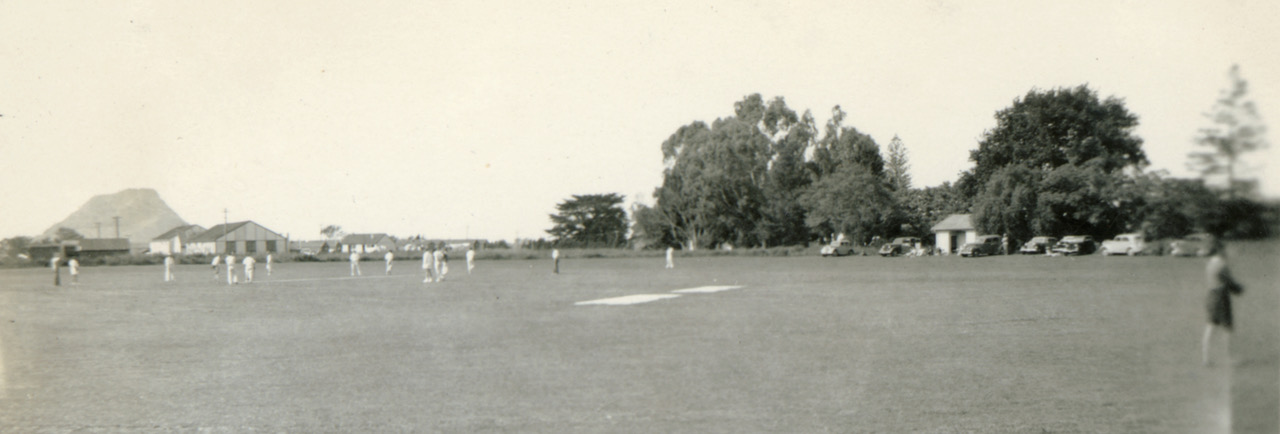
Council plans were to convert the transit camp area into a proper cricket ground. To facilitate this workmen stood by as residents left, so buildings could be dismantled or relocated immediately and prevent squatters moving in.

Cricket on the Tauranga Domain, early 1950s
Photograph by Herbert Lever
Image courtesy of Tauranga City Library, Ref. 06-016

Teenage Memories of a Nearby Resident

In the early 50s we were leasing the unused portion of the Tansit Camp to graze a few milking cows and as more huts were removed my father was able to extend his fences. We also kept a pig and it was my job to take 2 empty buckets (4 gallon tins) over to the cookhouse and return with the 2 full ones.

I have a memory of seeing people lined up to use the single telephone box which was inside the hedge on the Brown Street boundary. Another common sight was young mothers heading for the communal laundry with a baby in a cane pram, sometimes a toddler on a wooden seat across the top, and trying to balance a large cane basket of washing.

I was always reminded by my mother to go straight to the cookhouse and straight home.

Sources
Papers Past, BOP Times, 1944-1949
BOP Times Saturday Feature 6 Aug 1988
Nga Wahi Rangihou, Tauranga Book 22, page 50
Interviews with two older Tauranga residents

Friday, 10 April 2020

Tauranga Domain


Rotunda in the Domain, Tauranga, Postcard, published by F.G. Radcliffe (3565)
Collection of Justine Neal
Early days ... Ngai Tamarawaho and Ngati Tapu hapu occupied the land before the Ngati Maru taua attack in 1828. The taua was heavily armed and the loss of life was great.

The origins of the present day park go back to 1873 when Tauranga residents applied to the Native Minister for a domain to be set aside. Five years later the park was extended to the south. In 1881 the northern part was set aside for a secondary school. The southern part of the Domain was called the Wharepai Ground or Domain after David Asher’s boarding house, Wharepai, which was built in Hamilton Street in 1901 and demolished in 1971.

In 1890 a temporary tent hospital was erected in the grounds to cope with typhoid patients, the disease having been caused by the poor sanitary conditions in the town.

The band rotunda was well used over the years, on August 1 1906 the Bay of Plenty Times reported: The newly formed brass band will make its first appearance in public, when the members will give an open air concert in the band rotunda, in the Domain. A collection is to be taken up in aid of the fund in connection with the recent shipwrecks in Gisborne.

Unveiling of the statue of Canon Jordan, 28 Jan 1916, Postcard
Collection of Justine Neal
On 1 July 1914 the Bay of Plenty Times reported: A committee in connection with the Canon Jordan Memorial met on Friday last, and after considering various proposals, including fountains, memorial gates etc., they decided that the memorial take the form of a statue. The statue to be of Sicilian marble, with polished red Scotch granite pedestal, the material of which the base is to be composed to be decided at a further meeting in July.

On November 3 1915 the paper reported that the statue has arrived in the yard of Messrs. W. Parkinson & Co. who report it as an exquisite piece of work.

The unveiling ceremony took place on January 28 1916, well attended by local citizens and town dignitaries. Over a hundred years later Canon Jordan is still standing there, although somewhat weatherbeaten these days.

Tauranga's War Memorial Gates, Undated postcard
Collection of Justine Neal
After the end of WWI Tauranga, like many other New Zealand towns decided a War Memorial was needed to recognise the brave sacrifice of the many local boys who had gone to fight and not returned. On March 29 1919 a public meeting was held to decide what form the memorial at the Domain should take. It was agreed to a War Memorial in the form of an ornamental gateway and gates to the Domain. The gates were to be funded partly by public subscription, although according to the paper the people of Tauranga had not been exactly forthcoming with their money. On December 11 1921 the opening ceremony for the Memorial Gates was held. The official parade was in charge of Lt. Col. Wilson. Immediate next of kin of fallen soldiers were invited to wear their war medals on their right breast and were seated with veterans and returned soldiers.

On December 9 1924 tenders were called for the erection of a Ladies Pavilion.

Aerial view of the Tauranga Domain. Photo by P. Browning
Postcard published by A.H. & A.W. Reed (SR 615) Collection of Justine Neal
Today the Domain remains as a huge asset to a busy city with its sport fields, tennis courts etc. and its collection of amazing old trees. Now wouldn’t they have some stories to tell!

References
A Centennial History of Tauranga, 1882-1982, Don Gifford
Bay of Plenty Times
Papers Past
Musket Wars, Ron Crosby

Friday, 6 March 2020

Methodist Church Picnic

Image: Tauranga Heritage Collection, Ref. 0672/08
Handwritten on the back of this photograph are the words ‘Methodist Church Picnic, Tauranga’. Sadly, it is not recorded when or where the picnic took place or who these cheerful looking people are. However, a quick search of Papers Past shows that the Methodist Church Picnic was an annual event from the early 1900s into the 1930s. Popular locations for the picnic, which took place in January, included Yatton Park, Tauranga Domain and Otumoetai Beach.

Tuesday, 10 December 2019

Croquet at the Mount

The Mt Maunganui Croquet Club, undated photograph
Image courtesy of Tauranga Heritage Collection, Ref. 24842

Some time ago a photograph of women enjoying a game of croquet at the Tauranga Domain in the early 1900s featured on this blog. Here is another group of croquet playing women but this time at the base of the Mount possibly in the 1930s or 1940s.

‘The Mt Maunganui Croquet Club’ has been handwritten on the reverse of this photograph. While there are no details of a Mount Maunganui Croquet Club in A History of Mount Maunganui, there is mention of a women’s bowling club in the 1940s occupying the site where the Mount Hot Pools are now located.

Tuesday, 8 October 2019

A Game of Croquet

Group playing croquet. Photograph attributed to Mary Humphreys
Postcard, Image courtesy of Tauranga Heritage Collection, Ref 0213/08
This postcard was donated to the Tauranga Heritage Collection by Mrs Kay of Mount Maunganui in 1982. It shows a group of women and two girls enjoying a game of croquet at the Tauranga Domain. A croquet club was established at the domain on 8 November 1902 under the umbrella of the Bay of Plenty Lawn Tennis Club. The clothing suggests that this photograph could have been taken around that time period.

While the photographer is not known, it seems likely to have been local photographer Mrs Mary Humphreys. Her daughter, Miss Connie Humphreys, is recorded in the Bay of Plenty Times as being a member of the club.