Showing posts with label Sailing Vessels. Show all posts

Friday, 31 July 2026

Another new book from Trevor Bentley


Between 1864 and the early 1900s, Tauranga Harbour was not merely a backdrop to the district’s maritime history; it was the engine of it. Every local and visiting waka, schooner, cutter, barque, scow and steamer entering the harbour brought with them people, cargo, news and hope. During Tauranga’s Anglo-Māori War years (1864-1872), British battleship-troop carriers brought military occupation, violence, colonial officials, dispossession and despair.

While Tauranga’s early history is one of ships, it is also a history of the people who built them, sailed them, loaded them, anxiously watched them disappear over the horizon and joyously welcomed their return. This eight-part study casts light on Pākehā and Māori ship builders, their owners and their captains, on British and Māori fighting men, immigrant-settlers, merchants, labourers and visiting travellers, missionaries and officials.

The book restores their stories to the harbour and invites readers to see Tauranga not simply as a place on land but as a place defined by water - by tides, sandbanks, reefs, channels, and the vessels that once threaded among them. It is a reminder that our harbour has always been a gateway, a theatre of cross-cultural encounters, a workplace, a saltwater highway, a hazardous seaway and a home.

Racing from Tauranga to Auckland with cargoes of perishable goods, the Tauranga owned schooners Hope and Fortune arrived within a few hours of each other on 2 February 1866.

As many readers know, Trevor is a member of the society and an active contributor to this blog. His books and blogs explore Tauranga’s as well as New Zealand’s social, maritime and military history with a special focus on the Pākehā and Māori men and women who crossed cultures voluntarily and as captives. Dr. Bentley is the author of ten previous history books.

Book details

Early Maritime Tauranga: A History of Vessels, Visitors, Residents and Events, Volume II, 1864-1900s.

Author: Trevor Bentley

ISBN: 978-0-473-77735-7

Soft cover, 486 pages

RRP $39.99

Publisher: Kererū History Books.
https://www.kereruhistorynz.co.nz/


Image credit

Dawson, Montague. ‘The Orange Schooners,' from Ramsey, L.G.G. Montague Dawson, R.S.M.A., F.R.S.A., The Greatest Sea Painter in the World, F. Lewis, Leigh-on-Sea, England, 1970: 43, no. 179, plate 39.

Friday, 13 February 2026

The Mount Maunganui Channel and the Wrecking of the Cutter Waterlily, 1873


Tauranga Harbour, its main entrance and outer waters witnessed the wreckings of many waka Māori, sailing ships and steamers, both large and small during the course of the 1800s.

The narrow Maunganui Channel particularly, with its outer southern reef, shifting winds, strong currents, rocky southern shore (under Mauao) and Stony Point Reef continued to claim vessels well into the 1900s.

In 1829, the Mount’s channel rocks almost wrecked the Australian whaling ship Vittoria. Fortunately, the whalers Guide and Prince of Denmark were also in the harbour seeking provisions from local iwi. The combined tools and efforts of all three crews repaired the Vittoria sufficiently for it to sail clear before the weather turned.[1]

Marked today by the statue of the sea god Tangaroa, the Maunganui Channel’s Stony Point Reef nearly claimed immigrant visionary George Vesey Stuart’s newly arrived Te Puke and Katikati settlers. Clearing the channel and emerging into the harbour under full sail in January and December 1881 respectively, the 2000-ton Lady Jocelyn and 733-ton May Queen lost way and began drifting back towards the reef. Fortunately, there were steamships at the Town and Victoria wharves, whose skippers steamed to the rescue and towed both vessels to the safety of the old Man O’ War Anchorage.[2], [3]

In January 1881, the 2000-ton immigrant clipper Lady Jocelyn narrowly avoided going aground at Stony Point.

Maurice Forester, ‘Painting of the ship Lady Jocelyn’, Pae Koroki, Tauranga City Libraries Photo 06-197

While the two great ocean-going immigrant ships escaped the reef, a variety of smaller European-built sailing vessels under 20 tons were wrecked from the 1840s, particularly when their Māori and Pākehā skippers sailed too close to the Mount while entering and exiting Pilot Bay. Among them was the Waterlily.

Described as ‘a fine little cutter’ the Auckland based ten-ton Waterlily (not to be confused with the 17-ton schooner Waterlily which was also active at the time), was wrecked at Stony Point in June 1873. A versatile, single masted, fore-and-aft rigged sailboat with two gaff mainsails and a long bowsprit, the Waterlily had previously traded between Auckland and the Bay of Plenty ports for several years without mishap.[4]     

Having left Port Charles at the tip of the Coromandel Peninsula and bound for Tauranga, Captain Eggerton and his crew of three experienced strong northerlies and ‘thickening weather’ off Tauranga Harbour’s Katikati entrance around 9 p.m. Entering the Maunganui Channel and driven through by the wind and tide ‘at full force’, the Waterlily crashed onto Stony Point reef around 11 p.m. where ‘the sea commenced to break over her immediately’.

Tangaroa statue, Frank Szirmay ‘Tangaroa’ (1976), Port of Tauranga 

Photo: Bronwyn Holloway Smith, Public Art Heritage, Aotearoa New Zealand, Tauranga City Council Art Collection.

Stony Point Reef extends from the beach below Mount Maunganui to the plinth and statue of the Māori sea god Tangaroa. The Waterlily struck the reef to the statue’s right (i.e., on the left of this picture).

The concussion unshipped the rudder, which drifted away and was lost, depriving the crew of all control over the cutter. Prior to the wrecking, the captain, who could barely distinguish the nearby Mount in the deteriorating conditions, reported later that no channel buoys were to be seen.[5]

An anchor was dropped in an attempt to keep the cutter off the rocks, but it would not hold. The captain and crew were forced to abandon the Waterlily, but not before saving most of their personal effects and the jibsail which they got aboard the vessel’s dinghy. Managing, with difficulty, to clear the point they rowed into the shelter of Pilot Bay where they passed a miserable night on the beach.

The following morning Captain Eggerton, who was the son of the Waterlily’s owner, and the three sailors were collected and taken across the harbour and into town by a boat dispatched from the Tauranga ketch Isabella. Captain Eggerton immediately telegraphed Auckland to inform his father of the wrecking. The Waterlily, which was insured, had been loaded with 45 tons of firewood (uninsured), intended for Mr. Piercy, a Tauranga merchant.[6], [7]

A small sailing vessel on the rocks in heavy seas. The crew are attempting to salvage what they can 
from the wreck.

Image: Johan Christian Dohl, ‘Stranded Ship’- Strandet Skip - KODE Art Museums and Composer Homes, BB.B  Public domain.

Later that morning, local identities Captain Thomas Moller and Charles Hopkins returned to the wreck with the Waterlily’s crew on the lifeboat of the steamer Southern Cross. Landing on the beach below the Mount at low tide, they made their way along the reef through heavy surf to retrieve the cutter’s remaining sails and tackle. The following day Mr. Fullerton, another Tauranga resident, twice took his cutter down to the Mount, where he and his crew took away the Waterlily’s cargo of firewood for Mr. Piercy.[8]     

Evaluating the cause of the Waterlily wreck, the New Zealand Herald reported on I July 1873:

The casualty is entirely attributable to the neglected condition of the harbour, the channel of which some eight years ago was properly buoyed out and marked with beacons, and a harbourmaster appointed to see that these were kept in repair. Three years ago the harbourmaster, who was also the pilot, was removed at the suggestion of the sitting member of the Provincial Council for Tauranga… The removal of the pilot station acts prejudicially on the district because it prevents the entry into the harbour of men-o'-war, of which there have been not a few in Tauranga.[9]   

Tauranga remained a high-risk port for all types and sizes of vessels in the 1870s, due to its poorly marked and charted channels and ever-shifting sandbars. The harbour beacon that Captain Eggerton and the crew of the Waterlily had so desperately hoped to sight when passing through the channel had been swept away some weeks previously. To this day, knowledgeable mariners, aware of the risks of the Maunganui Channel and hoping for safe passage, make small offerings as they pass the statue of Tangaroa and the Te Kuia and Kurī Rocks further around the rock-strewn base of Mauao-Mount Maunganui.

Twice the tonnage of the 10-ton Waterlily, the cutter Lee was built at Henry Nicol’s shipyard in Auckland’s Mechanic’s Bay in 1864. The Lee also undertook trading voyages to Tauranga and the Bay of Plenty 
trading ports.

Image: Auckland Weekly News, ‘The cutter Lee, winner of the trading cutters’ race’. 4 February 1909. Auckland Libraries Heritage Collection Record ID AWNS-19090204-07-04.

References

[1] Collin, David R.; Kirkudbright’s Prince of Denmark and Her Voyages in the South Seas, Whittles, Dunedin, 2013: p 4.

[2] Brett, Henry, White Wings Vol. 1: Fifty Years of Sail in the New Zealand Trade, 1850-1900, Brett, Auckland, 1924: 42.

[3] Bay of Plenty Times, 4 January 1881: 2. Also see Bay of Plenty Times
13 January 1881: 2.

[4] Bay of Plenty Times, 25 June 1873: 3.

[5] New Zealand Herald, 1 July 1873: 2.                    

[6] Daily Southern Cross, 28 June 1873: 2.

[7] Bay of Plenty Times, 25 June 1873: 3.

[8] New Zealand Herald, 1 July 1873: 2

[9] ibid.


Friday, 26 August 2022

John Lees Faulkner and the schooner Jane, 1865-1871

Tauranga’s Early Maritime Traders, Part 1

An adventurous Yorkshireman from the ancient English port town of Whitby, John Lees Faulkner had originally been transported to New South Wales as a teenaged convict. He first arrived and settled at the Bay of Islands in 1832. Having trained as a convict shipwright at the Port McQuarie Dockyard, he soon built and began sailing his own vessel to the Bay of Plenty to trade with Maori at Tauranga. According to The Bay of Plenty Times of 9 Sept 1882:

Mr Faulkner’s object in coming to this district was ostensibly to obtain supplies to ship to the Bay of Islands which was one of the principal resorts for whalers in the South Seas. There were few Pakeha then present, but among the resident missionaries was Archdeacon Brown.

In 1840, Faulkner settled in Tauranga and established a trading store near Otumoetai Pa on land belonging to his wife to be Ruawahine of Ngai Tukairangi, a hapu of Ngai Te Rangi. From this base, close to the harbour entrance he supplied Maori with general trade goods, particularly agricultural implements, in exchange for cargoes of maize, flax and kauri gum. Sometimes accompanied by Ruawahine, he sailed these cargoes to the Bay of Islands and, from 1841, to the newly established Auckland settlement. During the 1840s and 1850s, Faulkner continued to build boats for himself, local Pakeha traders and several Maori rangatira at Tauranga. Noted for his integrity by both Pakeha and Maori, he was appointed Tauranga postmaster in 1860.  

John Lees Faulkner, Tauranga ship builder and trader (1807-1882)
Tauranga Library image collection Ref. 00-208

During the 1860s, Faulkner owned or part owned three trading vessels which, mainly crewed by local Maori sailors, regularly transported cargo and passengers between Tauranga and Auckland: the Maxwell (1862-63), the schooners Jane, 37 tons (1865-71) and the topsail schooner Tauranga, 61 tons (1863-72). A typical mid-sized schooner of the era, the Jane did not carry square rigged topsails above its foremast as did the Tauranga. Otherwise, its sail configuration was identical, with a schooner’s distinctive bow and bowsprit, two try sails carried on the foremast, a foresail and mainsail.

A swift and very busy vessel, the Jane ran military dispatches to and from Auckland during the mid to late 1860s, and delivered commissariat stores to British and colonial military forces at Tauranga and Opotiki. On the 10th March 1865, the Jane carried news to Auckland, confirming rumours that the Rev Carl Volkner had been killed at Opotiki by militant followers of the Pai Marire faith. In June 1865, the Jane’s then master, Captain Sellars, sailed to Auckland with the bereaved Mrs Volkner and her two daughters.

A 35-ton, New Zealand built schooner, the Governor Grey
Watercolour painting by Charles Heaphy, late 1840s
Whanganui Regional Museum, Ref. 1910.2.1

No images of the 37-ton Jane have survived. This 1860s sketch of the 35-ton New Zealand built schooner Governor Grey however, gives a fair indication of the Jane’s size and sail configuration.
Major Charles Heaphy, ‘The Governor Grey’, in Baille, Herbert, ‘Episodes of the Maori War’, in Transactions and Proceeding of the Royal Society of New Zealand, Vol. 53, 1921: 32.

The diverse commercial cargoes that the Jane’s skippers delivered to Auckland make interesting reading. Recorded in the Port of Auckland’s ‘Shipping Intelligence’ reports, published in contemporary newspapers, examples include:

16 October 1865.   -   From Opotiki, Tauranga, Mercury Bay with sawn timber, 8 passengers.

1 October 1866      -   The schooner Jane. Faulkner, master, with a cargo of kauri gum.

8 January1867.       -  The Jane schooner, Faulkner, 37 tons, with sheep from East Coast.

15 February 1868.  -  The Jane schooner from Tauranga with hides, tallow and passengers.

24 February 1868.  -  From Tauranga, 1 horse, 1 cow, a quantity of produce, and 25 passengers.

7 December 1868.  -  The Jane schooner, from Tauranga with cattle and passengers.

11 February 1869.  -  The Jane Schooner, Moller, master, with fruit etc.

The return cargoes that the Jane delivered to Tauranga’s settlers and its more substantial British and colonial military population included wine, ale, spirits, groceries, drapery, flour, general cargo, sundries, and passengers. The Jane also shipped cargoes of timber (presumably kauri) and sundries to Hawke’s Bay. During 1870, the Jane’s voyages to Auckland became less frequent and ceased altogether in 1871. An article in the Daily Southern Cross on 22 September 1869, explained:

The schooner ‘Jane,’ Captain Moller, whose trips [to Auckland] are as regular as the clock, came in again as is usual on his eighth day, deeply laden with stores. She leaves again this evening. We understand that the owner of the ‘Jane,’ Mr J. L. Faulkner, intends to put the schooner ‘Tauranga’ in the berth, as a regular packet between there and Auckland in place of the ‘Jane.’ Captain Moller is to have charge of her.
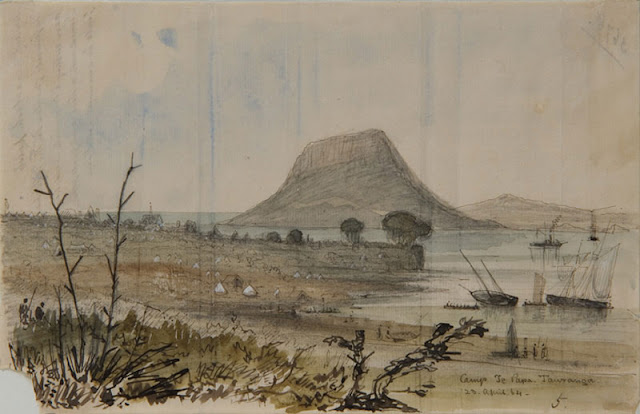
Military camp at Te Papa with sailing craft and a steamer, 1864

E. A. Williams (c.1824 – 1898), Camp Te Papa, Tauranga, 1864, watercolour, pen & ink on paper: 136x201mm, given by Dr H. D. Skinner, Dunedin, 1948. Hocken Collections Uare Taoka o Hākena, University of Otago, 75/100.

The Jane had several masters during the 1860s including Faulkner himself, Captains Moller and Sellars, and Faulkner’s sons Jarvis and Christopher. The brothers had initially learned their seacraft by sailing the family’s 16-ton cutter Bella on its runs between Tauranga and Maketu. From 1866, Christopher regularly sailed the Jane on trading voyages between Gisborne and Auckland, before sailing his father’s largest schooner Tauranga, which shipped considerably larger cargoes between Tauranga and Auckland.

From the 1860s, in the face of contrary winds which could delay them for days on end, sailing vessels were increasingly towed clear of Tauranga Harbour by local or visiting steam vessels. As the New Zealand-wide construction of steam powered vessels large and tiny accelerated during the 1870s, the glory days of Tauranga’s commercial sailing vessels were done. The number of familiar ‘sails’ readily recognized by residents as they entered the harbour dwindled and most of Tauranga’s picturesque commercial sailing ships soon passed from sight.

Whether Faulkner sold the aging Jane to Maori or Pakeha buyers or if it joined the old sailing hulks, abandoned and quietly decaying in the mangrove backwaters of Tauranga Harbour is unknown. The final Auckland Shipping Intelligence report to mention the vessel simply read: ‘5 May 1871. The Jane schooner, Faulkner, 37 tons, from Tauranga’.

The dominant figure in Tauranga’s early commercial maritime history, John Lees Faulkner died in 1882 at the age of 75 years. On the 9th of September that year, the Bay of Plenty Times described him as ‘a man of few words, naturally reserved, but of a kind, rough, genial-hearted disposition, ever ready to render assistance to his neighbours. Mr Faulkner's name will not be easily forgotten, for he was universally respected, and we may safely assert was without equal’.

Sources

Auckland Star, 17 August, 1911: 8.

Bay of Plenty Times, 9 September1882: 2.

Daily Southern Cross, 22 September 1869: 3.

Gifford, W.H. and H.B. Williams, A Centennial History of Tauranga, A. H. and A.W. Reed, Matamata, 1940, Capper Reprint, Christchurch, 1976.

Green, Julie, John Lees Faulkner (1807-1882), Tauranga Historical Society

Rorke, Jinty, John Lees Faulkner 1810-12? - 1882, Trader, Shipbuilder, Farmer in The Dictionary of New Zealand Biography, Volume One, W.H. Oliver (ed.), Bridget Williams Books and Department of Internal Affairs, Wellington, 1990:   118-119.