 |
| Photograph by Beth Bowden |
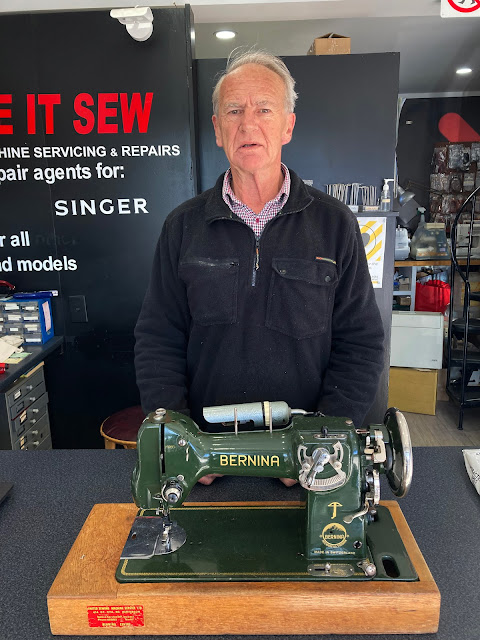
The sewing machine pictured here with Bernina mechanic Graeme Philp at his workshop in Twelfth Avenue is remarkable for a number of reasons, First, and of most importance to home seamstresses, “It sews perfectly,” says Graeme. Seventy-five years after it was manufactured – Graeme was able to establish the date, 1938-1941, from its serial number – its running stitch, zig-zag, and reverse stitching are performed evenly and without fuss. It is an early model, released only six years after the Swiss Gegauf factory created the Bernina marque[1] (the name comes from a range of mountains in the Swiss Alps, whose skyline effectively evokes the shape the machines create in needle and thread).
Secondly, and going to the main theme of this essay, it was made during wartime. Steel everywhere was being dedicated to the war effort. Even in neutral Switzerland, Gegauf’s insistence on using only the finest steel must have taken some hard negotiations. The corporate intertwining of Germany and Switzerland was expressed at a high level by a trade agreement signed on 8 August 1940, providing Switzerland with “raw materials, including coal and iron[2]” in return for the Swiss allowing transit of goods from Germany’s ally, Italy.
And Swiss precision-made goods were in demand by the Allies themselves. Substitute exporting meant that (for instance: sewing machine) factories in the UK and America could divert their production lines to more important, if less refined, war materiel; sewing machines were indeed needed for the production of uniforms, parachutes, tarpaulins, camouflage nets and any number of other military purposes, but new home sewing machines were definitely a luxury item in the middle of World War II. This one would have been a miracle of rare device to its owner, whether she[3] acquired it during or just after the war.
 |
| Photograph by Beth Bowden |
Graeme’s machine, which he bought, quite recently, at an estate sale in Te Awamutu, is driven by an electric motor made in England. He and I suppose that the unpowered machine was exported from Switzerland, then equipped with a motor before its owner emigrated with it to New Zealand. (Or it gained its motor once in New Zealand – sewing machine engines were common items to buy separately and fit on to an older, hand-turned or treadle machine.)
 |
| Bond & Bond advertisement, The Bay of Plenty Times, 30 July 1948 |
Meanwhile, back in Tauranga, sewing machines had been in short supply for years. This 1948 advertisement shows that modernising the household treadle was still a viable option well after the war had ended. The electric add-on’s price, though high[4], was considerably less than the cost of even a second-hand Singer treadle. The classified advertisement columns for that year offered a great many of them, all around the same price as a long-shuttle (and therefore somewhat elderly) model whose going price was £35[5]. No wonder advertisements for opportunities to rent machines, whether from a shop, or even in a private home, were also common.
Late in 1948 Sinclairs’ household goods store, at 45 Devonport Road, managed to secure ‘a few only[6]’ new Jones portable sewing machines but did not put a price in their advertisement; they did, however, offer apologetic inducements to purchase a machine suitable for a child “(Sorry None for Mother Yet)[7]” at “only 59/6 each”. And while it is possibly unfair to do so, compare the limited qualities on offer that same year from the “Grain” machine (twice the price of the toy one) with the sleek engineering of the 1941 Bernina.
 |
| Bond & Bond advertisement, The Bay of Plenty Times, 31 May 1948 |
Post-war boom times were reflected not only in goods and labour shortages. Clearly people were keen to celebrate victory by way of a new consumerism that took hold in the middle of the twentieth century[8], and even at the mid-point of the war were encouraged to do so as their patriotic duty.
 |
| Bond & Bond advertisement, The Bay of Plenty Times, 14 September 1943 |
Five years later the providential planners of 1943, who deposited their instalments of a few shillings a week in a National Savings Account (carrying 3% interest and helping the war effort) were still waiting to fulfil their consumer dreams.
Out in the country, however, home sewing went on much as it always had. The formation, in 1934, of the Te Puna Sewing Bee proved to be one of those social institutions that continued right across the war years. Three months before Hitler invaded Poland, Mesdames Chapman, Smith, Sharplin, Lochhead, Lloyd, Ainsworth, I’Anson, King and others gathered at Tom Lochhead’s homestead, “Pine Hill” for the usual competitions and the inevitable “dainty” afternoon tea. There was much mutual congratulation on achievements to date from the equally usual sales of work: £5 each to the Church of England and Presbyterians, £10 to the Te Puna Hall Committee, £4 10s to the Te Puna School Piano Fund, £1 to the Christmas Cheer fund of a leper colony, and “a large parcel of clothing to Sister Esther”[9]. Tom, who also audited the accounts, made a speech:
Mr. Thomas Lochhead then spoke, also congratulating the ladies on reaching their fifth year. He said that he was not sure which work the ladies were doing but he had heard that they had handed £10 to the Memorial Hall fund. This, he said, was a very good thing as the Hall has been waiting for improvements for the last, approximately, twenty years. He also said that he was very much in favour of these happy little meetings that the ladies have. At this time, with such disturbances in world affairs generally, the ladies should have other things to occupy their minds. He concluded by wishing the Sewing Bee many more happy and successful years in the future.
There is no evidence at all that the Te Puna Sewing Bee matched the war efforts of Mary Munro’s Patriotic League formed in WW1[10]. Many were the worked aprons, tea cosies, babies’ garments, ornamental clothes hangers and crochet-edged tray cloths that changed hands in successive sales of work, always with the funds being applied for charitable purposes – the Leper Colony was clearly a favourite – or for community-building fun, rather than warm socks for soldiers. The economics of modern mechanised warfare, the same military industrial complex that produced the early Berninas, had overtaken the home front.
The Sewing Bee seems to have faded away in the 1950’s, but there would have been more than a few youngsters at Te Puna School who remembered the annual picnic days held, not at their local, ordinary beach but in town at Otumoetai, courtesy of the Te Puna Sewing Bee[11].
[3] The gendered element of this remark is acknowledged, and the purchaser might have been a male tailor. The overwhelming evidence is that the mass market for sewing machines was female.
[4] Just under twice the weekly wage for a female clerical worker in 1948: £4/11/3d - https://paperspast.natlib.govt.nz/newspapers/BOPT19481001.2.28
[8] See, for instance, The Challenge of Affluence: Self Control and Wellbeing in the United States and Britain since 1950 by Avner Offer, Oxford University Press, 2006
[10] https://taurangahistorical.blogspot.com/ , “The Te Puna Patriotic League Stands Up for Itself – Mary Munro and Florence Lochhead” by Beth Bowden, 14 June 2019. Florence, as Mrs Chapman, succeeded Mrs J Wright, the inaugural President of the Sewing Bee.


