Showing posts with label Biography. Show all posts

Friday, 17 July 2026

Vivien Edwards – a life to celebrate

 I went to the woods because I wished to live deliberately, to front only the essential facts of life, and see if I could not learn what it had to teach, and not, when I came to die, discover that I had not lived [1].

Photo: Beth Bowden

Those who come to this website for quality writing and research are always in good hands if the article that piques their interest is the creation of Viv Edwards, an occasional contributor since 2011.  Viv died on 9 June 2026.

Elsewhere on this site you can find her characteristically modest explanation for her self-taught skills in reporting the past: “History sparked my interest, after finding an old Hospital Board report on the 1918 influenza epidemic, while nursing at Auckland Hospital. This led to several articles, talks and researching other topics.” 

Vivien was always one for understatement.  Her output over her lifetime was prodigious.  She never seemed to stop working.  As a mature student, she graduated B. Sc in biological sciences, a disciplined achievement for the working mother, by that stage, of two sons.

Nurses graduation. Staff nurse V.S. Edwards, Tutor nurse E. Hereford (2/2). Published 29 September 1964. 
Te Ao Mārama - Tauranga City Libraries Photo gca-7396

Her first and early career as a nurse culminated when she became a nursing tutor.  Some of her alumni were at her memorial service, and spoke warmly of her abilities to communicate technical information in a way that never lost sight of the human dimension.  She adapted that to many different subject areas in her lifetime.

For instance: she was the author of "Winkelmann: Images of Early New Zealand" (Benton Ross, 1987) and "Battling the Big B: Hepatitis B in New Zealand" (Dunmore Publishing, 2007). The two books could not be more different.  The first is a beautiful art hardback in large format, dealing with nineteenth-century challenges of photography.  It met the technical challenges of twentieth-century book production so well, it won the 1988 Book of the Year prize in that category.  The second is a contemporary account of health reform efforts led by Dr Alexander Milne.  His work is much cited in on-line journals but it takes 27 Google search listings before Viv’s work shows up.  Hers is not a scientific report; it is an eye-witness story – a ‘first draft of history’ - of just how hard it was to deal with an unacknowledged epidemic [2].  

Book of the Year award, 1988. Photo courtesy of Trevor Hoff

After leaving nursing in 1984 Viv made her living as a freelance writer for over 20 years, working for trade and professional magazines such as NZ Forest Industries Magazine, NZGP (the periodical for general practitioners), Management, NZ Business, The Transportant, Pharmacy Today, Safeguard, Her Business, NZ Pine International, Sea Spray, Bits and Bytes, Uno (Waikato and Bay of Plenty), and the Shed.  Every article was clipped and meticulously filed - in scrapbooks; her early journalism pre-dated the World Wide Web although she was quick to see its benefits and adapted fast.

Blogs for Tauranga Historical covered things that caught her fancy.  You can search for her articles on -

  • Oliver Macy Quintal (July 2011).  Pursuing this early lawyer’s past took her and her partner Trevor to find his grave on Norfolk Island.
  • Hannibal Marks, Harbourmaster (July 2014).  One of the many maritime tragedies of Tauranga’s past: he drowned here.
  • Tauranga Hospital’s Roof Garden (Feb 2019).  Viv took the photos to illustrate this article.  Her eye for colour and form is evident.

She also wrote a personal memoir of her nursing days for the Historical Review [3].  A 50-year history booklet written for New Zealand Lumber, 'History in Motion: Evolution of the NZL Group 1949-1999”, was aptly named; history never stood still for her.

Perhaps her most telling achievement was the long effort to publish the story of Mary Sutherland, the first woman forestry graduate in the world. At some point in her magazine-article work she opened a long-ignored filing cabinet at the Forest Institute and discovered a trove of papers relating to Mary.  Although her memorial plaque is in Whakarewarewa Redwood Forest, Viv knew there was more to explore.

Viv and an as-yet unidentified companion at Mary Sutherland’s memorial, c. 2011. Photo courtesy of Trevor Hoff

For several years she researched and wrote Mary’s story.  A Path Through the Trees was published in 2020 and in 2021 won the Ian Wards Prize “for making substantial imaginative and exemplary use of New Zealand archives and records.”

This is a fitting accolade for Vivien’s professional competence.  She had advanced bibliographical skills; she was a capable indexer; she was also a warm and insightful interviewer whose personal communications gleaned information that otherwise would never have come to light.  Before the internet, before and during the advent of the personal computer, she had a knack for the research process and collecting and managing large amounts of information.

She was also a tiger for the truth, who doggedly pursued her hunches.  Mary Sutherland first saw the light of print in 2011, as an entry in the Tauranga Library’s 2011 Memoir and Local History Competition.   If Trees could Talk: the Whakarewarewa Redwoods was the title of the essay [4].  It was to be a long time before the book itself showed up. For this and all these other reasons, Tauranga Historical can be very proud of her.

References

[1] David Thoreau, Walden; or Life in the Woods, Ticknor and Fields,1854. At the memorial service my eulogy concluded with a fuller passage from this work, which can be found at https://www.environmentandsociety.org/mml/walden-or-life-woods

[2] The book is now out of print but can still be borrowed from Te Whatu Ora’s library in Tauranga.

[3] Historical Review, Vol 70, No. 1, May 2022: Vivien Edwards, Nursing at Tauranga in the 1960s

[4] https://paekoroki.tauranga.govt.nz/nodes/view/20049

Tuesday, 1 July 2025

The Hewlett Legacy: From Aviation to Viticulture in Tauranga - Ms 67

From Tauranga City Library’s archives

A monthly blog about interesting items in our collection:

Next time you find yourself sipping a glass of wine or port, spare a thought for an individual who, by all accounts, established the first commercial vineyard in Tauranga, Air Commodore Francis Esme Theodore Hewlett.
Ms 67/15 - Photograph of Totara Casks

Hewletts – Mother and Son: 
Hilda Hewlett interpretation panel - Fourth Avenue, Tauranga

Much has been written previously in the Journals of the Tauranga Historical Society about the aviation exploits of Hilda Beatrice Hewlett (HR 41:Vol 2, p76-82 by HL Whitehead) and her son F.E.T. Hewlett (Journal of the Tauranga Historical Society No. 8:1957 and No. 35:1968). This blog will, therefore, focus on a recently digitised collection in Tauranga Library’s archive: Ms 67 - Papers relating to Maungatapu Vineyard and their creator, Air Commodore Francis Hewlett.
Hilda Hewlett, 1911 flying licence and picture, with awesome hat - Women Who Meant Business

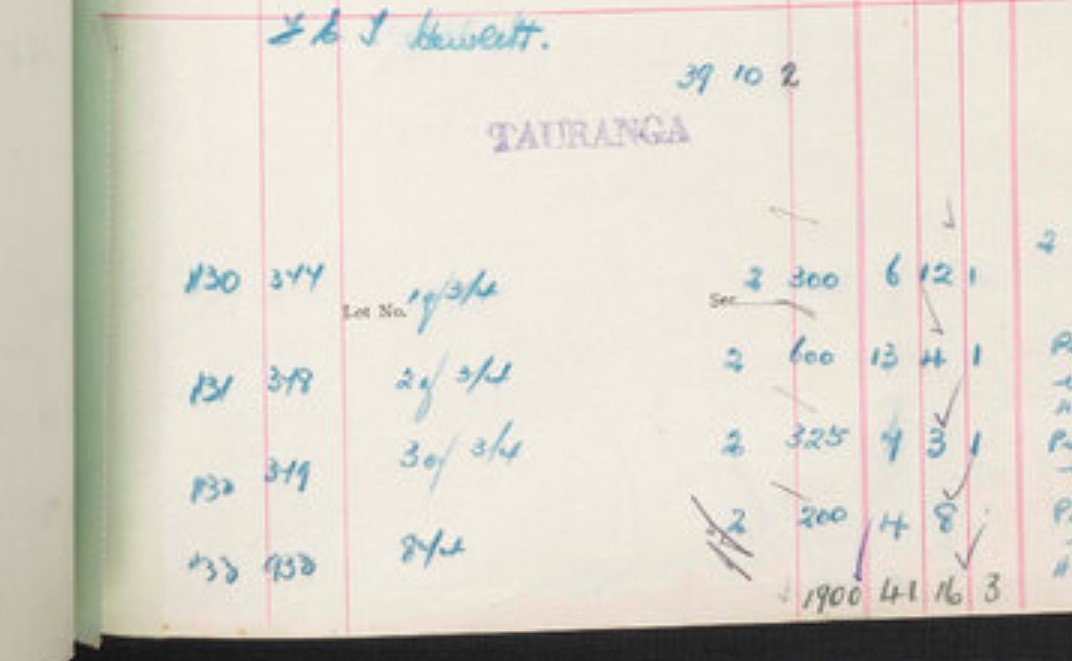
In 1926, Hilda, the first English woman to gain a pilot's licence, relocated to Tauranga, as did her daughter Pia Richards and Pia’s family.  Hilda bought various sections, including property on the corner of Eleventh Avenue and Edgecumbe Road - as well as a section at Devonport Road in Tauranga.  Tauranga rate book, 1937-1938 shows us Hilda owned property at Lots 231/2 Sec. 1 and 485/7 & 489 Sec. 2.

Map 24-047 - Section 2 - Tauranga

It must have been an idyllic location, overlooking the Waikareao tidal estuary, which had served as the town's flying field for eight years. 

Air Commodore F.E.T. Hewlett - Auckland War Memorial Museum

F.E.T. (Francis) Hewlett, following in his mother’s footsteps as a pilot, had a distinguished military career. During WWI he earned a Distinguished Service Order in 1915 and rose to the rank of Group Captain.  He retired from the Royal Air Force in 1934 and followed his mother and sister to live in Tauranga.  

The rate books show Hilda Hewlett owning lot 231/2 on Devonport road and this is where Francis Hewlett first set up business with a motor garage.
Bay of Plenty Times, Volume LXXI, Issue 13056, 26 January 1943, Page 3 Papers Past

The rate book 1937-1938 also shows that Francis Hewlett owned a section next to Hilda’s, on the edge of the Waikareao Estuary, lot 874, Section 2. (See above image: Map 24-047).
Ams 463/1/38 - Rate book, 1937-1938

In an address to the THS years later (1957) he talks of having “…a small house overlooking the Waikareao Estuary, we had a bank and half an acre of swampy land covered with gorse, blackberry and weeds. This was such an eyesore that we determined to tame it and drain the swamp; but we should have to cultivate it and plant something more interesting than the existing rubbish. Someone suggested grapes, so we set about finding how and why and where grapes were grown in New Zealand."

Te Ao Mārama - Tauranga City Libraries - 2025

We do not have any images of this property, however, a present-day photograph has been taken of the area, above the current archery field, that gives a very good idea of where the first vines were cultivated.  The work involved to continuously clear the weeds eventually became too much and the Hewletts searched for a site more suitable for grape growing commercially.

The Hewletts moved to Maungatapu, where they bought 12 acres of land and transported the vines from Waikareao to the new site. Current day Vine Street in Maungatapu is one of the streets originally part of this farm and was named after the Hewletts' vineyard.
Ms 67/18 - Maungatapu Vineyard - looking south-east towards Welcome Bay


When WWII broke out, Francis (F.E.T.) Hewlett enlisted as Wing Commander in the Royal New Zealand Air Force (RNZAF).  He progressed his military career and became Air Commodore, January 1945. Whilst he was away, not much progress was made with the winemaking, however, Francis Hewlett picked up from where he left off when he returned.
F.E.T. (Francis) Hewlett on his spraying tractor - Ms 67/18

The Papers relating to the Maungatapu Vineyard (Ms 67) contain the original speech delivered to the THS in 1957, photographs, wine labels, prize certificates and an essay titled "The suitability of Tauranga for outdoor grapes for wine making".  This must have been like a vintner's handbook back in 1957, but still provides interesting insight for today.  Some interesting points he makes are:
  • Henderson and Hawkes Bay identified as specialty grape-growing regions
  • The "American Invasion" during the war influenced the market for selling cheap, inferior wines where the main factor was the “kick” it gave
  • When men and women returned from WWII they had more of a discerning taste for quality wine and this in turn increased the demand for higher quality winemaking
  • Tauranga has the same climate as the northern Germany region of “Rotor Traminer”, and can grow exact replica Moselle vines
  • Some of the preferred winemaking grapes for Tauranga are Siebel varieties, which produce dry wines, sherries, port and Rosē.
Wine Bottle Label - Ms 67/7


Further reading...
For those interested in delving deeper into their stories, the Pae Korokī collection offers a treasure trove of resources, including the Papers relating to Maungatapu Vineyard (Ms 67) and the Journals of the Tauranga Historical Society The reference section has a biography of Hilda Hewlett, written by F.E.T. Hewlett’s daughter-in-law, Gail Hewlett: "Old Bird: the irrepressible Mrs Hewlett".

Sources
Hewlett, Gail. (c.2010). Old Bird - The irrepressible Mrs Hewlett. Leicester : Matador.
Women Who Mean Business website: https://womenwhomeantbusiness.com/2021/05/27/hilda-hewlett-1864-1943/
Auckland War Memorial Museum - Online Cenotaph 
Ams 463 - Tauranga Borough Council rate books, valuation rolls and related material
Bay of Plenty Times, Volume LXXI, Issue 13056, 26 January 1943, Page 3 - Papers Past - https://paperspast.natlib.govt.nz/ 

Tuesday, 6 May 2025

Bunka embroidery and a book by Rata Roden

From Tauranga City Library’s archives

A monthly blog about interesting items in our collection

One of the items recently digitised by the Heritage & Research Team is this framed embroidery mountain scene, worked by Rata Roden when she was 84.

'Japanese Punch' embroidery by Rata Roden, 1992  (Te Ao Mārama - Tauranga City Libraries Ams 457/4/9)

Japanese punch embroidery, or bunka embroidery, bunka shishu, uses a specialised hollow needle to weave rayon thread from the front of the fabric, through to the back. The effect is often likened to oil paintings or watercolours. As finished pieces tend to be fragile, they tend to be displayed as art, rather than onto clothing.


Rata was born 'Bessie Rata Lever', and the Lever family papers in our archives include her workbox and pincushions.

Workbox and contents (Te Ao Mārama - Tauranga City Libraries Ams 406/1)

 
Also in the workbox was a copy of her autobiography 'Here, there and most places'. Published in Tauranga in 1973, Rata acknowledged the assistance of Miss Joan Mirrielees, Kathleen Stratford and Gaye Rendell. The jacket blurb describes her story:
 
...Rata Roden has made an interesting record of her experiences in a variety of occupations in a variety of countries. It is the biography of a New Zealander, a farmer’s daughter, who, through dogged persistence realised her two main ambitions – to become a nurse, and to travel to foreign places. It is an absorbing account covering backblock farming days, nursing in the slums of London, living in many parts of Africa, the World War II in Egypt and England, travel to Japan, the Orient, Iceland, Greenland, Russia and Scandinavia. Altogether Mrs Roden has made eleven trips out of New Zealand and in her story she takes us with her."
 
Inside dust jacket and back cover of 'Here There and Most Places', published 1973.
 
Writing was in the family, as it's Rata's cousin Arthur Gray who wrote 'An Ulster Plantation'. Copies of both books are in the reference collection at Te Ao Mārama - Tauranga City Library.

  
Sources

Clasper-Torch, Micah. (2021, April 27). The history of punch needle. Sister Magazine, (61). sister-mag.com/en/magazine/sistermag-no-61-may-2021/the-history-of-punch-needle

Roden, Rata. (1973). Here, there and most places. Ashford-Kent Ltd.

Tokyo Bunka Art. (2007, May). Japanese Bunka Embroidery - The art of thread. tokyo-bunka-art.blogspot.com/2007/05

Victoria's Custom Framing & Stitchery. (2024, December 3). Bunka embroidery. facebook.com/story.php


Written by Kate Charteris, Heritage Specialist at Te Ao Mārama - Tauranga City Libraries

Tuesday, 4 April 2023

Princess Te Rangi Pai (1868-1916)

From Tauranga City Library’s archives
A monthly blog about interesting items in our collection

Annette Tootell (1914-1990)
Tauranga City Libraries Ms 102/03/1

"Ōmokoroa Woman Researches Forgotten Princess” - This is the headline of a Bay of Plenty Times article from 1981, which talks about how Annette Tootell (1914-1990) from Ōmokoroa spent many years researching the life of ‘Princess Te Rangi Pai’ (1868-1916). 

Te Rangi Pai was the stage name of Fanny Rose Howie (nee Porter), a singer acclaimed as a brilliant star on the concert stage in Britain and New Zealand in the early years of this century.  She was born at Tokomaru Bay and in 1901 Fanny travelled to England with her husband, to study with the baritone Charles Stanley. In England as ‘The Princess Te Rangi Pai’ she performed widely, including promenade and formal concerts, fashionable soirees and charity performances. She sang at the Royal Albert Hall on several occasions including the Grand Scotch Festival on St Andrew’s Eve 1902. 

Fanny Rose Howie (nee Porter) - 'Princess Te Rangi Pai'
Tauranga City Libraries - Ms 102/03

Programme Cover 1903-1904
Tauranga City Libraries - Ms 102/3

She returned to New Zealand in 1905 and toured the country in 1906 and 1907 and it is here the connection begins with Annette Tootell.  Annette’s mother, Gertrude Hunt and her uncle, Horace Hunt, both accompanied Te Rangi Pai on stage and tour as performers.  Gertrude later passed her scrapbook of newspaper cuttings and handbills to Annette (Ms 102/2), who in turn created her own scrapbook of Te Rangi Pai (Ms 102/3).  Interestingly, another uncle, Percival Hunt, is the father of well-known New Zealand poet, Sam Hunt.

At Rotorua - Gertrude Hunt, Te Rangi Pai, Maggie Papakura
Tauranga City Libraries Ms 102/3
  

Hine e Hine
Tauranga City Libraries - Ms 102/3
In 1908, Te Rangi Pai’s husband, John Howie, was appointed collector of customs for the Poverty Bay area, and Fanny lived with him in Gisborne, but eventually her illness made complete rest necessary and she went to live in a house built on ancestral land at Maungaroa, near Te Kaha.


In retirement she taught singing and composed many Māori songs including the lullaby ‘Hine e Hine’, which those of you of a certain age might remember, was used to signal the end of nightly broadcasts on Television New Zealand channels, “The Goodnight Kiwi”. 

Click here to listen to Hine e Hine.

Te Rangi Pai died at Opotiki in May 1916 and was buried at Maungaroa under a pōhutukawa tree. A fine Italian marble angel sits atop her lonely grave.

Angel on Te Rangi Pai's Grave c. 1970s
Tauranga City Libraries - Ms 102/3

Although the National Library of New Zealand has a handful of items from Annette Tootell, Tauranga City Libraries is very fortunate to have been gifted original source material, which has now been digitised  and is partially available to view on Pae Korokī  - Ms 102.  As part of the collection, we have an unpublished manuscript written by Annette Tootell, on Fanny Rose Porter’s life story. This is still in copyright, and we are keen to hear from anyone who has information about Annette’s 'estate', so that we may attribute the correct license to this item. If you do have information, we would appreciate contact by email: research@tauranga.govt.nz 

Sources: 

This archival collection has been digitised and is partially available to view on Pae Korokī. For more information about this and other items in our collection, visit Pae Korokī or email the Heritage & Research Team: Research@tauranga.govt.nz