Showing posts with label Literature. Show all posts

Tuesday, 1 July 2025

The Hewlett Legacy: From Aviation to Viticulture in Tauranga - Ms 67

From Tauranga City Library’s archives

A monthly blog about interesting items in our collection:

Next time you find yourself sipping a glass of wine or port, spare a thought for an individual who, by all accounts, established the first commercial vineyard in Tauranga, Air Commodore Francis Esme Theodore Hewlett.
Ms 67/15 - Photograph of Totara Casks

Hewletts – Mother and Son: 
Hilda Hewlett interpretation panel - Fourth Avenue, Tauranga

Much has been written previously in the Journals of the Tauranga Historical Society about the aviation exploits of Hilda Beatrice Hewlett (HR 41:Vol 2, p76-82 by HL Whitehead) and her son F.E.T. Hewlett (Journal of the Tauranga Historical Society No. 8:1957 and No. 35:1968). This blog will, therefore, focus on a recently digitised collection in Tauranga Library’s archive: Ms 67 - Papers relating to Maungatapu Vineyard and their creator, Air Commodore Francis Hewlett.
Hilda Hewlett, 1911 flying licence and picture, with awesome hat - Women Who Meant Business

In 1926, Hilda, the first English woman to gain a pilot's licence, relocated to Tauranga, as did her daughter Pia Richards and Pia’s family.  Hilda bought various sections, including property on the corner of Eleventh Avenue and Edgecumbe Road - as well as a section at Devonport Road in Tauranga.  Tauranga rate book, 1937-1938 shows us Hilda owned property at Lots 231/2 Sec. 1 and 485/7 & 489 Sec. 2.

Map 24-047 - Section 2 - Tauranga

It must have been an idyllic location, overlooking the Waikareao tidal estuary, which had served as the town's flying field for eight years. 

Air Commodore F.E.T. Hewlett - Auckland War Memorial Museum

F.E.T. (Francis) Hewlett, following in his mother’s footsteps as a pilot, had a distinguished military career. During WWI he earned a Distinguished Service Order in 1915 and rose to the rank of Group Captain.  He retired from the Royal Air Force in 1934 and followed his mother and sister to live in Tauranga.  

The rate books show Hilda Hewlett owning lot 231/2 on Devonport road and this is where Francis Hewlett first set up business with a motor garage.
Bay of Plenty Times, Volume LXXI, Issue 13056, 26 January 1943, Page 3 Papers Past

The rate book 1937-1938 also shows that Francis Hewlett owned a section next to Hilda’s, on the edge of the Waikareao Estuary, lot 874, Section 2. (See above image: Map 24-047).
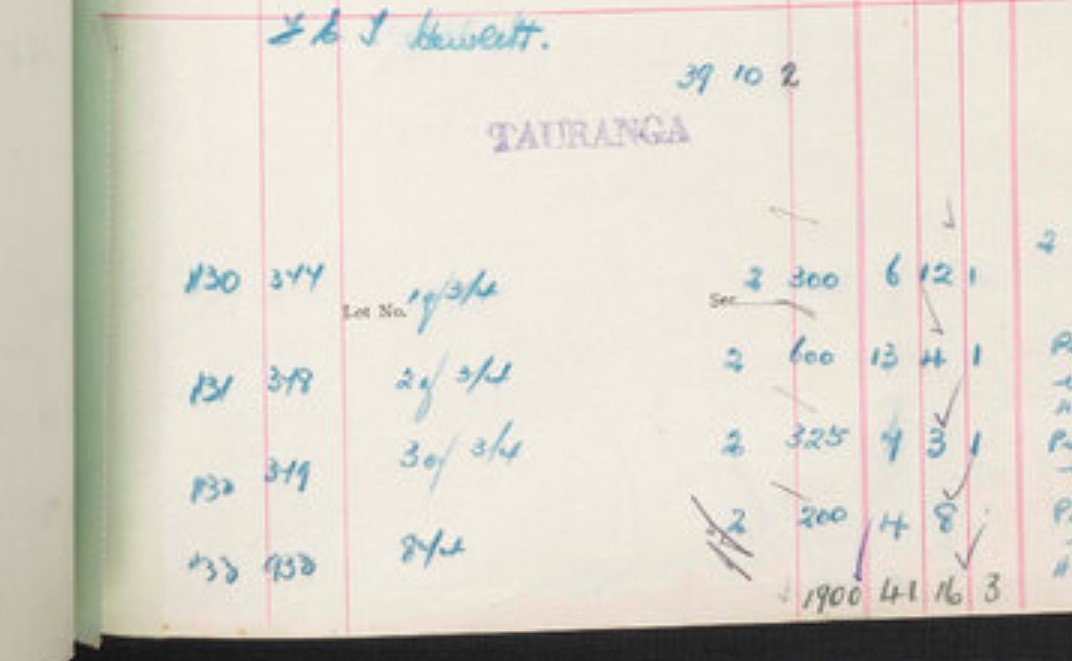
Ams 463/1/38 - Rate book, 1937-1938

In an address to the THS years later (1957) he talks of having “…a small house overlooking the Waikareao Estuary, we had a bank and half an acre of swampy land covered with gorse, blackberry and weeds. This was such an eyesore that we determined to tame it and drain the swamp; but we should have to cultivate it and plant something more interesting than the existing rubbish. Someone suggested grapes, so we set about finding how and why and where grapes were grown in New Zealand."

Te Ao Mārama - Tauranga City Libraries - 2025

We do not have any images of this property, however, a present-day photograph has been taken of the area, above the current archery field, that gives a very good idea of where the first vines were cultivated.  The work involved to continuously clear the weeds eventually became too much and the Hewletts searched for a site more suitable for grape growing commercially.

The Hewletts moved to Maungatapu, where they bought 12 acres of land and transported the vines from Waikareao to the new site. Current day Vine Street in Maungatapu is one of the streets originally part of this farm and was named after the Hewletts' vineyard.
Ms 67/18 - Maungatapu Vineyard - looking south-east towards Welcome Bay


When WWII broke out, Francis (F.E.T.) Hewlett enlisted as Wing Commander in the Royal New Zealand Air Force (RNZAF).  He progressed his military career and became Air Commodore, January 1945. Whilst he was away, not much progress was made with the winemaking, however, Francis Hewlett picked up from where he left off when he returned.
F.E.T. (Francis) Hewlett on his spraying tractor - Ms 67/18

The Papers relating to the Maungatapu Vineyard (Ms 67) contain the original speech delivered to the THS in 1957, photographs, wine labels, prize certificates and an essay titled "The suitability of Tauranga for outdoor grapes for wine making".  This must have been like a vintner's handbook back in 1957, but still provides interesting insight for today.  Some interesting points he makes are:
  • Henderson and Hawkes Bay identified as specialty grape-growing regions
  • The "American Invasion" during the war influenced the market for selling cheap, inferior wines where the main factor was the “kick” it gave
  • When men and women returned from WWII they had more of a discerning taste for quality wine and this in turn increased the demand for higher quality winemaking
  • Tauranga has the same climate as the northern Germany region of “Rotor Traminer”, and can grow exact replica Moselle vines
  • Some of the preferred winemaking grapes for Tauranga are Siebel varieties, which produce dry wines, sherries, port and Rosē.
Wine Bottle Label - Ms 67/7


Further reading...
For those interested in delving deeper into their stories, the Pae Korokī collection offers a treasure trove of resources, including the Papers relating to Maungatapu Vineyard (Ms 67) and the Journals of the Tauranga Historical Society The reference section has a biography of Hilda Hewlett, written by F.E.T. Hewlett’s daughter-in-law, Gail Hewlett: "Old Bird: the irrepressible Mrs Hewlett".

Sources
Hewlett, Gail. (c.2010). Old Bird - The irrepressible Mrs Hewlett. Leicester : Matador.
Women Who Mean Business website: https://womenwhomeantbusiness.com/2021/05/27/hilda-hewlett-1864-1943/
Auckland War Memorial Museum - Online Cenotaph 
Ams 463 - Tauranga Borough Council rate books, valuation rolls and related material
Bay of Plenty Times, Volume LXXI, Issue 13056, 26 January 1943, Page 3 - Papers Past - https://paperspast.natlib.govt.nz/ 

Tuesday, 6 May 2025

Bunka embroidery and a book by Rata Roden

From Tauranga City Library’s archives

A monthly blog about interesting items in our collection

One of the items recently digitised by the Heritage & Research Team is this framed embroidery mountain scene, worked by Rata Roden when she was 84.

'Japanese Punch' embroidery by Rata Roden, 1992  (Te Ao Mārama - Tauranga City Libraries Ams 457/4/9)

Japanese punch embroidery, or bunka embroidery, bunka shishu, uses a specialised hollow needle to weave rayon thread from the front of the fabric, through to the back. The effect is often likened to oil paintings or watercolours. As finished pieces tend to be fragile, they tend to be displayed as art, rather than onto clothing.


Rata was born 'Bessie Rata Lever', and the Lever family papers in our archives include her workbox and pincushions.

Workbox and contents (Te Ao Mārama - Tauranga City Libraries Ams 406/1)

 
Also in the workbox was a copy of her autobiography 'Here, there and most places'. Published in Tauranga in 1973, Rata acknowledged the assistance of Miss Joan Mirrielees, Kathleen Stratford and Gaye Rendell. The jacket blurb describes her story:
 
...Rata Roden has made an interesting record of her experiences in a variety of occupations in a variety of countries. It is the biography of a New Zealander, a farmer’s daughter, who, through dogged persistence realised her two main ambitions – to become a nurse, and to travel to foreign places. It is an absorbing account covering backblock farming days, nursing in the slums of London, living in many parts of Africa, the World War II in Egypt and England, travel to Japan, the Orient, Iceland, Greenland, Russia and Scandinavia. Altogether Mrs Roden has made eleven trips out of New Zealand and in her story she takes us with her."
 
Inside dust jacket and back cover of 'Here There and Most Places', published 1973.
 
Writing was in the family, as it's Rata's cousin Arthur Gray who wrote 'An Ulster Plantation'. Copies of both books are in the reference collection at Te Ao Mārama - Tauranga City Library.

  
Sources

Clasper-Torch, Micah. (2021, April 27). The history of punch needle. Sister Magazine, (61). sister-mag.com/en/magazine/sistermag-no-61-may-2021/the-history-of-punch-needle

Roden, Rata. (1973). Here, there and most places. Ashford-Kent Ltd.

Tokyo Bunka Art. (2007, May). Japanese Bunka Embroidery - The art of thread. tokyo-bunka-art.blogspot.com/2007/05

Victoria's Custom Framing & Stitchery. (2024, December 3). Bunka embroidery. facebook.com/story.php


Written by Kate Charteris, Heritage Specialist at Te Ao Mārama - Tauranga City Libraries

Friday, 20 September 2024

Ena Thompson, horticulturalist, writer and independent woman

A Chinese Gooseberries label advertising E. R. Thompson’s ‘Tropical Acres’ farm in Ōtūmoetai
Tauranga Heritage Collection, 0020/87, Tauranga Museum

My introduction to horticulturalist, writer and independent woman, Ena Thompson, came through a pair of print blocks and several corresponding advertising labels that are part of the Tauranga Museum collection. These ‘Tropical Acres’ labels were used on the end of trays carrying Chinese gooseberries grown, packed and transported from Ena’s family orchard in Ōtūmoetai in the 1950s.

Ena Thompson with her father John Shaw Thompson outside their Ōtūmoetai home early to mid-1920s. Te Ao Mārama - Tauranga City Libraries, Pae Korokī, Photo 04-681

John and Isabella Thompson, 11-year-old Ena and her younger brother Alwyn arrived in Tauranga in 1920 to settle on a 53-acre farm at the top of the Ōtūmoetai ridge that was purchased from Walter Bent.[i] Their home, a white weatherboard villa, was part of the deal and still stands in Longwood Lane.[ii] Less than twenty years earlier their farm had been part of a 180-acre property owned by Edward Howell and was known as ‘Willowbank Orchard’. The orchard was widely recognized for its ‘wonderful variety of fruits’ including peaches, nectarines, plums, and apples.[iii]

Thompson house, Longwood Lane, Ōtūmoetai, painted by family friend Ethel Macmillan
Te Ao Mārama - Tauranga City Libraries, Pae Korokī, Ams 80/11/55

While Ena’s father was a farmer’s son, at heart he was a journalist and editor. John continued to manage and own newspapers while orcharding, although this may have been a financial necessity as parts of the farm, then called ‘Viewpoint’, were sold in 1923 and 1936.[iv]  By the late 1920s, John was spending extended time away from Tauranga and in May 1929 was taken to court for failing to register the orchard as a commercial entity – the charge was later dropped.[v] The 30s and 40s were plagued with health issues for the Thompson family and during this period Ena managed the orchard. Her love of the country and farming is recorded in papers given to the Tauranga City Libraries archive in 1992. In her unpublished manuscript which was a ‘fictional’ account of running an orchard Ena wrote:

“The countryman learns to listen for country sounds which mark the day and measure the hours; the tui which calls at a certain hour each morning, an owl at dusk, the tame thrushes which cheep – cheep in the same spots day by day, the little mother-thrush which returns the second season and looks in the self-same spot for food for her nestlings. These are his friends, and such sounds chime and charm the hour on his clocks.”[vi]

As the farm shrank Ena diversified and it is for her venture into Chinese gooseberries (kiwifruit) that she is best known. In 1951 she contracted a Wellington firm to test the impact of cool storage on gooseberries and their findings led to Ena becoming the first person to send the chilled fruit to markets around New Zealand paving the way for overseas export. [vii]

A report completed by Townsend & Paul Ltd. in 1951 that showed the ‘Effect of Temperature on Chinese Gooseberries in Cool Store’

By the 1960s Ena’s focus was on flowers, growing daffodils and irises for the Auckland, Wellington, and Christchurch markets. At the same time the remaining orchard was subdivided, and sections were sold one by one. Ena was also engaged in a legal battle with the Tauranga County Council who wanted land for development on Hinewa and Ōtūmoetai Roads – an area that was known locally as Thompson’s Corner. As the city encroached and the last sections were sold, life in the country ended. Life was different but not quiet. Having many interests and friends beyond horticulture, Ena remained an active member of many Tauranga communities.

The corner of Ōtūmoetai Road and Hinewa Road can be seen towards the centre of this photograph. Longwood Lane is yet to be formed. The house that is circled is likely to have been Alwyn’s home next door to the family home that is obscured by trees. This photo was taken by Alf Rendell. He identified it as having been taken in 1950
Alf Rendell Collection RA031

References

[i] Tauranga was known to the family. John’s father, Robert Thompson, settled in Tauranga in 1866. He purchased land in Gate Pa and, as part of the Militia, received confiscated land. He eventually settled in Opotiki, becoming a major land holder in that district.

[ii] 8 June 1920, Bay of Plenty Times.

[iii] 16 February 1806, Bay of Plenty Times. Howell advertised the sale of his farm in 1907 stating that it would be subdivided to suit purchases.

[iv] Te Ao Mārama - Tauranga City Libraries Ms Ams 215. John started up the Thames Courier in 1933 and was the owner editor until it folded in 1942. John’s son, Alwyn, was employed as the paper’s advertising salesman. 30 July 1923 and 11 January 1936, Bay of Plenty Times.

[v] 8 May 1929, Bay of Plenty Times.

[vi] Te Ao Mārama - Tauranga City Libraries Ms Ams 215.

[vii] Te Ao Mārama - Tauranga City Libraries Ms Ams 215.

Friday, 2 June 2023

'Poor Tauranga'

Horace Annesley Vachell
The New York Public Library Digital Collections, Ref. 5154783

I’m probably showing my literary ignorance, but I doubt many Tauranga residents have heard of 20th century English writer Horace A. Vachell. However, it appears that he had heard of us when he wrote his short story 'Civility Pays' and had it published in the August 1930 edition of Windsor Magazine. And while Tauranga receiving a mention in an overseas magazine hardly seems noteworthy, the reaction to it in New Zealand certainly was.

Miss Inez Isabel Maud Cluett e Peacocke
Courtesy of Dictionary of New Zealand Biography

No doubt Varchell’s story would have gone without notice if it wasn’t for the New Zealand author and journalist Isabel M. Cluett (née Peacocke). Cluett’s article, ‘Through English Eyes’, which first appeared in Auckland Star in October 1930, expressed consternation at the negative portrayal of a New Zealander. She writes:

“Only recently I read a story by a well-known English author, Horace A. Vachell, in which he represents a New Zealander in London as dressed in "rough tweeds, red tie, white spats with brown boots, billycock hat jammed on the back of his head, and hands like a leg of mutton," the very image, as I conceive it, of some "flashy" racecourse tout at Epsom, but without the slightest resemblance to any New Zealander of my acquaintance. The author makes this worthy, who is "doing" England—which he fatuously refers to as "My England"—force his way into an exclusive London club, assault an elderly gentleman and the silver-haired hall porter, both of whom he knocks down by "well-directed" kicks and generally maltreats, and all because he does not agree with an article on food, which he believes the elderly gentleman to have written—mistakenly, by the way. This bounder and "bruiser" comes from Tauranga, New Zealand! Poor Tauranga, with its rather exclusive and conservative population, many of them, by the way, retired English people; what has it done to be singled out by this author as the hometown of his barbarous creation?”[i]

Cluett’s patriotic response to the ignorance of the English towards New Zealanders who, in her opinion, had earned a place in the Commonwealth following the sacrifices of the Great War, was picked up by newspapers throughout the country. The phrase ‘Poor Tauranga’ was repeated multiple times, including in the Evening Post – our plight having reached the capital! “The well-known author Mr Horace A. Vachell has displayed lamentable ignorance of New Zealand and New Zealanders in a story called 'Civility Pays.' His portrait of a New Zealander is such a gross caricature that it has moved Miss I. M. Cluett to pillory him.”

“Average Tauranga men?” – Group of unidentified young men, possibly surfers, Tauranga, c. 1940s
Vernacular photograph by unidentified photographer
Collection of Tauranga City Libraries, Pae Korokī, Ref. 09-153

And what did our very own Bay of Plenty Times make of ‘Poor Tauranga’ and the picture painted of our character? Beyond reprinting Cluett’s defence of the town it would seem we were prepared to rise above it or simply had nothing else to say.

Reference

[i] Auckland Star, Volume LXI, Issue 241, 11 October 1930.

Friday, 22 July 2022

Te Kura

Te Aho o Te Kura Pounamu (Te Kura) formerly known as Correspondence School turns 100 this year. For an amazing overview of the school’s history visit their website created to celebrate the centenary https://tekura100.co.nz/.

The Postman, New Zealand Education Department, Volume XXIII (Christmas 1950)
Image courtesy of Tauranga Heritage Collection.

Delving into the Tauranga Heritage Collection I came across The Postman, the school’s annual magazine. First published in 1927, it contains student poems, essays, and short stories alongside photographs of children and their pets. An entire section is dedicated to the school’s clubs and societies which in 1950 included The Naturalists’ Club and School Museum, Esperanto Club and Meccano and Models Club.[i]

My Puppy.

Two little ears and a little pink tongue,
That goes in and out when he’s had a long run.
Four padding paws as quiet as a mouse,
There’s nothing he likes better than a run through the house.
Two little eyes like twinkling stars,
Afraid of nothing except tractors and cars.
A little stump tail that wags all the day,
That is my puppy when he’s at play.

MARY HENDERSON, S.3. Picton.[ii] 

The Postman, New Zealand Education Department, Volume XXIII (Christmas 1950)
Image courtesy of Tauranga Heritage Collection

A poignant feature of the magazine is the ‘In Memoriam’ page, a reminder of why many students were enrolled in the school and a clear example that building relationships with students – all be it from a distance – was a core principle established by Janet Mackenzie when she established the service in 1922.[iii]

Thomas Overton - It is with deep regret that we heard of the death of Thomas Overton early this year. Thomas was a bright, cheerful little boy, and the news of his death following an operation, came as a shock to his teachers. To his parents and his brother John, we extend our sincere sympathy.” [iv]

The Postman, like Te Kura has evolved and is now called Link up. Published several times a year it is also available online https://www.tekura.school.nz/assets/link-up/Link-Up-April-2022.pdf. Much of the content remains the same and, as I discovered, is a wonderful source of positivity and inspiration.

References

[i] It is interesting to note that by 1955 the Esperanto Club is no longer in existence at the Correspondence School. Esperanto, a language created in 1887 by Leyzer Zamengov, was intended as a universal second language that promoted world peace and understanding.

[ii] The Postman, New Zealand Education Department, Volume XXIII (Christmas 1950), p.50. Tauranga Heritage Collection.

[iv] The Postman, New Zealand Education Department, Volume XXVIII (Christmas 1955), p.36. Tauranga Heritage Collection.