Showing posts with label Reserves. Show all posts

Tuesday, 7 May 2024

The Mystery of the Monmouth Cannons: Part 1

From Tauranga City Library’s archives

A monthly blog about interesting items in our collections.

Postcard, Taumatakahawai Pā (Monmouth Redoubt) c. 1910s.
Collection of Te Ao Mārama - Tauranga City Libraries, Pae Korokī ref 06-519

While sorting through our files relating to the 1990 Monmouth Redoubt restoration project, we came across this original letter dated 21st of March 1914 (also published in the Bay of Plenty Times) from Colonel G. Arnold Ward, Former Mayor of Tauranga, regarding the origin of the old guns in the Monmouth Redoubt.

Letter from Colonel Arnold G. Ward to the Tauranga Town Clerk, 1914.
Collection of Te Ao Mārama - Tauranga City Libraries, VF CCR.

In his letter to the Tauranga Town Clerk, Ward recounts the history of the six guns displayed in the redoubt, comprising of four field guns that “had done good service here in the Maori war”, as well as two much older cast muzzleloader guns.

The four “field guns” were 6-pounder rifled breech-loading Armstrong guns, two of which may have been present at the Battle of Pukehinahina (Gate Pā) (Osborne, 2014, para. 5). Following their years of service with the militia and later the Armed Constabulary (whose headquarters had been located on the redoubt), the guns had been made obsolete and placed into storage by the Defence Department - until 1899 when Mayor Ward requested that they be returned to Tauranga and displayed in the Monmouth Redoubt, as part of an initiative to convert the site into a public reserve (Kean, 2019, p. 13-15).
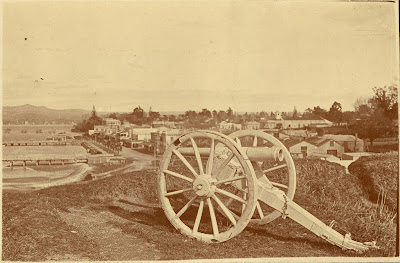
Print, Photographic, Armstrong Gun, Monmouth Redoubt, Tauranga, c. 1910s.
Image courtesy of Tauranga Heritage Collection, ref 0488/08

The two older guns mentioned by Ward were cast iron Napoleonic war cannons (more specifically carronades) dating to the early 1800s, which had been gifted to the Tauranga Borough Council in 1899 by Captain A. C. Turner and Mr. A. W. Burrows, in order to “add interest to the redoubt”. However, Ward admits, “their history I do not know and do not think their former owners knew it either”. 

Munitions on display at Taumatakahawai Pā (Monmouth Redoubt), Tauranga c. 1910s.
Collection of Te Ao Mārama - Tauranga City Libraries, Pae Korokī ref 10-161

Unlike the Armstrong guns, neither of the cannons had any known connections to the redoubt. The Burrows cannon, named Tawakeheimoa (named after the eldest son of Ngāti Kererū), is now confirmed to be one of early trader Phillip Tapsell’s twelve “big guns” used to protect his trading station at Maketu Pā, until it's capture in 1836 (Kean, 2018, p. 20). Indeed, in his letter Ward points to Tapsell as a possible original source of the Burrows gun (Ward, 1914).
Cannon, Tawakeheimoa.
Image courtesy of Tauranga Heritage Collection, ref 0017/99

The cannon donated by Captain Turner, known today as Te Tapihana, is also suspected to have come from Tapsell’s battery due to its similarity to the other Tapsell cannons (Matheson, 1989, p. 9). However, its provenance is by no means certain, since accounts about what happened to Tapsell's battery following the capture of Maketū Pā vary, making it difficult for us to verify the history of the guns (see Matheson, 1989, for a full discussion). 

One of the other cannons from Tapsell's battery, Maketū, c. 1970s.
Collection of Te Ao Mārama - Tauranga City Libraries, Pae Korokī ref 06-137 

During restoration efforts at the redoubt in the 1990s there was some discussion as to whether the cannons ought to remain in Tauranga or be sent back to Maketū (Hansen, 1998, letter). In the end the council opted to keep the cannons, as by that point in time they had become an important part of Tauranga's history (Matheson, n.d., personal communications).

Te Tapihana Cannon, Monmouth Redoubt, 2024.
Private Collection, Te Ao Mārama - Tauranga City Libraries. 

These days only Te Tapihana remains on display in the redoubt. Tawakeheimoa now resides in the care of the Tauranga Heritage Collection, as do three of the Armstrong guns – the remaining Armstrong gun can be found on display at the National Army Museum in Waiouru.

6-Pounder 3-cwt Armstrong RBL Gun Barrel, carriage is a modern reconstruction.
Display depicts a scene from the Battle of Pukehinahina (Gate Pā).
Image courtesy of National Army Museum, Waiouru.

Stay tuned! The mysterious history of the Tapsell cannons will continue in next month's blog post.

For more images of the Monmouth cannons in the Library Archives click here

Sources:

    Hansen, N. G. (30 January 1998). Letter to Tauranga District Council. Old Carronades at the Domain and on Monmouth Redoubt. Tauranga City Council Records (unpublished).

    Kean, F. (2018). Illustrated Historical Overview, Monmouth Redoubt, Lot 247, Section 1, Tauranga Town. Tauranga Heritage Collection (unpublished).


    Matheson, A. (n.d.). Personal communication. Old Carronades in the Domain & Redoubt (and Historic Village). Tauranga City Council Records (unpublished).

Ward, G. A. (21 March, 1914). "Old guns in redoubt". [Letter from Colonel G. Arnold Ward to the Town Clerk, Tauranga]. Collection of Te Ao Mārama - Tauranga City Libraries, VF CCR. 

Friday, 10 April 2020

Tauranga Domain


Rotunda in the Domain, Tauranga, Postcard, published by F.G. Radcliffe (3565)
Collection of Justine Neal
Early days ... Ngai Tamarawaho and Ngati Tapu hapu occupied the land before the Ngati Maru taua attack in 1828. The taua was heavily armed and the loss of life was great.

The origins of the present day park go back to 1873 when Tauranga residents applied to the Native Minister for a domain to be set aside. Five years later the park was extended to the south. In 1881 the northern part was set aside for a secondary school. The southern part of the Domain was called the Wharepai Ground or Domain after David Asher’s boarding house, Wharepai, which was built in Hamilton Street in 1901 and demolished in 1971.

In 1890 a temporary tent hospital was erected in the grounds to cope with typhoid patients, the disease having been caused by the poor sanitary conditions in the town.

The band rotunda was well used over the years, on August 1 1906 the Bay of Plenty Times reported: The newly formed brass band will make its first appearance in public, when the members will give an open air concert in the band rotunda, in the Domain. A collection is to be taken up in aid of the fund in connection with the recent shipwrecks in Gisborne.

Unveiling of the statue of Canon Jordan, 28 Jan 1916, Postcard
Collection of Justine Neal
On 1 July 1914 the Bay of Plenty Times reported: A committee in connection with the Canon Jordan Memorial met on Friday last, and after considering various proposals, including fountains, memorial gates etc., they decided that the memorial take the form of a statue. The statue to be of Sicilian marble, with polished red Scotch granite pedestal, the material of which the base is to be composed to be decided at a further meeting in July.

On November 3 1915 the paper reported that the statue has arrived in the yard of Messrs. W. Parkinson & Co. who report it as an exquisite piece of work.

The unveiling ceremony took place on January 28 1916, well attended by local citizens and town dignitaries. Over a hundred years later Canon Jordan is still standing there, although somewhat weatherbeaten these days.

Tauranga's War Memorial Gates, Undated postcard
Collection of Justine Neal
After the end of WWI Tauranga, like many other New Zealand towns decided a War Memorial was needed to recognise the brave sacrifice of the many local boys who had gone to fight and not returned. On March 29 1919 a public meeting was held to decide what form the memorial at the Domain should take. It was agreed to a War Memorial in the form of an ornamental gateway and gates to the Domain. The gates were to be funded partly by public subscription, although according to the paper the people of Tauranga had not been exactly forthcoming with their money. On December 11 1921 the opening ceremony for the Memorial Gates was held. The official parade was in charge of Lt. Col. Wilson. Immediate next of kin of fallen soldiers were invited to wear their war medals on their right breast and were seated with veterans and returned soldiers.

On December 9 1924 tenders were called for the erection of a Ladies Pavilion.

Aerial view of the Tauranga Domain. Photo by P. Browning
Postcard published by A.H. & A.W. Reed (SR 615) Collection of Justine Neal
Today the Domain remains as a huge asset to a busy city with its sport fields, tennis courts etc. and its collection of amazing old trees. Now wouldn’t they have some stories to tell!

References
A Centennial History of Tauranga, 1882-1982, Don Gifford
Bay of Plenty Times
Papers Past
Musket Wars, Ron Crosby

Friday, 21 February 2020

William James "Bill" Kennedy (1910 —1979)


Bill Kennedy (left) discusses the bush area he developed with Bill Turner
Bay of Plenty Times, 29 Jul 1989. Courtesy of Tauranga City Library
This dynamic man was a friend of my grandfather Duff Maxwell of The Elms. I well remember they spent quite a lot of evenings together in the 1960s as both were interested in the development of McLarens Falls Park as an Arboretum. In 1965 the Bay of Plenty Tree Society was given approval to begin planting and the Tauranga City Council undertook to cover the maintenance. It is now a world class facility with many thousands of trees covering 500+ species and a well known and popular recreational area covering some 190 Ha.

Another of this man’s enduring achievements was the establishment of Ngatuhoa Youth Lodge in the Kaimai Mamaku Forest Park in 1967. It was his vision to establish an Outward Bound facility.  Many thousands of school children and other groups over the past 53 years have stayed there and enjoyed the confidence boosting outdoor activities, beautiful bush and the Te Rere I Oturu Falls.

So what was the background of this man and what drove him to do these things. It is quite hard to find information on him but he was a family man, Crete veteran, local farmer, poet and city councillor for at least one term retiring from Council in 1968.

Friday, 10 January 2020

The Bungalow

A bungalow can be described as a single-storied house with a sloping roof, often surrounded by a veranda. The name derives from a Hindi word ‘bangla’ meaning “a house in the Bengali style,” and came into English during the era of the British administration of India.

California bungalows, Alameda, 2016. Photo Shirley Arabin
The 20th century bungalow became a popular house style in North America, Australia and New Zealand. It could be built of timber, plaster, brick, stucco or stone or a mixture of them all. The roof generally sits at a lower angle than the preceding villa style, and roof framing could be exposed at the eaves. Windows were smaller and hinged rather than hung sashes. The big bay window at the front was modified and often curved and clad in shingles on the exterior and inside a window seat. The shingles were very much an expression of its American roots. Decorative touches emerged from the British Arts and Crafts movement and from the American west.

Californian bungalow, Berkeley.  Photo DJ Grubb
The essence of the bungalow in New Zealand was the low roofline and the deep verandahs. There was a move away from the over decoration of the Victorian villa into a plainer and more practical style. In Britain a bungalow was usually a one story seaside house expressing the Arts and Crafts style, while in America it is known as a Craftsman house and often two storied, but the relationship still existed in the different locations. The roof and verandah were supported at the front of the house by sturdy piers of timber and often stone. Lead lights and stained glass featured in the windows and the interiors frequently had substantial varnished timber panelling in the major rooms, with plaster ceilings divided by boards. Door plates and handles could be copper or bronze in Art Nouveau or Art Deco motifs, and a copper hood over an open fire could be another feature. Modern facilities like electric power and indoor plumbing improved on the simpler villas. In Australia the Federation houses incorporated the bungalow style, generally with more decoration on gables and roof lines. The extent of the decoration depended on the original price of the house.

Fairview, Matheson homestead, Otumoetai. Photo Gainfort collection
A good example of a Tauranga Arts and Crafts house, Fairview the home of the late Alister Matheson in Matua was demolished some years ago. Alister's grandfather, Robert Matheson, made three purchases of land on the site of Ōtūmoetai Pā and established a 123 acre block. The Pā was originally part of the Tauranga land raupatu (confiscation) by the Government following the Tauranga battles of the New Zealand Wars in 1864, and the Matheson homestead was built in the 1920s.

The farm extended from the seashore to Otumoetai road, and the boundary with the Tollemache farm. In 1999 Alister Matheson received the Tauranga Heritage Award for his contributions to preserving and documenting Tauranga's history. He was a prolific writer for the Historic Review, The Bay of Plenty Historic Journal and published two books. The remnants of Fairview were sold to the Tauranga City Council in 2004 and became the Otumoetai Pa Historic Reserve.

Mr D G Jack's house , The Camp, Tauranga. Feb 1922. Photo Brain Watkins House Collection
 Sources

Stock N & Reynolds P, Bungalow: from heritage to contemporary, Random House NZ. 2014
http://tauranga.kete.net.nz/tauranga_local_history/topics/show/1088-alister-hugh-matheson-1925-2011

Note (27 Jan 2020): This article has been amended to reflect that the Otumoetai Pā was not deserted after the New Zealand Wars in 1864, but that it formed part of the raupatu (confiscation) by the Government following the Tauranga battles.

Friday, 2 August 2019

Pre-European Mauao

The Mount, Tauranga
Postcard published by A. McGlashan, postmarked 1915
Collection of Justine Neal
From time immemorial, rising 232m above sea level, Mauao, a conical extinct volcano has guarded the entrance to Tauranga Harbour. Mauao is a remnant of a large lava dome formed by the upwelling of rhyolite lava about 2-3 million years ago. In tradition Mauao was once a nameless peak in the Hautere forest. Spurned by the beautiful mountain Puwhenua, he asked the forest fairies to drag him into the ocean to dull his pain. But at sunrise they fled, leaving him forever at the shore. Hence his name Mauao – caught in the light of the day.

In pre-European days the vegetation cover of Mauao would have been minimal. There were at least three defended pa sites and numerous terraces, pits and middens have been recorded by present day archaeological exploration. Ranginui and Kinonui of the Takitimu waka established a pa on Mauao, as did the Waitaha people. They occupied Mauao for centuries, later Ngai Te Rangi and Ngati Pukenga  settled in the area, forming strong marital relationships.

Pilot Bay (Waikorire), Mount Maunganui, probably photographed by John Welsh, c.1920-1925
Postcard published by A.J. Mirrielees (No 45)
Collection of Justine Neal


The southern side of Mauao was the favoured area of occupation. The gentle slopes offered suitable soil for cultivation as well as free draining areas, easily terraced for occupation and crop storage. Fresh water was obtainable from several springs and the beaches of Waikorire offered launching and beaching areas for waka as well as ready access to the large shellfish beds in the harbour. Taro still grows in a spring gully (Te Puna Waitapu) immediately above the southern end of the motor camp and may represent a remnant pre-European Maori crop. On the eastern slopes one possible reason for the lack of occupation features is the high concentration of boulders and cobbles that litter the slopes. In addition the unstable nature of the rocky bluffs above this area may have presented a dangerous environmemt for permanent occupation.

Mauao, undated
by unidentified photographer and publisher
Collection of Justine Neal
The hazards of living below rock outcrops on Mauao are told in a story about Tamapahore following the battle of Kokowai. He is said to have selected a place to settle within Maunganui Pa, however, the other Ngai Te Rangi rolled great stones down the hill to his location; he took the hint and made a pa elsewhere at Maungatapu.

The summit pa of Mauao was one of the most strategically important locations in the Tauranga district with commanding views along much of the Bay of Plenty coast and inland to the volcanic plateau. An early description states ... "the pa of Maunganui covered about 100 acres. The fortifications crossed the top of the hill and ran down each side, then, circling round the base to the south, they met. The fortifications were so strong and the garrison so numerous that the pa seemed impregnable to Maori weapons."

The Mount, Tauranga, N.Z., photograph probably by Stevens Bros. (No 5), undated
Postcard published Frank Duncan & Co., Auckland
Collection of Justine Neal
1820 saw the end of Mauao as a stronghold. In that year Ngapuhi under the leadership of Te Morenga attacked the Ngai Te Rangi pa as revenge for the killing of Te Morenga’s niece, Tawaputa, in 1806. Te Morenga is reported to have had a total of between 600–800 men and just 35 muskets. But 35 muskets constituted an unstoppable force when those attacked had none, or very few. Over 400 men were killed in this battle and a further 260 taken north as prisoners.

In 1838 when William Colenso with Reverend William Williams climbed to the top of Mauao gathering geological specimens he recorded his impressions: This hill has been strongly fortified. The labour bestowed on it has been immense and yet it was taken and the slaughter was very great. It appears to have been inhabited to the very top. The sites of houses, the fireplaces and ancient excavations for stones and skulls still remaining. In 1865, following the battle of Te Ranga, Mauao was included in the lands confiscated by the Crown from Ngai Te Rangi. Today the Mauao Historic Reserve is private land, owned by the three iwi of Tauranga Moana under the formation of the Mauao Trust that is available, used and enjoyed by all as a public space.

References

Musket Wars. A History of Inter-Iwi Conflict, 1806-1845, by Ron D. Crosby, publ. 2017 by Oratia Media
A History of Mount Maunganui, by Bruce Cunningham & Ken Musgrave, publ. 1989 by Mount maunganui Borough Council
Mauao Historic Reserve Management Plan, Tauranga City Council, 2018