The
Heyday of Real Photo Postcards (1907-1909)
continued from Part 5
 |
Group
of men standing on steps of Post & Telegraph Office, Tauranga, c. Nov-Dec
1906
Real photo postcard photographed and published on Empire cardstock, attributed
to Mary Humphreys
Posted as a Christmas card by postmaster C.E. Nicholas, 18 Dec 1906
Collection of Tauranga Heritage Collection, Ref. 0162/09 |
In early October 1905 Mary
Humphreys announced to the residents of Tauranga that she was now able to take
pictures of “residences, grounds and similar subjects” and print them in real
photo postcard format at 6 shillings per dozen, or sixpence apiece.[i]
While the use of pre-printed postcard stock meant they were substantially
cheaper than the loose and mounted prints which had been readily available
until then, for general scenic views they could not compete against collotype-printed
postcards produced in large numbers by German printing firms and sold in local
outlets such as stationers T.S. Duncanson and T.E. Wayte, and later Guiness
Brothers and Miss Lacey’s Bazaar, for 1d to 2d each.
 |
Senior
Team, Kopana Hockey Club (Maud Nina Stewart at far right of front row), c. late
1906
Real photo postcard photographed and published on Empire cardstock, attributed
to Mary Humphreys
Posted by H.S.B. at Onehunga to Miss Stewart, Tauranga, 24 Dec 1906
Collection of Tauranga Heritage Collection, Ref. 0349/21 |
Short production turnaround times
and their suitability for limited print runs, however, meant that postcards
were ideal for commissioned views, particularly those which included
identifiable people, buildings or activities. Despite straying into territory
traditionally served by studio photographers as “outwork”, and for which she
now competed with a newly arrived photographer, Thomas Price’s brother-in-law Robert
Meers,[ii]
Humphreys was increasingly successful in this regard.
 |
”Regatta
day at Mount, 9th Nov 1906, O.L. Amy 1st in launch race”,
Tauranga Harbour entrance
Real photo postcard photographed and published on Kodak Austral cardstock by
Mary Humphreys
Collection of Steve Vergeest |
Although newspaper reports rarely
noted the format in which individual commissions were being produced, from 1906
onwards she was kept busy photographing weddings,[iii]
society events, sports teams,[iv]
the post office staff, business premises, visiting politicians,[v]
a sewing bee,[vi] a
picnic party, and even a yacht race in Tauranga harbour.
 |
Family
group seated on veranda of “Hightrees”, Tauranga, c. Nov-Dec 1908
Real photo postcard photographed and published on Empire greetings cardstock by
Mary Humphreys
Posted by Harold Shearman of Tauranga to Mrs Annie Nordell, Eketahuna, 14 Dec
1906
Collection of Steve Vergeest |
For the festive season Mary used
a variety of devices to allow her postcards to be used more specifically as Christmas
greetings cards. An advertisement placed in the Bay of Plenty Times for
the week from 11-15 October 1909 stated:
“PHOTOGRAPHIC
CHRISTMAS CARDS for Home and absent friends. Mrs HUMPHREYS is prepared to
execute the above. Orders left at Mr Duncanson's or Mr Wayte's attended to.” [vii]
In December 1908 Harold Shearman,
then a clerk at the Post Office and occupant of prominent Tauranga residence High
Trees, sent a postcard commissioned from Mary Humphreys, on Empire
cardstock pre-printed with a floral scroll design and the message “With Best
Wishes”, picturing himself with “wife & Co” seated on the veranda of their
home.
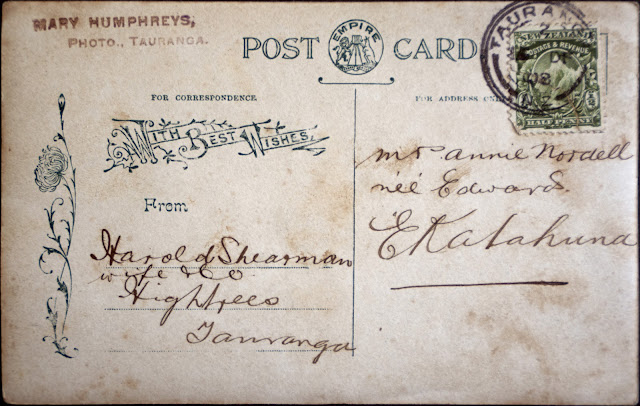 |
Empire
cardstock pre-printed with greetings message and handstamped, “Mary Humphreys,
Photo., Tauranga”
With half-penny “Aoraki” postage stamp, postmarked Tauranga, 14 December 1908
Collection of Steve Vergeest |
A similar postcard with a
slightly different “Compliments of the Season” design was sent at Christmas
1908 by Nurse Mary Chappell, a registered midwife and proprietor of The
Palms Nursing Home,[viii]
showing a woman in nurse’s uniform standing on the veranda of “The Palms”
(Tauranga City Libraries Pae Koroki Ref. 07-075).
 |
Empire
cardstock pre-printed with greetings message and handstamped, “Mary Humphreys,
Photo., Tauranga”
Inscribed, “Mrs Chappell, Tauranga … Xmas 1908
Collection of Tauranga City Libraries, Pae Korokī Ref. 07-075 |
 |
“Veterans
and returned troopers who took part in the ceremony to unveil a new obelisk at
Tauranga commemorating soldiers and sailors who fell during the New Zealand
Wars”, 11 Jul 1909
Photographed by Mary Humphreys, published in The New Zealand Graphic and
Ladies Journal, 21 Jul 1909
Collection of Auckland Libraries, Ref. NZG-19090721-0018-04 |
In July 1909 the editor of the Bay
of Plenty Times reported:
“Mrs Humphreys
secured a nice series of photographs of the recent ceremony of unveiling the
monument in the Military Cemetery, and the pictures are now available in post
card and other forms.” [ix]
This was the unveiling of the 1st
Waikato Militia Memorial, a monument to the soldiers of that regiment that had
fallen at Pukehinahina forty-five years earlier, at the Mission Cemetery (Ōtamataha
Pā).[x]
An unattributed photograph of veterans and others present at the ceremony, and
a photo of the “new obelisk” (Auckland
Library Ref. NZG-19090721-0018-08),
were published in the New Zealand Graphic on 21 July.[xi]
That they were in fact taken by Mary Humphreys is known because postcard prints
of at least two of the same images with Mary Humphreys’ stamp exist, held in a
private collection and at Tauranga Library (Pae Korokī Ref. 99-097). She also sent copies of
these postcards to Major General Robley in the UK, a gesture which ultimately
resulted in generous donations from a group of his friends for maintenance of
the cemetery.[xii]
 |
Tauranga
Gas Works, c. August 1909
Real photo postcard photographed and published on Empire cardstock by Mary
Humphreys
Collection of Tauranga City Libraries, Pae Korokī Ref. 01-569 |
In August 1909 she was on hand
for the inauguration ceremony of the long awaited Gas Works, and “afterwards
took a photograph of the gathering”.[xiii]
The postcard view above was perhaps on a different occasion, but is likely to
have sold in some numbers. She likewise produced commissioned views of various
business premises in Tauranga, including those of P. Munro, a general merchant
and land agent on the Strand (private collection), and F.H. Hammond, baker and
grocer on Willow Street (Tauranga Heritage Collection 0172/09).
 |
“From
the Mount, Tauranga, 1/1/12. GAW. 96C” View of Mt Maunganui and Hopukiore from the slopes of
Mauao
Real photo postcard, possible attribution to Mary Humphreys
Collection of Tauranga City Libraries, Pae Korokī Ref. 03-446 |
In October 1909 a series of
postcards promoting the development of the East Coast Railway were commissioned
by G.A. Ward, member of the Chamber of Commerce and newly elected president of
the Tauranga Railway League.
“The following
particulars relating to the East Coast railway have been prepared by Mr G.A.
Ward … and issued by the League to accompany the photographic post cards of the
East Coast railway and connecting lines to Pokeno and Rotorua, which are to be
distributed immediately …” [xiv]
Later views in this numbered
series, identified with the monogram “GAW” as part of the titling, include a
view of the railway line from the Moturiki Island quarry to the Railway Wharf
at the southern end of Waikorire (Pilot Bay) in January 1912 (number 96C, shown
above, perhaps one of a panorama), and one of the opening of the Tauranga-Te
Puke railway in October 1913 (number 100, private collection). Although
contemporary newspaper reports don’t state who the photographer was, it seems
likely that Mary Humphreys was responsible, as similar titling was used by her
for other postcard views from that time period.
 |
“Summer
breakers at the Mount, Tauranga, N.Z.”, taken on Mauao’s base track, c.
1910-1911
Silver gelatin print mounted on album page, photograph attributed to Mary
Humphreys
Tauranga Heritage Collection, Captain Mee Album Ref. 0032/12 |
An album of photographs presented
by Ward to Captain F.T. Mee, master of the SS Clan Ross, then the
biggest steamer to visit the port of Tauranga, by the Tauranga Chamber of
Commerce in May 1911, includes 43 photographs of the Tauranga district, most of
which were taken by Mary Humphreys, some over a decade earlier.[xv]
Four of them have the same style of titling, with G.A. Ward’s monogram on the
corner.
 |
“Ocean
Bay, The Mount, Tauranga, N.Z.” View from Moturiki, dated 11 January 1910
Lightly hand-tinted real photo postcard, photograph by Mary Humphreys
Collection of Justine Neal |
Many of these views were
published as postcards on a variety of pre-printed postcard stock, either with
or without her hand-stamp neatly placed in the top left corner of the address
side. As early as 1909 Humphreys was using Kodak Austral cardstock, replaced
from around 1916 by Kodak Ltd. “K” cardstock.
 |
Mary
Humphreys postcard on early Kodak Austral cardstock, used Jan 1910
Collection of Justine Neal |
 |
“The
Karaka Walk, The Mount, Tauranga, N.Z.” View of Waikorire from Mauao base
track, c. 1906-1910
Real photo postcard, photographed by Mary Humphreys
Collection of Steve Vergeest |
 |
Mary
Humphreys postcard on later Kodak Austral cardstock
Collection of Steve Vergeest |
Her commercial output appears to
have almost ceased by the outbreak of war in late 1914, although she was still
listed as a photographer in Wise’s New Zealand Post Office Directory for 1915.
A few postcards were used postally after that time, but most had probably been
published in earlier years. The specific reasons for her retirement from the
photographic scene is unknown, although Robert Meers did increase his postcard
output at around this time. In July 1913 he “remove[d] to commodious premises
lately occupied by T.E. Price” on the Strand,[xvi]
and in October formed a partnership with recently arrived photographer Mick
McMahon offering “all classes of photographic work”.[xvii]
While Meers is thought to have concentrated predominantly on studio portraits,
McMahon is known to have been very active in his outdoors work. Although the
partnership lasted less than a year, both of them continued to be active in Tauranga
after it was dissolved in May 1914.[xviii]
The competition for customers in a market which declined rapidly after the
outbreak of war may just have proved too stiff for Mary Humphreys.
She had achieved a great deal in the
space of a mere fifteen years. After mastering the technological and artistic
aspects of photography, she had developed a full portfolio of very competent
views throughout the region. She embraced the opportunities offered by the
newly developed technology of half-tone reproduction, and formed business
relationships with several national newspapers. She was a pioneer of the local
postcard industry, and produced a substantial number of views – probably
several hundred – documenting not only the countryside but also numerous local
events. Her known postcards are keenly sought after by local collectors, but plenty
of work still needs to be done on the origins of images from that era, and more
unattributed photographs may well prove to have been taken by her.
Mary Humphreys died in Tauranga
on 7 January 1946. Her obituary in the Bay of Plenty Times noted:
“Tauranga
loses one of its oldest and most respected residents … She took an active part
in all social activities in Tauranga and was a keen supporter of the Church of
England, the Mission to Seamen and all patriotic affairs during the two wars.
She was also one of the early supporters of the Barnardo [sic] homes. Mrs Humphreys
was well known throughout New Zealand for artistic work and needlework. She
will be missed by a large circle of friends in Tauranga and elsewhere.”
Acknowledgements
The research carried out for this
series of articles on the elusive and enigmatic Mary Humphreys would have been
impossible without access to several private and public photograph and postcard
collections. I’m very grateful to several individuals, namely Geoff Willacy, Brian
Ducker, Justine Neal, Steve Vergeest and Debbie McCauley, who have very generously
allowed me to peruse their collections, and in some cases take photographs or
scans of the postcards, and shared their thoughts gained from years of research.
Likewise, I appreciate the staff at Tauranga Library Archives and Tauranga
Heritage Collection, who afforded me unfettered access to their public collections.
Previous research published by Justine Neal, Shirley Arabin, Geoff Willacy (Historical Review, Vol 63 No 2, p42-47) and
Debbie McCauley (ref) has also been very useful.
References
[i] Mary Humphreys, “Photographic
Post-Cards. Advertisement,” Bay of Plenty Times, October 9, 1905, Volume
31 Issue 4810 edition.
[iii] “Weddings.
Rusling-Rodgers,” Bay of Plenty Times, April 11, 1906, Volume 31 Issue
4885 edition.
[iv] “Untitled [Mrs
Humphreys’ Photograph of Tauranga City Junior Football Team],” Bay of Plenty
Times, September 6, 1905, Volume 31 Issue 4796 edition.
[v] “Trip to Papamoa,” Bay
of Plenty Times, April 7, 1909, Volume 37 Issue 5342 edition.
[vi] “Sale of Work,” Bay
of Plenty Times, October 29, 1906, Volume 35 Issue 4970 edition.
[vii] Mary Humphreys, “Photographic
Christmas Cards. Advertisement,” Bay of Plenty Times, October 11, 1909,
Volume 38 Issue 5420 edition.
[ix] “Local and General
[Ceremony Unveiling Monument in Military Cemetery],” Bay of Plenty Times,
July 19, 1909, Volume 37 Issue 5384 edition.
[xi] “‘Lest We Forget’ -
The Victims of the Maori War,” The Weekly Graphic and New Zealand Mail,
July 21, 1909, Volume 43 Issue 3 edition.
[xii] “Local and General
[Mrs Humphreys Received Letter from Robley],” Bay of Plenty Times,
October 18, 1909, Volume 38 Issue 5423 edition.
[xiii]
“Progress. The New
Gasworks. Inauguration Ceremony,” Bay of Plenty Times, August 18, 1909,
Volume 37 Issue 5397 edition.
[xiv] “Railway Reasons,” Bay
of Plenty Times, October 11, 1909, Volume 38 Issue 5420 edition.
[xv] Mary Humphreys and
Thomas Edward Price, Captain Mee Album, May 1911, Photograph album,
Silver gelatin prints, 230mm (height), 290mm (width), 40mm (depth), May 1911,
Tauranga Heritage Collection,
https://view.taurangaheritagecollection.co.nz/objects/26940/photograph-album.
[xvi] “Untitled
[Photographer R.W. Meers Removed to New Premises],” Bay of Plenty Times,
July 2, 1913, Volume 41 Issue 5978 edition.
[xvii]
Robert Walter Meers
and Michael Patrick McMahon, “Partnership Notice. Advertisement,” Bay of
Plenty Times, October 29, 1913, Volume 41 Issue 6030 edition.


