Showing posts with label Social History. Show all posts

Friday, 3 July 2026

Mrs Ruth Mander (1915–2015)


Left to right: Ruth Mander, Ina Bathe, Mary Parker, and Nancy Snodgrass admiring the rose "Remember Me" at the Tauranga Rose Gardens, Robbins Park, 1991

Image: Te Ao Mārama - Tauranga City Libraries Ams 382/4/5

After several years working with the Tauranga Museum collection, I pondered on a number of donations made by Mrs Ruth Mander (née Prescott). Curious to learn more about them, I visited Ruth at her home on Ōtūmoetai Road in June 2011, where she shared memories of her life and the transformation of Ōtūmoetai from a rural district into a suburb of Tauranga. [1]

Ruth’s path to Tauranga began in the late 1930s after her mother became seriously ill with a goitre.[2] As the eldest daughter, she left her job in Hamilton to care for her younger siblings while her mother spent an extended period in hospital.[3] In 1937, seeking a healthier climate, her father, a First World War veteran, sold their Waikato farm and moved the family to a citrus orchard in Ōtūmoetai. 

Ōtūmoetai and Hinewa Roads, looking over Cherrywood and Bureta towards Mauao and Motuotau Island, c1950. 

Image: Te Ao Mārama - Tauranga City Libraries Photo 12-575

At that time, the area was still largely rural. Work on the orchard, along with caring for poultry and a house cow, formed part of everyday life. Social life centred on visiting neighbours, swimming in the harbour below Ōtūmoetai Pā, and attending local dances. It was through these connections that Ruth met the Mander girls, Betty, Dot, and Nola. They would often bike together to attend films in town, taking the long way around as Ngatai Road had not yet been formed. These friendships would ultimately change the course of her life. 

Ray Mander, the older brother, had returned home for a holiday but stayed after meeting Ruth, and the two quickly became engaged. They purchased five acres on the Ōtūmoetai ridge and were among the first in the district to plant Chinese gooseberries, later known as kiwifruit. In a practical move to secure a government loan, they married quietly at the newly opened Tauranga Post Office in December 1938 - the first couple to do so - marking the beginning of their life together. Ruth recalled that afterwards they went to Rendell’s Photography and had a wedding photo taken and then to the only restaurant in town for a meal. 

Te Puke Times, Volume 26, Issue 52, 2 July 1937, Page 3. Papers Past.

With the help of a State Advances loan, they built a Beazley bungalow on their land, designed by Ruth herself. Construction was slow, and they did not move in until September 1939, but the house would remain their home for the rest of their lives. Over the following eight years, they had four children, bringing both busyness and energy to their lives, and it was clear that Ruth took great pride in them. While the orchard developed, Ray took on various jobs, later running a hardware shop in Ōtūmoetai and keeping bees on the property. Ruth managed the household, sewed much of the family’s clothing, and maintained strong connections within many communities.

A wicker pram purchased in the 1940s by the Manders from The Mart in Willow Street.

Image: Tauranga Museum 2005/84

Ruth became involved in numerous organisations, serving for decades as treasurer of both Forest and Bird and Rural Women, and participating in local garden clubs from the 1950s onward. Over time, the landscape around them changed. Ruth recalled that after the Second World War, orchards and farms across Ōtūmoetai were subdivided into residential sections. Roads such as Lemon Grove replaced rows of trees, and the rural district she had first known gradually became the suburb it is today.

 When I met Ruth, she was living alone, Ray having died in 1995. Despite being nearly blind, she was fiercely independent, able to stay in the home she had lived in for more than seventy years with the support of her family and her deep familiarity with every corner of it. She was particularly keen for me to identify some of the objects she had donated to the museum, and I was pleased to do so while hearing the stories connected to them - her memory remaining very sharp.

A 1930s ‘Airzone’ wooden mantle radio purchased for the Mander’s new home.

Image: Tauranga Museum 0038/95

References


[1]       At the time of our meeting, it felt only right to address her as Mrs Mander, so I hope she would forgive me for referring to her here as Ruth.

[2]       A goitre is an abnormal enlargement of the thyroid gland in the neck, often visible as a swelling at the base of the throat.

[3]       Ruth initially worked as a technician for Glaxo Laboratories and later took a position in the office at the New Zealand Dairy Company while waiting for an opportunity to move into their laboratory.


Friday, 19 June 2026

David Topi Werahiko Borell – a tribute

On Saturday 9 May, fifty years and one day after his death, representatives of Tauranga Historical were invited to gather with members of the Borell whānau  to commemorate their koro and our rangatira’s contributions to his community.


Paparoa marae, 9 May 2026  (Image: Beth Bowden)

Family man, famed sportsman and scholar, Mr David Borell of Te Puna was a member of the Tauranga Historical Society in various roles in the 1960’s.  He was on the Executive Committee for a long time, starting in 1963 and serving as Vice President for 1965 (the job was taken over by T. R. Te Kani in1966).  But his activities extended far beyond those administrative functions, and well into the century’s – and his – 70s.

Te Puna Rugby Team, 1920.  Davy Borell is third from left in the middle row. (Image: Te Ao Marama, 08-073)

Davy, as he was usually known, famously turned down the chance to play for the All Blacks because his wife was due to have a baby.  The confidence that underlay such a decision may have come from his earlier experience as a scholarship boy:  he had won his secondary education at a big-city school, Sacred Heart College in Glen Innes, Auckland, where he learned Latin, history and geography.  He spoke te reo all his life and moved effortlessly between te ao Māori and te ao pākehā.  In his retirement, he put these talents at the service of the Tauranga Historical Society.

In the Society’s September 1964 Journal (Number 21) [1] he published a long-form article titled “Historic Te Puna”.  Being the scholar he was, it took two full pages of background description of waka voyages, social context, and whakapapa before he actually got on to Te Puna;  and in the midst of this introduction is a small personal gem:  his father saw the famous, now lost, family portrait sent by Queen Victoria in return for a gift of a sack of wheat flour milled at Rangiawahia.  Davy mentions:

My father actually saw this portrait of the Royal Family, which he said measured about three feet by about four feet.  In 1932 communication was made to the then Governor through the authorities, for a possible replacement of that portrait or something similar, but of course the request proved negative.  It was I who wrote out the request and covered almost two foolscap sheets of writing paper.

Davy then goes on to describe, in order, the pā of Te Puna – Oikimoke, Epeha, Hamaruru, Raropua, Oturu, the strange and beautiful story of Hawaiki, the island pa of Tukoro, Hūharua on today’s Plummers Point, and the inland pa of Hopuni, Tawhitinui, Pukewhanake, Paerangi.

We must note here, given the current exhibition of toki at the Western Bay Museum:

The  at Hakarua [Hūharua]… was a repository of scores of stone axe-heads.  Miss Violet Plummer, while I was there building at her home, showed me two boxes of these stone axe-heads.  Some of them were well polished, others were of a rougher nature, and the best ones she told me were sent away to the Auckland museum, a box full of them… a taiaha was found in swampy ground lower down… Who knows, there may be a lot of other old artifacts within or immediately outside that .

 Davy wrote beautifully, and was a great storyteller.  He could evoke character and personality, drama, emotion, and humour.  He describes the workings of the mill on the Wairoa River, and how his father Werahiko and Hone Bidois built St Joseph’s church.  He himself learned his carpenter’s trade from Werahiko.  As late as 1967 he was still using these skills for the benefit of the Society, making “a large cabinet” for the Society archives, “placed temporarily in the Sladden Library room adjoining the City Council Library.”  A suggestion that the cabinet was included in the Museum collection (Journal Number 42, April 1971) remains unconfirmed.

He was just as much at home of the water of Tauranga Moana as the mainland, and organised two trips, both involving launch travel, to entertain and inform Society members.  Under his guidance, in 1965 they enjoyed boating out to Ōmokoroa and thence (by bus) to Whakamārama; and, in 1966, took another trip out to Motuhoa Island, which started with a pōwhiri:

After these formalities were over, the tractors with their passengers and others who preferred to walk moved off towards the western end of the Island to the home of Mr. and Mrs. C. G. Borell.  It was a lengthy trudge, for those on foot, but it helped to build up a thirst and an appetite…Mr Peter Bidois, who is a highly respected elder of the Pirirakau tribe, extended a worm welcome to the visitors in traditional Māori style.  He likened their coming to the arrival of the early Māori fleet of canoes, with the winds, from the four corners of the earth, making the same waves that had carried both the visitors and the Māori people on their journeys.
Luncheon was then set on tables on the lawn…

By far the best story of island life, however, appeared in the April 1967 Journal (Number 30). It is an account of horse racing on Matakana Island, meetings which took place on New Year’s Day of 1919, 1920 and 1921: [2]

A Committee of management was elected, Mr. Aramoana Amohau being chairman and Mr. Turoia Kuka, secretary.  The first programme  was made known by way of notebook and verbal contacts.  The news spread like wildfire, and nominations were soon received for the various races.  … one such race horse, named Oaklands, a fine upstanding brown gelding, by appearance, and that alone; anyone would have deemed defeat in a race impossible; but alas, it was not to be.  Some of the Island half-racehorses which ran against Oaklands beat him to a frazzle. 

For the descriptions of the “Island half-racehorses”, and their names, and those of their owners, and the weight of their jockeys, and the adjudication of the races themselves, and the hilarious double-booking of the Tauranga Municipal Band that eventually triggered official intervention, you really do have to read the full article.  When Davy died eight years later, the Journal editor reprinted it, along with his obituary (Number 57, September 1976).

At the end of his very first article for the Journal, Davy expressed the fear that

As we are being borne aloft on the wings of progress and speeding on into the vortex of a faster world, the very things we loved and cherished are being swept away…

Screenshot of a Matakana Island beach race in 2012.  (Image: Stan Walker, J M Media)

At the commemoration we all agreed that he would be pleased to know that horses still occasionally race at Matakana Island. [3]  

 [1] All sources for the Journal references in this essay are available on Pae Koroki.  For the Collection Summary page, go to https://paekoroki.tauranga.govt.nz/nodes/view/23915

 [2] For a vigorous overview on horse racing activities in Tauranga, see Leabourn, B. From the Government Paddock to Group 1 Glory, especially Chapter 3.  https://paekoroki.tauranga.govt.nz/nodes/view/50640

 [3] https://www.youtube.com/watch?v=gXgUvLgNpps&t=24s , JM Media


Friday, 16 January 2026

Classic Refreshments of a Kiwi Summer


Mrs J. T. Trotter left and Mrs S. A. Sefton with three-year old Steven Trotter enjoy fish and chips on the Strand reclamation. Published Bay of Plenty Times 23 March 1971.
Te Ao Mārama - Tauranga City Libraries Photo gcc-16664

Who among us has not enjoyed a sunny seaside snack of fish and chips, coupled with a fizzy drink and maybe followed by an ice cream?  How long have Tauranga residents been able to do so?  It took quite a while for the components of this classic meal to come together.

Exactly 152 years and two days ago, at a race day at the Tauranga racecourse on 14 January, 1874, hot and thirsty spectators were offered a fizzy drink – the long-standing classic and ubiquitous ginger beer. Messrs Grant & Co superintended the refreshments tent [1[ and a Mr. Clarke handed out the non-alcoholic beverage, probably in sturdy, re-usable bottles that looked like this:

Tauranga Museum, 3189/85
Image courtesy of Tauranga Museum

Ginger beer was enormously popular, not only for the slightly daring implication that it might be intoxicating, but also because it was cheap and easy to make in a bottling plant or at home.  (Ginger was also a well-loved spice and thought to aid digestion.)  Prizes were awarded for the best home-made ginger beer at A & P Shows[2] and by 1923 T.H. Hall was offering it in a commercial quantity[3]:

The other elements of our now-traditional meal trio were less easily adaptable to open-air enjoyment.  The first reference I can find to an offering of fish and chips is in the Bay of Plenty Times of 16 April 1909 [4], where Mr W. H. Beets, one of the firm of Beets Bros. that flourished briefly in Tauranga during the early years of the century, offers a terse invitation:


This is, unfortunately, some months after the same paper had advertised the Beets Bros clearing sale, so maybe it is a last gesture to mark the end of their endeavours from their premises on the Strand? 

I have been unable to trace the location of either the Beets’ “depot” or the “Strand supper room” as such – it may have been a venue so convenient and well-frequented that everyone knew where Mr Beets’ hospitality would be on offer. Supper rooms were to be found as part of larger buildings all over Tauranga, so this one was very likely to be part of another establishment, possibly the Commercial Hotel.  In this, approximately 1908, photo, where the two-storey hotel is the backdrop, fish can be seen hanging on its verandah:

Tauranga Museum 0333/21
Image courtesy of Tauranga Museum

One thing is quite clear, however – in early Tauranga, fish and chips were not eaten out of paper on your lap[5], but were served on plates set on tables.  The clearest evidence of this is provided in 1911[6]:

So – mass public consumption of fish and chips occurred much later than ginger beer.  And, still later, came ice cream.


Column header, Bay of Plenty Times, Volume XXII, 9 December 1896, Page 3[7]

People knew about ice cream, of course.  But suspicions of the mass-produced stuff were rampant.  The 1909 – 1910 issues of the BP Times carry several stories of high microbe counts, the presence of arsenic, and even ptomaine poisoning.  So the cream had to be reliably sourced (Beets Bros had advertised a milk ordering service during their time here); and, although pasteurisation was well understood as a preservation process, it was complex to accomplish.

The 1896 feature article, underneath  “The Dairy” headline, highlights the way in which an apparently American manufacturer achieves production in sufficient quantity to supply the ice cream parlour in his city for the summer months.  The correspondent, J. Moldenhower, states: “Thus treated you can ship your cream with absolute safety in jacketed [i.e., insulated] cans any reasonable distance.  If the cream on arrival at its destination is cooled again to below 50 degrees, it will keep sweet for 24 hours at least even without freezing.  The pasteurised cream not only keeps from souring, but it keeps its flavour perfectly fresh for several days.”

Well, maybe.  For some time ice cream was to remain a delicacy made in private homes, involving much labour.  


Ice cream maker, Tauranga Museum 2115/85
Image courtesy of Tauranga Museum

By 20 January 1913, however – one week less than 113 years ago – we are back at the Tauranga races, where, in the “capable hands of Mrs F. H. Hammond”, a midday dinner was provided, followed by “afternoon tea, ice cream, and cream and fruit, from 2 p.m. till 6 p. m.”[8]

It could be said that Mrs Hammond broke the ice.  In October of that year, an ice cream stall was up and running at a Methodist Church sale of work[9]; and at last, in 1914, ice cream was to be had from a shop on the Strand[10],  Whitehead’s Tea Rooms.  Did Whitehead’s customers get to wander along a sunny street licking a cone?  Almost certainly not.  A thick conical sundae glass kept the confection colder for longer (anyone who has eaten ice cream made from real cream knows how quickly it drips and puddles).

A century ago our 1970's family eating with their fingers al fresco on the Strand may have chosen Whitehead’s for their classic summer meal.  And they might have found it as delicious as the fizz, fish, chips, and ice cream of today.

Ice cream sundae glass, Tauranga Museum 0209/85
Image courtesy of Tauranga Museum


[1] https://paperspast.natlib.govt.nz/newspapers/BOPT18740114.2.8
[2] See, for instance, results listed in the Bay of Plenty Times of 24 March 1916, 16 March 1917, and 15 March 1918
[3] https://paperspast.natlib.govt.nz/newspapers/BOPT19230111.2.2.6
[4] https://paperspast.natlib.govt.nz/newspapers/BOPT19090416.2.7
[5] An early example of such informality, however, is the account of the Peace Celebration in 1919, when, along with ginger beer, participating children (in large numbers) were given paper bags containing a lunch (likely to be a sandwich, a cake and some fruit).  Having eaten its contents, they felt free to blow up and pop! the bag.


Monday, 3 March 2025

Putt’s Ponies, Bethlehem

Darren Beard sits on Peanuts, one of the miniature horses at Bethlehem, being held by Mr A. M. Putt
120-format film negative, published in the Bay of Plenty Times, 1 Sep 1972
Te Ao Mārama - Tauranga City Libraries, Pae Korokī Ref. gca-20903

I came across these images recently and it brought back great memories of pony riding when I was about twelve years of age and a wannabe horsey girl. A lovely man, Mr Putt and his family had several miniature horses on their property in Bethlehem Road in the 1970s (and possibly even before my time) and for a small fee we could be led or let loose depending on the rider’s ability and experience. Both my mother and grandmother took us children (four girls) for a treat on more than one occasion.

Woman rides one of Mr A. M Putt's miniature horses at Bethlehem
120-format film negative, published in the Bay of Plenty Times, 1 Sep 1972
Te Ao Mārama - Tauranga City Libraries, Pae Korokī Ref. gca-20900

In these images you can see the homestead in the background and the trees surrounding it. For those readers familiar with the Bethlehem Town Centre, the trees behind the house are still there — between Liquorland and Patrick’s Pies. They are well established natives and I am delighted they were retained by the developers. The whole site was for some years a kiwifruit orchard owned by the Thompson Brothers and also for quite a period just bare land awaiting the development.

Sunday, 16 February 2025

Brain Watkins House Garden Party – A Special Milestone


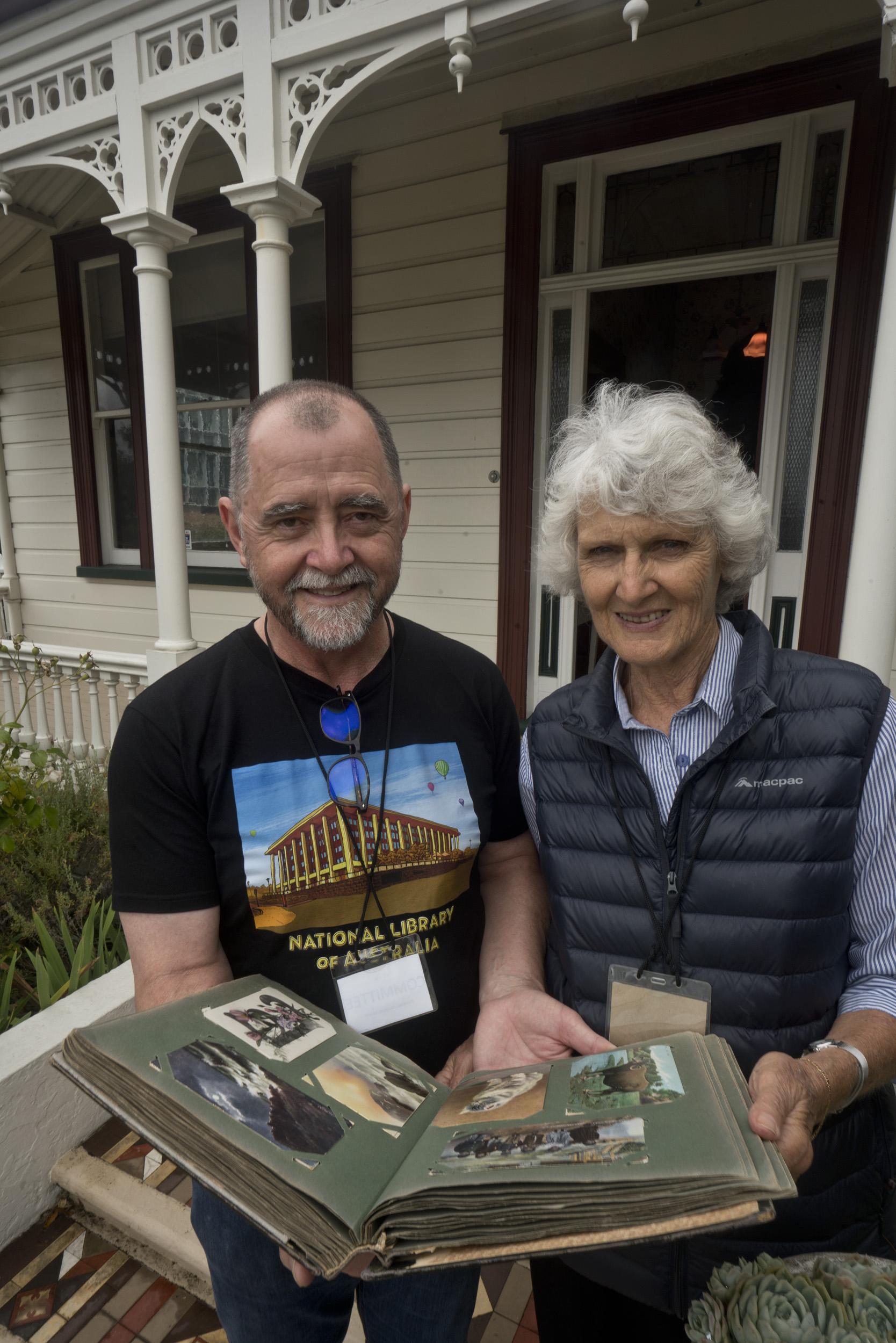
Mr and Mrs B.C. Julian examining a family postcard album on the front steps of Brain Watkins House at the Tauranga Historical Society’s inaugural Garden Party in December 1979
Photograph by the Bay of Plenty Times photographer, published 3 Dec 1979
Courtesy of
Korokī33738

In November the Society hosted visitors to the Brain Watkins House and garden as part of the biennial Bay of Plenty Garden & Art Festival, the second time we have done this instead of our usual Garden Party. What members and visitors alike probably didn’t appreciate was that the occasion happened to be the 45thanniversary, almost to the day, of our first Garden Party on 1 December 1979.

Willie Watkins and Elva Brain, c. August 1965
Photo Brain Watkins House Collection

The home of Elva Brain and Willie Watkins on the corner of Cameron Road and Elizabeth Street was left to the Society earlier that year as a bequest in Elva’s will and the garden party was an opportunity for members and guests to inspect the house and gardens which are still the Society’s home, and an important focus of our activities. More than 150 members and their guests attended, many in Victorian costumes, including then Mayor Eric Faulkner with his wife Connie, MP for Tauranga, Keith Allen, film and television actress Pat Evison, and visitors from historical societies in Hamilton, Whakatāne and Te Awamutu. We retain strong links with the Whakatāne & District Historical Society in our joint publication of the Historical Review, the Bay of Plenty Journal of History.

Wooden half hull model by Joseph Brain, Brain Watkins House Collection

Guests had an opportunity to view the rooms of the home containing not only the existing furnishings in a setting reminiscent of earlier decades, but also mementoes collected over a century. On display were old family photographs and documents, including Joseph Brain’s will, plans of his engineering projects around Tauranga, early photographs of the house, cups won at sailing regattas and even prizes won by Elva when a schoolgirl.

Elva Brain in the arms of her mother Kate, with her four older sisters, on the steps of their home, c. early 1890s
Carte de visite photograph, Brain Watkins House Collection

Elva was born in 1891 the house which her father Joseph Brain had built a decade earlier, and she lived in it for most of her life. She and her sister Bessie inherited the property when her mother died, and she became the sole owner after her sister died in 1957. The layout of the rooms and their contents have changed little since 1979, the Society choosing to preserve and maintain the look and feel of the early New Zealand home, with all its idiosyncrasies.

Brain Watkins House guides Leslie Goodliffe and Glennis Smith with the Brain family postcard album which featured in the 1979 Garden Party photo, 16 Feb 2025
Photo: Brett Payne

We also look after the more ephemeral contents of the house, such as the postcard album pictured in the photograph. Our conservation plan is currently being updated and our volunteer team not only show visitors around the house, but keep up an ongoing monitoring of the house’s condition. With the assistance of both the Tauranga Heritage Collection and the Tauranga Library’s Archives, the Society is in the process of conserving and digitising many of the house’s artifacts, and ensuring that they are cared for in the most appropriate physical and environmental conditions.

Friday, 29 November 2024

Flo Chapman's Farm Diaries

Flo's diaries, 1935, 1940, 1957

Farm diaries hardly ever survive. Because – if used as the publishers of these practical tools of farming life intended – they were there at the docking race, the hayshed or the A&P show. They, like their owners, had a hard life. Used to record only the dullest and most quotidian details from year to year they, mostly, were discarded as soon as the farm accounts were beyond the reach of auditors and the taxman.

Notwithstanding their usefulness for farming life, in fifty years of publication the New Zealand Journal of Agriculture makes only four references to the farm diary. These references are, however, very telling. The diary is an essential aspect of prudent husbandry [1] and land management [2]. It supports the farm’s business records [3] and can be used to satisfy an inquiring accountant of just when and why that cheque stub recording “Cash  - Repairs and Maintenance” (often abbreviated to “Cash - R&M”) was written out [4].

Perston Collection plan showing Chapman's farm, n.d.

You can therefore imagine the excitement felt by the archivist of the Te Puna Community Archive when, among the items stashed in a cupboard of the soon-to-be-demolished Te Puna Community Library, were found three battered volumes, each, apparently, recording day-to-day activities on George Chapman’s farm along Wairoa Road in Te Puna. The earliest has the scrawled inscription “1935” on its cover. The next carries an advertisement for boot polish and is from 1940, the first full year of the Second World War. The third, in slightly better nick, is confidently labelled, “Whitcombe’s New Zealand Farmers’ Diary for 1957” and carries the exhortation, below an image of exemplary mixed-country industriousness and prosperity: “This Diary will help you to increase your profit very materially, if you will keep a record of the notable facts and incidents, relating to your farming operations from day to day.”

How wonderful, the community archivist (the present writer) thought, in a landscape so changed and fractured by horticulture and life-style blocks as Te Puna’s, to have even three separate years’ record of day-to-day farming on a single farm before, during and in the decade after, WW II.

Vicinity of Chapmans farm, 2024, riverline in distance

George and Florence (always known as ‘Flo’)  Chapman’s farm was close [5] to those of H J Perston [6] and Arthur Todman [7].  If a conscientious record of ‘notable facts and incidents’ on their  property had been kept, the mid-twentieth century rural economy of quite a large swathe of land above the Wairoa River [8] might, by inference, be available to future researchers.

It turns out, not. The diaries are, each of them, Flo’s brief and unemotive account of the doings on, off and around the farm and within her household. There’s hardly a day missed, except for some blank sequences when she is evidently away from the farm. The weather is invariably reported on, but as often in terms of getting the washing dry as getting the haymaking done – or even, being “too wet to work this afternoon”. There are many references to arable crops – mangolds, onions, lucerne - and very few to animals. Pigs are delivered or sent away and the bobby calves are put out for the truck, which sometimes fails to turn up. (George’s carriage-horse hobby, for which he won prizes in 1927 [9], seems to have faded by 1935.) And his activities in the Farmer’s Union, which had been prodigious through most of the 1930’s [10], were much curtailed for the year of the 1940 diary. On January 26, Flo notes, “Men went to a farmers meeting, I went to the pictures”. After that, although they are sometimes in town on the day of Union meetings, Flo does not record any specific purpose for the trip. Fuel was tight in wartime, costs were rising in the war economy, and labour was in short supply. Their farm worker, Richard (Dick) Flavell was called up in early October [11] – nowhere mentioned in the diary – and was still on-farm for Christmas and Boxing Day, because Flo notes he had both days off.

In the easier economy of 1957, or maybe after some hard-won experience, Flo’s farm diary becomes more like the record idealised in the Journal of Agriculture. She notes the cost of baling 333 bales of hay on January 8: “£25-13-0 paid”. One-and-six a bale would have seemed a lot compared to 1935, when George and helpers built a haystack, but, unlike stacked hay, bales maintain higher nutritional qualities and all of every bale is quick and easy to feed out. The herd tester is there for the afternoon and morning milkings over 24 and 25 March. The dairy season re-starts on 7 July, when the first calf is born on a morning of “very heavy frost”. The first can of cream is sent off on 19 July, presumably still in excellent condition after eight successive days of frost that ended only on the 17th. As the cows “come in” for the new milking season, arrivals of bobby calves and the first lamb are interspersed with car repairs and Flo’s bowling scores. On the same day she got a £2/7/2d cheque for the bobbies, George got measured for a suit. Flo has hot water piped to her wash house and carpet in her kitchen. Things are looking up on the farm.

Flo's handwriting, 31 Dec 1957

Such threads and patches are probably insufficient to support any firm historical conclusions about mid-twentieth century farming life in Te Puna. But, lodged safely as they are in the Te Puna Community Archive, the diaries are valuable as representative examples of rural work and local society, only occasionally resonant of the world a long way away [12] and often silent or only hinting at issues that must have had significant impact on the Chapman’s life on their farm [13].  These humble volumes would repay more considered study.

All images by Beth Bowden

References

[4] Author’s personal recollection, Ettrick Farms Limited records (private archive).

[6] I am indebted to René Swan of Tauranga City Libraries for finding Perston’s survey drawing in their collection of local maps and plans

[10] Papers Past, multiple references; for background to farming politics at the time, see also https://taurangahistorical.blogspot.com/2019/12/putting-matters-right.html  Author, Beth Bowden

[12] Diary entry, 4 October 1935:  “War started between Italy & Abyssinia.”

[13] Farm labour, for instance.  Not only was Dick Flavell’s departure to be a soldier delayed for months after he was balloted in 1940;  Flo’s 1935 entries between the fortnight beginning 30 September – 13 October tersely describe the strains created by worker Reg’s decision to leave.

Friday, 12 April 2024

Baikie’s Bread Deliveries

By guest author Brooke McCann

Tom Baikie standing next to his delivery truck outside one of his earlier stores – The Strand, Tauranga, 1930
Photo: R.J. Rendell

In the early days, my great-grandfather Tom Baikie would travel the rough country roads surrounding Te Puke - delivering the daily bread from his bakery. Eventually the rural mail car took over, providing a service to deliver food parcels along with the post. Mike Bayliss, a Te Puke resident, remembers:

“Today it’s amazing to think that we had Tom’s bread delivered by the rural mail man when we lived only 2km away from the bakery. If it was a half barracuda, picking the end out and eating it on the way from the mailbox was delicious— but I once got in big trouble when not much more than the crust was left.”
Local Peter Muir was just a young boy when he’d help his grandfather Graham Barrow deliver goods in his truck. They’d load up large bags of flour from the rail goods shed to drop at Baikie’s.  Te Puke had the aptly named tradesmen Mr Baikie the baker, Mr Butcher the butcher, Mr Barrow the carrier and Mr Washer’s garage.

One of the jobs as the baker’s eldest daughter, was to make catering deliveries in the company van. As soon as my Nana June was old enough, she sat the exam for her driver’s license.  In the mid-forties a full driver’s license was available at 15, and this was the age a lot of people left school to work.

Tom Baikie with daughter June

June spent many hours preparing, with lessons from Tom. The local policeman conducted the exam, and the driving test route was well known among Te Puke teenagers. June had it down pat. She’d memorised which streets she would be asked to park, when to do a three-point turn, and where to perform a hill start. After months of practice, June executed the course beautifully, with no mistakes. On return to the station, as she sat in the driver’s seat, the policeman turned to speak. He told her that she’d done brilliantly on her driver’s test, however he had not yet asked her to start the vehicle, yet alone given her any instructions on where to drive!

Friday, 22 September 2023

Tauranga Photographers: Maurice Anthony Murphy

View from Hopukiore (Mt Drury), Tauranga, c. 1930s-1940s
Postcard format photograph by M.A. Murphy
Collection of Justine Neal

This unusual postcard view of residential Mount Maunganui, viewed from the summit of Hopukiore (Mount Drury) looking in a south-easterly direction, was taken by Maurice Anthony Murphy of The Strand, Tauranga, probably in the 1930s or 1940s. But who was M.A. Murphy? A quick search of PapersPast and Ancestry.com suggests that he emigrated aged 27 with his wife and two year-old daughter from England in 1923, giving his occupation as an outfitter. Initially he worked as a salesman in Gisborne and Auckland, before moving to Tauranga in 1931. His occupation in the electoral roll for 1935 is shown as “manager”, but by 1938 he had become a shopkeeper, and he remained in that occupation until his retirement between 1960 and 1963.

Reverse of postcard by M.A. Murphy of Tauranga
Collection of Justine Neal

He quickly involved himself in the business and social communities of the town, was a keen rower and office holder in the Rowing Club, was elected a member of the Tauranga Chamber of Commerce in March 1934, president of the Tauranga Hockey Association (April 1935), a member of the Bay of Plenty Jockey Club (February 1936) and president of the Umpires’ Association. His wife Winifred loaned crockery for use at the Plunket Society’s Christmas Party, and appears to have been involved with the W.C.T.U. Their daughter Heather, then in Standard VI, attended the Tauranga High School ball in August 1932 dressed as a pierrot.

The reference number “101” on the front of the postcard suggests that it may have been one of a series, perhaps even of at least 101 views, but if so where are the others? What was the nature of the shop which had on the Strand, and did he sell the postcards there? The use of a stamp for his name suggests that it was a sideline, or that he wasn’t in the postcard business for long enough to have specially printed cardstock made.

I’d be interested to hear from anyone who can shed further light on Mr Murphy and his photographic venture, or if you have postcards published by him, please get in touch at gluepot@gmail.com. Thank you to Justine Neal for the opportunity to share these images.