Showing posts with label Sanitation. Show all posts

Friday, 24 April 2026

The Domestic Services Block (The Cottage) at The Elms Te Papa

In colonial times, for safety reasons, settlers often constructed a kitchen separate from the main homestead.  This was certainly the case in the mid-1800s at the Church Missionary Society station (now known as The Elms) on Te Papa peninsula here in Tauranga Moana. The kitchen building and nearby bakehouse were just a few feet from the main house.  In 1877, however, a fire destroyed both, the cause thought to be a candle left burning in the maid’s room when she went over to the house for evening prayers. 

 Due to stupendous efforts of the townsfolk who heard the mission bell ringing urgently and came to assist, putting out the fire and draping wet blankets over the shingles of the house roof, the large wooden home was unscathed. The burnt-out buildings were rebuilt as soon as practical, slightly more distant from the main house.

The replacement bakehouse under construction. Image: John Kinder

There is no way of knowing if the floor plan of the new building was the same as the one it replaced.  Today the domestic services block, as it has sometimes been referred to, consists of four rooms in a row, each with their own exterior door, An internal door connects the first two rooms. One source** quotes the rooms being used as kitchens, bedrooms and a storeroom.”

 On the death of the second Mrs Brown in 1887 the property passed to her sister Euphemia Maxwell, a widow, and her unmarried daughters Alice and Edith. At this time The Elms consisted of 17 acres of land and most of the dozen or so mission buildings the Browns had purchased from the Church Mission Society over the previous decade. Permanent structures had originally included two houses, two schools, the chapel, Archdeacon Brown’s free-standing library, a storehouse, boathouse, carpenters’ workshop, smithy, and the kitchen building and bakehouse. 

Alice outside the cottage, 14 February 1945.  Image: The Elms Collection

In 1913 subdividing the property created 47 sections.  These were sold over the next few years, reducing the land area around the main house to about 3 acres and providing much needed capital to reroof it and add a kitchenette and bathroom. This enabled Euphemia to live out her days at The Elms in greater convenience until her passing in 1919.  Daughter Edith’s death occurred in 1930. Her sister Alice advertised for live-in help and a couple named Turner came to occupy “the cottage” as the 1877 building had become known. 1945 brought another couple, George and Elsie Lambie, who lived there rent-free in exchange for domestic and gardening help, which included Elsie showing visitors around at times.

When my grandparents Duff and Gertrude Maxwell became life tenants after Alice’s death in July 1949, the Lambies stayed on for a while, but then followed a series of tenants and boarders in the 50s and early 60s. A woman and her 11-year-old son* rented the cottage around 1950 until it was possible to find a home at Mount Maunganui where she had a teaching position. One family did two different stints there a few years apart whilst awaiting the building of their new homes in Ōtūmoetai.

 Gertrude Maxwell’s sister Mildred Huggins was in residence for a few years in the early 60s. A bathroom was added for her in the space between the cottage and the old bakehouse (then in use as a laundry area). Mildred returned to England leaving the cottage free for my uncle, his wife and their first child who spent time there while saving up for their first home.  

Mildred Huggins at home.  Image: julie Green

Finally, in 1971, Auntie Mildred returned from England to ‘retire’.  For the next 20 years she lived in the cottage very happily, mending broken china people brought to her, making marmalade on the old stove set up in the corner of the washhouse and washing her very long white hair in her pink bathroom. Mercifully the place was not burnt down again - she had a habit of placing logs in the fire that were too long and gradually feeding them in as the end burnt away. Six years before her passing she moved into a rest home. Several members of the extended family then lived in the cottage at various times.

 By the early 1990s both the main house and cottage were no longer occupied.  The Elms Foundation, which took over the property, began to use the room nearest to the house as an office.  The infill addition, containing the extra bathroom, was demolished. Thus the two buildings (the first kitchen and the old bakehouse) were separated once more. 

The bathroom addition in 1999.  Image: Julie Green

Currently the building is used by the management of The Elms Foundation as offices, a reception area and a base for the visitor guides. There is a very educational laundry display in the “Mangle room” and the Dairy is complete with original shelving for the display of milk pans  and butter making equipment. These two rooms are unlined, showing their interesting construction details, including the old wooden shakes, which remain under the corrugated iron roof.

 Acknowledgements

*This informal record was inspired by meeting the widow and daughter of the 11 year old lad. They visited The Elms recently to ascertain if the story they had heard from him was true.  We were able to confirm that it was.

**I referred to Sarah Ell’s book, ‘The Spirit of a Place’ to confirm some details to add to my recollections.

Tuesday, 1 April 2025

April Fool's Day and the Tauranga Ladies Rest Room

 From Tauranga City Library’s archives

A monthly blog about interesting items in our collection

An April Fools Day prank reported by the Bay of Plenty Times in 1964 was flour footprints leading to Tauranga's Ladies' Rest Rooms in Spring Street...

April Fool's Day Prank (Ladies Rest Room) (Photo gca-6426)

Although the joke isn't readily apparent sixty-one years later, the front of the Ladies' Rest Rooms were clearly visible, which caused some excitement when this negative was discovered as part of the ongoing Gifford-Cross project to re-house and digitise approximately 140,000-180,000 negatives contributed by local photographers to the Bay of Plenty Times.

There is another view of the building, tucked between Hayman Sharplin's Real Estate Agents and the New Zealand Insurance Company, in the 1965 Bay of Plenty Times photograph of members from the Australian Salvation Army Youth Congress...

Aust. Salvation Army Youth Congress - Wellington (Photo gcc-11226)

The rest rooms visitor's book is in our archives (Te Ao Mārama - Tauranga City Libraries Ams 106), unfortunately in very poor condition, it is still possible to carefully turn the pages and read entries from Mrs' and Misses noting the date, where they were visiting from, and what they thought of the facilities.
 
Detail from the first page of Ams 106 - Ladies’ Rest Room visitors' book, Tauranga, 1937-1946, showing comments from 2-5 February 1938.
 
Not an April Fools Day prank was the first meeting of the Tauranga Women's Representative Committee on 1 April 1935, where those present agreed to draft a letter to the Borough Council along the lines of...
 
"We the undersigned, being residents in and near the borough of Tauranga, emphatically protest against the action taken by the Borough Council, in deciding to build the Ladie's [sic] Rest Room on the Town Wharf, believing that such a position would be dangerous to life and limb, and detrimental to health; and urge that further investigation be made before the work is proceeded with."
excerpt from Te Ao Mārama - Tauranga City Libraries Ams 22
 
Eighteen months later "the rest room scheme provided another animated controversy at the Borough Council meeting", with the Bay of Plenty Times describing the debate where Councillor McKinnon opposed 'anything being erected on the waterfront
 
They had a waterfront that was unequalled in the Dominion. It could not be measured in pounds, shillings and pence. In the waterfront they had glorious nature and nothing should be erected that was detrimental to it'
Bay of Plenty Times, 15 October 1936, p. 3.
 
After over two years of debate, discussion and public petitions, the rest rooms were finally constructed in Spring Street in 1937. Stephanie Smith's blog and Abby Wharne's talk, provide more of the history.
 
The Strand retaining green park spaces for people to walk and play.
 
 
The Strand, Tauranga, from the Taumatakahawai (Monmouth Redoubt). 1939 or 1940. Te Ao Mārama - Tauranga City Libraries Photo 02-346
 
Sources:

Bay of Plenty Times. (1936, October 15). Ladies' Rest Room. Waterfront site. Vetoed by Councilpaperspast.natlib.govt.nz/newspapers/BOPT19361015.2.30

Smith, Stephanie. (2015, December 25).  Friday, 25 December 2015 The Spring Street Ladies’ Rest Room. Tauranga Historical Society Blog. taurangahistorical.blogspot.com/2015/12/

Te Ao Mārama - Tauranga City Libraries. (2021, March 3). Women’s Organisations in Tauranga: The Past and the Curious - talk by Abby Wharne. [Video]. Pae Korokī. AV 21-003/2. paekoroki.tauranga.govt.nz/nodes/view/42917


Written by Kate Charteris, Heritage Specialist at Te Ao Mārama - Tauranga City Libraries

Tuesday, 18 February 2020

Chapel Street

Photograph by Whites Aviation. Courtesy of Tauranga Heritage Collection
This aerial view of Sulphur Point, and the Otumoetai peninsula, was taken by Whites Aviation. The exact date of the photograph is unknown. However, as it shows the reclamation of land for the construction of the Chapel Street sewage treatment plant, it is likely to date from the late 1960s. Development of the sewage treatment plant began in 1969 and cost $1.6 million. There are many other points of interest in this photograph including the Otumoetai Golf Course, which was leased to the Otumoetai Golf Club in 1969.

Tuesday, 27 November 2018

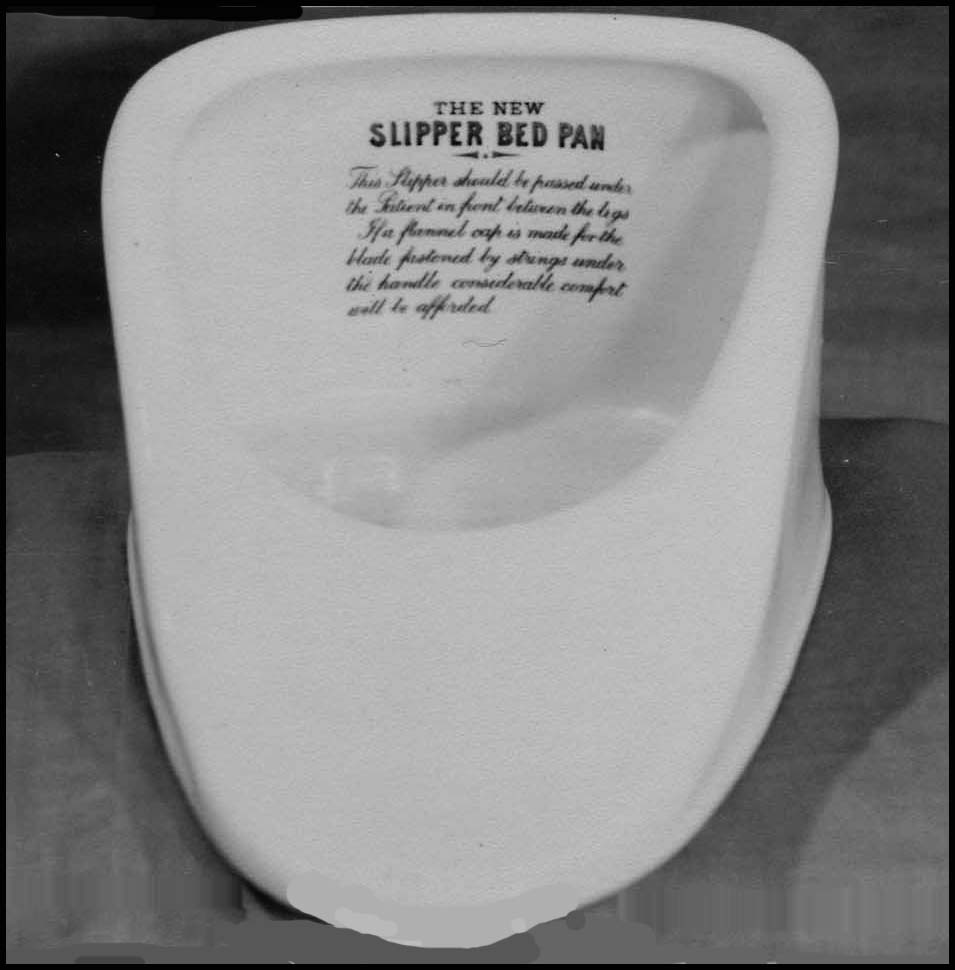
The Slipper Bed Pan

In the past, bedpans were made from pewter, ceramics, metal and more recently cardboard. George Washington, who died in 1799, used one made from pewter in his later years.


When I was a student nurse at Tauranga Hospital in 1963, I was browsing in a second hand goods shop on Cameron Road, and noticed an old porcelain slipper bed pan. The instructions on the back wall of the pan were:
THE NEW
SLIPPER BED PAN
The Slipper should be passed under
the Patient in front between the legs.
If a flannel cap is made for the
blade fastened by strings under
the handle considerable comfort
will be afforded.
An auction was in progress in the shop, and the lady next to me (who I did not know) shouted to the auctioneer, that I wanted the pan. He auctioned it next. Despite not believing I had bid, the slipper bedpan became mine. It cost two shillings and sixpence. Rather than be seen carrying an old bedpan along Cameron Road to the Nurses’ Home, I asked for it to be wrapped.


Later I discovered slipper bedpans were common in the 1920s and 30s. They were most useful for patients who found it difficult to move. Rather than being called a slipper pan, it was sometimes referred to as a fracture pan.

When I tried to give the pan away, no-one wanted it. It became a flower vase in my room in the Nurses’ Home, and it overflowed with blooms. A friend thought he purchased one bunch of flowers, and discovered he’d bought ten. At the Nurses’ Dance, the band played ‘Pennies From Heaven,’ while the pan was passed around for donations. £2.10/- was collected for the Student Nurses Association.


But the pan met an untimely end. Recorded with an article ‘Pan Antics’ in Tauranga Hospital’s magazine Suture Line 1963-64, is the death notice:
BEDPAN-SLIPPER – On October 31st 1963, at 2.10 pm. (By accident). Beloved pal of Pan Anne, and famed member of the Nursing Organisation. Funeral service will be held tomorrow, 10 am in Room 107. Procession then leaving for the Rubbish Bin, Ground Floor, Wing 3. (Clean rubbish only by request, or donation to the Student Nurses’ Association). TILL DEATH DO US PART.

Friday, 25 December 2015

The Spring Street Ladies’ Rest Room

Corner of Willow and Spring Streets, c.1940s
Image courtesy of Tauranga City Library Ref. 99-807
The Women’s Representative Committee had agitated for a rest room for a number of years without success: there was difficulty in agreeing on a site. It was not until 1936 that the committee obtained a loan of £593 from the Borough Council so that building could commence. Work began on the rest room in Spring Street on 1 June 1937, the Foresters’ Hall having been shifted to allow for construction.

/Post Office, corner of Grey and Spring Streets, c.1940
Image courtesy of Tauranga City Library Ref. 99-1287
Harry Leslie Daniel West (c.1887-1937) was the Borough Architect at the time. He started in partnership with his father in Timaru, but moved to Opotiki in about 1914, to Whakatane in 1921, and finally to Tauranga in about 1934, just three years before his death. Many of his buildings in the Bay of Plenty still stand; sadly the Ladies’ Rest Room is not among the survivors.

The rest room kept a visitors’ book, now in the archives of Tauranga Library. If this book is to be believed, the Rest Room had some famous visitors. Miss G. Garbo, of Hollywood, pronounced it “stunning”, and Miss D. Durbin was similarly impressed.

Note: Stephanie Smith has been unable to locate a photograph of the Ladies' Rest Room itself and would be delighted to hear from any readers who know of one.

Friday, 19 June 2015

The Great Tauranga Cockroach Cure

Auckland Star, 4 March 1908, Courtesy of Papers Past
Tauranga has wakened to find itself famous. It has produced a preparation which, according to Dr Purdy [Auckland District Medical Officer], is a sure killer of cockroaches. In future, Tauranga will be known to the whole world as the place where the cockroach-killers come from.
The Observer, 7 December 1907, page 16.
Mr Thomas Albert, or Albert Thomas, Pruden (1872-1957) ran “The Art Studio” on The Strand, next to Mr Wayte’s Fancy Goods Department. He advertised himself as a painter, signwriter, paperhanger, glazier, and artistic director, and he sold wallpaper and artists’ materials. To supplement his income he also gave painting lessons to those wishing to develop their artistic talents. But this art lover had a very practical side: he invented and patented an “insect destroyer”, and this is what became known as the Tauranga Cockroach Cure, even though in 1901 when he took out the patent he had been living in Taranaki.

What its formula was we don’t know. The Waihi Daily Telegraph believed it was a substance found in a natural state at Tauranga – in which case the vigour of the present-day cockroach population in this town is hard to explain – but most other papers describe it as a “concoction”. One suggestion is that it was a mixture of sugar and arsenic, which would have killed just about anything, let alone cockroaches. Spread in the holds of ships and in the premises of a particularly badly-infested Auckland bakery, it was, apparently, very effective. Mr Pruden advertised it in the newspapers for a couple of years, but in about 1909 it vanishes from the headlines and the advertisement columns and does not reappear.

George Sound, by George E. Pruden
Mr Pruden came from an artistic family. This painting is by his brother, George Edmund Pruden, who is noted in Una Platts’ Nineteenth Century New Zealand Artists as exhibiting with the Canterbury Society of Arts, 1905-1912.