Showing posts with label Horticulture. Show all posts

Friday, 20 September 2024

Ena Thompson, horticulturalist, writer and independent woman

A Chinese Gooseberries label advertising E. R. Thompson’s ‘Tropical Acres’ farm in Ōtūmoetai
Tauranga Heritage Collection, 0020/87, Tauranga Museum

My introduction to horticulturalist, writer and independent woman, Ena Thompson, came through a pair of print blocks and several corresponding advertising labels that are part of the Tauranga Museum collection. These ‘Tropical Acres’ labels were used on the end of trays carrying Chinese gooseberries grown, packed and transported from Ena’s family orchard in Ōtūmoetai in the 1950s.

Ena Thompson with her father John Shaw Thompson outside their Ōtūmoetai home early to mid-1920s. Te Ao Mārama - Tauranga City Libraries, Pae Korokī, Photo 04-681

John and Isabella Thompson, 11-year-old Ena and her younger brother Alwyn arrived in Tauranga in 1920 to settle on a 53-acre farm at the top of the Ōtūmoetai ridge that was purchased from Walter Bent.[i] Their home, a white weatherboard villa, was part of the deal and still stands in Longwood Lane.[ii] Less than twenty years earlier their farm had been part of a 180-acre property owned by Edward Howell and was known as ‘Willowbank Orchard’. The orchard was widely recognized for its ‘wonderful variety of fruits’ including peaches, nectarines, plums, and apples.[iii]

Thompson house, Longwood Lane, Ōtūmoetai, painted by family friend Ethel Macmillan
Te Ao Mārama - Tauranga City Libraries, Pae Korokī, Ams 80/11/55

While Ena’s father was a farmer’s son, at heart he was a journalist and editor. John continued to manage and own newspapers while orcharding, although this may have been a financial necessity as parts of the farm, then called ‘Viewpoint’, were sold in 1923 and 1936.[iv]  By the late 1920s, John was spending extended time away from Tauranga and in May 1929 was taken to court for failing to register the orchard as a commercial entity – the charge was later dropped.[v] The 30s and 40s were plagued with health issues for the Thompson family and during this period Ena managed the orchard. Her love of the country and farming is recorded in papers given to the Tauranga City Libraries archive in 1992. In her unpublished manuscript which was a ‘fictional’ account of running an orchard Ena wrote:

“The countryman learns to listen for country sounds which mark the day and measure the hours; the tui which calls at a certain hour each morning, an owl at dusk, the tame thrushes which cheep – cheep in the same spots day by day, the little mother-thrush which returns the second season and looks in the self-same spot for food for her nestlings. These are his friends, and such sounds chime and charm the hour on his clocks.”[vi]

As the farm shrank Ena diversified and it is for her venture into Chinese gooseberries (kiwifruit) that she is best known. In 1951 she contracted a Wellington firm to test the impact of cool storage on gooseberries and their findings led to Ena becoming the first person to send the chilled fruit to markets around New Zealand paving the way for overseas export. [vii]

A report completed by Townsend & Paul Ltd. in 1951 that showed the ‘Effect of Temperature on Chinese Gooseberries in Cool Store’

By the 1960s Ena’s focus was on flowers, growing daffodils and irises for the Auckland, Wellington, and Christchurch markets. At the same time the remaining orchard was subdivided, and sections were sold one by one. Ena was also engaged in a legal battle with the Tauranga County Council who wanted land for development on Hinewa and Ōtūmoetai Roads – an area that was known locally as Thompson’s Corner. As the city encroached and the last sections were sold, life in the country ended. Life was different but not quiet. Having many interests and friends beyond horticulture, Ena remained an active member of many Tauranga communities.

The corner of Ōtūmoetai Road and Hinewa Road can be seen towards the centre of this photograph. Longwood Lane is yet to be formed. The house that is circled is likely to have been Alwyn’s home next door to the family home that is obscured by trees. This photo was taken by Alf Rendell. He identified it as having been taken in 1950
Alf Rendell Collection RA031

References

[i] Tauranga was known to the family. John’s father, Robert Thompson, settled in Tauranga in 1866. He purchased land in Gate Pa and, as part of the Militia, received confiscated land. He eventually settled in Opotiki, becoming a major land holder in that district.

[ii] 8 June 1920, Bay of Plenty Times.

[iii] 16 February 1806, Bay of Plenty Times. Howell advertised the sale of his farm in 1907 stating that it would be subdivided to suit purchases.

[iv] Te Ao Mārama - Tauranga City Libraries Ms Ams 215. John started up the Thames Courier in 1933 and was the owner editor until it folded in 1942. John’s son, Alwyn, was employed as the paper’s advertising salesman. 30 July 1923 and 11 January 1936, Bay of Plenty Times.

[v] 8 May 1929, Bay of Plenty Times.

[vi] Te Ao Mārama - Tauranga City Libraries Ms Ams 215.

[vii] Te Ao Mārama - Tauranga City Libraries Ms Ams 215.

Friday, 19 April 2024

‘Fruit Brought Forth by the Sun’

Mr R. Henderson of Katikati packing tamarillos for export to Brisbane, July 1971
Image courtesy of the Gifford-Cross Collection, NZME, Te Ao Mārama - Tauranga City Libraries Photo, Pae Korokī Ref. gca-19469

When this recipe booklet fell from the pages of my mother’s Des Britton cookbook, I was delighted to discover that it was issued by several local fruit-growers’ associations.[i] At the top of the list of publishers was The Bay of Plenty Sub-tropical Fruits Association. Formed in May 1947, the group’s first resolution was to print precisely this kind of material in a bid to overcome what they saw as a major hindrance to the success of their enterprise - the consumer’s ‘ignorance’ of unfamiliar fruits.[ii]


‘Recipes: Sub-tropical and Citrus Fruits’ found in my mother’s 1970s cookbook
Images courtesy of Fiona Kean

Two months later, the first pamphlet featuring the tree tomato was ready for sale. Big things were expected of this ‘versatile fruit’ and in 1949 its production outstripped other sub-tropical varieties by a significant margin – 450 tons compared to 50 tons of passion fruit, 35 tons of Chinese gooseberries (kiwifruit) and 10 tons of feijoas.[iii] It was anticipated that 250 tons would be canned in Hastings the following season. Tree tomatoes grown in the Bay of Plenty were finally going places.[iv]

The historic Ōtūmoetai home, Maungawhare, circa 1900,
just a few years after this advertisement (below) was placed in the Bay of Plenty Times
Image courtesy of Te Ao Mārama - Tauranga City Libraries, Pae Korokī Ref. 03-361

The first mention in the newspaper of a tree tomato growing in New Zealand was in May 1890 when the Waikato Times reported that Mr G. Mason of Claudelands Nursery was growing the ‘novelty’ from seed imported from Ceylon.[v] Two years later, papers were reporting plants for sale in Thames and in 1895 J. J. Bettelheim, a nurseryman and market gardener in , Tauranga, was advertising for customers to inspect his tree tomato plants.[vi]


Astute readers will note that by the time my mother’s pamphlet was printed the fruit had undergone a re-brand and were sold as tamarillos. The new name was first suggested in 1966 by Mr W. Thomson the chairman of the Tree Tomato Advertising and Promotion Committee. It was officially adopted on April 4, 1967, at a ceremony held at Waitangi. Thomson explained the meaning:

“The first section of the composite name Tama, had been chosen as a compliment to New Zealand, the country of adoption. It also had historical significance, Tama being the commander of one of the early migratory canoes which brought the Maoris [sic] to New Zealand from Polynesia … The tree tomato was a native of Brazil and Peru. In these two countries the fruit is known as Paolo de tomate and tomate de arbol, which translated literally means tree tomato … we are endeavouring to get away from the association with the word tomato, but as a compliment to the countries of origin the final portion of this has been retained as Tillo. The letter T was replaced in Tillo make it easier to pronounce.”

Now is the perfect time to learn more about the tamarillo and fruit growing in our region, with the opening of the Western Bay Museum’s exhibition ‘The Food Bowl of Plenty’. To hear more about it, listen to museum manager Paula Gaelic on RNZ. Not to mention that tamarillo season has begun!

References


[i] Best known in the 70s and 80s as a restaurateur and TV chief, Sir Des Britton was ordained an Anglican Priest in 1983 and served as the head of the Wellington City Mission from 1996 to 2011.

[ii] Calling themselves the ‘Small Sub-Tropical Fruits Association’ the later dropped the word ‘small’. Bay of Plenty Times, Vol. LXXV, Issue 14370, 21 May 1947, p.3.

[iii] Te Awamutu Courier, Volume 79, Issue7139, 30 November 1949, p. 6.

[iv] Bay of Plenty Times, Vol. LXXVII, Issue 15068, 31 August 1949, p.2.

[v] Waikato Times, Volume XXXIV, Issue 2784, 17 May 1890, p. 2.

[vi] Bay of Plenty Times, Volume XXI, Issue 3261, 6 May 1895, p.5.

Friday, 28 January 2022

Mayfield House

J.W. Oliver homestead, Moffats Road, Bethlehem, Tauranga, c. 1905-1909
The house during Oliver family occupation
Courtesy of Pae Koroki Tauranga Library. Ref. 02-569

Since 1995 Mayfield House has stood in the Tauranga Boys’ College grounds on the corner of Cameron Road and Fifteenth Avenue due to the generosity of Sir Paul Adams. The house, built in 1905 for a farmer J W Oliver on 144 acres adjacent to the main road in Bethlehem is now 115 years old. Gordon Cummings had the first farm of 820 acres that ran from Cambridge Road to the sea and sold it to Oliver’s father who subdivided the land into farms for his sons.

Mayfield homestead, Bethlehem, Tauranga. Front view
The house Hawkridge during Mayfield family occupation
Courtesy of Pae Koroki Tauranga Library. Ref. 03-290

The building was typical of houses of that period in New Zealand with weatherboard cladding and a corrugated iron roof. A gable fronted room on the left and a verandah across the remainder of the building that ended with a side gable. There were three sash windows onto the verandah and a finial on each gable. There were two brick chimneys on the rear pitch of the roof, probably one for a fireplace and the other in the kitchen. JW Oliver farmed a dairy herd and planted an orchard.

"The kauri timber from which the house was constructed was brought from Mercury Bay in the Coromandel down the coast by the scow Pearl and through the harbour to the Wairoa Bridge where it was loaded on to a horse-drawn dray and taken to the site. The price for timber and deliver was between ten and fifteen shillings per one hundred feet.   Puriri blocks were used for the foundations. The iron for the roof and the guttering came from Chappell’s Hardware on the corner of Eighth Avenue and Cameron Road."

Colonel and Mrs. Mayfield and family
Courtesy of Pae Koroki Tauranga Library & The Elms Foundation. Ref. 2008.0455

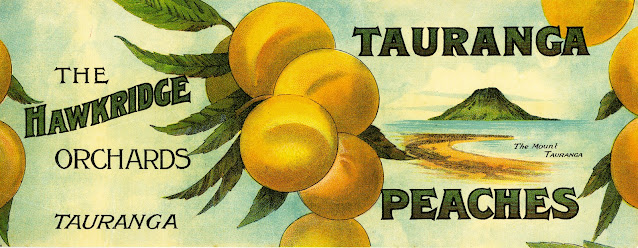
In 1909 Major Edwin Mayfield bought the property named it Hawkridge and added on a gable fronted extension on the right-hand end of the house. He and his partner Neil Chater bought the original Golden Queen peach cuttings from the Reeve family and set up a canning factory at the orchard.  Unfortunately, by 1926 rot and fire blight brought the orchard to an end and the peaches and pear trees were pulled out. They had been canned under the brand Tauranga Peaches, Hawkridge Orchards.

Hawkridge Orchards label for canned Golden Queen peaches, Bethlehem, c 1920s
Courtesy of Pae Koroki Tauranga Library. Ref. 10-085

By 1966 all of the land except for the house and two and a quarter acres had been sold and it was then  owned by Mr T Gower. Later Sir Paul Adams bought the property and removed the old house in order to make space to build a new home. Today Mayfield House is a sports pavilion overlooking the cricket pitch at Tauranga Boys’ College.

Mayfield House, Tauranga Boys College, Cameron Road, 4 January 2022
Photograph copyright and courtesy of Shirley Arabin

Sources

Mayfield House History in https://www.tbc.school.nz/mayfield-house-history. Accessed 16/12/2021

Traill, Mrs R.G., Memories of Bethlehem, in Journal of the Tauranga Historical Society, No. 49, Dec 1973, p5

Friday, 28 May 2021

Alfred Brown, the Gardener

One of Tauranga's First  English-style Gardens

A view of Brown's garden from the south c1897
Cabinet card photograph by Thomas E. Price, Tauranga

Alfred Nesbit Brown (1803-1884) was one of Tauranga’s first European residents who helped establish the Church Mission Society Te Papa Station in the 1830s. It is obvious from entries in his journal that along with organising temporary shelter for his and other missionary families, a high priority was to set out a garden with specimen trees and crops of fruit, berries, vegetables, nuts and grains.

The Archdeacon's Sentinels in the 1960s

Their home was what is now known as The Elms and in the grounds there are still at least 5 large trees planted by him in the early 19th Century. Seed from Norfolk pines was reputedly obtained in Sydney on their voyage out and two young trees were planted in such a way as to become navigational aids for ships entering the Tauranga Harbour. Later they were known as the Archdeacon’s Sentinels and appeared on Admiralty charts into the 20th Century.

Spring view of Brown's 190 year-old oak

Acorns were brought from “home” in England and a young oak grown during the Brown’s years in the Bay of Islands was transplanted to a corner of the garden in what was to become their permanent home for nearly 50 years. It is now a magnificent tree of almost 200 years and the size of many much older back in the old country.

At some time later an English chestnut was introduced, maybe as a food source, and there are presently three large specimens in this 5 star-rated garden of national significance.

A garden fete under the Bunya pine, c 1900

It became very desirable to plant exotic symmetrical pines in Victorian times and therefore a Bunya pine from Queensland was a valuable addition to Alfred’s growing arboretum. It still continues to grow taller even though it has now been there on the front lawn for over 150 years.

Apart from mostly deciduous trees which also included many elms, some ash and Stone pines a lot of time and energy was expended on food-bearing plants. From writings by Brown and his various houseguests, we can build up a picture of the tremendous variety of plantings and crops that were established.


The chestut to the left, a young elm to the right

There were various nut trees, apart from the chestnut, walnuts, hazelnuts and almonds. Fruit trees included a Kentish cherry, a peach orchard and many apples including their son Marsh’s crabapple. Hedges were hawthorne, elderberry and gorse. Vines included grapes, passionfruit, and melons. There were all types of berries including blackcurrants. The many vegetables included potatoes, kumara, pumpkins, turnips and carrots. There were six acres of wheat and corn was also cultivated. The flower gardens included many roses, aloes, sweet peas and bulbs.

All in all it was obviously an amazing place and undoubtedly a huge effort not only by Brown and his family but also many other people living at or associated with Te Papa. If you have never taken a trip to The Elms/Te Papa, I can recommend it as a lovely place to spend time at: elms.org.nz

Sources
Garden booklet prepared by Elms Guide Beverley Corbett (unpublished)
The Elms garden image collection

Friday, 27 September 2019

The Brain Watkins Garden Flora: Bougainvillea

Bougainvillea, Brain Watkins House, c.1966
Image from the Brain Watkins House Collection
The bougainvillea needs little introduction in Tauranga as it grows well in our temperate climate. Its brightly coloured branches scramble through many an archway, trellis and fence throughout the city.

A fine old specimen of bougainvillea grows in the backyard at Brain Watkins House. It has a multi-leadered trunk and the ever lengthening stems are kept under control by an annual trim. The date of planting is unknown but a photograph taken in 1966, when Elva Brain was in residence, shows it as a mature specimen with flowering stems arching over the now demolished outside laundry. The shrub has a similar appearance today, some 53 years later.

Photograph by Anne Marquand
The distinguishing brightly coloured ‘flower’ is not a petal but a modified leaf or bract. The Treasury of Botany published 1876 by Longmans, Green and Co. provides a description rich in floriferous Victorian prose….. ‘The flowers are almost concealed by large membranous or leafy bracts, which grow in triplets and form magnificent masses of paniculate inflorescence. The bracts are large and of a rich rose colour ; hence the inflorescence is singularly handsome.’

Bougainvillea was first collected in Rio de Janeiro, Brazil by the French botanist Dr. Philibert Commerson (1727 - 1773) during his voyage of circumnavigation (1766-1769) on board the frigate La Boudeuse. He named the plant for his friend and commander of the ship, Louis Antoine de Bougainville (1729-1811). Introduction to gardens in France and England quickly followed its discovery and by 1834 bougainvillea was growing in the large conservatory in Chatsworth, England, the home of plant collector the Duke of Devonshire. The species further migrated to Asia and Australia and by the mid nineteenth century it was available for sale in New Zealand. The Mason Bros of  Auckland listed the plant in their 1873 nursery catalogue. At 2/6d it was amongst the more expensive plants on sale.

Photograph by Anne Marquand
Growing near the Elizabeth Street gate, our bougainvillea certainly is the ‘right plant in the right place’ as in days gone by it was often planted by an entrance way as a sign of welcome to visitors.

Tuesday, 30 July 2019

Remembering Alice Maxwell

Alice Maxwell in 1938 with visitors Mr G. C. Williams and Mr C. R. Kemp,
standing in the doorway of the library at The Elms.
Image courtesy of Tauranga Heritage Collection, Ref. 0372/08
Upon the death of Alice Maxwell, The Bay of Plenty Times wrote:
‘…Tauranga has lost a unique and well loved figure. Tauranga’s loss is New Zealand’s loss, for there is scarcely a corner of the Dominion from which someone has not come to view the treasures which The Elms contains and to hear from Miss Maxwell’s own lips vivid accounts of Tauranga’s early history. To pass through the doors of The Elms during Miss Maxwell’s long association with it was to enter another world.’ 26 July 1949.

The ‘Alice Maxwell Memorial Kauri’ interpretation panel
Image courtesy of Fiona Kean, Private Collection
Jump forward seventy years and Alice’s contribution to The Elms and the city continues to be recognised. This time in the form of a gathering to witness the unveiling of an interpretation panel, which highlights the importance of two beautiful kauri trees planted to remember Alice.

Peri Kohu (speaking), Andrew Gregg, Elms Manager, and Board of Trustees Chairperson Ian Thomas, at the unveiling,
24 July 2019
Image courtesy of Fiona Kean, Private Collection
The panel reads:
‘Alice Maxwell who passed away on the 24th of July 1949, lived at The Elms for 62 years. She, along with her widowed mother Euphemia and older sister Edith, dedicated most of her life and resources to preserving the house and grounds as a memorial to Christian work done among Māori in the 19th Century. Following her funeral and burial in the Mission Cemetery, her nephews Grant and Duff Maxwell planted these two kauri trees (one each side of the gate) in her memory. This plaque was unveiled on 24 July 2019, the 70th anniversary of Alice’s death.’
Julie Green, who spoke on behalf of the Maxwell family at the unveiling, 24 July 2019
Image courtesy of Fiona Kean, Private Collection

Members of the Maxwell family with a framed photograph of Alice Maxwell. One of the kauri trees is visible far right. Image courtesy of Fiona Kean, Private Collection

Tuesday, 26 February 2019

Tauranga Hospital's Roof Garden

Roof Garden, from rear, 1994: puka trees: pond area, to right beyond box hedging: hebes, a variety of pittosporums, Teucrium fruticans (germander) (large grey green plant). Lower right: mixed conifers. Next to path, ground cover junipers. Bottom right corner: Australian frangipanis. Photo: Vivien Edwards
When the Clinical Services building at Tauranga Hospital was planned, Hamilton architects Gillman, Garry, Clapp and Sayers’ suggestion to use soil for roof insulation and create a garden, met with controversy. There was no other roof garden completely covering a roof in the Southern Hemisphere, let alone one on top of a hospital building. After reassurance from the architects a garden could be created without the roof leaking, and approval came from Wellington, it was decided to proceed. The therapeutic value of plants and the important role gardens play in creating optimum conditions for people to heal, was recognised. Such a garden would create an environment where patients, relatives and staff could retreat from stressful events, find beauty and solace, and be restored. When patients’ health and the weather conditions allowed, those confined to bed, could be wheeled out into the garden, along with supporting equipment such as intravenous drips. Mobile patients would make their own way.

In 1994, I had the opportunity to investigate the story of what was then Western Bay Health’s roof garden, as GP Weekly, a publication I wrote for, which now no longer exists, regularly published a page on doctors’ gardens. Ron Benfell, one of two gardeners employed at the time, showed me around the garden. His fellow gardener was Frank Thompson. The two men spent two to three days a month, maintaining the roof garden. They also cared for the other hospital gardens. Unfortunately, some gardens had to make way for new hospital buildings, to service Tauranga’s burgeoning population.

Puka tree (Meryta sinclairii), 1994. Photo: Vivien Edwards
Alyson Howell, customer services manager for Western Bay Health at the time, told me the roof garden was developed in 1971. The garden had been carefully planned. The roof was waterproofed with polybutanol, and the piped drainage system had control valves. There were layers of chaff, straw and pumice, then soil, only a spade-end deep, except where mounded to create raised areas. Despite minimum soil depth, some conifers were 20 to 25 feet high. The flowering cherries had recently been topped. A large variety of perennial species were chosen for their particular qualities, and with regard to their rooting system. “We couldn’t plant a tree with tap roots on the roof.”

Those on the upper floors of what was then the main hospital building, look down onto the garden. Cameron Road is on one side of the garden. Below, on the other side, are secluded courtyards, accessed through the clinical departments. In 1994, the courtyard nearest to the main building had a white camellia, and the central courtyard, a large Japanese maple Shin deshobo, which hung over the courtyards on either side. The furthest, more shaded courtyard grew pongas and other ferns. The railing near the entrance to the roof garden was covered with maroon-coloured jasmine and fatshedera. Bouganvilleas were being established. A cobblestone path and dwarf box hedging divided the garden into separate feature areas of conifers, small perennial shrubs and natives. A waterfall (out of sight in the photo) was set in a grassed area. It had a long run to the bottom, before the water was pumped back. Walking through the garden, which is around a quarter of an acre in size, there were weeping silver birches, pittosporums, three flowering prunus trees, surrounded by several smaller crepe myrtles, followed by mixed conifers, and a dwarf kowhai next to small perennials.

Pond area of the roof garden, 1994. Photo: Vivien Edwards
The pond had a backdrop of Leptospermums, azaleas, Choysia and Pittosporums. Before the large pukas (Meryta sinclairii) were two wide-leafed Australian cabbage trees. Pink proteas and Ceanothus behind a seat created shelter and privacy. Beyond the native shrub area was a stand of large conifers and Australian frangipanis. Along the meandering, cobblestone path, wisteria clinging to the pergola, helped to offset the hospital’s large ventilation cooling towers. At night the garden was strategically lit. Those unable to sleep, could look down on the trees.

Since 1994, the roof garden has undergone change. The pond was fenced to comply with health and safety legislation and I don’t remember seeing the waterfall when I was last there. But the roof garden is still a beautiful and restful place, worth a visit next time you are at Tauranga Hospital.

Friday, 25 January 2019

The Floral Ship on the Strand

Floral Ship. Tauranga. B.P. N.Z. 3001.
Undated postcard, publisher unknown. Collection and courtesy of Justine Neal
A floral ship constructed in 1938 has graced The Strand ever since, it has no doubt featured in many holiday photos and many of those who live in Tauranga have fond memories of this iconic creation. The shape of the ship has changed over the years, in fact in some photos, it appears to have lost its trim lines altogether.

Floral Ship. Strand, Tauranga, N.Z.
Postcard sent March 1956, publisher unknown. Collection and courtesy of Justine Neal
 Bay of Plenty Times, 13 Feb 1941
The Floral Ship at Tauranga
by Kathleen E.S. Gunn. Wellington, N.Z.

A floral ship sits proudly on the Strand,
Dressed in a dainty cloak of cactus green,
She looks so stately with an air so grand,
And reigns o'er all our hearts like any queen.

Her passengers are little dancing elves so gay,
Her cargoes are made up of golden dreams,
And as she dails away, far-off to dreamland bay
She's bathed in shafts of sunlight's golden gleams.

No guns are there to mar the beauty of her decks
She seems to be symbolical of "Peace,"
And someday soon she'll harbour all the wrecks
When Love will triumph over hate and wars will cease.

For this is how this floral ship appealed to me -
A ship of Peace, arrayed in mother Nature's garb,
So perfect and so beautiful she sails along Life's sea:
No rocks of strife will pierce her with their barb,

O lovely floral ship I'll often dream of thee!
My ship of Peace, set in a garden gay with flowers
In fair Tauranga by the shimmering, deep blue sea
In memr'ys lane I'll wander by thy fairy bowers.

The Floral Ship. Strand Gardens. Tauranga.
Undated postcard, publisher unknown. Collection and courtesy of Justine Neal

The floral ship was built by Charles Cameron, the borough gardener for Tauranga, and Thomas Ross who worked for him. Wire netting, at a cost of 15s, was formed into the shape of a ship and covered a base of packed earth. It was planted mainly with succulents. By 1940 the Bay of Plenty Times reports the ship as having grown somewhat wider in the beam since it was launched a few years ago and Mr. Cameron and his staff were stripping the outer covering of plants and replacing them with smaller ones. Over the years the plants used to cover the floral ship have been Echeveria, lime-green Pyrethrum (never allowed to flower) and blue Lobelia.

Floral Ship, The Strand, Tauranga, New Zealand.
Undated postcard published by P.P.L. Hastings. P.705. Collection and courtesy of Justine Neal
In 1947 the Bay of Plenty Times reported that the floral ship was refitted and ready for sea again. Now very colourful the ship was built up of Echeverias, the smoke effect being achieved with pyrethrum and circled with a border of lavender.

The Floral Ship on the Strand, Tauranga, New Zealand, circa 1960.
Postcard published by Dow Productions No. 37. Photography Lyric Studios, Auckland
Collection and courtesy of Justine Neal
During January 1960 the floral ship underwent a complete rebuild and in 2005 a full restoration took place.

References
Papers Past.
Tauranga Library Kete.

Friday, 18 January 2019

The Brain-Watkins Garden Flora: Lily of the Valley

Elv Brain & Willie Watkins' wedding, 1963. Photo: Brain-Watkins House Collection

LILY OF THE VALLEY    Convallaria majalis

When Elva Brain married Willie Watkins in 1963, lily of the valley was her wedding flower of choice. The small delicate blossoms in Elva’s wedding bouquet complemented her lace wedding dress and pearl jewellery. An arrangement of lily of the valley flowers in a fine crystal vase was placed on the top tier of the wedding cake.

Lily of the valley, with its association of modesty and purity, has long being favoured by brides through  the ages. Catherine Middleton on her marriage to Prince William in 2011 carried a bridal bouquet of lily of the valley as did Princess Grace of Monaco at her wedding in 1956. In the  “The Language of Flowers’, its meaning of ‘luck in love’ and ‘a return to happiness’  reveals a traditional  significance of the flower within the wedding ceremony.

Lily of the Valley in Brain-Watkins House. Photo: Anne Marquand

Convallaria (of the valley) majalis (May) was established in gardens from medieval times onwards and became one of the many flowers associated with the Virgin Mary. Tradition relates how the plant sprang from Mary’s tears at the Cross and from those tears shed by Mary Magdalene on finding Christ’s tomb. The country name for the plant ‘Our Lady’s Tears’ carries this Marian association. A red flowering variety was recorded in the 17th century and the double variety, ‘Flore Pleno’ was grown from the 18th century onwards.

The lily of the valley is a hardy perennial native to Europe and North America and grows in cool, moist climates throughout the world. Dark green oval leaves appear in early spring followed by fragrant bell shaped white flowers in late spring-early summer. The plant has an indefinite spread and grows best in a moisture retentive, nutrient dense soil in partial shade. It is propagated by dividing the creeping rhizomes in late autumn when the foliage has died down.

A fragrant essential oil distilled from the flowers is used in the perfume industry. The leaves yield a dye when mixed with lime water - green in spring and a yellow bronze colour from the mature leaves in autumn. The plant has no culinary use as all parts are poisonous.

Lily of the Valley in Brain-Watkins Garden. Photo: Anne Marquand
A memory from the 2004 Conservation Plan for Brain Watkins House  recalls lily of the valley growing along the fence on the Elizabeth Street side of the house. It still grows nearby today, now confined to a small bed amongst other cottage favourites, montbretia and the shasta daisy. The old pink flowering climbing rose shades the plants from the hot Tauranga sun.

Perhaps when Elva opened her bedroom window on a spring morning, the soft fragrance of the lily of the valley flowers floated though her room and in her later years that gentle scent ‘comforted the heart and vital spirits’. (Culpepper)