Showing posts with label Te Ao Mārama - Tauranga City Libraries. Show all posts

Tuesday, 5 May 2026

The Library's Bay of Plenty Farmer Newspapers


From Tauranga City Library’s archives

A monthly blog about interesting items in our collection

In 2023, the Library's Heritage and Research Team was invited to see if there were any published items of value we could retrieve from the basement storage area at the NZME offices on Cameron Road. Among other titles, we found issues of the Bay of Plenty Farmer, a local, tabloid publication that the library had never collected.  

The newspapers are in fairly good condition. Some issues are bound in large volumes and others are loose with punch holes near the margins. We placed them all in snug fitting archival boxes and we keep them in the library’s climate controlled room for their protection and preservation.  


A bound volume of Bay of Plenty Farmer newspapers inside an archival box.

The Bay of Plenty Farmer was a free, monthly newspaper, delivered to the ‘farm gate.’ Printing commenced in 1982 and lasted until probably 2001. After 12 years, the publishing team moved from their Cameron Road location to ‘Farming House’ at 102-104 Spring Street, sharing the premises with Federated Farmers and Farmer Mutual Group. From September 1998 it was published from the Mount and Papamoa Times offices in Mount Maunganui.


An article in the Bay of Plenty Farmer, on Clydesdale horses working in the Tarawera Forest, July 1982. 

The newspaper comprised regular features on farming industries such as dairying, horticulture, forestry, motoring, education and house & garden, along with regular columns from the Bay of Plenty Federated Farmers.  It featured articles with photographs by local journalists such as the late Brian Rogers, who went on to co-found SunMedia and produce the rural Coast & Country News publication in 2000.


Photos of the Te Puke A&P Show, published in the Bay of Plenty Farmer, March 1994, p. 8.

Plenty of local social history is captured as Bay of Plenty Farmer journalists attended rural special events such as local A&P Shows, school agricultural days and the National Fieldays. Later, issues featured coloured front-page photographs and advertising.


Front page colour photo from the Bay of Plenty Farmer showing Ben Wiltshire with Shetland ponies, September 1998.


Kiwifruit industry related articles featured heavily in the publication, however, it is interesting to note that, through the years, other interesting agricultural ventures like ferret and ostrich farming were embraced by Bay of Plenty locals. 


An article on fitch ferrets, bred in Waihī for their pelts, Bay of Plenty Farmer, July 1982.

An article on ostrich farming, with ostrich industry advertising on the same page, Bay of Plenty Farmer, February 1998.

The only other copies of the Bay of Plenty Farmer are at the Alexander Turnbull Library, which holds limited runs - from 1985 to 1986 and from 2000 to 2001, so many of these newspaper issues are unique to Te Ao Mārama - Tauranga City Libraries collection. 


Sources

A&P Show. (1994, March). Bay of Plenty Farmer. Tauranga, New Zealand.
From the horses mouth. (1998, September). Bay of Plenty Farmer. Tauranga, New Zealand.
Fry, C. (2025, October 12). Rural paper celebrates 300th issue milestone. SunLive. https://www.sunlive.co.nz/news/372839-rural-paper-celebrates-300th-issue-milestone.html
Ostrich prices level with bird's productive value. (1998, February). Bay of Plenty Farmer. Tauranga, New Zealand.
Riches in fitches. (1982, July). Bay of Plenty Farmer. Tauranga, New Zealand.
Secombe, W. (1992, July). A pictorial look at the Bay at work. Bay of Plenty Farmer. Tauranga, New Zealand.


Written by Michelle Bradbury, from Te Ao Mārama - Tauranga City Libraries


Tuesday, 7 April 2026

Forestry on Matakana Island in 1969

From Tauranga City Library’s archives

A monthly blog about interesting items in our collection

Te Ao Mārama - Tauranga City Libraries' Heritage and Research Team and its predecessors have been collecting local history material for over 50 years. The snapshot above is from a set donated to the team by Hamilton City Libraries - Te Ohomauri o Kirikiriroa, and digitised in 2021. The set is undated, but looks like it may be from the 1970s or 1980s. The set can be viewed here, each individual image includes an edited version with colour restored, due to severe fading of the original prints.

The present Heritage and Research Team at Tauranga are reviewing their Vertical File collection and other, related items are emerging. In the Forestry file was an article clipped from an unidentified magazine and with no date, called "Matakana Island : reaping the Pineland wealth", by Olaf Petersen. After some investigation we determined it was published in the New Zealand Weekly News of 2 June 1969. We have added a scan of the article to Pae Korokī.

It contains twelve images selected from photographs the Auckland-based Petersen took of timber felling and processing on Matakana Island, in Tauranga Harbour. Of the twelve photographs in the piece, eight include pictures of individuals. For some reason only one of them is named - Mr Stuart Hume, forest plantation manager on Matakana - in the top left corner of page 31.

In 1988 the photographer donated his archive to the Auckland War Memorial Museum. It is described at length in their Collections Online entry for the archive. Two of the photographs from this article have been digitised. The photographer had collected information about his subjects that wasn't included in the published article, so we can now add a little bit more detail to the story of forestry on Matakana Island.

The photograph on page 31 captioned "A stack of timber is wired together ready for transport" is described by Auckland Museum as "Photograph of Hohepa (Joe) Hamuera Kohu working in a shed and operating a hand lever used in timber production".

The photograph below it, captioned "Morning tea break in the Pinelands forest on Matakana", is described as "Three men who are working at felling trees in the forest, stop for a break to drink from jars and a thermos. On verso the men are named as L to R; Melbo Rolleston, Charlie Murray, Eru Tukaki. They are surrounded by felled trees and a stand of forest in the back ground. Sitting on the trees near them are two chainsaws and an axe". The published version has been cropped and is missing Melbo Rolleston.

We hope that over time more photos used in the article will be digitised, allowing the identification of more individuals.

Extracting the article, finding the work of other institutions and receiving donations has allowed us to both increase our knowledge of a subject of local interest and enable more questions to be asked. This process of accumulation can be slow and indirect, but placing it in Pae Korokī opens it up to discovery and engagement by one of the distinctive communities of Tauranga Moana. 

Sources:

Matakana Island / Neil G. Hansen. Journal of the Tauranga Historical Society No. 63, August 1979, pages 38-40 (or 41-43 of the PDF).

Matakana Island (Tauranga) / Jinty Rorke. Te Ao Mārama - Tauranga City Libraries, Matakana Island.

Matakana Island / Suzanne Woodley. Wellington, N.Z. : Waitangi Tribunal Division, Department of Justice, 1993.

Petersen was a well-known photographer who died in 1994. Te Ao Mārama -Tauranga Libraries holds copies of a recent collection of his nature photography - Nature boy : the photography of Olaf Petersen.

Tuesday, 3 March 2026

No Deed Goes Unpunished: Forging Title at Lot 202

From Tauranga City Library’s archives

A monthly blog about interesting items in our collection

Lot 202, Section 1, Town of Tauranga: a century-long ownership anomaly

Lot 202, Section 1, on the corner of Grey and Elizabeth Streets, originated as part of the Te Papa lands purchased in 1838–1839 from Ngāi Te Rangi by the Church Missionary Society to be held in trust, and was transferred to the Crown under post-war pressure in 1867 for the creation of the Tauranga township. At that time it was one of the sections that Governor Grey had promised to Crown aligned Arawa and Ngāi Te Rangi chiefs to receive in recognition of their service during the New Zealand Wars. Twenty-six sections were selected for this purpose, and Crown grants were eventually issued for twenty-five of them. Strangely, and despite later being occupied, Lot 202 was never officially granted, remaining on paper at least, in Crown ownership.

This went unnoticed for decades.

From 1871, it had been occupied and used by Anaru Haua and later by his descendants. Although the family lived primarily on the sections next door, Lot 202 was fenced, cultivated as a garden, and used as a horse paddock. After the road level was raised in 1920 the section was re-fenced, with a gated and padlocked entrance at the corner. Rates were paid on the land from at least 1910, and it was widely known locally as Haua’s paddock. In 1950 Charles William Haua, who had been operating at the Spring Street end of Grey Street, built a blacksmith’s shop on the section and continued to operate his business there.

Charlie Haua's blacksmith's shop, Grey Street, cnr Grey and Elizabeth Streets
Charlie Haua's blacksmith's shop, cnr Grey and Elizabeth Streets
Te Ao Mārama - Tauranga City Libraries Photo 02-156

By the 1920s, when the Crown reviewed lands that were “looked on as Crown lands subject to Native claims,” the mistake came to light.  Competing claims were raised by hapū who had originally been intended recipients of township sections in 1867, and in 1955 the Māori Land Court made an order vesting the land in Tamihana Tikitere of Ngāti Uenukukōpako. It looked like the Haua's might loose access to Lot 202 and the new blacksmith's shop would need to move.

Charlie Haua was not making his claim to the proprety through the Māori Land Court however, but under the Land Transfer Act, on the grounds that the land had been clearly and unambiguously in his family’s complete possession for several generations. In legal speak this is a principle known as adverse possession; and it meant that he could not make his case to the Māori Land Court, even though their decision directly affected the same land. Instead, he brought proceedings in the Supreme Court (A.122/59), heard in 1960 before Justice Hardie Boys. The Court examined the full history of the section and found as a matter of fact that Haua and his ancestors had occupied Lot 202 openly, continuously, exclusively, and notoriously (in the legal sense) from the nineteenth century onward. Lot 202’s ambiguous status, caused by administrative failure, was finally resolved by judicial decision after nearly a century.


Charlie Haua's blacksmith's shop, Grey Street, Tauranga c. 1940s.
Mollie Hardy, Charlie Haua, Pat Holloway.
Te Ao Mārama - Tauranga City Libraries Photo 99-1161

Charlie operated his blacksmith business from the corner of Grey and Elizabeth Streets until 1969 when we finally retired. His blacksmithing operation was transferred to the Tauranga Museum / Historic Village, where it was preserved as a working exhibit. There, he continued to demonstrate blacksmithing for school groups and visitors, keeping the craft alive as a public heritage activity for many years. 

The judgement is part of Ms 81, the Papers of Charlie Haua within the archives at Te Ao Mārama - Tauranga City Libraries, which have been digitised at made available on Pae Korokī Tauranga Archives Online. 

Sources

Lot 202 Section 1 Town of Tauranga, Judgement of Hardie Boys, J. (Journal of the Tauranga Historical Society Number 57, page 11)
Lot 202, Section 1 in Tile 4: Survey Office map 55557
Judgement of Hardie Boys, J. for Haua v Tamihana and the District Land Registrar (Ms 81/2/1)
Papers relating to post war land tenure in the Western Bay of Plenty and other related material (Ams 270/1)


Written by Harley Couper, Heritage Specialist at Te Ao Mārama - Tauranga City Libraries


Tuesday, 6 January 2026

The Centennial Film in Tauranga, 1938-39

From Tauranga City Library’s archives

A monthly blog about interesting items in our collection

In 1938 the Government Film Studios, part of the Tourist and Publicity Department, started filming for a production to celebrate New Zealand’s centennial year in 1940. A short sequence of settlers landing from the ship that carried them from England was shot on location on Ocean Beach. The lower slopes of Mauao are visible in the background, but are not identified.
There are several reports in the Bay of Plenty Times on the filming of what it called the New Zealand Centenary Film. A front page article on Friday 4 November 1938 describes the arrangements being made ahead of the arrival of the production unit and two lead performers. They included collecting ‘properties’ to represent the arrivals’ belongings, and recruiting extras for the scenes on the beach.
The St John Ambulance Association proposed holding a fundraising ball where the attendees would attend in period costume, the best of which “will be given the opportunity of appearing in the film”.
The ball was held in the Town Hall on 28 November, with the costumes worn described enthusiastically in the Times the following day. Some of those selected as extras are listed, including a Miss Doreen Mander. Pae Korokī contains scans of two copies of a photo of a Miss Dorothy Mander in costume – presumably the same person.

Picture of Dorothy Mander in costume for filming on Ocean Beach, Mount Maunganui

Dorothy Mander in costume for filming on Ocean Beach, Mount Maunganui
(Te Ao Mārama - Tauranga City Libraries Photo 01-343)

 Planned weekend rehearsals went ahead over the weekend of 2 and 4 December 1938, despite bad weather. There is a gap in reporting until 16 December when the director, Mr. Bridgman, and leading lady of the film, Miss Una Weller (accompanied by her mother), judged the costumes at a fancy dress ball for school children held at the Peter Pan Hall in Pacific Avenue. On 20 January 1939 there was a notice calling for extras for some filming at Whareroa.
Pae Korokī has scans of five other photographs taken during the filming on Ocean Beach. Three were provided for scanning by Ray Armstrong, one by Marion Proud, and we have a print from an unknown donor in our Climate Controlled Room.

Picture of Filming on Ocean Beach, Mount Maunganui 1938-1939

Filming on Ocean Beach, Mount Maunganui 1938-1939

(Te Ao Mārama - Tauranga City Libraries Photo 01-155)

Picture of sets and extras on Ocean Beach, Mount Maunganui, 1938-1939

Sets and extras on Ocean Beach, Mount Maunganui 1938-1939

Te Ao Mārama - Tauranga City Libraries Photo 01-156

These two photos were provided by Te Ao Mārama's then New Zealand Room team for a Bay of Plenty Times feature called “Back in time”, one in 2001 and another in 2006. Several people responded with more information - "Mr W. D. Moxham of Alexandra [writes that].... as a child he was an 'extra' in the film, qualifying for this privilege not because of his acting prowess but because he was top in arithmetic that day at Mount Maunganui Primary School" (Bay of Plenty Times, 18 August 2001).

This information enabled the dates of the filming to be narrowed down. However, no informant could remember the title the film was eventually released under – “One Hundred Crowded Years”. The articles found in Papers Past for 1938 helped make the connection. This led to the discovery of more detail about the production from a chapter in a 2004 book edited by William Renwick (listed in the Sources and available online). This doesn't mention who played the Māori seen on screen, opening a hāngī to feed the new arrivals, guiding the settlers into the bush, and later attacking a redoubt.

A lack of resources and the outbreak of World War 2 in September 1939 dramatically slowed the completion of the film. It wasn’t released until the very end of the Centennial Year, when “the government gave it to the National Patriotic Fund Board, which made it available to provincial patriotic committees to screen as a fundraiser” (Renwick, p. 269). It toured the country for the next 18 months, raising £1,200.

The fifty-minute film can now be watched on Archives New Zealand’s YouTube channel, with the landing sequence starting at 12 minutes 35 seconds, followed by the pioneers’ journey inland to start breaking in the countryside for farming (filmed around Ōropi at the same time).


As you might expect of a celebratory film of the period it skims quickly over the complexities of the Treaty of Waitangi, land ownership and later instances of warfare between Māori and Pākehā. This may be particularly so since the film’s ending included footage of New Zealand soldiers boarding a ship back to the Old World, to fight in a war with no certain outcome.

Picture of children exploring part of the set built on Ocean Beach, Mount Maunganui 1938-1939

Exploring part of the set built on Ocean Beach, Mount Maunganui 1938-1939

Te Ao Mārama - Tauranga City Libraries Photo 01-269

In early December 1938 the film’s director wrote to the Mount Maunganui Town Board for permission to build “temporary huts, etc., on the ocean front necessary in the taking of the Centenary film”. This was granted, but it looks like the budget didn’t stretch to anything too elaborate.

Sources:

Bay of Plenty Times, Volume LXVII:

Issue 12497, 4 November 1938, Page 1

Issue 12517, 29 November 1938, Page 1

Issue 12521, 3 December 1938, Page 4

Issue 12521, 3 December 1938, Page 5

Issue 12522, 5 December 1938, Page 1

Issue 12531, 16 December 1938, Page 4

Issue 12258, 20 January 1939, Page 4

 Renwick, William. One Hundred Crowded Years: The Centennial Film. Chapter 19 of Creating a National Spirit: Celebrating New Zealand's Centennial. Wellington : Victoria University Press, 2004. Pages 260-270.

“The Tin Shed” : the origins of the National Film Unit. Wellington : New Zealand Film Archive, 1981.

Early documentary film in New Zealand - last paragraph. Retrieved 20 December 2025

One Hundred Crowded Years. Wikipedia. Retrieved 18 December 2025. 


Written by Leslie Goodliffe, Information Access Specialist at Te Ao Mārama - Tauranga City Libraries

Tuesday, 2 December 2025

Joyce West, Tauranga writer

 From Tauranga City Library’s archives

A monthly blog about interesting items in our collection

In the reference section of Te Ao Mārama - Tauranga City Libraries, there is a a dedicated collection in honour of esteemed Tauranga writer, Joyce Tarlton West (1908-1985). 

While working full-time as an accountant - writing only at night, over a four-decade career, Joyce West produced a series of detective novels (with Mary Scott), articles and poems for periodicals, and eight children's outdoor adventure books which garnered global popularity. 

Joyce started writing in her teens and had stories published in the New Zealand Herald and the Weekly News. She wrote her first novel, Sheep Kings, while living at the family farm in Oropi, in 1936. Her 1953 novel, Drover's Road, was rejected by 13 publishers before being accepted by  J. M. Dent & Sons, Ltd, London.  It would go on to be used in New Zealand schools as an English curriculum literary text.

A black-ink illustration on p. 63 of  'Cape Lost' (1963), one of many that are Joyce West's own work.

Much of the inspiration for Joyce's childrens' stories came from her own childhood. She and her siblings did their secondary schooling by correspondence as her parents were both school teachers, who taught at remote schools in Northland, Taupō and the East Coast.  Her books have countryside settings,  depicting the rural places where she was raised.   Joyce told the Bay of Plenty Times, "I specialise in a type of nostalgia writing... I write childrens' books because I had such a pleasant childhood in an environment so differerent from ours today." (1974, p.9).


Joyce West, with her award-winning book, 'The Sea Islanders', and the contract from Walt Disney Productions, 1974.
Te Ao Marama - Tauranga City Libraries photo gcc-26441

The Sea Islanders, published in 1970, was a particularly successful work. It featured in the BBC series Jackanory,  airing in five parts in September, 1971. Walt Disney Productions bought the rights to the book, though a screen adaption  was never made. 

A copy of 'The Sea Islanders' translated into Danish, in the Joyce West Collection at the library.

Following Joyce's death in 1985, the library sought to recognise her contribution to children’s literature through the establishment of the Joyce West Collection; a reference collection created to preserve and celebrate excellence in New Zealand children’s literature, and provide a resource for those interested in the field of New Zealand children’s writing in years to come. Initially beginning with a copy of each of Joyce's books, the collection grew through the annual addition of award-winning titles donated by the Bay of Plenty Children’s Literature Association (now Bookrapt), an organisation of which Joyce was a foundation member and patron. With help from the Friends of the the Library, the library continues to expand this collection by adding titles that include New Zealand Book Award winners and noteworthy authors from the Bay of Plenty region and beyond.

A signed copy of 'Drover's Road' with a 'Joyce West Memorial Collection' plate in the front of the book.


References

Bay of Plenty Times. (1974, October 26). Author gets TV showing.

Gilderdale, B. (1982). A sea change: 145 years of New Zealand junior fiction. Longman Paul.

Gilderdale, B. (1991). Introducing twenty-one New Zealand children's writers. Hodder & Staunton.


For more information about these and other items in our collection, visit Pae Korokī or email the Heritage & Research Team: research@tauranga.govt.nz


Written by Michelle Bradbury from the Heritage & Research Team, Te Ao Mārama - Tauranga City Libraries.

Monday, 6 October 2025

The imagination of Michael Hodgkins

 From Tauranga City Library’s archives

A monthly blog about interesting items in our collection

This month is the 60th anniversary of Michael Hodgkin's death, at his hut on the salt water marshes of Ōtūmoetai.

Headstone unveiled in 2009 at the Tauranga Anglican Cemetery, following fundraising by Tauranga Historical Society. 

Tauranga City Council cemeteries. B3691

The nephew of New Zealand artist Frances Hodgkins, and grandson of the founder of Aotearoa's first art gallery, Michael followed his parents to Tauranga in 1937 and was well known in the district, walking long distances to gather botanical samples.

Alister Matheson and Jinty Rorke wrote in his 'Dictionary of New Zealand Biography' entry:

Local teachers, aware of Hodgkins’s immense knowledge of nature, encouraged him to visit their schools so that children could ask him questions. They also used him in lessons to foster a tolerance of eccentrics. Seated under a tree in the playground with his black Aberdeen terrier, Angus, Hodgkins held children spellbound with the tales he told of natural history.  

 One of these students was David Saric, who collected pencil sketches and notes made by Michael and donated them to Te Ao Mārama - Tauranga City Archives (Ams 285). A delightful collection that showcases a broad range of topics.

Peacock. Te Ao Mārama - Tauranga City Libraries Ams 285/1/38

Motorbike. Te Ao Mārama - Tauranga City Libraries Ams 285/1/42

David recalled Michael's 'sparkling blue eyes', and how his ability to sketch and write notes, perhaps from a photographic memory 'inspired many kids - sowed seeds of thought'.

In the era of the first moon landing, Michael's tales of satellites in the sky and how and why they worked, must have been spellbinding for young minds.

Sketch of a satellite (not to be confused with a water cannister with spikes).

Te Ao Mārama - Tauranga City Libraries Ams 285/1/1/1

First page of Satellite notes. Te Ao Mārama - Tauranga City Libraries Ams 285/1/1/2

The accompanying seven pages of Michael's note that the satellite

...with the dog would be more a ball shaped container fitted with an air supply food supply and means of warming the dog also a parachute to bring the dog down when the Satellite has descended to near to earth...if the dog can be got back alive...

Writing on scraps of paper that were available, Michael's fifth page of satellite notes is penciled across typed columns of people notes, such as B.R. Shakes from Tauranga was previously with Downer & Co, and Palmer from Tauranga had spent five years with the Auckland Harbour Board and had nearly completed their Accountancy Proficiency.
 
Fifth page of Satellite notes. Te Ao Mārama - Tauranga City Libraries Ams 285/1/1/2
 
The value of archives can be measured in many ways, one of the almost intangible is how they connect and delight the viewer. Enjoy exploring the collection, and imagine yourself as a child in 1950s-60s Tauranga, sitting under a tree, as a man (who later inspired characters in the writings of Frank Sargeson, Ian Mune and the TV film 'The Mad Dog Gang meets Rotten Fred & Ratsguts'), sketches in pencil and tells you about tigers, turtles, koala, Robin Hood, Māori warriors, aircraft carriers and more.
 
Thanks to David Saric, and others who have shared their memories of Michael 'Spring Heel Jack'.
 
Sources
 
Kean, Fiona. (2014, June 6). Michael Hodgkins, a gentleman and a scholar. Tauranga Historical Society. taurangahistorical.blogspot.com/2014/06/michael-hodgkins-gentleman-and-scholar.html
 
Matheson, Alister and Rorke, Jinty. (2000). Biography: Hodgkins, Geoffrey Michael William. Te Ara - the Encyclopedia of New Zealand. teara.govt.nz/en/biographies/5h25/hodgkins-geoffrey-michael-william
 
Saric, David. (2009). Portfolio. Te Ao Mārama - Tauranga City Libraries, Ams 285/2. paekoroki.tauranga.govt.nz/nodes/view/113206
 
Te Ao Mārama - Tauranga City Libraries. (n.d.). Who was Michael Hodgkins? paekoroki.tauranga.govt.nz/nodes/view/118696

 
Written by Kate Charteris, Heritage Specialist at Te Ao Mārama - Tauranga City Libraries

Tuesday, 5 August 2025

Family History Month 2025

From Tauranga City Library’s archives

A monthly blog about interesting items in our collection

This month libraries and archives across the motu (country) will be hosting events and displays for Family History Month, including Tauranga, Rotorua and Whakatāne. For those searching online, Pae Korokī has some great resources to add social context and images to family stories.

You can search Pae Korokī by name, street, organisation, iwi and more. It is good to start broad e.g. just the surname, and then add more keywords depending on the results (the how to guides have some good search tips). You can browse through the results, or use the filters to refine your selection.

Some of the collections that will show in your results include:

Tauranga Photo News. Described by a librarian as 'the Instagram of that generation', between 1962 and 1970 Renwood Studios and other contractors would capture local events, celebrations, weddings, arts, theatre and sports events, and people at work for.  

Front cover of Tauranga Photo News No. 17, October 1963.

Although the covers were brightly covered the pages inside were black and white newsprint, now with a slight yellow tinge (print copies are viewable in the reference section at He Puna Manawa - Tauranga City Library). Gatherings of all sizes were shared, including these photos of Tauranga Rovers basketball team celebrating the end-of-season at Mrs M. Scott's Ōtūmoetai home.

Page 58 of Tauranga Photo News No. 17, October 1963.

For those looking for people photographed between February 1969 and September 1979, Tony A'Hern, local editor and photographer, donated a set of Photo News negatives. Logan Publishing Tauranga and Bay of Plenty Photo News Collection Many of these weren't published and don't yet have names in the metadata. If you recognise anyone do let the Heritage & Research Team know.

Audience at Western Music, December 1969.

Te Ao Mārama - Tauranga City Libraries, Logan Publishing, Tauranga and Bay of Plenty Photo News Collection Photo pn-5558

Gifford-Cross Photographic Collection is another wonderful source of high-quality images of local people, places and events. Donated by the owners of the Bay of Plenty Times in 1992, there is an ongoing project to share online the approximately 140,000 - 180,000 images.

Sometimes family research involves looking through lots of items to find the few that are of your family. The image below is one that there are no names associated with the photograph, but someone might recognise a parent or aunt or uncle or tīpuna.

Children on board Japanese ship, July 1966.

Te Ao Mārama - Tauranga City Libraries Photo gcc-14892

You might also see relations in our Audio visual  collections. Particularly in footage of city events captured by local film-makers such as Norman Blackie, Roy Pilkington and Jack and Rene Fenn. Maybe someone in your family was on an Orange Festival float or competing in an apple eating contest in the 1960s and 70s, or at the opening of Taurua Marae in Rotoiti (1960)?

Or perhaps you can hear their voice sharing memories in an early 2000s oral history recording, a project by Max AveryJinty Rorke  and others.

The archive collections are a treasure trove, containing all sorts of items and ephemera, including family scrapbooks, like Ms 102, compiled by Annette Tootell, whose mother Gertrude Hunt, was the accompanist for renown singer Te Rangi Pai (Fanny Rose Porter, Poata):

Page 1 from the scrapbook of photographs and copies of newspaper articles about Te Rangi Pai's career as a singer.

Te Ao Mārama - Tauranga City Libraries Ms 102/3

Minute books from local organisations can contain comments from an ancestor, and a snaphot of their interests, hobbies and public service. They may test your manuscript reading skills, but like Papers Past, can quickly go from seemingly dry text to fascinating glimpses of societal values and conversations.

Snippet from the Tauranga Combined Māori Women's Welfare League discussion in November 1972 about possible sponsorship of a contestant for the Tauranga Orange Festival Queen.

Te Ao Mārama - Tauranga City Libraries Ams 35/3/1

If you know of a business a relation was employed by, there may be a relevant collection in the archives, like this record of Miss Bunker receiving a gold watch for 10 years' service at Rainster House.

Page from the Rainster House Album, part of Rainster House papers and photographs, 1945-2005.

Te Ao Mārama - Tauranga City Libraries Ams 308

Maps can help determine old streets that might have since changed name or numbering or even location. Aerial photographs 'maps' allow you to zoom in from above and trace paths previously walked.

Tauranga City Centre from Matapihi Rail Bridge, by Aero Surveys (NZ) Ltd, June 1965.

Te Ao Mārama - Tauranga City Libraries Map 23-136

If you use the 'Zoom to 100%' icon in Pae Korokī (from the tools menu on the left of the image), you will see the detail much clearer and crisper, than just 'zooming' in with your mouse or fingers on the screen.

Tales of the streets and clubs and people, are also told in local history publications, such as the early issues of the Journal of the Tauranga Historical Society.

There is a lot to explore in Pae Korokī to help provide context and detail to your family tree, and maybe one day you can publish it in a book, like local historian Robert Craig Scott, or share as a story in Pae Korokī.

National Library have an online guide for family researchers, and Te Ao Mārama Tauranga Library hosts drop-in genealogy sessions the second Tuesday of the month between 10am and 12noon.
 
Enjoy exploring online, or in person at He Puna Wānanga, the Heritage & Research room in Te Ao Mārama - Tauranga City Library, discovering and adding colourful leaves and story branches to your family tree.


Written by Kate Charteris, Heritage Specialist at Te Ao Mārama - Tauranga City Libraries

Tuesday, 1 July 2025

The Hewlett Legacy: From Aviation to Viticulture in Tauranga - Ms 67

From Tauranga City Library’s archives

A monthly blog about interesting items in our collection:

Next time you find yourself sipping a glass of wine or port, spare a thought for an individual who, by all accounts, established the first commercial vineyard in Tauranga, Air Commodore Francis Esme Theodore Hewlett.
Ms 67/15 - Photograph of Totara Casks

Hewletts – Mother and Son: 
Hilda Hewlett interpretation panel - Fourth Avenue, Tauranga

Much has been written previously in the Journals of the Tauranga Historical Society about the aviation exploits of Hilda Beatrice Hewlett (HR 41:Vol 2, p76-82 by HL Whitehead) and her son F.E.T. Hewlett (Journal of the Tauranga Historical Society No. 8:1957 and No. 35:1968). This blog will, therefore, focus on a recently digitised collection in Tauranga Library’s archive: Ms 67 - Papers relating to Maungatapu Vineyard and their creator, Air Commodore Francis Hewlett.
Hilda Hewlett, 1911 flying licence and picture, with awesome hat - Women Who Meant Business

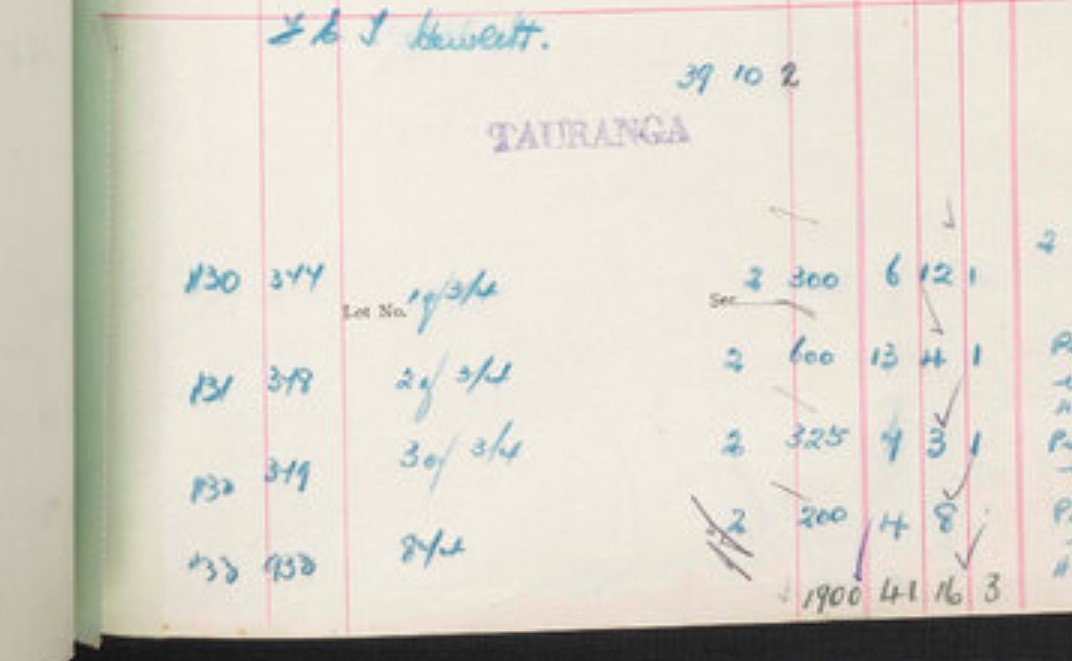
In 1926, Hilda, the first English woman to gain a pilot's licence, relocated to Tauranga, as did her daughter Pia Richards and Pia’s family.  Hilda bought various sections, including property on the corner of Eleventh Avenue and Edgecumbe Road - as well as a section at Devonport Road in Tauranga.  Tauranga rate book, 1937-1938 shows us Hilda owned property at Lots 231/2 Sec. 1 and 485/7 & 489 Sec. 2.

Map 24-047 - Section 2 - Tauranga

It must have been an idyllic location, overlooking the Waikareao tidal estuary, which had served as the town's flying field for eight years. 

Air Commodore F.E.T. Hewlett - Auckland War Memorial Museum

F.E.T. (Francis) Hewlett, following in his mother’s footsteps as a pilot, had a distinguished military career. During WWI he earned a Distinguished Service Order in 1915 and rose to the rank of Group Captain.  He retired from the Royal Air Force in 1934 and followed his mother and sister to live in Tauranga.  

The rate books show Hilda Hewlett owning lot 231/2 on Devonport road and this is where Francis Hewlett first set up business with a motor garage.
Bay of Plenty Times, Volume LXXI, Issue 13056, 26 January 1943, Page 3 Papers Past

The rate book 1937-1938 also shows that Francis Hewlett owned a section next to Hilda’s, on the edge of the Waikareao Estuary, lot 874, Section 2. (See above image: Map 24-047).
Ams 463/1/38 - Rate book, 1937-1938

In an address to the THS years later (1957) he talks of having “…a small house overlooking the Waikareao Estuary, we had a bank and half an acre of swampy land covered with gorse, blackberry and weeds. This was such an eyesore that we determined to tame it and drain the swamp; but we should have to cultivate it and plant something more interesting than the existing rubbish. Someone suggested grapes, so we set about finding how and why and where grapes were grown in New Zealand."

Te Ao Mārama - Tauranga City Libraries - 2025

We do not have any images of this property, however, a present-day photograph has been taken of the area, above the current archery field, that gives a very good idea of where the first vines were cultivated.  The work involved to continuously clear the weeds eventually became too much and the Hewletts searched for a site more suitable for grape growing commercially.

The Hewletts moved to Maungatapu, where they bought 12 acres of land and transported the vines from Waikareao to the new site. Current day Vine Street in Maungatapu is one of the streets originally part of this farm and was named after the Hewletts' vineyard.
Ms 67/18 - Maungatapu Vineyard - looking south-east towards Welcome Bay


When WWII broke out, Francis (F.E.T.) Hewlett enlisted as Wing Commander in the Royal New Zealand Air Force (RNZAF).  He progressed his military career and became Air Commodore, January 1945. Whilst he was away, not much progress was made with the winemaking, however, Francis Hewlett picked up from where he left off when he returned.
F.E.T. (Francis) Hewlett on his spraying tractor - Ms 67/18

The Papers relating to the Maungatapu Vineyard (Ms 67) contain the original speech delivered to the THS in 1957, photographs, wine labels, prize certificates and an essay titled "The suitability of Tauranga for outdoor grapes for wine making".  This must have been like a vintner's handbook back in 1957, but still provides interesting insight for today.  Some interesting points he makes are:
  • Henderson and Hawkes Bay identified as specialty grape-growing regions
  • The "American Invasion" during the war influenced the market for selling cheap, inferior wines where the main factor was the “kick” it gave
  • When men and women returned from WWII they had more of a discerning taste for quality wine and this in turn increased the demand for higher quality winemaking
  • Tauranga has the same climate as the northern Germany region of “Rotor Traminer”, and can grow exact replica Moselle vines
  • Some of the preferred winemaking grapes for Tauranga are Siebel varieties, which produce dry wines, sherries, port and Rosē.
Wine Bottle Label - Ms 67/7


Further reading...
For those interested in delving deeper into their stories, the Pae Korokī collection offers a treasure trove of resources, including the Papers relating to Maungatapu Vineyard (Ms 67) and the Journals of the Tauranga Historical Society The reference section has a biography of Hilda Hewlett, written by F.E.T. Hewlett’s daughter-in-law, Gail Hewlett: "Old Bird: the irrepressible Mrs Hewlett".

Sources
Hewlett, Gail. (c.2010). Old Bird - The irrepressible Mrs Hewlett. Leicester : Matador.
Women Who Mean Business website: https://womenwhomeantbusiness.com/2021/05/27/hilda-hewlett-1864-1943/
Auckland War Memorial Museum - Online Cenotaph 
Ams 463 - Tauranga Borough Council rate books, valuation rolls and related material
Bay of Plenty Times, Volume LXXI, Issue 13056, 26 January 1943, Page 3 - Papers Past - https://paperspast.natlib.govt.nz/ 

Tuesday, 3 June 2025

Robert Falla in the Bay of Plenty and the Sladden Collection

 From Tauranga City Library’s archives

A monthly blog about interesting items in our collection

1930 portrait of Robert Alexander Falla (1901-1979) while assistant zoologist with the British, Australian and New Zealand Antarctic Research Expedition.

Robert Falla in 1930

Head-and-shoulders portrait of Robert Alexander Falla, assistant zoologist on Antarctic expedition aboard the Discovery; inscribed "With regards R.A.F. June 1930"  (Te Ao Mārama - Tauranga City Libraries Ms 33/5/52)

When Robert Falla retired in 1966 he had been Director of the Dominion Museum (now the Museum of New Zealand Te Papa Tongarewa) for nearly 20 years. He was born in Palmerston North. His father was a railway clerk. He matriculated from Auckland Grammar School in 1918, after winning a scholarship in 1915, and wanted to go to sea. Several attempts to get work on a ship were not successful. However, he managed by determination and hard work to turn his childhood exposure to ‘natural history’ from an interest – particularly in birds - into a successful and prolific career as a zoologist, which also got him on several lengthy sea voyages.

He worked his way into academic study by getting a Bachelor of Arts with a Senior Scholarship in education in 1924, working as a primary teacher, then becoming a lecturer in general science at the Training College. In 1927 he graduated as a Master of Arts with a thesis on the teaching of nature study and biology in New Zealand.

At the same time as this work and study he was doing scientific fieldwork and publishing the results. Falla established his reputation as an ornithologist with the 1924 publication of “Discovery of a breeding place of Buller’s Shearwater, Poor Knights Island, N.Z.” in Emu Vol. 24, No. 1 pp 37-43. This is among the at least 16 books and offprints (pamphlet versions of academic papers for distribution to collaborators and colleagues) he had written that Falla sent to Sladden “With the authors’ compliments” during the 1920s and 1930s, and now in the Library’s Sladden Collection.

In 1928 Bernard Sladden was the lead author of an article written with Falla - “Alderman Islands: a general description, with notes on the flora and fauna”, published over two issues of the New Zealand Journal of Science and Technology (Vol. 9, No.’s 4-5, November 1927 (pp 193-205) and February 1928 (pp 282-290). Sladden had his copy bound with other offprints – including his own 1924 article about Karewa and 1926 article about Tūhua – reporting on the fauna, flora and geology of the islands of the Bay of Plenty.


This shows how integral amateur researchers like Sladden were in building the body of scientific knowledge of New Zealand’s natural history. He hadn’t just provided the boat to get to the Alderman Islands, he had been an active participant in the collection and formal publication of the data. Sladden could also by letter and sample keep the professionals informed of new discoveries and developments in the part of the country where he lived, expanding their geographic range.

Falla’s scientific career flourished – “In 1929 he was appointed assistant zoologist to the British, Australian and New Zealand Antarctic Research Expedition (BANZARE) under the leadership of Sir Douglas Mawson”[1]. Prints of photos taken by Falla on the expedition made their way into Sladden’s papers – e.g. Te Ao Mārama - Tauranga City Libraries Ms 33/5/311

However, the lengthy absences this work required eventually led to Falla’s resignation from the Training College. He had already mentioned in a 1930 letter to Sladden, kept in our archive, that he could only process his work from the expedition in his spare time [2]. This is in response to what must have been a comment from Bernard’s letter to him that managing the farm was keeping him from his own researches.

“In 1931 [Falla] was appointed ornithologist and education officer at the Auckland War Memorial Museum” where in 1937 he completed the publication of the BANZARE report on birds, “still considered a classic work on the birds of the southern ocean[3].” The Sladden Collection has the copy Falla inscribed and sent to “B. Sladden with compliments & regards. R.A.F. Jan 1938”.
 
By this time Falla had been appointed director of the Canterbury Museum, where amongst other work he instigated the investigation into moa remains at Pyramid Valley. Again, Falla sent an offprint to Bernard Sladden “with compliments”.
 
Falla was a Carnegie Scholar in 1939, touring and studying museums and their displays in the United States, United Kingdom and Europe (until interrupted by the outbreak of war). During the war he participated in coastwatching expeditions to the sub-Antarctic islands (ensuring German, and later Japanese ships didn’t try and use them as bases for commerce raiding), but also fitting in some geological and ornithological observations.

He was made Director of the Dominion Museum in 1947, and according to his obituaries was always unhappy that the administrative work of this role was keeping him from the kind of fieldwork and publishing he had enjoyed in the 1920s and 1930s with colleagues like Bernard Sladden.
 
  1. Falla 's entry in the Dictionary of New Zealand Biography accessed 14 March 2025
  2. Falla, Robert Alexander, 1901-1979, Letter from Robert Alexander Falla to Bernard Sladden, 25 Jun 1930). Te Ao Mārama - Tauranga City Libraries Ms 33/3/1/6
  3. Falla 's entry in the Dictionary of New Zealand Biography accessed 14 March 2025
Written by Leslie Goodliffe, Information Access Specialist at Te Ao Mārama - Tauranga City Libraries