From Tauranga City Library’s archives
A monthly blog about interesting items in our collection
In 1938 the Government Film Studios, part of the Tourist and Publicity Department, started filming for a production to celebrate New Zealand’s centennial year in 1940. A short sequence of settlers landing from the ship that carried them from England was shot on location on Ocean Beach. The lower slopes of Mauao are visible in the background, but are not identified.
There are several reports in the Bay of Plenty Times on the filming of what it called the New Zealand Centenary Film. A front page article on Friday 4 November 1938 describes the arrangements being made ahead of the arrival of the production unit and two lead performers. They included collecting ‘properties’ to represent the arrivals’ belongings, and recruiting extras for the scenes on the beach.
The St John Ambulance Association proposed holding a fundraising ball where the attendees would attend in period costume, the best of which “will be given the opportunity of appearing in the film”.
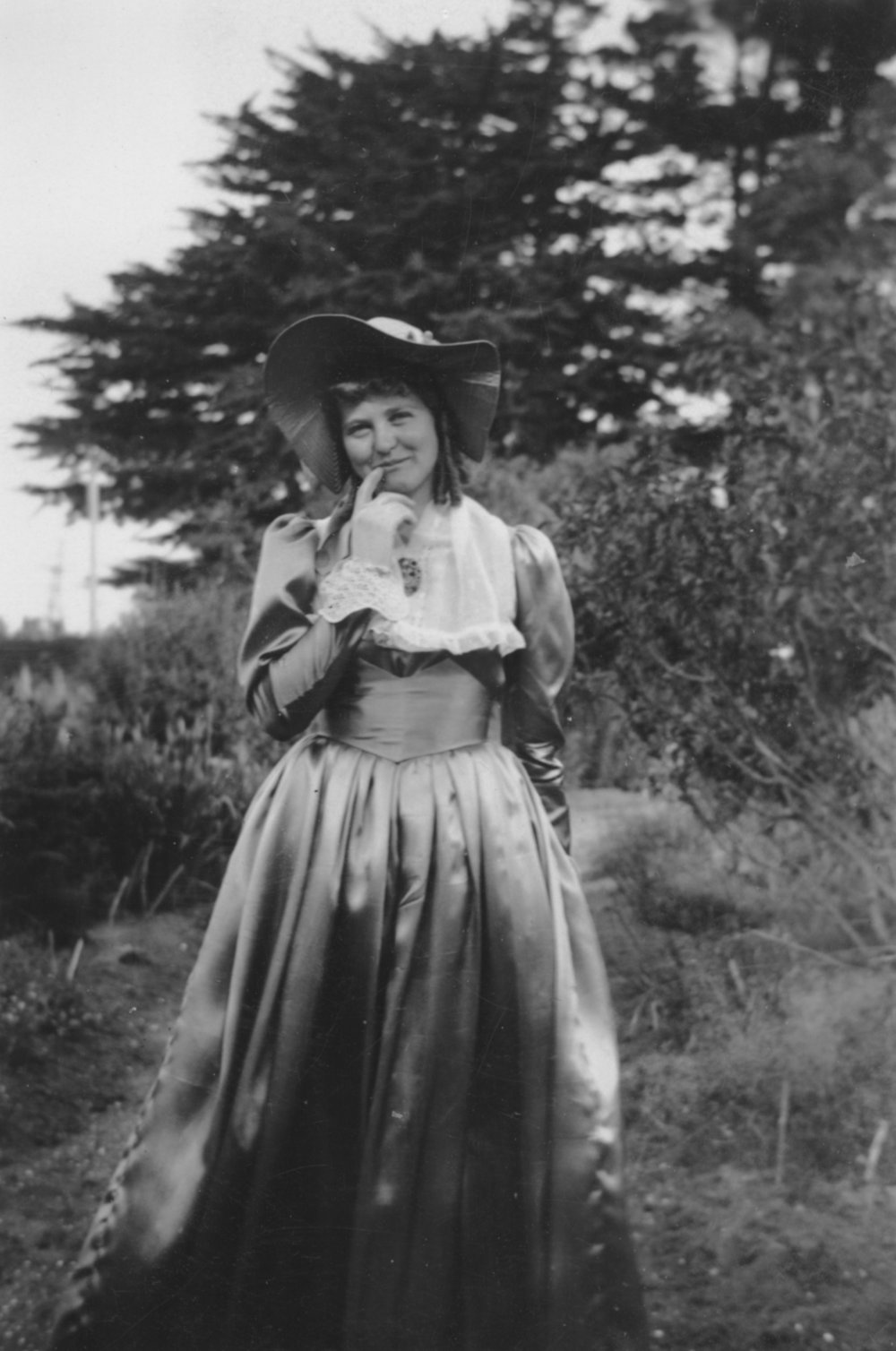
The ball was held in the Town Hall on 28 November, with the costumes worn described enthusiastically in the Times the following day. Some of those selected as extras are listed, including a Miss Doreen Mander. Pae Korokī contains scans of two copies of a photo of a Miss Dorothy Mander in costume – presumably the same person.
Planned weekend rehearsals went ahead over the weekend of 2 and 4 December 1938, despite bad weather. There is a gap in reporting until 16 December when the director, Mr. Bridgman, and leading lady of the film, Miss Una Weller (accompanied by her mother), judged the costumes at a fancy dress ball for school children held at the Peter Pan Hall in Pacific Avenue. On 20 January 1939 there was a notice calling for extras for some filming at Whareroa.
Pae Korokī has scans of five other photographs taken during the filming on Ocean Beach. Three were provided for scanning by Ray Armstrong, one by Marion Proud, and we have a print from an unknown donor in our Climate Controlled Room.

Filming on Ocean Beach, Mount Maunganui 1938-1939

Sets and extras on Ocean Beach, Mount Maunganui 1938-1939
Te Ao Mārama - Tauranga City Libraries Photo 01-156
These two photos were provided by Te Ao Mārama's then New Zealand Room team for a Bay of Plenty Times feature called “Back in time”, one in 2001 and another in 2006. Several people responded with more information - "Mr W. D. Moxham of Alexandra [writes that].... as a child he was an 'extra' in the film, qualifying for this privilege not because of his acting prowess but because he was top in arithmetic that day at Mount Maunganui Primary School" (Bay of Plenty Times, 18 August 2001).
This information enabled the dates of the filming to be narrowed down. However, no informant could remember the title the film was eventually released under – “One Hundred Crowded Years”. The articles found in Papers Past for 1938 helped make the connection. This led to the discovery of more detail about the production from a chapter in a 2004 book edited by William Renwick (listed in the Sources and available online). This doesn't mention who played the Māori seen on screen, opening a hāngī to feed the new arrivals, guiding the settlers into the bush, and later attacking a redoubt.
A lack of resources and the outbreak of World War 2 in September 1939 dramatically slowed the completion of the film. It wasn’t released until the very end of the Centennial Year, when “the government gave it to the National Patriotic Fund Board, which made it available to provincial patriotic committees to screen as a fundraiser” (Renwick, p. 269). It toured the country for the next 18 months, raising £1,200.
The fifty-minute film can now be watched on Archives New Zealand’s YouTube channel, with the landing sequence starting at 12 minutes 35 seconds, followed by the pioneers’ journey inland to start breaking in the countryside for farming (filmed around Ōropi at the same time).
As you might expect of a celebratory film of the period it skims quickly over the complexities of the Treaty of Waitangi, land ownership and later instances of warfare between Māori and Pākehā. This may be particularly so since the film’s ending included footage of New Zealand soldiers boarding a ship back to the Old World, to fight in a war with no certain outcome.

Exploring part of the set built on Ocean Beach, Mount Maunganui 1938-1939
Te Ao Mārama - Tauranga City Libraries Photo 01-269
In early December 1938 the film’s director wrote to the Mount Maunganui Town Board for permission to build “temporary huts, etc., on the ocean front necessary in the taking of the Centenary film”. This was granted, but it looks like the budget didn’t stretch to anything too elaborate.
Sources:
Bay of Plenty Times, Volume LXVII:
Issue 12497, 4 November 1938, Page 1
Issue 12517, 29 November 1938, Page 1
Issue 12521, 3 December 1938, Page 4
Issue 12521, 3 December 1938, Page 5
Issue 12522, 5 December 1938, Page 1
Issue 12531, 16 December 1938, Page 4
Issue 12258, 20 January 1939, Page 4
Renwick, William. One Hundred Crowded Years: The Centennial Film. Chapter 19 of Creating a National Spirit: Celebrating New Zealand's Centennial. Wellington : Victoria University Press, 2004. Pages 260-270.
“The Tin Shed” : the origins of the National Film Unit. Wellington : New Zealand Film Archive, 1981.
Early documentary film in New Zealand - last paragraph. Retrieved 20 December 2025
One Hundred Crowded Years. Wikipedia. Retrieved 18 December 2025.
Written by Leslie Goodliffe, Information Access Specialist at Te Ao Mārama - Tauranga City Libraries


