Friday, 11 March 2022

Motuopuhi (Rat Island) in the Waimapu Estuary

Motuopuhi. Raewyn Adams 1984
Image courtesy of Tauranga City Libraries, Pae Korokī, Ref. 99-697

This three acre, one rood, slightly raised flat island is quite close to the Turret Road Peninsula (Te Rua O Te Tuna.)* It was, according to Maori legend, formerly much closer to the pa occupied by Waitaha on the end of Maungatapu Peninsula.  The story goes that puhi (maidens of high rank) were taken there each night so as to preserve their purity and enable them to make better marriages. However after too many nocturnal trysts by young lovers the wahine of the hapu took it upon themselves to heave the island further up the estuary, thereby forming the channel along its path.

Devonport Rd and Fraser Street, looking towards Motuopuhi island with Rangataua Bay, Maungatapu and Matapihi in the back-ground c 1949, by Alfred Hugh Rendell
Image courtesy of Tauranga City Libraries, Pae Korokī, Ref. 12-592

Motuopuhi was included in land confiscated from Ngaiterangi in 1863. In 1886 H.W. Brabant reported, as Commissioner of Tauranga lands, that Hamiora Tu and Ngamanu, local chiefs, had been granted Lot 100 Te Papa Parish comprising of 52 acres “in consideration of their loyalty and of their former claims to Motu-o-puhi and the adjoining mainland known as Te Rauparanga.”  **

Evidently with an eye to its purchase, a survey of the island was begun in 1882 by Captain A.C. Turner, a licensed surveyor, but on being advised by S. Percy Smith, the Chief Surveyor at that time, that the island was Crown land, Turner did not lodge his plan. In 1913, Mr C.B. Turner, also a surveyor and a son of Captain Turner, forwarded the plan of the survey which he had found amongst his father's papers. payment was made by the Crown to the estate of Captain Turner for the survey, and the plan was lodged, examined and approved. It is now S.O. Plan 17040, and the land is now described as Section 8, Block X, Tauranga Survey District.

The island was set apart as a Reserve of Recreational Purposes in 1952 and subsequently, in 1959, it was vested in the Mayor, Councillors and Citizens of the Borough of Tauranga in trust for the same purposes. [Extract from THS Journal No 14, 1960, Courtesy of Tauranga City Library]

In more recent times it has been the home to at least two European occupants, Charles Spearing Kensington from the early 20th Century until about 1928 and later William O’Halloran and his wife Ethel from the early 1930s for almost 30 years. There is clear evidence of a dwelling on aerial images from 1937, 1943 and 1959.
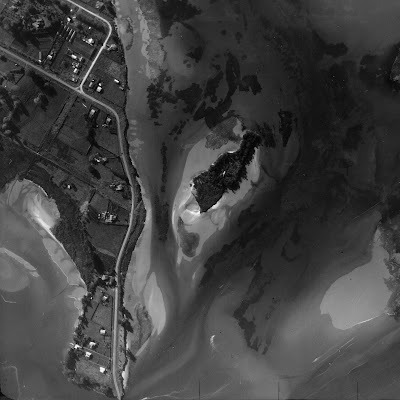
1937 Aerial shot of Motuopuhi clearly showing the roof of a dwelling
Image courtesy of Tauranga City Libraries, Pae Korokī, Ref. 99-448

According to Max Avery in his book Maritime Tauranga, Charles Kensington was "an early Tauranga surveyor born in Bath, England, who came to New Zealand aged four, engaged in survey work in various parts of New Zealand and later in timber milling in the Coromandel be-fore settling at Oropi. He was a Crown lands ranger, his district extend-ing from Coromandel to the East Cape, and he retired from that position in 1917 to Ohauiti, dying in 1930."

Former farmer and horse trainer William O’Halloran  and his wife Ethel took up residence and they kept a Model T car in a shed on Turret Rd opposite his island home. I assume they lived without power in the manner of pioneers of earlier times.  (To be continued as new information has just come to hand.)
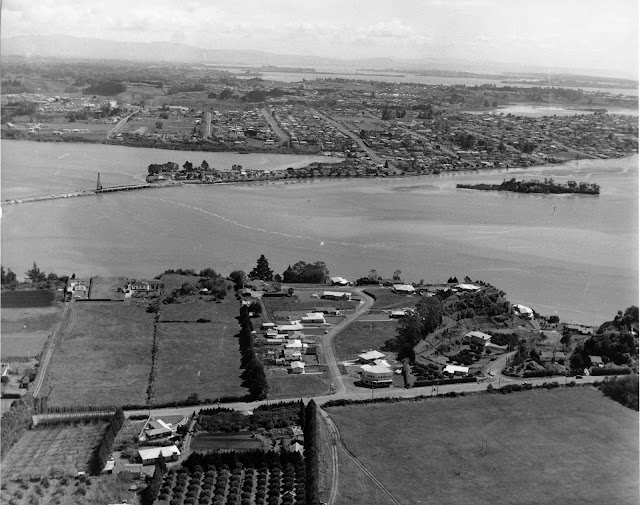
Aerial View of  Maungatapu Rd, Anchorage Grove looking over the Waimapu Estuary. Harini  Bridge is centre. c 1960 Carters Photo Services
Image courtesy of Tauranga City Libraries, Pae Korokī, Ref. 00-152

When the writer was young her class was taken to Rat Island by a Standard 4 teacher for an estuary study and also many times on family outings for swimming and picnicking. These days she takes her grand-children there for adventures with deep black mud in the “lagoon” and to learn about the estuary ecosystem. There are still grapevines and a fig tree growing on the Maungatapu side of the island  and a surprising number of people venture there at low tide when the crossing is merely ankle deep.

NB. Apparently the name Hairini is from the Biblical Cyrene - similar to Bethlehem (Peterehema) and Judea (Huria), other local districts.

Sources
Maritime Tauranga, self published by Max Avery  2013
Pae Koroki. - THS Journal No. 14 article by E L Adams 1960
                    - Stories of Tauranga Moana, By Evelyn Stokes 1980
                    - All images courtesy of Pae Korokī
*    given verbally by a contact of Max Avery
**  In article by E L Adams

Tuesday, 1 March 2022

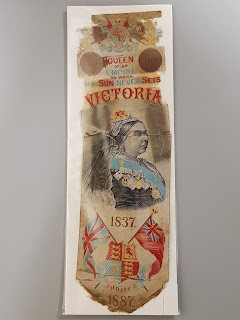
Queen Victoria’s Golden Jubilee bookmark, 1887

From Tauranga City Library’s archives
A monthly blog about interesting items in our collection

Our catalogue description of this item, written a few years ago, reads: 

Woven/machine-embroidered bookmark celebrating 50 years of Victoria’s reign. Includes portrait of monarch. Reads: “Queen of an Empire on which the sun never sets VICTORIA 1837. 1887”. Originally filed as ephemera (EPH 1/35). Condition note: damaged; enclosed in card and transparent seal.

Now I can confidently say that our bookmark is woven, not machine-embroidered. It is a typical example of a ‘Stevengraph’ – a type of woven silk novelty devised by Thomas Stevens (1828-1888), a Coventry weaver. The many pictures, bookmarks, portraits, and greeting cards produced by Stevens and others represent an early example of industrial diversification, invented to use jacquard loom machinery which might otherwise have been redundant. Coventry was the centre of silk ribbon weaving, and in the 1860s its factories and workers began to suffer from a free-trade agreement that allowed cheap French imports into England. Thomas Stevens, clearly a lateral thinker, adapted the looms to produce colourful items on popular subjects. Stevengraphs depict football matches, famous ships, famous people, buildings, events in history, mail coaches – the list goes on. Events such as exhibitions and jubilees were obvious opportunities to produce a commemorative Stevengraph like ours. The attractive silks proved irresistible to Victorian souvenir-hunters and are still appealing to modern collectors. 

Photograph taken by Stephanie Smith, Tauranga City Libraries.

Our example has had a hard life. At some stage it has been ripped across the bridge of Her Majesty’s nose, adding an unfortunate beakiness and squintiness to the royal visage; worse, the tear has been mended with a tape which has stained the silk. I would like to think that the damage indicates that its former owners were avid readers and used it so often that they wore it out.

Sources: 
http://www.stevengraph-silks.com/index.html
https://en.wikipedia.org/wiki/Stevengraph 


This archival item is on our schedule for digitisation, and will be added to Pae Korokī once digitised. For more information about other items in our collection, visit Pae Korokī or email the Heritage & Research Team: Research@tauranga.govt.nz

Written by Stephanie Smith, former archivist at Tauranga City Library.

Friday, 18 February 2022

Planes and Beaches

Boeing floatplane on Tauranga Harbour, 12 March 1920
Image courtesy of Tauranga City Libraries, Pae Korokī, Ref. 99-133

On 12th March 1920 a seaplane crossed the Waikareao Estuary, flew over the Domain and the Military Cemetery to the harbour where the pilot began his descent. He flew in a wide circle towards Whareroa and executed a perfect landing on the water opposite Victoria Wharf then taxied to the beach south of the Town Wharf.

Two hours 14 minutes earlier the seaplane had left Auckland with the pilot Mr. G. B. Bolt and Dr. H. W. Cleary, Catholic Bishop of Auckland aboard. Dr. Cleary was making a pastoral visit to Tauranga, Opotiki and Whakatane. Also on board was the mail to be delivered at various spots along the way.

A large crowd had gathered to witness the plane’s arrival including a group of excited children from the Tauranga District High School who had been given permission to leave their lessons. The mayor Mr. B. Dive and several councillors were present. “Mr Dive said the arrival of the seaplane marked the first air flight to Tauranga but the time was coming when these machines would be as plentiful as cars.” The seaplane left at 11.00am, crossing Hopukiore (Mt. Drury) and heading down the coast to Whakatane and Opotiki. (The Bay of Plenty Times, 12/03/1920)

A beach can be a very handy place to land a small plane as the following photos prove.

Ocean Beach, Mount Maunganui showing aeroplane approaching
Postcard photograph by John Welsh, c. 1922-1924
Image courtesy of Tauranga Heritage Collection, Ref. 0341/10

“Walsh Bros. Aeroplane will be making passenger flights at the Mount from 2 p.m.. tomorrow. Fares as usual. If wind unfavourable for the Mount flights will be made from the Waikareao beach.” (The Bay of Plenty Times, 29 April 1922)
“An aeroplane flew over the town this morning, it approached from the south- west and landed on the Ocean Beach at Mount Maunganui.” (The Bay of Plenty Times, 29 March 1924)

A plane lands on Ocean Beach, c. 1930
Image courtesy of Tauranga City Libraries, Pae Korokī, Ref. 03-043
 
A solo pilot ... Early days of flying Tasman" Ocean Beach, Mount Maunganui, c. 1930
Unmounted Kodak Velox vernacular photographic print (57x81mm)
Image courtesy of Tauranga Heritage Collection, Ref. 0217/08

Seaplane at Waikorire (Pilot Bay), Mount Maunganui, c. 1960s
Postcard by N.S. Seaward’s Studio, Broad Bay, Dunedin (Scenic New Zealand Series).
Image collection of Justine Neal

Friday, 11 February 2022

Recollections of Dennis George Marsh - Part 4

Fourth part of a series contributed by guest author Dennis Marsh
(continued from Part 3)

Calf Club Day, Te Puke Primary School, c. October 1961
Image courtesy of Tauranga City Library, Bay of Plenty Times Collection, Pae Korokī Ref. gca-2362

While I was going to primary school in Te Puke, I made friends with David Cannell. David’s father kept pigs. To feed them he used to buy old or unwanted horses, slaughter them and cook the meat up in big drums. It used to stink something awful and, as they lived on the outskirts of the shops, the cooking smell used to waft over the town and many people used to say derogatory things about the Cannell's. One weekend when I was staying with David, his father had been given an old thoroughbred. David’s dad said I should take it home as a horse to ride. I spoke to Dad on the phone and he was adamant that I was not to bring it home, but relented over the weekend and I rode it home on the Sunday afternoon. It was my first long ride on a horse and with no saddle – and by the time I got home I hurt in places no self-respecting person could mention. Dad laughed and called them “half-crowns”. Later Dad used to ride Captain, the name he was given, with Ron Brown when they went to muster the sheep. He was a ‘bugger’ of a horse to ride and the racehorse in him meant he did not like any other horse getting in front of him and he would bite down on the bit so that we had no control over him. Boy could he run !!!!

Dell at First Farm, Te Puke
Photograph collection of Dennis Marsh

We went to school on the bus leaving about 7:30 in the morning and getting home about 4:15. My job was to get dressed as quick as I could and get over to the shed to help Dad. Most of the time when I got there the cows had been milked and I had either to take them to the paddock, wash the shed and the yard or watch the separator to make sure the whey was going into the correct drum and the pig sty. We usually got finished at 5:00 and could then go back to the house and get ready for tea or maybe even do my homework.

My teacher was Jack Gemming. Jack taught us in standard 4 and 5. He then got promoted to secondary school. So when I went to college, I had Jack as my form teacher all through High School. I was part of the first batch of third formers to attend the Te Puke High School, as previously it had been a District High School.

Te Puke School bus, c. 1930s
Image courtesy of Tauranga City Library, Pae Korokī Ref. 07-073

The school bus was owned by the Te Puke Bus Company, Bill and Con Buckley, and most of the time our driver was Naera someone. Norrie Williams was the cream run driver and used to deliver all the stuff Mum ordered from town: groceries, bread, medicines and the stuff Dad ordered form the factory shop. Sometime if I was late to catch the bus, I would have to get a ride to school with Norrie who would drop me off at the factory corner and I walked up the hill to school. Sometimes there would be other kids on the cream truck for the same reason.

“Dennis and George Marsh with 1939 Ford V8 truck at first farm”
Photograph collection of Dennis Marsh

Dad and Mum bought a 1939 Ford V8 small truck- what would be called a ute in today’s language. It had a metal tray on the back and metal sides about 600mm high. Dad made a wooden crate to fit on the back so that he could take animals to the sale yards and back again. Going to “Town” was something special. Mum and Dad in the front and the three kids on the back – under a cow cover if it was raining. The road was only metalled so in the summer we had to contend with the dust and mud in the winter.

Capitol Theatre, Te Puke, c. 1960s
Postcard, Image courtesy of Pae Korokī, Ref. 99-046

Nevertheless, town day was something great. We could meet our friends, especially the girls, and if we had been very good at home, Dad might take us to the picture in the Capitol Theatre – always downstairs as it cost less. I only went upstairs after I started to get pocket money and I could afford to pay the difference myself.

Lolly dispenser, Capitol Theatre, Collection of Te Puke Museum
Photograph by Sandra Haigh, Courtesy of Western Bay Community Archives (Ref)
This work is licensed under a Creative Commons Attribution-No Derivative Works 3.0 New Zealand License

Dennis Marsh, Stewart St, Te Puke, 1961
Photograph collection of Dennis Marsh

Around this time the Post Office put new telephone lines up No. 1 and No. 2 Road. Dad got the job of taking down some of the old poles and wires. He wanted to use the poles for posts and the wire for fencing. I went with him on weekends to help. One Saturday when we were picking up the wire on the back of the truck, Dad said “Hop in and drive to the next heap”. I had driven different makes of tractors but never the truck. But youthful bravado rose to the fore. “OK” I said. Staring the motor and getting the truck moving was OK but then a car came down the road as I was driving to the next heap. What to do ???  PANIC. Dad saw what was happening and called out “Just keep going, You’re OK” and that was my first experience of driving the truck on the road.

(To be continued)

Friday, 4 February 2022

Finding new appreciation

Working with the Tauranga Heritage Collection over the years, I’ve come to appreciate, if not love, some surprising objects. Top of my list is our Marshall Steam Traction Engine.  I’ll never forget having the opportunity to drive it - to feel the heat from the firebox and the rumble of the ground beneath the solid rubber tyres. It made a traction engine convert out of me.

Marshall Sons & Co Steam Traction Engine (1904) at the Tauranga A. & P. Show, Tauranga Racecourse, 2009
Tauranga Heritage Collection Ref. 1358/85

Recently I’ve been working with the Tauranga Embroiderers’ Guild to delve into our textile collection in preparation for Stitch-a-Plenty, the Association of New Zealand Embroiderers’ Guild’s National Conference to be held in Tauranga July 2022. It has been a wonderful experience seeing the collection though their eyes. And once again, it has given me new appreciation for objects I’ve not considered before. This time it’s tea cosies.

The Tauranga Heritage Collection has a wonderful variety of tea cosies demonstrating nearly every type of embroidery skill from whitework and cutwork to beading and pulled thread (example). However, my two favourites are a lovely Victorian beaded and Berlin work cosy and a cottage shaped silk thread-embroidered cosy, which likely dates from the 1930s. Both were donated by local families.

Victorian beaded and Berlin work tea cosy. Tauranga Heritage Collection, 2928/84

Cottage shaped silk thread embroidered tea cosy. Tauranga Heritage Collection, 1736/84

It came as surprise to me that the first documented use of a tea cosy in Britain was in 1867. I had imagined it would be much earlier. There is some suggestion that covers to keep tea warm would have been in use when tea was first introduced into England in the late 1600s. It was during the Victorian era that the tea cosy craze took hold and no respectable home or tea party host was without one. Anna Russell, Duchess of Bedford, is credited with popularising afternoon tea and, by association, the cosy. But if you think the cosy has been relegated to the past you might be surprised to know that these days, like many old traditions, it is finding a new audience. Hopefully our small collection can provide tea enthusiasts with some inspiration.

References

Richard Rutt, A history of hand knitting. (London: Batsford. 1987).
https://blog.dominiontea.com/2017/04/29/history-tea-cozy/