Showing posts with label Photographs. Show all posts

Tuesday, 6 January 2026

The Centennial Film in Tauranga, 1938-39

From Tauranga City Library’s archives

A monthly blog about interesting items in our collection

In 1938 the Government Film Studios, part of the Tourist and Publicity Department, started filming for a production to celebrate New Zealand’s centennial year in 1940. A short sequence of settlers landing from the ship that carried them from England was shot on location on Ocean Beach. The lower slopes of Mauao are visible in the background, but are not identified.
There are several reports in the Bay of Plenty Times on the filming of what it called the New Zealand Centenary Film. A front page article on Friday 4 November 1938 describes the arrangements being made ahead of the arrival of the production unit and two lead performers. They included collecting ‘properties’ to represent the arrivals’ belongings, and recruiting extras for the scenes on the beach.
The St John Ambulance Association proposed holding a fundraising ball where the attendees would attend in period costume, the best of which “will be given the opportunity of appearing in the film”.
The ball was held in the Town Hall on 28 November, with the costumes worn described enthusiastically in the Times the following day. Some of those selected as extras are listed, including a Miss Doreen Mander. Pae Korokī contains scans of two copies of a photo of a Miss Dorothy Mander in costume – presumably the same person.

Picture of Dorothy Mander in costume for filming on Ocean Beach, Mount Maunganui

Dorothy Mander in costume for filming on Ocean Beach, Mount Maunganui
(Te Ao Mārama - Tauranga City Libraries Photo 01-343)

 Planned weekend rehearsals went ahead over the weekend of 2 and 4 December 1938, despite bad weather. There is a gap in reporting until 16 December when the director, Mr. Bridgman, and leading lady of the film, Miss Una Weller (accompanied by her mother), judged the costumes at a fancy dress ball for school children held at the Peter Pan Hall in Pacific Avenue. On 20 January 1939 there was a notice calling for extras for some filming at Whareroa.
Pae Korokī has scans of five other photographs taken during the filming on Ocean Beach. Three were provided for scanning by Ray Armstrong, one by Marion Proud, and we have a print from an unknown donor in our Climate Controlled Room.

Picture of Filming on Ocean Beach, Mount Maunganui 1938-1939

Filming on Ocean Beach, Mount Maunganui 1938-1939

(Te Ao Mārama - Tauranga City Libraries Photo 01-155)

Picture of sets and extras on Ocean Beach, Mount Maunganui, 1938-1939

Sets and extras on Ocean Beach, Mount Maunganui 1938-1939

Te Ao Mārama - Tauranga City Libraries Photo 01-156

These two photos were provided by Te Ao Mārama's then New Zealand Room team for a Bay of Plenty Times feature called “Back in time”, one in 2001 and another in 2006. Several people responded with more information - "Mr W. D. Moxham of Alexandra [writes that].... as a child he was an 'extra' in the film, qualifying for this privilege not because of his acting prowess but because he was top in arithmetic that day at Mount Maunganui Primary School" (Bay of Plenty Times, 18 August 2001).

This information enabled the dates of the filming to be narrowed down. However, no informant could remember the title the film was eventually released under – “One Hundred Crowded Years”. The articles found in Papers Past for 1938 helped make the connection. This led to the discovery of more detail about the production from a chapter in a 2004 book edited by William Renwick (listed in the Sources and available online). This doesn't mention who played the Māori seen on screen, opening a hāngī to feed the new arrivals, guiding the settlers into the bush, and later attacking a redoubt.

A lack of resources and the outbreak of World War 2 in September 1939 dramatically slowed the completion of the film. It wasn’t released until the very end of the Centennial Year, when “the government gave it to the National Patriotic Fund Board, which made it available to provincial patriotic committees to screen as a fundraiser” (Renwick, p. 269). It toured the country for the next 18 months, raising £1,200.

The fifty-minute film can now be watched on Archives New Zealand’s YouTube channel, with the landing sequence starting at 12 minutes 35 seconds, followed by the pioneers’ journey inland to start breaking in the countryside for farming (filmed around Ōropi at the same time).


As you might expect of a celebratory film of the period it skims quickly over the complexities of the Treaty of Waitangi, land ownership and later instances of warfare between Māori and Pākehā. This may be particularly so since the film’s ending included footage of New Zealand soldiers boarding a ship back to the Old World, to fight in a war with no certain outcome.

Picture of children exploring part of the set built on Ocean Beach, Mount Maunganui 1938-1939

Exploring part of the set built on Ocean Beach, Mount Maunganui 1938-1939

Te Ao Mārama - Tauranga City Libraries Photo 01-269

In early December 1938 the film’s director wrote to the Mount Maunganui Town Board for permission to build “temporary huts, etc., on the ocean front necessary in the taking of the Centenary film”. This was granted, but it looks like the budget didn’t stretch to anything too elaborate.

Sources:

Bay of Plenty Times, Volume LXVII:

Issue 12497, 4 November 1938, Page 1

Issue 12517, 29 November 1938, Page 1

Issue 12521, 3 December 1938, Page 4

Issue 12521, 3 December 1938, Page 5

Issue 12522, 5 December 1938, Page 1

Issue 12531, 16 December 1938, Page 4

Issue 12258, 20 January 1939, Page 4

 Renwick, William. One Hundred Crowded Years: The Centennial Film. Chapter 19 of Creating a National Spirit: Celebrating New Zealand's Centennial. Wellington : Victoria University Press, 2004. Pages 260-270.

“The Tin Shed” : the origins of the National Film Unit. Wellington : New Zealand Film Archive, 1981.

Early documentary film in New Zealand - last paragraph. Retrieved 20 December 2025

One Hundred Crowded Years. Wikipedia. Retrieved 18 December 2025. 


Written by Leslie Goodliffe, Information Access Specialist at Te Ao Mārama - Tauranga City Libraries

Tuesday, 1 April 2025

April Fool's Day and the Tauranga Ladies Rest Room

 From Tauranga City Library’s archives

A monthly blog about interesting items in our collection

An April Fools Day prank reported by the Bay of Plenty Times in 1964 was flour footprints leading to Tauranga's Ladies' Rest Rooms in Spring Street...

April Fool's Day Prank (Ladies Rest Room) (Photo gca-6426)

Although the joke isn't readily apparent sixty-one years later, the front of the Ladies' Rest Rooms were clearly visible, which caused some excitement when this negative was discovered as part of the ongoing Gifford-Cross project to re-house and digitise approximately 140,000-180,000 negatives contributed by local photographers to the Bay of Plenty Times.

There is another view of the building, tucked between Hayman Sharplin's Real Estate Agents and the New Zealand Insurance Company, in the 1965 Bay of Plenty Times photograph of members from the Australian Salvation Army Youth Congress...

Aust. Salvation Army Youth Congress - Wellington (Photo gcc-11226)

The rest rooms visitor's book is in our archives (Te Ao Mārama - Tauranga City Libraries Ams 106), unfortunately in very poor condition, it is still possible to carefully turn the pages and read entries from Mrs' and Misses noting the date, where they were visiting from, and what they thought of the facilities.
 
Detail from the first page of Ams 106 - Ladies’ Rest Room visitors' book, Tauranga, 1937-1946, showing comments from 2-5 February 1938.
 
Not an April Fools Day prank was the first meeting of the Tauranga Women's Representative Committee on 1 April 1935, where those present agreed to draft a letter to the Borough Council along the lines of...
 
"We the undersigned, being residents in and near the borough of Tauranga, emphatically protest against the action taken by the Borough Council, in deciding to build the Ladie's [sic] Rest Room on the Town Wharf, believing that such a position would be dangerous to life and limb, and detrimental to health; and urge that further investigation be made before the work is proceeded with."
excerpt from Te Ao Mārama - Tauranga City Libraries Ams 22
 
Eighteen months later "the rest room scheme provided another animated controversy at the Borough Council meeting", with the Bay of Plenty Times describing the debate where Councillor McKinnon opposed 'anything being erected on the waterfront
 
They had a waterfront that was unequalled in the Dominion. It could not be measured in pounds, shillings and pence. In the waterfront they had glorious nature and nothing should be erected that was detrimental to it'
Bay of Plenty Times, 15 October 1936, p. 3.
 
After over two years of debate, discussion and public petitions, the rest rooms were finally constructed in Spring Street in 1937. Stephanie Smith's blog and Abby Wharne's talk, provide more of the history.
 
The Strand retaining green park spaces for people to walk and play.
 
 
The Strand, Tauranga, from the Taumatakahawai (Monmouth Redoubt). 1939 or 1940. Te Ao Mārama - Tauranga City Libraries Photo 02-346
 
Sources:

Bay of Plenty Times. (1936, October 15). Ladies' Rest Room. Waterfront site. Vetoed by Councilpaperspast.natlib.govt.nz/newspapers/BOPT19361015.2.30

Smith, Stephanie. (2015, December 25).  Friday, 25 December 2015 The Spring Street Ladies’ Rest Room. Tauranga Historical Society Blog. taurangahistorical.blogspot.com/2015/12/

Te Ao Mārama - Tauranga City Libraries. (2021, March 3). Women’s Organisations in Tauranga: The Past and the Curious - talk by Abby Wharne. [Video]. Pae Korokī. AV 21-003/2. paekoroki.tauranga.govt.nz/nodes/view/42917


Written by Kate Charteris, Heritage Specialist at Te Ao Mārama - Tauranga City Libraries

Sunday, 16 February 2025

Brain Watkins House Garden Party – A Special Milestone


Mr and Mrs B.C. Julian examining a family postcard album on the front steps of Brain Watkins House at the Tauranga Historical Society’s inaugural Garden Party in December 1979
Photograph by the Bay of Plenty Times photographer, published 3 Dec 1979
Courtesy of
Korokī33738

In November the Society hosted visitors to the Brain Watkins House and garden as part of the biennial Bay of Plenty Garden & Art Festival, the second time we have done this instead of our usual Garden Party. What members and visitors alike probably didn’t appreciate was that the occasion happened to be the 45thanniversary, almost to the day, of our first Garden Party on 1 December 1979.

Willie Watkins and Elva Brain, c. August 1965
Photo Brain Watkins House Collection

The home of Elva Brain and Willie Watkins on the corner of Cameron Road and Elizabeth Street was left to the Society earlier that year as a bequest in Elva’s will and the garden party was an opportunity for members and guests to inspect the house and gardens which are still the Society’s home, and an important focus of our activities. More than 150 members and their guests attended, many in Victorian costumes, including then Mayor Eric Faulkner with his wife Connie, MP for Tauranga, Keith Allen, film and television actress Pat Evison, and visitors from historical societies in Hamilton, Whakatāne and Te Awamutu. We retain strong links with the Whakatāne & District Historical Society in our joint publication of the Historical Review, the Bay of Plenty Journal of History.

Wooden half hull model by Joseph Brain, Brain Watkins House Collection

Guests had an opportunity to view the rooms of the home containing not only the existing furnishings in a setting reminiscent of earlier decades, but also mementoes collected over a century. On display were old family photographs and documents, including Joseph Brain’s will, plans of his engineering projects around Tauranga, early photographs of the house, cups won at sailing regattas and even prizes won by Elva when a schoolgirl.

Elva Brain in the arms of her mother Kate, with her four older sisters, on the steps of their home, c. early 1890s
Carte de visite photograph, Brain Watkins House Collection

Elva was born in 1891 the house which her father Joseph Brain had built a decade earlier, and she lived in it for most of her life. She and her sister Bessie inherited the property when her mother died, and she became the sole owner after her sister died in 1957. The layout of the rooms and their contents have changed little since 1979, the Society choosing to preserve and maintain the look and feel of the early New Zealand home, with all its idiosyncrasies.

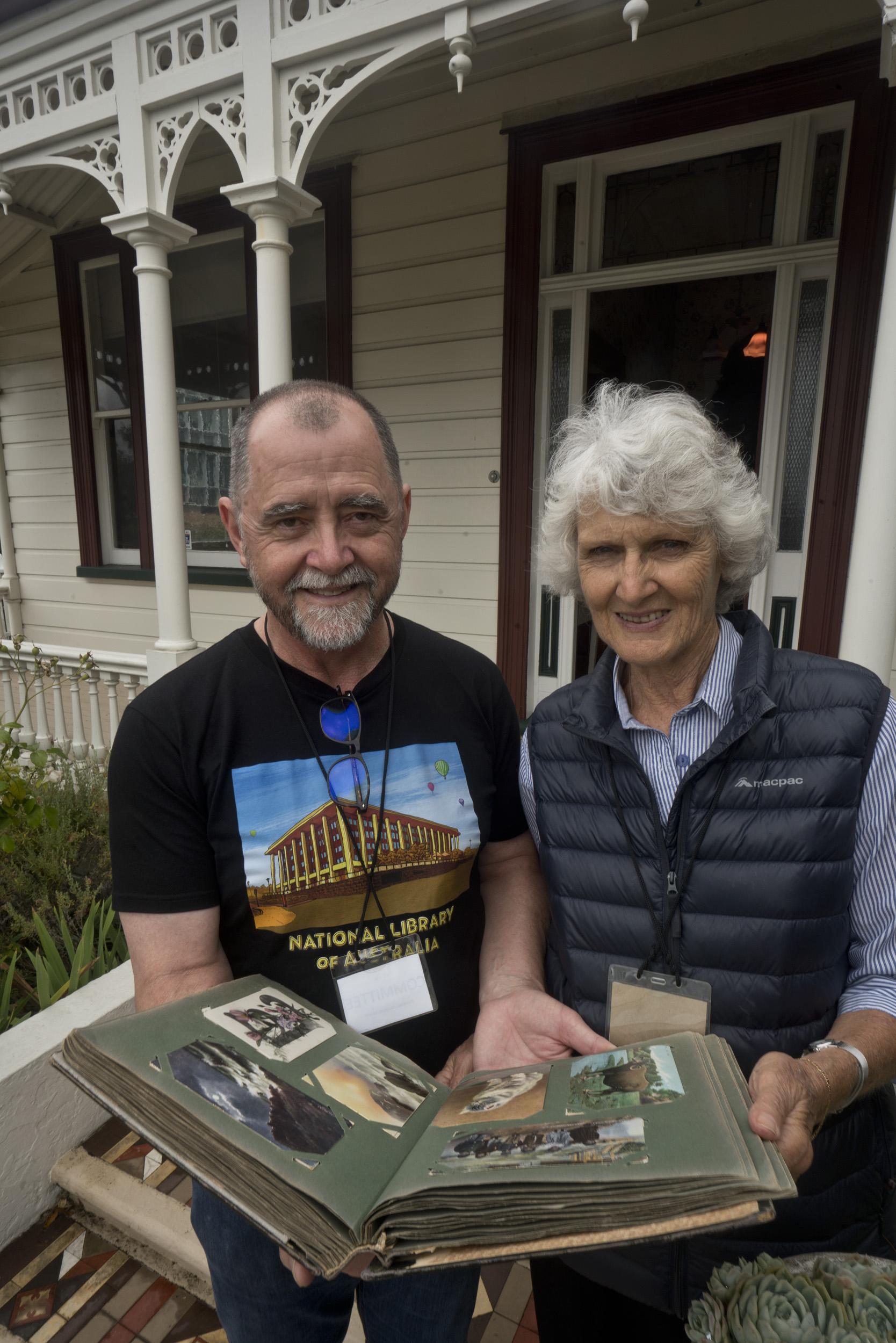
Brain Watkins House guides Leslie Goodliffe and Glennis Smith with the Brain family postcard album which featured in the 1979 Garden Party photo, 16 Feb 2025
Photo: Brett Payne

We also look after the more ephemeral contents of the house, such as the postcard album pictured in the photograph. Our conservation plan is currently being updated and our volunteer team not only show visitors around the house, but keep up an ongoing monitoring of the house’s condition. With the assistance of both the Tauranga Heritage Collection and the Tauranga Library’s Archives, the Society is in the process of conserving and digitising many of the house’s artifacts, and ensuring that they are cared for in the most appropriate physical and environmental conditions.

Friday, 30 August 2024

Tauranga Photographers: Stewart Brothers

Class photograph, Tauranga School, c. 1890-1892
Carte de visite photograph by F.E. Stewart of Stewart Bros., Tauranga
Collection of Tauranga City Libraries, Pae Korok
ī Ref. 04-502

In late June 1890 a Mr F.E. Stewart “of the firm of Messrs Stewart Bros., photographers, Thames” arrived in Tauranga on a visit[1] and, after negotiations with resident photographer and chemist Charles Spencer, made an arrangement to “take over Mr Spencer’s photographic business here for a few weeks.”[2] It is unclear why Spencer, who had been very active in the district photographically over the previous decade,[3] seems to have lost interest in the studio aspect of his business in the 1890s, but he had his fingers in many pies, and in 1893 moved with his family to Auckland.[4]

Stewart quickly showed his willingness to take up where Spencer had left off, announcing:

“First-class work at reasonable prices. Enamelling a specialty, also children’s portraits. Views of residences, etc., taken.”

Enamelling referred to the glossy finish that he was able to produce on his card-mounted portraits, while reference to children mostly signified to his customers that he was both equipped with the latest in fast lenses and shutters, and adept in pacifying notoriously fidgety or excitable children. The statement that “views of residences, etc.” would be taken indicates that in addition to welcoming customers to Spencer’s studio premises conveniently situated on the Strand, he was happy to carry out what was commonly referred to as outdoors work.

Class photograph, Tauranga School, c. 1890-1892
Carte de visite photograph by F.E. Stewart of Stewart Bros., Tauranga
Collection of Tauranga City Libraries, Pae Korok
ī Ref. 04-327

Two fine class photos taken at the Tauranga School in 1890 or 1891, then situated on the corner of Harington Street and Cameron Road,[5] have survived in the library’s collection, now displayed on Pae Korokī. They demonstrate Stewart’s skill at capturing the detail in the faces of a large group of students using the diminutive carte de visite format.

But who was “F.E.”? Since he was only ever referred to by his initials in the local press during his brief stay here, he’s not been particularly easy to track down, and it didn’t help that he proved to be unrelated to any of several other Stewart families then living in the coastal Bay of Plenty.

Young woman, tentatively identified as Marion Sophia Gilman (née Ferguson), c. 1890-1891
Carte de visite portrait, photographed by F.E. Stewart of Stewart Bros., Tauranga
Collection of The Elms Foundation

Francis Edward Stewart was born in 1865 at Chiselhurst, Kent (England) to carpenter Edwin Stewart and his wife Ellen. The family, including an older brother Herbert Samuel, arrived in New Zealand in January 1875 as assisted immigrants,[6] settling in Hamilton by 1877.[7] By early 1888 they were living in Cambridge, and older brother Herbert, working as a photographer, produced photographic views that were compared favourably with those from “the Auckland fraternity”.[8] By April 1890, probably after encountering stiff competition from well-established Cambridge photographers,[9] both Herbert and his younger brother Francis had moved to Thames, presumably sensing a growing demand there, and opening a studio in Queen Street.[10]The appearance of Francis in Tauranga only two months later suggests that clients in Thames were not as plentiful as expected.

The Tauranga Brass Band (including F. Stewart, front row, 4th from left), c. mid-1891
Attributed to F.E. Stewart of Stewart Bros., later reprinted on card mount with incorrect date
Collection of Tauranga City Libraries, Pae Korok
ī Ref. 01-592

Francis, or Frank as he was occasionally known, quickly made friends in the Tauranga community, where his musical skills were an important social asset. He joined a small local orchestra as a cornet player[11] and, with George Arnold Ward, subsequently played a role in the resurrection of the Tauranga Brass Band,[12] which made its first public appearance in March 1891.[13] He was engaged to take photographs of “the Mercury Bay and Tauranga Football teams and the Brass Band [above] … the Fife and Drum Band [below] … [and] the Fire Brigade in full uniform” at the Domain in mid-1891.[14]

The Tauranga Drum & Fife Band, c. mid-1891
F.E. Stewart of Stewart Bros., Thames and Tauranga
Collection of Tauranga City Libraries, Pae Korok
ī Ref. 12-015

By early September, however, Stewart had decided to move on, and was given a rousing farewell by Ward and his other band mates.[15] Subsequent sightings of him in Waipawa (November 1891)[16] and Dannevirke (February 1892)[17] suggest that he was touring the central North Island. In the mid- to late 1890s Francis Stewart seems to have rather disappeared from view, although his brother Herbert did open a hairdressing saloon in Rotorua in 1895, simultaneously announcing that he hoped to open a photographic studio in due course.[18] In December 1895 there was a report of a “Mr Stewart, photographer” making a trip to the Ureweras and returning with a “portfolio full of interesting views”, which must have been either Herbert or his brother Francis.[19]

Popular Pastimes in New Zealand – Jumping at the A & P Show, Auckland, c. December 1907
Halftone print stereocard, photographed by F.E. Stewart, published by New Zealand Graphic
Collection of Te Papa Tongarewa, Ref. O.005495

In January 1900 a photograph of the Jubilee Swimming Carnival at Auckland’s Caliope Dock, an event which had taken place a decade earlier in 1890, appeared as a halftone print under the byline of F.E. Stewart – almost certainly our Francis Ernest –in the New Zealand Illustrated Magazine.[20] Then between December 1907[21] and January 1912[22] he was an intermittent contributor to the New Zealand Graphic of photographs of sporting events and leisure activities, mostly in the Auckland region, but occasionally further afield in locations such as Thames and Whanganui. In 1907 they also published some of his stereoviews as part of their New Zealand Graphic Series, issued with the weekly newspaper.[23]

Mud Volcano, Waiotapu, Rotorua, N.Z. (Radcliffe & Stewart, #158), c. 1907-1914
Sterephotographic view, photographed by F.E. Stewart, published as postcard by F.G. Radcliffe
Tauranga Heritage Collection, Ref.
0105/19

A series of his stereophotographic views of the Auckland North, Rotorua and Taupo districts were published as postcards under the “Radcliffe & Stewart” banner, probably between 1909, when F.G. Radcliffe is known to have commenced his operations,[24] and the onset of the Great War in late 1914.

Tour group and guide standing before wharenui, Rotorua, c. 1900-1922
Photographed by F.E. Stewart, Rotorua
The Ngaire Hart Estate Collection, Courtesy of
Cordy’s Auctions

In December 1915 advertisements appeared simultaneously in the Auckland[25] and Wellington[26] newspapers, inserted by Stewart and Bennett, photographers of Rotorua, looking for a outdoor photographer and a lady retoucher, “with experience [in] bromide printing and photographic colouring preferred”. Postcard format photographs are known from this era depicting tourist groups with Maori guides at several locations, including Whakarewarewa[27]and Ohinemutu (above), with “F.E. Stewart Photographer Rotorua” either as a blind stamp or in purple ink on the reverse.

Studio portrait of Te Akakura Ru (wife of Rua Kenana) and her son Ruhoni, Rotorua, c. 1910-1920
Silver gelatin postcard print, photographed by F.E. Stewart
Collection of Whakatāne Museum Te Whare Taonga o Taketake, Ref. P96

From the high negative numbers (up to 8648 have been found) it is clear that by this time Francis had a substantial operation in Rotorua, presumably with an outdoor photographer employed to capture the tourists on their peregrinations, while Stewart and possibly a retoucher remained at the studio to take indoor portraits and carry out the developing and printing.

Group of men and women doing a haka of welcome, Rotorua, c. 1907-1922
Photographed by F.E. Stewart
Collection of Alexander Turnbull Library (James Cowan Collection), Ref. 1/2-021059-F

Francis Stewart worked from premises in Pukaki Street, Rotorua until at least 1922, then between 1925 and 1938 moved to Amohau Street, describing himself as an apiarist. Then in 1941, a further move took him to Mount Maunganui where he became a shopkeeper. He remained there until his death in 1953.[28]

References

[1] “Untitled [F.E. Stewart on a Visit to Tauranga],” Bay of Plenty Times, June 30, 1890, Volume 17 Issue 2530 edition.

[2] Francis Ernest Stewart, “Photography. F.E. Stewart of the Firm of Stewart Bros., of the Thames. Advertisement,” Bay of Plenty Times, July 24, 1890, Volume 17 Issue 2537 edition.

[3] Brett Payne, “Charles Spencer (1854-1933) – Part III – Serving the Community,” Tauranga Historical Society (blog), September 13, 2019, http://taurangahistorical.blogspot.com/2019/09/charles-spencer-1854-1933-part-iii.html.

[4] Brett Payne, “Visiting Price’s Corner Studio on The Strand,” Blog, Tauranga Historical Society (blog), October 3, 2014, https://taurangahistorical.blogspot.com/2014/10/visiting-prices-corner-studio-on-strand.html.

[5] Alan Charles Bellamy, ed., Tauranga 1882-1982, the Centennial of Gazetting Tauranga as a Borough (Tauranga, New Zealand: Tauranga City Council, 1982).

[6] “New Zealand, Archives New Zealand, Passenger Lists, 1839-1973,” Database with images (Wellington, New Zealand: Archives New Zealand, June 14, 2024), 1839–1973, FamilySearch. http://FamilySearch.org, https://www.familysearch.org/search/collection/1609792.

[7] “New Zealand, Electoral Rolls, 1853-2010” (Wellington, New Zealand: Parliamentary Library), Ancestry.com, accessed February 25, 2024, https://www.ancestry.com/search/collections/1836/.

[8] “Mr H. Stewart, Photographer, of Cambridge,” Waikato Times, March 30, 1889, Volume 32 Issue 2608 edition.

[9] Herbert Samuel Stewart, “H. Stewart, Photographer, Cambridge. Advertisement,” Waikato Times, November 30, 1889, Volume 33 Issue 2713 edition.

[10] Francis Ernest Stewart, “Photography. F.E. Stewart’s Studio Now Open. Advertisement,” Thames Star, April 26, 1890, Volume 22 Issue 6559 edition.

[11] “Athletic Tournament (Tauranga Gymnastic Club),” Bay of Plenty Times, September 22, 1890, Volume 17 Issue 2561 edition.

[12] “Untitled [The Tauranga Brass Band],” Bay of Plenty Times, December 31, 1890, Volume 17 Issue 2573 edition.

[13] “Untitled [The Tauranga Brass Band’s First Public Appearance],” Bay of Plenty Times, March 16, 1891, Volume 18 Issue 2604 edition.

[14] “Untitled [F.E. Stewart Engaged to Take Photographs at Domain],” Bay of Plenty Times, August 7, 1891, Volume 17 Issue 2715 edition.

[15] “Brass Band. Presentation to Mr F.E. Stewart,” Bay of Plenty Times, September 9, 1891, Volume 20 Issue 2728 edition.

[16] Francis Ernest Stewart, “F.E. Stewart, Photographer. Advertisement,” Waipawa Mail, November 28, 1891, Volume 14 Issue 2692 edition.

[17] “Untitled [Photographer Mr Stewart Now in Dannevirke],” Bush Advocate, February 25, 1892, Volume 7 Issue 590 edition.

[18] “Local News and Notes [Mr H. Stewart Opens Hair-Dressing Saloon],” Hot Lakes Chronicle, July 17, 1895, Volume 2 Issue 128 edition.

[19] “Local News and Notes [Mr Stewart, Photographer, Has Returned from Urewera Country],” Hot Lakes Chronicle, December 18, 1895, Volume 3 Issue 159 edition.

[20] Francis Ernest Stewart, “Calliope Dock Auckland. Scene of the Jubilee Swimming Carnival, 1890,” New Zealand Illustrated Magazine, January 1, 1900, Volume 1 Issue 4 edition.

[21] Francis Ernest Stewart, “Auckland Agricultural Association’s Show [Photographs],” New Zealand Graphic, December 7, 1907, Volume 39 Issue 23 edition.

[22] Francis Ernest Stewart, “Wanganui Celebrates the Anniversary of the Province With a Big Caledonian Gathering. [Photographs],” New Zealand Graphic, January 29, 1913, Volume 49 Issue 5 edition.

[23] Francis Ernest Stewart, “Snapshots Taken During the Jumping and Riding Competitions at the Enormously Successful Auckland Show. [Photographs],” New Zealand Graphic, December 7, 1907, Volume 39 Issue 23 edition.

[24] William Main and Alan Jackson, “Wish You Were Here”: The Story of New Zealand Postcards (New Zealand Postcard Society, 2005).

[25] Stewart and Bennett, “Outdoor Photographer, Youth and Retoucher. Advertisement,” New Zealand Herald, December 2, 1915, Volume 52 Issue 16090 edition.

[26] Stewart and Bennett, “Photographer and Retoucher. Apply Immediate. Advertisement,” Dominion, December 10, 1915, Volume 9 Issue 2640 edition.

[27] Francis Ernest Stewart, Tour Group at Whakarewarewa, c.  -1920 1900, Silver gelatin postcard print, 88mm x 138mm, c.  -1920 1900, Te Papa Tongarewa, https://collections.tepapa.govt.nz/object/1400586.

[28] “New Zealand, Electoral Rolls, 1853-2010.”