Showing posts with label Sladden Collection. Show all posts

Tuesday, 3 June 2025

Robert Falla in the Bay of Plenty and the Sladden Collection

 From Tauranga City Library’s archives

A monthly blog about interesting items in our collection

1930 portrait of Robert Alexander Falla (1901-1979) while assistant zoologist with the British, Australian and New Zealand Antarctic Research Expedition.

Robert Falla in 1930

Head-and-shoulders portrait of Robert Alexander Falla, assistant zoologist on Antarctic expedition aboard the Discovery; inscribed "With regards R.A.F. June 1930"  (Te Ao Mārama - Tauranga City Libraries Ms 33/5/52)

When Robert Falla retired in 1966 he had been Director of the Dominion Museum (now the Museum of New Zealand Te Papa Tongarewa) for nearly 20 years. He was born in Palmerston North. His father was a railway clerk. He matriculated from Auckland Grammar School in 1918, after winning a scholarship in 1915, and wanted to go to sea. Several attempts to get work on a ship were not successful. However, he managed by determination and hard work to turn his childhood exposure to ‘natural history’ from an interest – particularly in birds - into a successful and prolific career as a zoologist, which also got him on several lengthy sea voyages.

He worked his way into academic study by getting a Bachelor of Arts with a Senior Scholarship in education in 1924, working as a primary teacher, then becoming a lecturer in general science at the Training College. In 1927 he graduated as a Master of Arts with a thesis on the teaching of nature study and biology in New Zealand.

At the same time as this work and study he was doing scientific fieldwork and publishing the results. Falla established his reputation as an ornithologist with the 1924 publication of “Discovery of a breeding place of Buller’s Shearwater, Poor Knights Island, N.Z.” in Emu Vol. 24, No. 1 pp 37-43. This is among the at least 16 books and offprints (pamphlet versions of academic papers for distribution to collaborators and colleagues) he had written that Falla sent to Sladden “With the authors’ compliments” during the 1920s and 1930s, and now in the Library’s Sladden Collection.

In 1928 Bernard Sladden was the lead author of an article written with Falla - “Alderman Islands: a general description, with notes on the flora and fauna”, published over two issues of the New Zealand Journal of Science and Technology (Vol. 9, No.’s 4-5, November 1927 (pp 193-205) and February 1928 (pp 282-290). Sladden had his copy bound with other offprints – including his own 1924 article about Karewa and 1926 article about Tūhua – reporting on the fauna, flora and geology of the islands of the Bay of Plenty.


This shows how integral amateur researchers like Sladden were in building the body of scientific knowledge of New Zealand’s natural history. He hadn’t just provided the boat to get to the Alderman Islands, he had been an active participant in the collection and formal publication of the data. Sladden could also by letter and sample keep the professionals informed of new discoveries and developments in the part of the country where he lived, expanding their geographic range.

Falla’s scientific career flourished – “In 1929 he was appointed assistant zoologist to the British, Australian and New Zealand Antarctic Research Expedition (BANZARE) under the leadership of Sir Douglas Mawson”[1]. Prints of photos taken by Falla on the expedition made their way into Sladden’s papers – e.g. Te Ao Mārama - Tauranga City Libraries Ms 33/5/311

However, the lengthy absences this work required eventually led to Falla’s resignation from the Training College. He had already mentioned in a 1930 letter to Sladden, kept in our archive, that he could only process his work from the expedition in his spare time [2]. This is in response to what must have been a comment from Bernard’s letter to him that managing the farm was keeping him from his own researches.

“In 1931 [Falla] was appointed ornithologist and education officer at the Auckland War Memorial Museum” where in 1937 he completed the publication of the BANZARE report on birds, “still considered a classic work on the birds of the southern ocean[3].” The Sladden Collection has the copy Falla inscribed and sent to “B. Sladden with compliments & regards. R.A.F. Jan 1938”.
 
By this time Falla had been appointed director of the Canterbury Museum, where amongst other work he instigated the investigation into moa remains at Pyramid Valley. Again, Falla sent an offprint to Bernard Sladden “with compliments”.
 
Falla was a Carnegie Scholar in 1939, touring and studying museums and their displays in the United States, United Kingdom and Europe (until interrupted by the outbreak of war). During the war he participated in coastwatching expeditions to the sub-Antarctic islands (ensuring German, and later Japanese ships didn’t try and use them as bases for commerce raiding), but also fitting in some geological and ornithological observations.

He was made Director of the Dominion Museum in 1947, and according to his obituaries was always unhappy that the administrative work of this role was keeping him from the kind of fieldwork and publishing he had enjoyed in the 1920s and 1930s with colleagues like Bernard Sladden.
 
  1. Falla 's entry in the Dictionary of New Zealand Biography accessed 14 March 2025
  2. Falla, Robert Alexander, 1901-1979, Letter from Robert Alexander Falla to Bernard Sladden, 25 Jun 1930). Te Ao Mārama - Tauranga City Libraries Ms 33/3/1/6
  3. Falla 's entry in the Dictionary of New Zealand Biography accessed 14 March 2025
Written by Leslie Goodliffe, Information Access Specialist at Te Ao Mārama - Tauranga City Libraries

Tuesday, 7 November 2023

Jones & Company

From Tauranga City Library’s archives

A monthly blog about interesting items in our collection

More often than not at the library, we receive research enquiries that pique our interest and we end up making discoveries and connections within the library that we would not otherwise have known about.  This is exactly what happened in this instance, where a member of the Jones' family sent us an email enquiring about a particular building at 107 Grey Street, Tauranga.  This led to much ‘ferreting about’ in the archives, and hence, an interesting story evolved.

At 143 Thirteenth Avenue, Tauranga is Hillsdene Chapel, a faithful replica of early colonial architecture, housing Jones & Company, funeral directors.  It was named Hillsdene in recognition of the history of the former estate on which it stands.


Jones & Company - Image capture: Feb 2010 Copyright 2023 Google

Hard to believe the business was established back in 1909, although it was not entirely recognisable then as the same business it is today. Somewhere along the way the name of the business changed, as did the owners and even its founding trade as furniture manufacturers.

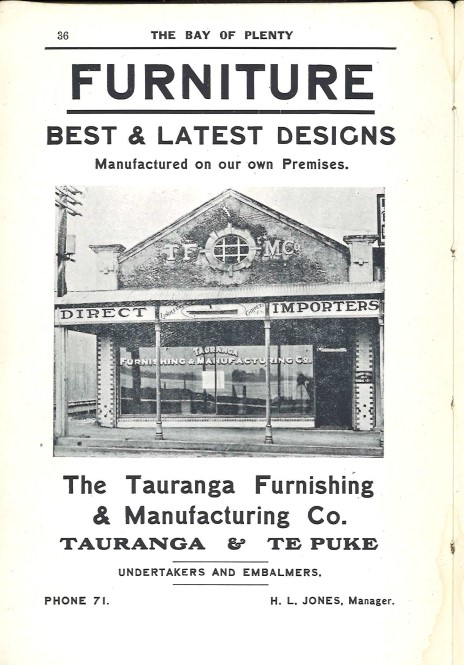
In 1909 the Jones family set up business on the Strand as “Furniture Makers & Upholsters”.  The business soon moved to premises in Hamilton Street and in 1910 formed the company ‘Tauranga Furnishing and Manufacturing Company’.  A newspaper article in the Bay of Plenty Times states: “Amongst the most attractive premises in town are those occupied by the Tauranga Furnishing and Manufacturing Company in Hamilton Street.”

Advertisement - Bay of Plenty Times 11 October 1911

Mr Hugh L. Jones was the company director in those days and he employed over five staff, as he had expanded his casket making to a funeral business.  The  funeral directors wore top hats and tail coats and the horses that pulled the hearse were hired from a local stable in Spring Street, where the old Post Office building is.

By 1913 the Jones family had moved to a much larger and grander building at 21 Devonport Road, which these days is where the temporary library, He Puna Manawa is located.


21 Devonport Road - Tauranga City Libraries 993.42 SETT (Sladden Collection)

The premises had a large workshop which enabled the Tauranga Furnishing and Manufacturing Company to produce a large range of furniture – as well as wooden caskets.  The furniture making side of the business remained in Devonport Road until 1945 when it was taken over by Babington Bros.


Babington's Furnishings - Photo pn-3149

Mr H. E. (Bill) Jones, Hugh’s son, took over as manager of the funeral side of the business and another son, Frank, entered the business about 1946.  In 1938, Jones and Company, as it was then known, built the distinctive Spanish styled building at 107 Grey Street and the funeral parlour moved there.  It was situated just in front of Charlie Haua’s blacksmith business and there were very few shops surrounding it in those days.

107 Grey Street c. 1950s - Photo 02-156

The Grey Street building, with its attractive facade, became quite a landmark in Tauranga and for many years its location was ideal for the funeral business.  The business remained in the Jones family until March 1980, when it was purchased by brothers, Dave and Jim McMahon, however they retained the Jones and Company name.


Jones & Co. Chapel c. 1940 - Photo 03-354

By 1983 Jones and Company had outgrown the building on Grey Street and they moved to ‘Hillsdene’ in 13th Avenue. The Grey Street building was sold to new owners and it still stands today as an iconic reminder of Tauranga’s past, although it currently has a “For Lease” sign in the window giving it a rather forlorn appearance.  People may recognise it most recently as the Versaille Restaurant, which operated on Grey Street for a number of years.


Versaille Restaurant at 107 Grey Street 2015 - Tauranga City Libraries Photo 15-331

Sources: