Showing posts with label Stationers. Show all posts

Friday, 26 April 2024

Mary Humphreys, Photographer: Part 5

A Plethora of Publishers (1907-1912)

In 1905 and 1906 several local and national firms had published postcards depicting Tauranga scenes, including a series of black-and-white and colour collotype cards depicting scenes photographed by Mary Humphreys. They were printed in Germany, published by local stationer T.S. Duncanson in early 1907 and appear to have sold well.

“Post Office, Tauranga”, postmarked 20 December 1907
Black-and-white collotype print, photographed by Mary Humphreys, unidentified publisher
Collection of Brian Ducker

Another series of Tauranga scenic postcards, this time printed in Berlin by monochrome collotype, were published in late 1907, of which two views are known – although there may be others as yet unidentified. We can be sure that at least one of them – a new view of the second Tauranga Post Office – was taken by Mary Humphreys, since she later published it as a real photo postcard under her own name.

Back of Berlin Series postcard by Mary Humphreys, published c. 1907
Image courtesy of Brian Ducker

Although the publisher is not identified, it is possible that they were published and sold by Duncanson’s competitor T.E. Wayte. An advertisement which Mary Humphreys inserted in October 1909 showing her readiness to execute orders for the Christmas season clearly indicated that she had business relationships with both stationers.[i]

“Strand, Tauranga”, c. 1906-1907
Black-and-white collotype print, attributed to Mary Humphreys, unidentified publisher
Collection of Tauranga City Libraries, Pae Korok
ī Ref. 04-246

The other was a view of The Strand looking north, the pavements in front of the shops and the balconies above full of people, and unusually there is not a horse or wheeled vehicle in sight.

“The Basin at Mount, Tauranga,” c. 1907, attributed to Mary Humphreys
Black-and-white collotype print, published by T.S. Duncanson, November 1908
Collection of Brian Ducker

In November 1908 Duncanson announced the arrival of yet another series of eight new Tauranga views.[ii] These were printed using the collotype process in black-and-white in England rather than Germany, probably as a result of British political pressure discouraging trade with Germany at around this time. “Harbour” was a reissue of number 103 in the A.G. Series, while the views of “First Avenue” and “The Spit & Mount” were also issued by Mary Humphreys as real photo postcards and exist as prints mounted in albums. It can probably be assumed that Mary took the photographs for all eight views.

Back of English Series postcard by Mary Humphreys, published November 1908 by T.S. Duncanson
Image courtesy of Justine Neal

English Series of postcards published by T.S. Duncanson, Tauranga, November 1908

The craze in postcards had by then gripped New Zealanders – the reduction in postage for a postcard from a penny to a half-penny in December 1907 helped to fuel the rising demand.[iii] That month the Sydney general post office was forced to suspend delivery of postcards due to the sheer volume received – half a million cards weighing almost two tonnes.[iv] In New Zealand a peak was reached in 1909 with over eight million cards sent through the post.[v] Throughout the country it was an opportunity which photographers and postcard publishers were keen to exploit, and Tauranga was no exception.

Souvenir of Tauranga, view of Tauranga waterfront from the Redoubt
Multi-view fold-out postcard “booklet” published by T.S. Duncanson, c. 1912
Collection of Justine Neal

Ten views of Tauranga on multi-view fold-out, black-and-white collotype printing

Back of “Souvenir of Tauranga” postcard, phototyped in Saxony (Germany)

Some local postcards were still being printed in Germany as late as 1912. Although we have no posted or dated examples to indicate when it was used, this fold-out collotype-printed multi-view issued by Thomas Duncanson could not have been produced prior to 1912, when the Coronation Fire Brigade Station was built. In December 1912 Duncanson announced, “a new series of post cards, picturesque Tauranga views.”  It includes at least one view – “Harbour South Tauranga” – published as a real photo postcard on Kodak Austral cardstock with Mary Humphreys’ characteristic lettering used for the title “Tauranga N.Z.” on the front (below). Another view – “Wharf and Strand” was published around the same time in FGR’s “Humphries Series” (see below), and was also likely her photograph. Some or all of the others may also have been taken by her, but definite attributions have yet to be made.

Women seated on foreshore, The Strand, Tauranga, c. 1910-1912
Photograph attributed to Mary Humphreys, printed on Kodak Austral cardstock
Collection of Tauranga City Libraries, Pae Korok
ī Ref. 04-574

Tauranga, photographed by Mary Humphreys, c. 1908-1914
Real photo postcard, published by F.G. Radcliffe as “Humphries Series” No 7
Tauranga Heritage Collection, Ref.
0112/09

Sometime around 1911 to 1914 several of Humphreys’ photographs were released as real photo postcards under the “F.G.R.” imprint of prolific publisher F.G. Radcliffe, who operated from premises in Auckland between 1909 and 1923. Radcliffe used a number of photographers around the country, and often titled a series with the photographer’s name.[vi] In Mary’s case he made a mistake in the spelling of her name, resulting in the “Humphries Series”, numbered from 1 to 13 (although only four of these have so far been found).

Wairoa River and Bridge, photographed by Mary Humphreys, before October 1901
Real photo postcard, published by F.G. Radcliffe as “Humphries Series” No 13
Collection of Tauranga City Libraries, Pae Korok
ī Ref. 03-048

No 13 in the series is her view of the Wairoa River and bridge previously published in the Weekly Press (1901) and as a collotype postcard by Duncanson (1907). Mention has already been made of No 4, while No 7 was a south-easterly view over downtown Tauranga, also published by Humphreys herself as one of a four-part panorama.

Back of “Humphries Series” No 13, published by F.G. Radcliffe, c. 1911-1914

Collotype printed postcards from abroad and half-tone local printings were well suited to general scenic views, but more topical subjects with perhaps more limited demand were better served by real photo postcards, which had better definition and quick turnaround times. Photographs could be taken of events, for example, and small numbers of prints produced from them and be ready for sale on shop counters within a matter of days. In the next article (Part 6) we will see how Humphreys ventured into that market on her own account.

References

[i] Mary Humphreys, “Photographic Christmas Cards. Advertisement,” Bay of Plenty Times, October 11, 1909, Volume 38 Issue 5420 edition.

[ii] Thomas Sanderson Duncanson, “The Novelty Depot. ’Xmas Season, 1908. Advertisement,” Bay of Plenty Times, November 20, 1908, Volume 37 Issue 5285 edition.

[iii] “Untitled [Half-Penny Post Cards],” Bay of Plenty Times, December 16, 1907, Volume 36 Issue 5145 edition.

[iv] “Australian News. Sydney, Dec 28,” Bay of Plenty Times, December 30, 1907, Volume 36 Issue 5148 edition.

[v] Alan Jackson, “Early History of the Picture Postcard in New Zealand,” in Post Marks: The Way We Were - Early New Zealand Postcards, 1897-1922 (Auckland, New Zealand: Kowhai Media Ltd, 2015), pp15-21.

[vi] William Main and Alan Jackson, “Wish You Were Here”: The Story of New Zealand Postcards (New Zealand Postcard Society, 2005).

Friday, 23 February 2024

Mary Humphreys, Photographer - Part 4

The Postcard Craze Arrives in Tauranga (1904-1907)
(continued from Part 3)

New Zealand’s first pictorial postcard, addressed to Mrs Maxwell, The Elms, postmarked 22 Dec 1904
Chromolithographic print, published in December 1897 by the NZ Post & Telegraph Department
Collection of The Elms Foundation, Ref. 2009.0418.12

Pictorial postcards started to appear in New Zealand from 1897, and the first cards that used photographic, as opposed to artist-drawn, images were probably produced from 1899.[i] Muir & Moodie of Dunedin joined the fray in 1901 – views from their extensive catalogue of Burton Brothers plates were printed in Germany at very modest cost using the collotype process, which facilitated the addition of multiple blocks of colour to produce striking chromolithographic images.[ii] Postcard collecting fever took off in New Zealand around 1902 to 1903: Tauranga stationer Thomas Duncanson’s Novelty Depot was selling New Zealand postcards in December 1902,[iii] including pictorial postcards a year later.[iv]

“Tauranga, N.Z.” (No. 41), taken c. 1904 by an unidentified photographer, postmarked 12 Nov 1904
Panoramic postcard published by Harding & Billing for T.S. Duncanson (Tauranga)
Collection of Tauranga City Library, Pae Korokī Ref. 99-796

In mid-December 1904 Duncanson introduced “a fine view of Tauranga on panoramic letter card,” a three panel, fold out half-tone reproduction view – this may have been the first “picture postcard” of Tauranga.[v] The scene is almost identical to that published by Mary Humphreys in the Weekly Press three years earlier,[vi] albeit the Post Office had burnt down in the interim, but T.E. Price had a similar view published in the Auckland Weekly News in April 1899 (AWNS-18990407-07-0), so this could conceivably have been taken by either of them, or indeed someone else altogether.

Panoramic Photographic Pictures, Tauranga & Vicinity
Booklet of half-tone photographic views, published by T.S. Duncanson, 1905
Collection of Tauranga City Library, Pae Korok
ī Ref. 05-039

“Public School”, Tauranga, 1905 (from Panoramic Photographic Pictures)
Unidentified photographer, published by Brett Publishing Co. (Graphic Series) & T.S. Duncanson
Collection of Tauranga City Library, Pae Korok
ī Ref. 05-075

By October 1905 Duncanson had published a far more elaborate “book of panoramic views” of Tauranga by an unidentified photographer – cover displayed above – which were half-tone prints, but not postcards.[vii] The images were marked “Graphic Series. Protected – C.B. & Co., Ltd. 1.9.05” which suggests that they were produced by the Brett Publishing Co. and marketed by Collins Bros. & Co., Ltd., but doesn’t provide any further clues as to who the photographer was.

Town Wharf and Strand, Tauranga, Postmarked Rotorua 29 November 1905
Half-tone postcard print on generic cardstock, by unidentified photographer and publisher
Collection of Justine Neal

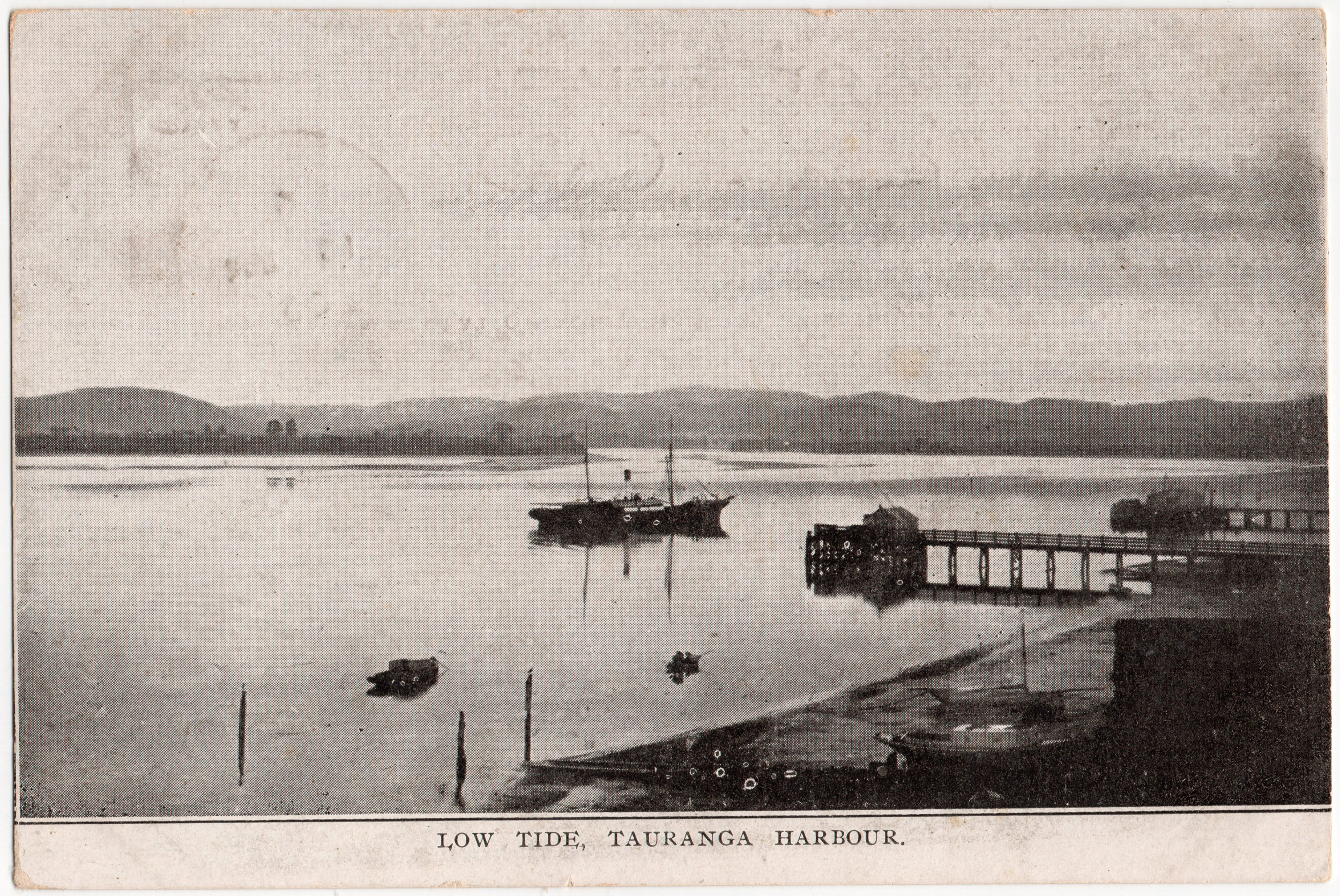
By May 1905 Thomas Wayte’s Fancy Goods Depot on the Strand had postcard albums in stock[viii] and he was publishing his own postcard views within a matter of months, probably the half-tone black-and-white views of Tauranga’s harbour and waterfront by an unknown photographer that were being posted overseas from the Bay of Plenty in time for Christmas that year. These include “Town Wharf and Strand” and “Low Tide, Tauranga Harbour”.

“Low Tide, Tauranga Harbour”, Postmarked Tauranga 10 March 1906
Half-tone postcard print on generic cardstock, by unidentified photographer and publisher
Collection of Justine Neal

Advertisement, Bay of Plenty Times, 9 October 1905[ix]

By late 1905, with a shop on Wharf Street, Mary Humphreys had built up a substantial catalogue of views of Tauranga and this new format became an obvious outlet for her. The Bay of Plenty Times reported:

“Now that photographic post-cards are not only a fashionable, but very agreeable way of communicating with one's friends, in any part of the world, many will be glad to learn that Mrs M. Humphreys, of this town, is taking pictures of residences, grounds and similar subjects, for clients, for transference to postcards and is quoting the same at 6s per dozen cards. In view of the usual coming Christmas and New Year greetings to friends, especially across the sea, it will be well to place orders early.”[x]

Back of Empire Coralyte postcard stock (brown ink), collection of Brian Ducker

Packet for Empire Coralyte Bromide Postcards, Matt.
Collection of Powerhouse Museum, Ref.
97/92/14-33/4

It is possible that Humphreys had already been producing postcards on smaller scale prior to this date, although perhaps only for personal purposes, since very few early examples have been found. A postcard on Empire postcard stock printed with brown ink – not used postally – which was commercially available from the Empire Works Co. of Sydney as early as September 1902,[xi] is known depicting men on a bush excursion. Some of them are are wearing naval caps and uniforms and may be crew of the H.M.S. Lizard, which visited Tauranga in April 1903, and whom she is known to have photographed.[xii]

First Avenue, Tauranga, postmarked Tauranga 10 Apr 1907
Hand-coloured real photo postcard (Empire cardstock), photographed by Mary Humphreys, bef. 1907
Collection of Brian Ducker

The earliest real photo postcard produced by Humphreys that this author has seen which can be reliably ascribed a date of use (April 1907) is a hand-coloured view of First Avenue, Tauranga. The photographer placed her camera and tripod at the intersection with Cameron Road and pointed it east down the then tree-lined avenue towards Devonport Road; three young girls, one holding an umbrella, stand in the foreground. If the girls include Mary’s daughters, which seems likely, their apparent ages would suggest of roughly 1905 to 1906 for the photograph.

Back of Empire Coralyte postcard stock (green ink)
Collection of Tauranga City Library, Pae Korok
ī Ref. 99-687

View of Tauranga’s Strand and waterfront from the Redoubt, c. 1901-1902
Mounted half-plate print photographed by Mary Humphreys
Collection of Tauranga City Library, Pae Korok
ī Ref. 99-352

More commonly found are Mary’s real photo postcards on Empire cardstock printed with green ink; one of them includes a slightly cropped version of this view of Tauranga’s waterfront. It must have been taken prior to the replacement of the wooden seawall with a concrete one in 1902, and possibly on the same occasion as a street level view shown in a previous article (Ref. 99-1182).

Tauranga Maoris Preparing Christmas Dinner (A.G. Series No 107 C),
Photographed by Mary Humphreys, colour collotype print published by T.S. Duncanson
Collection of Justine Neal

In January 1907 T.E. Wayte advertised “colour postcards of N.Z. scenery.”[xiii] A couple months of later, not to be outdone, T.S. Duncanson announced that he was “issuing a new series of postcards of Tauranga and district … comprising views of the Wairoa Rapids; First Avenue, Tauranga; Wairoa Bridge; Post Office; and a group showing Tauranga Maoris preparing Christmas dinner. A further series in colours will shortly be issued.” These came out as the A.G. Series, printed by the collotype process in Germany, with scenes numbered from 103 to 108 - coloured versions had a “C” suffix – and, although she wasn’t acknowledged, they were all produced from photographs taken by Mary Humphreys.

The inclusion of a view of the new Post Office, only completed in March-April 1906, implies that Duncanson’s order could not have been placed before then, although it included at least one view which had previously been published by Humphreys as early as October 1901 (#104 Wairoa or Ruahihi Rapids). Although many extant A.G. Series postcards are postally unused, postmarks on those that were sent through the post indicate their use between May 1907 and September 1909. Alan Jackson, in his introduction to early New Zealand postcard history, believes that minimum printing orders would have been about 500 cards of a single image, and that there was a turnaround of some three months between placement of the order and delivery.[xiv] The story behind the “A.G. Series” is unknown, but it seems likely that orders from multiple clients were combined. A.G. Series 101 was a view of T. Johnstone's pharmacy on the corner of Manners & Willis streets in Wellington,[xv] but no others are known.

Back of A.G. Series postcard stock, chromo printed in Berlin (Collection of Justine Neal)

Judging from the number that have survived, this series of postcards was very popular. The next article in this series (Part 5) will look at further series of Mary Humphreys’ images that were published by Wayte and Duncanson, and how she partially met the growing demand by issuing her own real photo postcards using newly taken views.

References

[i] William Main and Alan Jackson, “Wish You Were Here”: The Story of New Zealand Postcards (New Zealand Postcard Society, 2005).

[ii] Alan Jackson, “Early History of the Picture Postcard in New Zealand,” in Post Marks: The Way We Were - Early New Zealand Postcards, 1897-1922 (Auckland, New Zealand: Kowhai Media Ltd, 2015), pp15-21.

[iii] Thomas Sanderson Duncanson, “Christmas and New Year Trade. Advertisement,” Bay of Plenty Times, December 5, 1902, Volume 29 Issue 4383 edition.

[iv] Thomas Sanderson Duncanson, “At the Novelty Depot. Advertisement,” Bay of Plenty Times, December 4, 1903, Volume 31 Issue 4533 edition.

[v] Thomas Sanderson Duncanson, “Novelty Depot. ’Xmas, 1904. Advertisement,” Bay of Plenty Times, December 14, 1904, Volume 31 Issue 4688 edition.

[vi] Ward, “Tauranga: The Capital of the Bay of Plenty.”

[vii] Thomas Sanderson Duncanson, “Tauranga Going Ahead. Advertisement,” Bay of Plenty Times, October 13, 1905, Volume 31 Issue 4812 edition.

[viii] Thomas Edward Wayte, “Wayte’s ‘Fancy Goods’ Depot. Advertisement,” Bay of Plenty Times, May 22, 1905, Volume 31 Issue 4751 edition.

[ix] Mary Humphreys, “Photographic Post-Cards. Advertisement,” Bay of Plenty Times, October 9, 1905, Volume 31 Issue 4810 edition.

[x] “Untitled [Mrs Humphreys Making Postcards],” Bay of Plenty Times, October 6, 1905, Volume 31 Issue 4809 edition.

[xi] “Intercolonial News,” The Australasian Photographic Review 9, no. 9 (September 21, 1902): 269–70.

[xii] “Untitled [H.M.S. Lizard Arrives in Port].”

[xiii] Thomas Edward Wayte, “Untitled Advertisement [Coloured  Post-Cards of N.Z. Scenery],” Bay of Plenty Times, January 11, 1907, Volume 35 Issue 5000 edition.

[xiv] Jackson, “Early History of the Picture Postcard in New Zealand.”

[xv] T Johnstone’s Pharmacy, Corner Manners & Willis Streets Wellington NZ, c 1907, Lithographic postcard, Postcard, c 1907, Alexander Turnbull Library, Wellington, New Zealand, https://natlib.govt.nz/records/22899967.