Showing posts with label Trades. Show all posts

Friday, 21 February 2025

Beazley's Pre-Cut Houses

Construction of Beazley Homes’ admin block, Hull Road, Mt Maunganui, November 1966
120-format film negative, Published in the Bay of Plenty Times, 9 Nov 1966
Collection of Te Ao Mārama - Tauranga City Libraries, Pae Korok
ī photo gca-13802

In 1950 local father and son home builders, Barry and Fred Beazley, began expanding throughout the North Island. By 1961 they were in the South Island and a year later the company Beazley Homes Ltd. came into being with its head office at Hull Road, Mount Maunganui.

Aerial view of Beazley Homes’ yard, Hull Road, Mt Maunganui, c. October 1966
35mm-format film negative, Unpublished Bay of Plenty Times photograph
Collection of Te Ao Mārama - Tauranga City Libraries, Pae Korok
ī photo gcc-11112

They occupied a large block of land which included the timber yard, Mount Timber and Hardware, the truss plant, the moulding shed and the pre-cut division. The main entrance to the yard was off Hull Rd. The company was known for its pre-cut timber frames that could be sent all round New Zealand and the Pacific.
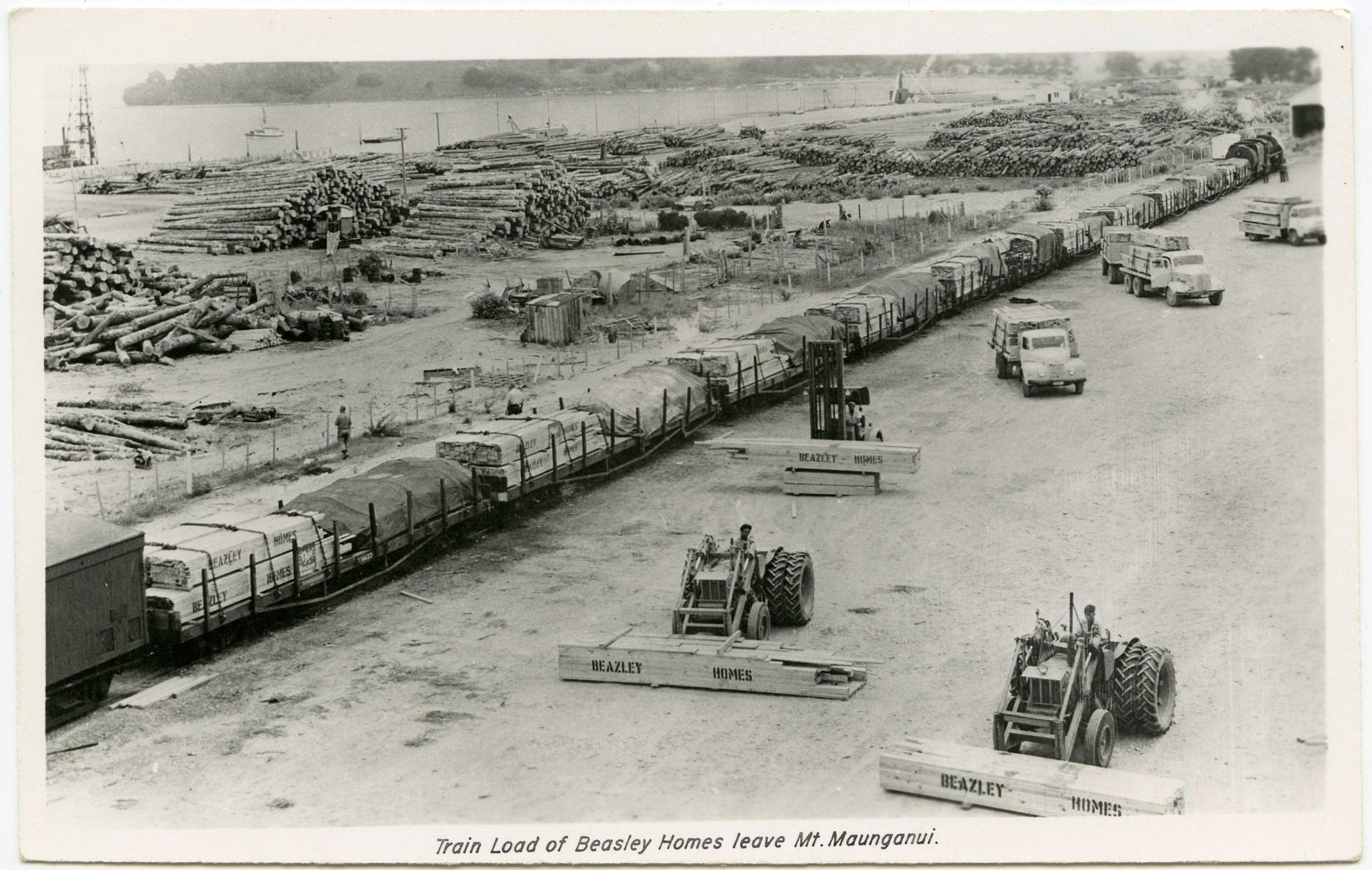
Train load of Beasley [sic] Homes leave Mt Maunganui
Black-and-white postcard (140 x 88 mm), publisher unknown
Tauranga Heritage Collection, Ref. 0039/11

The pre-cut division was staffed with approximately twenty people; one quantity surveyor, three draughtsmen and seventeen others whose job it was to set out the plates and frames, cut the roofs and studs and pack up each completed house lot.  A train came in to the rail siding each day to pick up the wagons loaded with the pre-cut houses. Forty went out each week to franchise builders from Whangarei to Wellington.

Beazley Homes Ltd brochure, c. 1970s
Tauranga Heritage Collection, Ref. 0390/24/1-28

In 1974 all the plans and quantities had to be changed from imperial measurement to metric – a massive job as every measurement on the plans were affected. As a cost saving exercise Beazleys decided to change all inside walls from 4x2 to 3x2 and so all the plans and quantities had to be changed again. After six months it was discovered that 3x2 walls couldn’t keep the studs straight so the plans had to be changed back again.

Beazley Home exhibit at Trades Fair, October 1966
(Detail) 120-format film negative, Published in the Bay of Plenty Times, 11 Oct 1966
Collection of Te Ao Mārama - Tauranga City Libraries, Pae Korok
ī photo gca-13393

The completed houses left Beazleys like giant flat packs and were loaded onto ships at the wharf for the Maldives, Papua New Guinea and Australia. The pre-cut houses sent to Australia were destined for miner’s homes at Mt. Tom Price and a hundred at a time went to Weipa in far north Queensland. One delivery of a hundred arrived there without the kitchens, there was a ‘slight delay’ as the kitchens caught up with the rest of the houses. Hurricane bolts were sent for each corner of the house to prevent the houses from being blown apart during a cyclone.

Pre-built Beazley Homes Ltd. accommodation unit for export market on back of truck, 1977
Fletcher Holdings Archives, Ref. P9006/6

Beazleys sold out to Fletchers in 1973. Pre-cut houses have been replaced by pre-nailed frames and the pre-cut roofs with trusses.

Sources

Fletcher Trust Archives
www.nzherald.co.nz
Pae Korokī Tauranga City Library
Selwyn Neal
Tauranga Heritage Collection

Friday, 21 June 2024

Changing Tauranga Part 5: 108 Devonport Road

Buildings which have been part of our cityscape for many years continue to disappear without fanfare. A prime example is 108 Devonport Road, an unremarkable structure without any architectural merit that most Tauranga residents are likely to have forgotten already.[i] Regardless, its departure in January-February of this year (2024) is worth noting and, at the eleventh hour, perhaps it has an interesting story or two left to tell?

108 Devonport Road in the process of being demolished, late January 2024
Image courtesy of Fiona Kean, private collection

While 108 Devonport Road is listed in the 2008 Central Tauranga Heritage Study, frustratingly the document gives no further details. In the hopes of narrowing down the building’s age, I consulted G. Duncan’s CBD plan completed in April 1934 and immediately found a candidate – circled below.[ii] However, on closer inspection, these two shops with dwellings upstairs appear too far from the corner of Devonport Road and Elizabeth Street and too close to the Tauranga Club.[iii]

Plan of Tauranga CBD completed by G. Duncan, April 1934
Image courtesy of Tauranga City Libraries, Pae Korokī Ref. tcl-map-21-002

A photograph taken of roadworks at the corner of Elizabeth Street and Devonport Road, published in the Bay of Plenty Times in November 1963, offers a glimpse of 108. At the time, the building was occupied by Camerons Appliances who, according to their sign, sold ‘Electrical’, ‘Prams’, ‘Toys’ and ‘TV’. A second image reveals that the property was auctioned by Dalgety Real Estate in 1969. The owner, Charles Cameron, was a qualified electrician operating in Tauranga in the early 1940s.[iv] On his return from the war, Charles established Camerons Appliances and in the early 1950s, as his business grew, the building was extended.[v]

Road works – Eastern corner Elizabeth Street & Devonport Road. Published BOPT 20 November 1963
Image courtesy of Tauranga City Libraries, Pae Korokī Ref. gcc-5114

Premises to be auctioned by Dalgety Real Estate. Published BOPT 8 December 1969
Image courtesy of Tauranga City Libraries, Pae Korokī Ref. gca-18838

Happily, this information narrows the building’s construction date to between April 1934 and 1946. A search of the Bay of Plenty Times was now manageable. Using the terms ‘Devonport Road’ and ‘Lot 244’ approximately two thousand results were generated in PapersPast.[vi] In June 1936 the subdivision of Lot 244, Section 1 was debated by Borough Councillors, the issue being what, if anything, should be built on the ‘nice corner section’.[vii] The owner of the section was Miss Ruby Norris - a member of the well-known Tauranga family who were in the land trade. In June 1938 Norris & Bell advertised they had a corner section in Devonport Road available for sale which was ‘ideal for shops or flats.’[viii] Sadly, having scrolled through the results, this was the only information possibly relating to 108 Devonport Road that I could find. Perhaps a future researcher will have better luck, or this blog will inspire a knowledgeable resident to come forward and share that hoped-for story.

Lot 244 (circled) was subdivided, and 106-108 Devonport Road is identified with a star
Image courtesy of the Tauranga Heritage Collection

References

[i] The address is 106-108 Devonport Road. For simplicity I will refer to it as 108 in this article.

[iii] Currently the site of Devonport Towers – January 2024.

[iv] His war record states his enlistment address as Devonport Road, Tauranga. https://www.aucklandmuseum.com/war-memorial/online-cenotaph/search?n=charles+cameron&plc=tauranga

[v] Bay of Plenty Times, 11 July 1946, p.5.

[vii] Bay of Plenty Times, 12 June 1936, p.3.

[viii] Bay of Plenty Times, 25 June 1938, p.2.

Friday, 24 February 2023

The Strand - Early Days

The Strand, with wooden seawall and beach, c. 1883 (photographer unknown)
Collection of Tauranga City Library, Pae Korok
ī Ref. 04-214

In the early days of Tauranga’s European settlement the foreshore extended from about the present Harbourside Restaurant building to the foot of the cliff on which Monmouth Redoubt was built and was known as “The Beach.” Later, when a rough track was formed along the frontage, it became known as Beach Road and, later still, Beach Street. Finally, after the construction of the first wooden seawall plus other improvements, it became The Strand. In 1872 the building of the seawall began. It was built using 3 inch, well cured, kauri planks and extended from Spring Street to Harington Street.

The Strand with wooden seawall, from the Town wharf, probably 1886
Mounted print, photographed by A.A. Ryan, The National Photographic Company
Tauranga Heritage Collection Ref.
0431/08

A letter to the editor of the Bay of Plenty Times 18 May 1891 pointed out the dangerous state of the seawall, especially if an easterly wind was blowing when the sea was washing the earth from between the planks and causing a chain of holes on the outer edge of the Strand immediately behind the seawall and possibly scouring out the soil under the Strand itself.

The Strand, with concrete seawall and reclamation, c. 1902 (photographer unknown)
Collection of Tauranga City Library, Pae Korok
ī Ref. 04-214

In 1902 a new concrete seawall, built by Joseph Brain extended the Strand further into the harbour and the wooden wall was buried in the process.

The Strand (southern end) with shipping, c. 1910s
Postcard view, photographer (attributed) Mary Humphreys
Collection of Tauranga City Library, Pae Korok
ī Ref. 04-574

Early streets were made using the materials at hand, shell and shingle from the Mount beaches was barged across the harbour to be put on the roads. In 1906 there was a change in road making with preliminary arrangements being made for the asphalting of the Strand. In 1902 the Borough received a Coronation grant of 200 pounds which enabled the go ahead and completion of the King Edward VII Esplanade and on 8 August the foundation stone was laid by the Mayoress, Mrs Jordan. The new footpath ran along the harbour side of the Strand reclamation and soon became as simply “The Esplanade.” In March 1905 there was great excitement in the town when, with great ceremony, Prime Minister Seddon declared The Esplanade open. The mayor had first invited Seddon to attend and open the completed work in 1902 but the pressure of other work had kept him away till then.

The Strand from the Wharf, Tauranga, c. 1910s
Postcard, photographed by F.G. Radcliffe
Tauranga Heritage Collection Ref.
0147/09

Apparently plane trees were growing along the Strand before the well known palm trees of today. On 8 August 1906 The Bay of Plenty Times reported that at that evenings Borough Council meeting the question of the removal of the plane trees was brought forward by Councillor Bull. His suggestion was that the plane trees should be dug up and planted on the reserve called the police paddock, and palms or other suitable trees to replace the plane trees on The Strand. He also suggested that each councillor donate a palm tree for the purpose mentioned. Votes were even for and against, so the Mayor used his casting vote against the motion. By 1910 the palm trees in cages were featuring in photos of the day.

The Strand with palm trees, c. 1918
Postcard, photographed by W.T. Wilson
Collection of Justine Neal

By 1909 parts of the Strand were lit by gas lamps and in 1936 an ornamental lighting system consisting of twelve lamps was installed in time for Christmas. The Strand was a desirable place to have a business because the coastal ships bringing passengers and freight came in there. On the days the ships berthed the wharf was an incredibly busy place. In the early days cows had the freedom of the borough and at various times could be seen leisurely ambling along the Strand or sunning themselves on the Esplanade. They even occasionally helped themselves to the vegetables displayed outside the greengrocers. In return they efficiently mowed the grass on the streets and kept the trees (perhaps the aforementioned planes) trimmed to a convenient height.

The Strand, Tauranga. c 1920s
Postcard photograph by McLaren
Collection of Justine Neal

Where else could a shop owner hang a “Gone Fishing” sign on the shop door, stroll across the Strand to one of the two wharves for a spot of fishing, and be back behind the counter in minutes if they were really needed. A couple of entrepreneurs set up a business on the Strand selling fresh fish from barrows, snapper at 6d each! When they ran out of fish they’d row out into the harbour to replenish their stock.

In 1924, with the railway bridge linking Matapihi and Tauranga completed, the citizens’ interest turned towards the railway line’s track through the town. Business people wanted it along the Strand but the King Edward VII Esplanade  with its seats, grass, shrubs and the tide lapping the edges was a pleasant place to be and many townspeople did not want it spoilt. They wanted the line to run along Elizabeth Street, but business interests had their way, so the railway embankment along the Strand was built in 1925.

A new era in the life of this ever-changing part of Tauranga was about to begin.

References

Papers Past: Bay of Plenty Times, 18 May 1891 & 8 August 1926
Tauranga Historical Society Journals. No. 17, 28, 59, 78
D. Kahotea, K. Phillips, S. Arabin, Archaeological Survey, Tauranga City Central Business District, Te Papa
Tauranga Heritage Collection
Tauranga City Libraries

Friday, 16 September 2022

Tauranga Photographers: Vyvian Tindall and "Studio Vivian"

Photographed by Studio Vivian, Tauranga, c. 1962
Private collection

By 1963, when Tauranga became a city, the population of the urban area had almost reached 25,000. It had trebled since the end of the war, was still growing rapidly, was therefore able to support a vibrant range of services, including a burgeoning professional photography scene.  Apart from the stalwarts - Renwood Studios, Carters Photo Service, Bay of Plenty Photo Laboratories, the Tauranga Photo News and Candid Camera Craft - there were several smaller businesses including Studio Vivian, which first appeared under the "Portrait Photographer" heading in phone directory listings in 1964.

Extract from Tauranga Telephone Directory, 1964

The proprietor of the Studio Vivian was Vyvian Tindall (note the difference in spelling), who operated out of her home on Cameron Road. Although the electoral roll for 1963 shows both her and her husband William Ernest Tindall, whom she had married in 1956, as photographers, records after 1966 suggest that she later ran the business on her own. Her husband otherwise worked as a fitter and turner. Initially settling in Pillans Road, Otumoetai after her marriage, she had two daughters and they had moved to Cameron Road by 1963.


Family at The Elms, c. 1969
Photographed by Studio Vivian, Tauranga
Private collection

Apart from the bare bones of her career laid out in the impersonal lists of public records, little further information about her career has been uncovered. Most of her photographs no doubt lie in personal and family collections, from one of which the two images above are derived. Julie Green recalls:

My memories of Vivian Tindall are of an elegant tallish blonde (with the sixties eye make-up) and her two daughters, the younger of whom was in my class at school. They lived on the same side of Cameron Road as Brain Watkins House, but about two blocks towards the domain. The house was pale stucco, split-level. The family lived upstairs and the studio/workroom was in the basement.  There seemed to be long theatre-type curtains in the studio and I remember watching a young woman employee sitting in good light by the north window colouring and creating white lines for what may have been a fence. I was horrified she was scratching the image with a craft knife.

Charlie Haua at the Blacksmith’s Shop, Tauranga Historic Village, 1978
Photograph by Studio Vivian, Tauranga
Collection and courtesy of Tauranga City Libraries, Pae Korok
ī Ref. 02-095

That she did outside commissions as well as within the confines of a studio environment is evidenced by the images of Charlie Haua working in his Blacksmithy at the Historic Village in 1978. Although she appears to have maintained a relatively low profile, phone directory listings for Studio Vivian Home Portraits continued to appear regularly at the same address until 1979. By 1981, although still working as a photographer, Vyvian Tindall had moved to Remuera, Auckland.

Ted Morris, c.1976
Photograph by Studio Vivian, Tauranga
Collection and courtesy of Tauranga City Libraries, Pae Korok
ī Ref. 02-098

References

The New Zealand Official Year-Book, 1964, Department of Statistics, Wellington, https://www3.stats.govt.nz/New_Zealand_Official_Yearbooks/1964/NZOYB_1964.html

1964 Telephone Directory, courtesy of John and Julie Green

Electoral Rolls and Telephone Directories, 1954-1982, Nga Wahi Rangahau, Tauranga City Library

Email correspondence with Julie Green, 21 May 2022