Showing posts with label Brain Watkins House Collection. Show all posts

Sunday, 16 February 2025

Brain Watkins House Garden Party – A Special Milestone


Mr and Mrs B.C. Julian examining a family postcard album on the front steps of Brain Watkins House at the Tauranga Historical Society’s inaugural Garden Party in December 1979
Photograph by the Bay of Plenty Times photographer, published 3 Dec 1979
Courtesy of
Korokī33738

In November the Society hosted visitors to the Brain Watkins House and garden as part of the biennial Bay of Plenty Garden & Art Festival, the second time we have done this instead of our usual Garden Party. What members and visitors alike probably didn’t appreciate was that the occasion happened to be the 45thanniversary, almost to the day, of our first Garden Party on 1 December 1979.

Willie Watkins and Elva Brain, c. August 1965
Photo Brain Watkins House Collection

The home of Elva Brain and Willie Watkins on the corner of Cameron Road and Elizabeth Street was left to the Society earlier that year as a bequest in Elva’s will and the garden party was an opportunity for members and guests to inspect the house and gardens which are still the Society’s home, and an important focus of our activities. More than 150 members and their guests attended, many in Victorian costumes, including then Mayor Eric Faulkner with his wife Connie, MP for Tauranga, Keith Allen, film and television actress Pat Evison, and visitors from historical societies in Hamilton, Whakatāne and Te Awamutu. We retain strong links with the Whakatāne & District Historical Society in our joint publication of the Historical Review, the Bay of Plenty Journal of History.

Wooden half hull model by Joseph Brain, Brain Watkins House Collection

Guests had an opportunity to view the rooms of the home containing not only the existing furnishings in a setting reminiscent of earlier decades, but also mementoes collected over a century. On display were old family photographs and documents, including Joseph Brain’s will, plans of his engineering projects around Tauranga, early photographs of the house, cups won at sailing regattas and even prizes won by Elva when a schoolgirl.

Elva Brain in the arms of her mother Kate, with her four older sisters, on the steps of their home, c. early 1890s
Carte de visite photograph, Brain Watkins House Collection

Elva was born in 1891 the house which her father Joseph Brain had built a decade earlier, and she lived in it for most of her life. She and her sister Bessie inherited the property when her mother died, and she became the sole owner after her sister died in 1957. The layout of the rooms and their contents have changed little since 1979, the Society choosing to preserve and maintain the look and feel of the early New Zealand home, with all its idiosyncrasies.
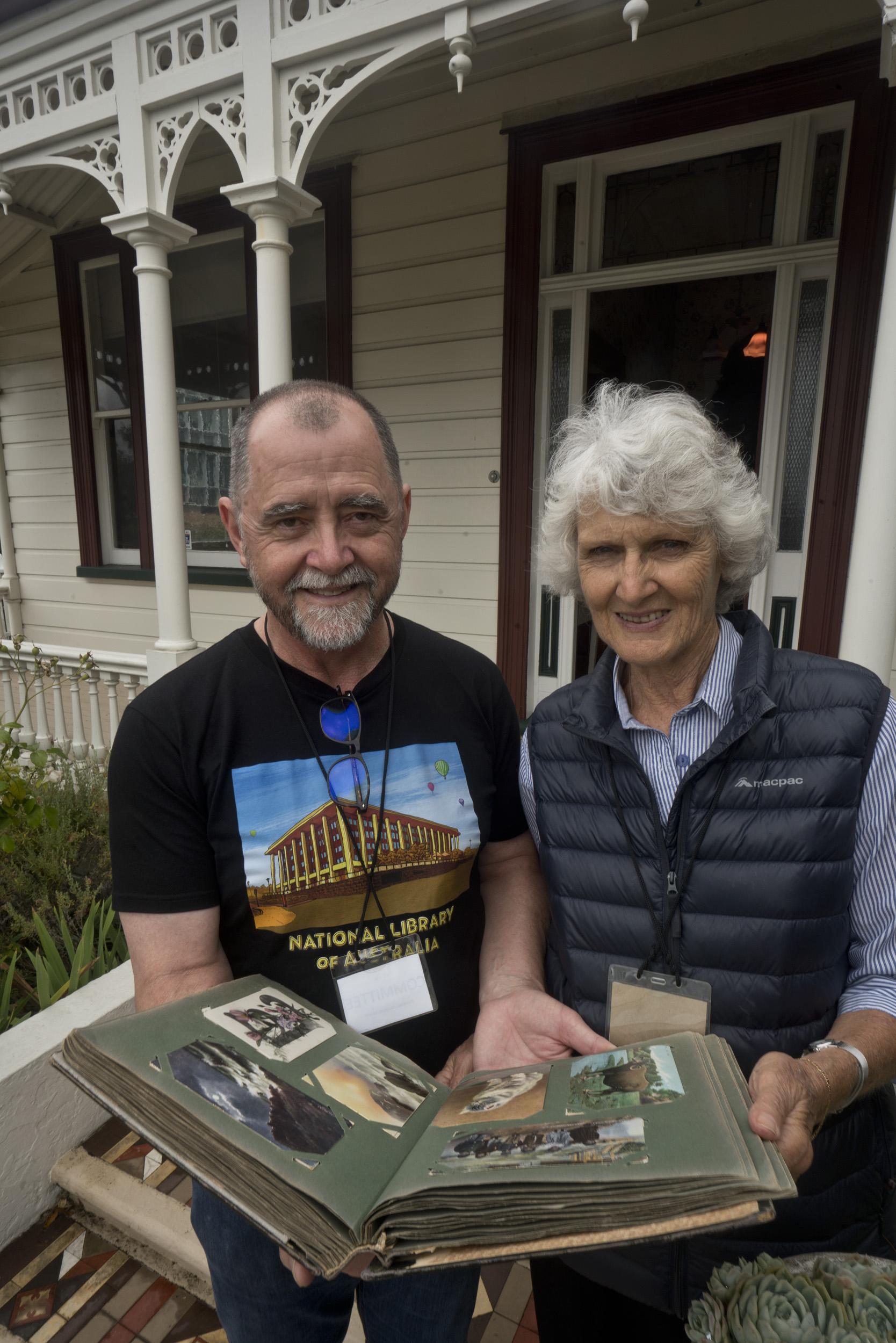
Brain Watkins House guides Leslie Goodliffe and Glennis Smith with the Brain family postcard album which featured in the 1979 Garden Party photo, 16 Feb 2025
Photo: Brett Payne

We also look after the more ephemeral contents of the house, such as the postcard album pictured in the photograph. Our conservation plan is currently being updated and our volunteer team not only show visitors around the house, but keep up an ongoing monitoring of the house’s condition. With the assistance of both the Tauranga Heritage Collection and the Tauranga Library’s Archives, the Society is in the process of conserving and digitising many of the house’s artifacts, and ensuring that they are cared for in the most appropriate physical and environmental conditions.

Friday, 25 October 2024

Just a Material Girl

Attending a conference for Conservators of Cultural Materials, Tauranga Historic Village 

ERCO tote

Even the promotional material on offer at the 2024 conference of NZCCM - https://nzccm.org.nz/ - was something of a revelation to one of the newest members of the society (me).  ERCO, one of the sponsors for the conference, offered, in a high-quality and stylish tote bag, two equally stylish, impeccably designed magazine-type pamphlets intended to describe “the encounter between artwork and collector… a special moment that deserves qualitative, individual light…” 

The intensity so often present in GLAM [1] sector language was, refreshingly, not often used in the papers put forward over the following two days.  Nevertheless, the underlying commitment and concerns expressed by those describing their own encounters with items as various as a silk embroidery of Queen Alexandra, the dendroglyphs on Rēkohu (Chatham Island), whāriki (fine woven mats) recovered after the devastating Cyclone Gabrielle flood at Rangatira Marae [2], and the sailing vessel Edwin Fox, “a large – very large – composite object” stood alongside the practical realities and continual compromises needed to solve problems, do no (or as little as possible) harm, and – invariably – find ways to pay.

Putting a price on the survival of cultural objects is, of course, the most materialistic attitude of all.  However agonising it is when matters are taken away from human agency – as when the expected protection of a shipping container storing harakeke raranga and other taonga proved inadequate to meet the fury of Cyclone Gabrielle (“Swept away – now on its way to China” co-presenter Dr Rangi Te Kanawa was told) – it seems even worse when the costs of preservation are deemed to be too much for the owner to bear.  No doubt this is a factor explaining the abiding popularity of the TV programme, The Repair Shop, where small items of immense sentimental value are lovingly re-created - apparently at no cost - to a condition that satisfies (we only ever see the success stories, of course) the owner.

In a stimulating juxtaposition of engineering and conservation, Dr Kepa Morgan offered his Mauri-ometer [3], “a useful alternative to other decision support tools including cost benefit analysis” to attempt to establish the value of, well, almost anything that has ecosystem, cultural, community and economic dimensions – characteristics of most memory institutions, often vexingly considered only for their economic viability.

Compared with the coyness within the Repair Shop barn, money is often front-of-mind in the Baumgartner Fine Art Restoration studio, based in Chicago.  American respect for paying for the best (expertise as well as artwork) is a consistent and often overt aspect of Julian Baumgartner’s practice.  But not this time.  As is evident in his video [4], this overlooked artifact seems to have been an uncosted part of a job lot – the memories associated with it as faded as the object itself.

Baumgartner still shot

 “We don’t own them – we merely care for them, for the next generation,” Julian muses as he prepares to unveil what museum-trained conservators might regard as a rather over-done exhibit.  (You will have to watch the video for the full before-and-after effect.)  But the dawning delight of the inheritor of Aunt Vi’s framed wedding photograph, and the plausible possibility that the framing workshop made this as a one-off, special tribute to her, are important elements of what we here in Aotearoa would call the mauri of this object.

The NZCCM conference offered some rather more low-key, local insights into “the complex reality of private conservation practice” from two practitioners, one at the start of her career, the other heading her own business, Heritage Preservation and Field Support Solutions [5] (the name says a lot), based in Taranaki.  The talk was headlined, “Balancing Ethics and Efficiency” – two poles of a useful continuum that might assist in the still-not-quite-settled debate on the Tauranga Museum project.  The Mauri-ometer, of course, introduces a few other factors.

Friends of the Museum newsletter front page

For a very long time now, the Tauranga Heritage Collection has had only very limited exposure on the cultural and community fronts.  Kept in strictly regulated storage conditions, conservation efforts limited to gentle cleaning with de-ionised water and cotton swabs (and only on some items), reliant on conservation assessments by trained professionals in selecting and preparing objects for eventual exhibition, challenges await these artifacts.  Mostly they are best preserved by being left cold and in the dark.  Hardly conducive to a joyous, special encounter in a carefully chosen quality of light.


Silk top hat and cotton lace collar from Brain Watkins House

Like the one-time Edwin Fox Society [6], (and, since 2023, the Marlborough District Council [7]) the Tauranga Historical Society has its own large, composite object to care for.  Brain Watkins House is both beloved and unique, and complex and expensive to maintain.  (It might be fun to assess it against the Mauri-ometer.)  Even the two very small objects pictured above carry their own mauri.  The collar, showing few signs of wear, will now never be put to its purpose of adorning a blouse for a special occasion.  The silk hat undoubtedly went on the imposing head of the respected shipbuilder and stoneworker Joseph Brain, but will never be worn again.  As a result of the NZCCM conference, I am left to ponder whether, even though they are cherished as collection items, the joy has left them.

References

[1] Acronym for Galleries, Libraries, Archives and Museums – also sometimes called “memory institutions”.

[2] For a fuller account (and illustrated) of the catastrophic effects of, and community response to,  Cyclone Gabrielle at the Rangatira Marae, see Jamie Tahana, https://www.nzherald.co.nz/kahu/cyclone-gabrielle-rangatira-marae-whanau-salvaging-precious-taonga/UHIJC4PLMZBG5GF4DFT4BA72NA/

[4] Baumgartner, J. “Wither [sic or (maybe) pun intended] the Heirloom?” https://www.youtube.com/watch?v=U4Fr7YGpvXw

Friday, 19 August 2022

Sulphur Point

Sulphur Point works, c1910-1924
Collection of Tauranga City Libraries, Pae Korok
ī Ref. 04-629

On 30 March 1885 the New Zealand Manure and Chemical Company was formed to mine sulphur on Whakaari (White Island) intending to produce both fertiliser and sulphur ore, the latter for export and also to be used in the manufacture of sulphuric acid.

The Spit and Mount, Tauranga, c1909
Postcard from the collection of Justine Neal

A base on the mainland was needed and Tauranga was chosen because of its sheltered harbour and the hilly surrounding countryside providing a convenient market for fertiliser. A site was acquired on the shore of Tauranga Harbour at what came to be known, for obvious reasons, as Sulphur Point. A small superphosphate manufacturing works was built. This plant was demolished in 1910. For the next 70 years various enterprises made use of the Spit including being used as the rubbish dump.

In 1907 George Moore established a fishing and fish drying industry at Sulphur Point and with the help of the Salvation Army a small freezing plant was set up. The Te Ope Fish Supply Company was sold to Sanford Ltd. in 1913.

The Spit and Mount, Tauranga, c1915
Chromolithographic postcard by Mirrielees & McMahon
Collection of Justine Neal

The Tauranga Defence Rifle Club had its rifle range at Sulphur Point and in 1917 Captain J.C. Millar presented to the club a handsome tea set and tray to be shot for by the ladies on the rifle range on March 1st. The lady who won it was Elva Brain and the silver tea service and tray are on display at the Brain Watkin House along with a photo of Elva beautifully attired in her long white dress and hat.

In 1923 plans were approved for the White Island Chemical Company to construct a wharf at Sulphur Point. They wanted to extend the existing jetty to a maximum of 600 feet in order that larger vessels could load and unload at the wharf at any time.

The Spit and Mauao, undated postcard
Collection of Justine Neal

In 1926 the Sulphur Point Road was metalled to give easier access to the White Island Agricultural Chemical Company’s works. This company became White Island Products and eventually went into liquidation in 1934 with the plant being auctioned on site at Sulphur Point.

In 1942 a permit was issued to the firm of J Kaaklund Ltd. for the establishment of a fish canning works. The build was not smooth sailing as the following report from the Bay of Plenty Times, 15 December 1942 records.


“While engaged in placing roofing iron on the building at Sulphur Point, which is to be used as a fish canning factory, yesterday afternoon Mr.J.D.Simpson, of Hairini and Mr. Gordon Decke, of First Avenue, fell twenty feet to the ground.

Mr. Simpson suffered a fractured leg and is a patient in Tauranga Hospital, his condition being satisfactory, while Mr. Decke suffered from shock.

The two men were sitting on a sheet of iron from which they had removed the nails to adjust, when the sheet slid off the roof, carrying Mr. Simpson and Mr. Decke with it.”

Later that year the Public Works Dept. advised that it had recently acquired three sections at Sulphur Point and wished to erect three tents or huts for their staff.

Railway Station on reclaimed land at Sulphur Point, undated
Postcard from Tauranga Heritage Collection, Ref. 0030/11

In 1944 there were plans afoot for Sulphur Point to become an industrial area. Tauranga Harbour Board leased four sections to TeKau Knitwear. Mr. P. Densem said thought needed to be given to the erection of buildings and layout and provision of open spaces so the board could not be blamed for creating slums later on.

The first proposal I can find for reclamation at Sulphur Point is 1937 when a proposal was made to reclaim 5 acres between the railway yards and the shore end of Sulphur Point. This proposal did not go ahead. Eventually land reclamation for Sulphur Point began in ernest in 1965 and by 1990 90 hectares of land had been reclaimed.

References

Island Volcano, W.T.Parham.

Dictionary of New Zealand Biography

Papers Past, Bay of Plenty Times, 3 Mar 1944
Papers Past, Bay of Plenty Times, 7 Feb 1917
Papers Past, Bay of Plenty Times, 15 Dec 1942
Papers Past, Bay of Plenty Times, 9 Apr 1926
Papers Past, Bay of Plenty Times, 29 Sept 1944
Papers Past, Bay of Plenty Times, 3 May 1926
Papers Past, Bay of Plenty Times, 14 Aug 1942

Friday, 1 July 2022

Three Young Teachers Confess

Side by side in Ada Brain’s Birthday Book, given to her on her 21st birthday in 1895[1], are the Confessions of her sister Alice and one D W (David William) McNaughton.  Although Alice and David did not marry until 22 February 1910[2], “quiet[ly], at the residence of the bride’s parents,” the attraction between them is apparent from even a cursory reading of their responses to the leading questions put forward on pages 292 - 307[3] of Ada’s book. 

Alice esteems honesty above all other virtues; David opts for constancy.  Alice wants her ideal man to be “true hearted.”  David thinks he should be “lighthearted and true.”  Alice’s ideal woman is “loving to all” while David sees his ideal as “kind and loving.”  And while Alice proudly - and, or so I think, with her tongue in her cheek - puts herself forward as “the most beautiful thing in nature,” David, a few pages on, nominates “A. J. Brain” as his “favourite heroine.”  (His hero was “Bruce”, presumably Robert the Bruce.  And Alice was indeed pretty.  I have been unable to find any images of the young David McNaughton.)

Why did they wait so long before their quiet wedding?  Perhaps the clue is in David’s answer to the question, “At what age should a man marry?” – “at 25 if he can support a wife” (he was twenty-five at the time.)  Alice, eighteen, thought the age should be “28”, but also stipulated the ability to support a wife.  And she gave herself six years to assume the responsibilities of the married state: a woman should marry at “24 if she’s got enough sense.”  Even at eighteen she was sensible, disavowing “love at first sight” until eight months had passed.  David, more impatient, required six.

Both were teachers.  Alice, whose career evidently ceased upon her marriage, rose to become headmistress of Greerton School.

Korokī Ref. 04-565

We will leave her there.  Mother of five children, her firstborn’s birthday 1911[4], she disappears into domesticity and her husband’s steady rise in his teaching career.  David achieved early glory in 1892[5] by passing the examination for the Junior Civil Service examination, coached by a Mr Murphy of the Tauranga High School.  That same year, spending the winter playing rugby[6], he worked as probationary pupil teacher at Tauranga’s No.2 School, also known as the Harington Street School, where Mabel Blick and Esther Brain were senior students.  Both made entries in Ada’s book.

Teaching was as tough a profession in those days as it is now.  Emphasis on professional development (as modern terminology has it) was critical to advancement.  David was promoted in 1894 at the Harington Street School[7], and also that year sat an examination in which half the candidates failed.  He garnered 585 points[8] out of a possible 1100, (I suspect this means he scraped through with a margin of 35) and (locally) was outdone by two women, Miss Elliott, a colleague at his same school, and Miss Louisa Wilson from Katikati.  He may not have been on top of his game for the exam.  He was reported as having been ill in the spring of 1894, which occasioned a delay in Miss Elliott’s transfer to Whakatane and the consequent possibility of his meeting with the eligible Miss Brain[9] (eligible to be a replacement teacher, I hasten to say.)

The rest is, as others say, history.  Two years after their closely paralleled confessions, David was transferred to Opotiki[10] and, shortly afterwards, as headmaster in Waihi[11].  Carrying his certificate at level D[12], he moved from Waihi to the city as first assistant master at Chapel Street School, Auckland, in 1903[13].  And in 1904 he passed his first year exam in manual training in woodwork[14].  This seems to have provided an impetus to his career and his ability to support a wife: he passed five Class C teaching subjects in 1906[15], and came “visiting relatives” in Tauranga.  His confessed fondness for the piano showed up at a 1908 concert in Ramarama[16], where he was one of the two accompanists.  Two years later he married Alice.

My other player in Ada’s parlour game, Frederick Koller, seems to have been a racier character than thoughtful, methodical David.  His far less earnest responses[17] as a 21-year-old may, however, indicate that there was no second game going on in his life at the time. To twenty-first century minds he seems a bit unreconstructed: his “greatest earthly happiness” was to “lie on my back and smoke with a nice girl to brush away the flies”.  His ideal woman was “a true woman” (emphasis his) and he considered “a lovely woman (unpainted)” to be “the most beautiful thing in nature”.

Nonetheless, Fred sounds like fun, and he was bright.  Mr Murphy’s coaching secured him tenth place among the candidates examined by the Auckland Education Board in 1893.  He loved to perform.  He got a safe 687 points[18] in his 1895 Board of Education exam and was mentioned for his part in a farce[19] in aid of a Church of England vicarage in Ellerslie. His game was cricket, not rugby[20] and his daughter Dulcie was fast on her five-year-old feet.[21]

For despite his misgivings about young women - “D- Fool (as a rule)” (he confessed to the same opinion about “the young man of the period”) Fred got married in 1901[22].  Frances Colebrook, born in Gisborne in 1873, was a little older than he, although she outlived him by fifteen years.  Neither he nor she met the criteria he offered in Ada’s book.  “At what age should a man (and, next, a woman) marry?”  he was asked.  “Depends on circumstances,” he stated firmly. For a man: 30 years old.  The woman: 25.  He was 27, she, much the same age.  So much for the truth of the confessional.

References


[3] The source for the quotations in this essay is the Birthday Book itself, held in the Brain Watkins House Museum Collection.

[4] Actually, 29 March 1911. 

[17] At pages 474-484 of the Birthday Book

[19] Literally: its title was  “Area Belle”https://paperspast.natlib.govt.nz/newspapers/TO18950928.2.73