Showing posts with label Tauranga Hospital. Show all posts

Friday, 24 March 2023

Moses Spence

Working Bee at Tauranga Hospital, with Moses Spence seated at centre (X), c. 1900s-1910s
Unmounted large format print by unidentified photographer
Tauranga Heritage Collection, Ref. 0435/08

The above image in the Tauranga Heritage Collection depicting a working bee at the Tauranga Hospital, taken early in the 20th century, intrigued me. A group of men with shovels and a wheelbarrow along with some nurses, all anonymous except for a man marked with an X.  He was Moses Spence and said to be chairman of the hospital board.  This turned out not be entirely accurate: Moses Spence was elected a member, but not chairman of the Bay of Plenty Hospital and Charitable Aid Board in 1911. One cannot imagine a member of our former DHB turning up shovel in hand to do a bit of work about the place.

So, who was Moses Spence? 

Mr Berry outside Moses Spence’s store, Tauranga, c. 1900
Mounted print by unidentified photographer
Collection of Tauranga City Library, Pae Korok
ī Ref. 01-467

Born in County Armagh, Ireland, Moses Spence joined George Vesey Stewart’s Special Settlers and sailed to New Zealand on the Lady Jocelyn.  It was the only emigrant ship to arrive in the Port of Tauranga and did so in January 1881. Spence drew a farm of 160 acres near Te Puke that he developed and where he persuaded his brother Samuel to join him.  Samuel had emigrated some years before Moses and farmed in the South Island.  Between them the brothers developed several farms including some that had been abandoned by other settlers.

Rev. James Richards in Moses Spence’s gig, c. 1904
Collection of Tauranga City Library, Pae Korokī Ref. 04-460

By 1887 Spence was working for R.C. Roberts, a grain and seed merchant in Tauranga, and the following year opened his own business with partner Phillip Bennet. By the 1890s the partnership dissolved and Spence added to the grain and seed side, selling fertiliser as an agent for Kempthorne Prosser, and selling their flour and bran for the Waimapu Flour Mill.  In 1893 he bought out Carlos Kramer Walters’ share of the Maketu store. He purchased shares in the Herald Gold Mining Company of Whangamata and in the Te Puke Gold Mining Company.

Building Bee at Methodist Church Hall, Tauranga, 1 January 1914
(Moses Spence standing hatless in middle row at far left)
Collection of Tauranga City Library, Pae Korokī Ref. 04-459

Meanwhile he took an active part in the Tauranga Methodist Church, where he sang in their concerts and was involved in building the first Methodist Church on the corner of First Avenue and Devonport Road. In 1897 Moses Spence was elected to the Tauranga Borough Council, then successfully stood for Waimapu Riding of the Tauranga County Council in 1908, and the Hospital and Charitable Aid Board in 1911.  In 1900 he took the first of three trips back to Ireland.

Moses Spence’s gravestone, Tauranga Methodist Cemetery, February 2023
Photographed by Justine Neal

He never married but gave away the daughter of his late brother Samuel when she married in 1918. He moved to Auckland in about 1920 to live near his brother’s family but returned frequently to visit Tauranga for events like the A & P Show. Moses Spence died in Auckland aged 90 in 1942 and was buried in the Tauranga Methodist Cemetery alongside Samuel and Maggie Spence.

Sources

Shearer, Dr. The Hon. Ian, and Wright-StClair, Dr Rex, A Century on Cameron Road. A History of Tauranga Hospital 1914-2014, Tauranga, 2016.

Bay of Plenty Times, Papers Past

Friday, 17 December 2021

Marie Stewart and TEMCO

(continued from Part 1 published 2 July 2021, by a contributor who wishes to remain anonymous)

"More eggs for housewives" BOPT 20 Aug 1949
Courtesy of Papers Past

During the War years there were serious shortages of many things, and one was eggs for city dwellers. Marie Stewart was one of the initiators of the Tauranga  Co-operative Egg Marketing Society Ltd in 1943. She was assisted and encouraged by an English friend Joyce Laurence (Lorrie) who lived in New Zealand during the war.  Farmer’s wives could bring their baskets of eggs to a rudimentary egg depot near the Railway Bridge on the Strand extension and have them put under a light to check their quality. Any that passed were purchased and went into the pool of eggs to supply American servicemen, hospitals and urban households. At that time eggs were fetching 4d a dozen and often were bartered for other items. Poultry food was also in-ferior and very expensive.

Marie and Lorrie and the 1930 Model A Ford coupe
Image courtesy of Mackersey Family

In most centres these egg pool initiatives were under the wing of the local dairy co-ops but in Tauranga it was very soon set up separately. Marie also gave talks at var-ious meetings of the CWI in the mid 40s on ‘Egg Production.’  Marie sold the stock and plant from Cheriton in Waihi Rd around 1951 due to poultry disease problems, and travelled to Rhodesia (now Zimbabwe) to help her old friend Lorrie on her poultry farm.

In the early 50s a levy of 1d per dozen was imposed by the Tauranga Co-operative Egg Marketing Society Ltd which financed the Society’s new premises. Profits were made, bonuses were paid and the Department of Agriculture began to recommend the area for intending poultry farmers.

Temco advertisement showing new building
Bay of Plenty Year Book, 1955, Astra Publishing
Image courtesy of Julie Green

A new building was opened ten years to the day after the formation of the society, helping business to grow tremendously. They ended up with twenty trucks delivering eggs from Thames to Opotiki and the eastern Waikato. In 1965 a mash plant opened at Mount Maunganui for the manufacture of poultry food, and there were TEMCO (having become the Tauranga Egg Marketing Company) branches in Rotorua, Taupo and Whakatane.

The TEMCO fleet in front of the mash plant at Mt Maunganui, 1960s
Image courtesy of Tauranga City Libraries (Pae Koroki Ref. 02-117)

Many readers will remember the TEMCO processing plant situated on Cameron Road between 16th and 17th Avenue from the 1960s. I believe it was closed in the 1980s and the building was repurposed. Latterly it was an organic food outlet.

Packing eggs at Temco, 1963
Image courtesy of Bay of Plenty Times and Tauranga City Libraries (Pae Koroki, Ref. gca-5360)

By 1964 the city growth had squeezed Marie and her day-old chick enterprise out into the country. She moved operations to Taniwha Place next to the Wairoa River. Her niece Margaret remembers that in earlier times the newly hatched birds were careful-ly packed in octagonal boxes and transported to the Service Car (a forerunner of buses) depot from whence they were distributed rapidly all over the country. Eventually she produced 250,000 chicks annually and some even traveled as far as New Caledonia.

Marion was the first woman to serve on a primary producer board (1969-1973) and was awarded an MBE in 1974 for her services to the poultry industry and other com-munity organisations, such as the Plunket Society and the local Hospital Board.

Miss Stewart (at left) leaving Government house with her MBE
Image courtesy of Mackersey Family

She contributed to the New Zealand Farmer magazine for five decades and in the year of her death was given the poultry industry’s highest award.

Her last book ‘Keeping Chooks, Ducks, Turkeys and Geese?’ was published in 1979, dedicated to “My humble hens that have sent me to many more parts of the world than most are privileged to see.”

References

Anon (1949) “More Eggs for the Housewives,” Special Committee is Appointed, Bay of Plenty Times, Vol 77, Issue 15059, 20 Aug 1949, p20, from Papers Past https://paperspast.natlib.govt.nz
Anon (1955) Advertisement, Bay of Plenty Year Book, 1955, Astra Publishing
Anon (1962) Beautiful Bounteous Bay of Plenty, Stanton Smith & Co., Wellington, for Tauranga Branch of New Zealand Travel & Holidays Association
Anon (1971) Short History of TEMCO, Journal of the Tauranga Historical Society, No. 43, August 1971, p33-34, courtesy of Pae Koroki https://paekoroki.tauranga.govt.nz/nodes/view/23941
Anon (1975) Bay of Plenty Times, 26 Aug 1975
Elizabeth Cox. 'Stewart, Marion Watson', Dictionary of New Zealand Biography, first published in 2000. Te Ara - the Encyclopedia of New Zealand, https://teara.govt.nz/en/biographies/5s46/stewart-marion-watson (accessed 4 December 2021)
Mackersey family reminiscences

Friday, 2 July 2021

Marion "Marie" Watson Stewart (1898-1983)

This is the first of a two-part series by a contributer who wishes to remain anonymous. It is about an English woman who adopted New Zealand as her home, and was instrumental in establishing an important avicultural enterprise in Tauranga.

Marie Stewart
Photo by Rupert Connell, Tauranga

Marie Stewart was a Birmingham girl who, along with many of the population of industrial England, developed bronchitis as a youngster. She nursed her ailing mother for her final seven years and then made a conscious choice to get into the country air and consequently specialised in raising and managing poultry.

In 1931 she travelled to New Zealand to visit her sister, Kathrine Bell of Townhead Farm, intending to stay for six months, but never used her return ticket. She worked at Massey Agricultural College in Palmerston North for three years as a researcher and lecturer, supplementing her income as a regular columnist for several agricultural papers and authoring three books on poultry keeping.

In the mid-1930s she came to Tauranga to be nearer to her sister and very soon needed to take over the management of the household due to Kathrine’s serious illness following the birth of her second child. To assist her in this unfamiliar role she consulted the Plunket nurse and soon became very involved in the running and support of the Society, a task she took seriously for 45 years.

Marie with niece Margaret and nephew Walter at the Kaimai summit

Once her domestic responsibilities had reduced, Marie turned her energies to purchasing about nine acres of land in Waihi Road, where she set up her own model poultry farm “Cheriton” on the site of the present day The Bayview (formerly Melrose Home and Hospital for the Elderly.)

Marie with a Black Orpington Rooster

She developed a large flock of layers and sent dressed birds to many Rotorua and Taupo Hotels. She won many prizes for her Black Orpingtons. Her birds were housed in sheds and a series of ‘arks’ which could be moved over the ground.

Scene at Cheriton

Marie belonged to a group of women who organised week-long ‘camps’ for selected country girls in the 1930s and she was responsible for the ‘physical jerks’ and a talk on ‘How to budget for buying clothes.’  She was also a member of the Health Stamp Committee which organised sales of stamps and first day covers to raise funds for much needed Health camps for sickly and underprivileged children. Other interests were the Lyceum Club and the Repertory Theatre. She was also a Justice of the Peace for many years.

Scene at Cheriton

During the 1940s she became the County Council’s representative on the Tauranga Hospital Board, a position she held for 33 years.

--- To be continued ---

Sources
Dictionary of Biography of NZ
Papers Past- BOP Times
Interview with niece Margaret
All images courtesy of the Mackersey Family

Tuesday, 29 December 2020

New Books: A Path Through the Trees


Mary Sutherland graduated from the University College of North Wales (now Bangor University) in 1916. She was the first woman forestry graduate in the world, and during WW1 she worked with women in Britain’s forests; on a Scottish Baronet’s estates, then with the developing British Forestry Commission. Mary came to New Zealand in 1923 and was employed by the NZ State Forest Service. An educated woman with practical skills working in an entirely male-run industry created challenges. 

After losing her position for the second time following the 1932 Economic Commission report, Mary forged a new career in botany at the Dominion Museum. During World War 2, she supervised at the YWCA-administered War Workers’ Hostel in Woburn and at the end of the war, she was appointed the Department of Agriculture’s first farm forestry officer.

A conservationist, and life-long lover of trees, Mary maintained her membership with the New Zealand Institute of Foresters throughout life: she served on the NZIF council in 1935-36, and as vice president during 1941-42. Interested in the world and in travel, Mary was proud of her university training. Believing all women deserved higher education, she served on various committees and the executive, for the Wellington Branch of the Federation of University Women.

Vivien is grateful to the Stout Trust, and the New Zealand Institute of Forestry for enabling Mary’s story to be published.

Tauranga connections

Mary Sutherland’s niece was the late Frances Glendenning, who lived in Welcome Bay, and was a friend of the Tauranga Library. Known as Frankie, she collected Sutherland family information, which included nine letters written by Mary, her 1952 diary and photographs.

Marion Stewart, who was Margaret Mackersey’s aunt, was a friend to Mary Sutherland. Marie, as she was called, owned the chicken farm ‘Cheriton.’ She set up the Tauranga Egg Marketing Cooperative which supplied American forces in the Pacific with eggs and chickens, and she was a long-standing member of the Tauranga Hospital Board. Mary and Marie’s cruise together in Fiordland in 1950 is a chapter in the book, written using information taken from Marie Stewart’s diary and Mary’s family letter.

Violet MacMillan was born in Katikati in 1902 and died in Tauranga in 1981. She was the first supervisor at the Woburn War Workers’ Hostel in World War 2 and  returned a year later to her position at Otago University College. Mary Sutherland who had been working as assistant supervisor, then took over as supervisor.

The author

Originally a trained nurse, Vivien Edwards worked as a freelance writer for over 20 years. She used to be a regular contributor to New Zealand Forest Industries magazine, hence her interest in how a woman came to be working in this country’s forests in the 1920s and 30s. Vivien has an interest in research, and Mary Sutherland’s story is her third book. The others were ‘Winkelmann: Images of Early New Zealand’ (Benton Ross 1987) and ‘Battling the Big B: Hepatitis B in New Zealand’ (Dunmore Publishing Ltd. 2007). As many readers will be aware, Vivien is also an active member of the Society and a past contributer to this blog.

A Path through the Trees has been reviewed on Kete Books and is available from Books A Plenty or directly from the author (Email).

Tuesday, 26 February 2019

Tauranga Hospital's Roof Garden

Roof Garden, from rear, 1994: puka trees: pond area, to right beyond box hedging: hebes, a variety of pittosporums, Teucrium fruticans (germander) (large grey green plant). Lower right: mixed conifers. Next to path, ground cover junipers. Bottom right corner: Australian frangipanis. Photo: Vivien Edwards
When the Clinical Services building at Tauranga Hospital was planned, Hamilton architects Gillman, Garry, Clapp and Sayers’ suggestion to use soil for roof insulation and create a garden, met with controversy. There was no other roof garden completely covering a roof in the Southern Hemisphere, let alone one on top of a hospital building. After reassurance from the architects a garden could be created without the roof leaking, and approval came from Wellington, it was decided to proceed. The therapeutic value of plants and the important role gardens play in creating optimum conditions for people to heal, was recognised. Such a garden would create an environment where patients, relatives and staff could retreat from stressful events, find beauty and solace, and be restored. When patients’ health and the weather conditions allowed, those confined to bed, could be wheeled out into the garden, along with supporting equipment such as intravenous drips. Mobile patients would make their own way.

In 1994, I had the opportunity to investigate the story of what was then Western Bay Health’s roof garden, as GP Weekly, a publication I wrote for, which now no longer exists, regularly published a page on doctors’ gardens. Ron Benfell, one of two gardeners employed at the time, showed me around the garden. His fellow gardener was Frank Thompson. The two men spent two to three days a month, maintaining the roof garden. They also cared for the other hospital gardens. Unfortunately, some gardens had to make way for new hospital buildings, to service Tauranga’s burgeoning population.

Puka tree (Meryta sinclairii), 1994. Photo: Vivien Edwards
Alyson Howell, customer services manager for Western Bay Health at the time, told me the roof garden was developed in 1971. The garden had been carefully planned. The roof was waterproofed with polybutanol, and the piped drainage system had control valves. There were layers of chaff, straw and pumice, then soil, only a spade-end deep, except where mounded to create raised areas. Despite minimum soil depth, some conifers were 20 to 25 feet high. The flowering cherries had recently been topped. A large variety of perennial species were chosen for their particular qualities, and with regard to their rooting system. “We couldn’t plant a tree with tap roots on the roof.”

Those on the upper floors of what was then the main hospital building, look down onto the garden. Cameron Road is on one side of the garden. Below, on the other side, are secluded courtyards, accessed through the clinical departments. In 1994, the courtyard nearest to the main building had a white camellia, and the central courtyard, a large Japanese maple Shin deshobo, which hung over the courtyards on either side. The furthest, more shaded courtyard grew pongas and other ferns. The railing near the entrance to the roof garden was covered with maroon-coloured jasmine and fatshedera. Bouganvilleas were being established. A cobblestone path and dwarf box hedging divided the garden into separate feature areas of conifers, small perennial shrubs and natives. A waterfall (out of sight in the photo) was set in a grassed area. It had a long run to the bottom, before the water was pumped back. Walking through the garden, which is around a quarter of an acre in size, there were weeping silver birches, pittosporums, three flowering prunus trees, surrounded by several smaller crepe myrtles, followed by mixed conifers, and a dwarf kowhai next to small perennials.

Pond area of the roof garden, 1994. Photo: Vivien Edwards
The pond had a backdrop of Leptospermums, azaleas, Choysia and Pittosporums. Before the large pukas (Meryta sinclairii) were two wide-leafed Australian cabbage trees. Pink proteas and Ceanothus behind a seat created shelter and privacy. Beyond the native shrub area was a stand of large conifers and Australian frangipanis. Along the meandering, cobblestone path, wisteria clinging to the pergola, helped to offset the hospital’s large ventilation cooling towers. At night the garden was strategically lit. Those unable to sleep, could look down on the trees.

Since 1994, the roof garden has undergone change. The pond was fenced to comply with health and safety legislation and I don’t remember seeing the waterfall when I was last there. But the roof garden is still a beautiful and restful place, worth a visit next time you are at Tauranga Hospital.

Friday, 7 December 2018

Agnes Faulkner

Agnes Faulkner. Image courtesy of Tauranga City Library Ref. 99-1339
 Agnes Faulkner (nee Davies) was born in Opunake 1891 and died in Tauranga 1986, aged 95

Agnes was one of a family of 13 and it was her dream to become a teacher, but shortly after their arrival in Tauranga she began work at age 13 as a tailoress. Married in 1912 to “Barley” Faulkner she barely left her home for the next 20 years as she raised children and acted as bookkeeper and telephonist for her husband’s ferry business.

Finally in 1932, under doctors orders, she attended a Country Women’s Institute meeting and from that day her world opened up. She became involved in The St John’s movement, and during one period was giving up to nine lectures a week in first aid or home nursing. She was one of the first women to act as an ambulance attendant and eventually became the Superintendent of the Nursing Division.

Bay of Plenty Times, Image courtesy of Papers Past
From 1934 -1977 she was heavily involved in health services and served as only the 2nd woman on the hospital board. She was a prime mover in the establishment of the maternity annexe. In 1953 The Queen bestowed her with a Coronation Medal and an MBE in 1958.*

Agnes was also involved in the Road Safety Council and The Tauranga Historical Society das well as being a JP. In her latter years she continued to lecture on Maori medicines and cures and was a volunteer at The Tauranga District Museum.

* Some sources say 1950

Sources

Biographical Sketches of The Centennial Mural (Artist Elizabeth Grainger and Editor Ernest E. Bush), Feb 1982
Tauranga 1882-1982;The Centennial of Gazetting of Tauranga as a Borough (Edited by A.C. Bellamy) TCC 1982
Manuscript 43 in Vertical Files, Heritage Research Room, Tauranga Library; From interview with Agnes in 1981

Tuesday, 27 November 2018

The Slipper Bed Pan

In the past, bedpans were made from pewter, ceramics, metal and more recently cardboard. George Washington, who died in 1799, used one made from pewter in his later years.


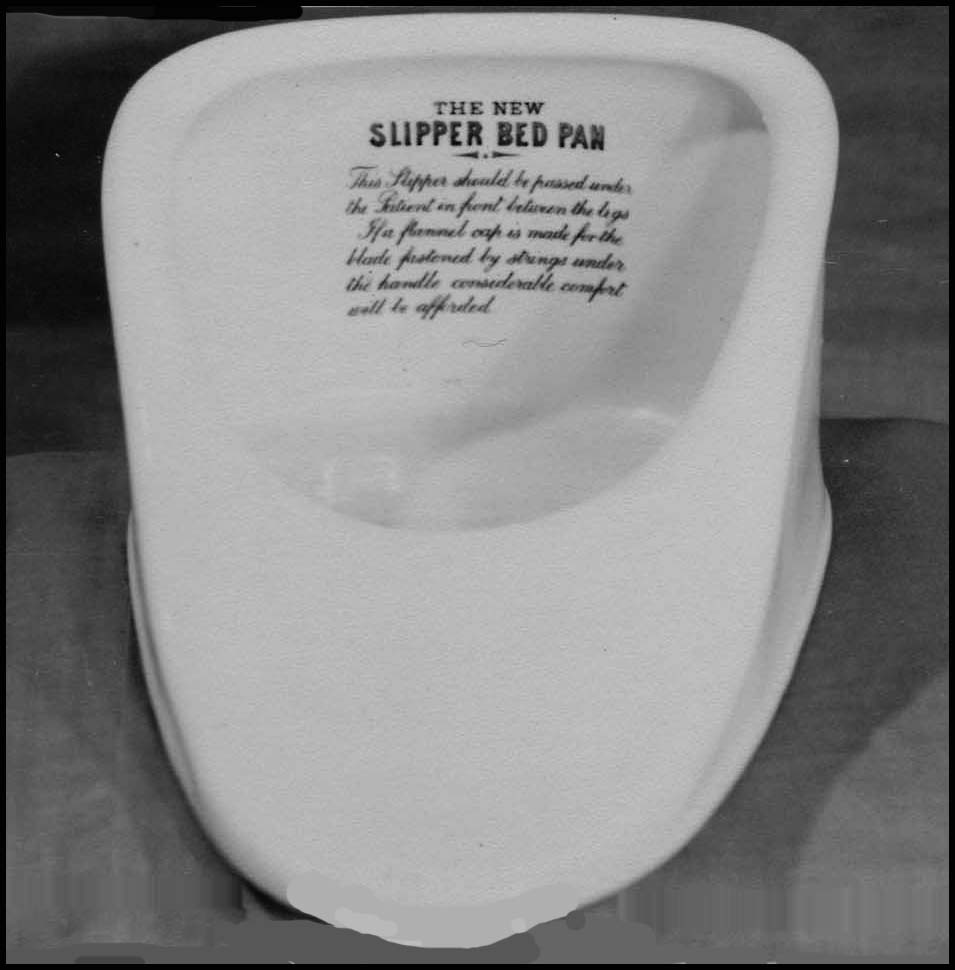
When I was a student nurse at Tauranga Hospital in 1963, I was browsing in a second hand goods shop on Cameron Road, and noticed an old porcelain slipper bed pan. The instructions on the back wall of the pan were:
THE NEW
SLIPPER BED PAN
The Slipper should be passed under
the Patient in front between the legs.
If a flannel cap is made for the
blade fastened by strings under
the handle considerable comfort
will be afforded.
An auction was in progress in the shop, and the lady next to me (who I did not know) shouted to the auctioneer, that I wanted the pan. He auctioned it next. Despite not believing I had bid, the slipper bedpan became mine. It cost two shillings and sixpence. Rather than be seen carrying an old bedpan along Cameron Road to the Nurses’ Home, I asked for it to be wrapped.


Later I discovered slipper bedpans were common in the 1920s and 30s. They were most useful for patients who found it difficult to move. Rather than being called a slipper pan, it was sometimes referred to as a fracture pan.

When I tried to give the pan away, no-one wanted it. It became a flower vase in my room in the Nurses’ Home, and it overflowed with blooms. A friend thought he purchased one bunch of flowers, and discovered he’d bought ten. At the Nurses’ Dance, the band played ‘Pennies From Heaven,’ while the pan was passed around for donations. £2.10/- was collected for the Student Nurses Association.


But the pan met an untimely end. Recorded with an article ‘Pan Antics’ in Tauranga Hospital’s magazine Suture Line 1963-64, is the death notice:
BEDPAN-SLIPPER – On October 31st 1963, at 2.10 pm. (By accident). Beloved pal of Pan Anne, and famed member of the Nursing Organisation. Funeral service will be held tomorrow, 10 am in Room 107. Procession then leaving for the Rubbish Bin, Ground Floor, Wing 3. (Clean rubbish only by request, or donation to the Student Nurses’ Association). TILL DEATH DO US PART.