Showing posts with label Tauranga Heritage Collection. Show all posts

Friday, 17 April 2026

D is for Dog (skeleton)


Excavation at Ōtūmoetai pā on Levers Road, 2005. Image courtesy of Tauranga Museum.

In 2005, archaeologists made a significant discovery at Ōtūmoetai pā on Levers Road - an intact dog skeleton, or kuri, buried in a grave at the highest point of the pā. Such finds are highly unusual in New Zealand archaeology. According to the country’s leading expert on kuri, Dr Geoff Clark, this suggested something out of the ordinary, possibly ritual in nature and associated with a person of high status. 

A mounted kuri. Image courtesy of Otago Museum 

Kuri were descended from Polynesian dogs, which accompanied the first people to Aotearoa in the thirteenth century. Medium-sized and long-haired, kuri are often described as being roughly the size of a modern border collie. They arrived as part of wider voyaging traditions, with waka travelling from Hawaiki carrying a variety of animals and plants, many of which did not survive in the cooler climate of Aotearoa.


Dog skeleton found at Otūmoetai pa. Image courtesy of Tauranga Museum.

Kuri were valued not only for food but also their bones, which were used for making fishhooks. Several hooks dating to before 1600AD were unearthed during the Heritage New Zealand excavation at Ōtūmoetai pā. Archaeologist Ken Phillips who led the dig was reported as saying that “to be buried intact is pretty unusual considering most of his mates probably ended up as fishhooks.” 

Matau made from dog's jaw bone. Image courtesy of Tauranga Museum

It is generally believed that interbreeding with European dogs led to the extinction of the kuri by the 1860s. This period coincided with major upheaval at Ōtūmoetai pā, which was caught up in the confiscation of 50,000 acres of Tauranga land by the government in 1865, following the New Zealand Wars.


Friday, 25 October 2024

Just a Material Girl

Attending a conference for Conservators of Cultural Materials, Tauranga Historic Village 

ERCO tote

Even the promotional material on offer at the 2024 conference of NZCCM - https://nzccm.org.nz/ - was something of a revelation to one of the newest members of the society (me).  ERCO, one of the sponsors for the conference, offered, in a high-quality and stylish tote bag, two equally stylish, impeccably designed magazine-type pamphlets intended to describe “the encounter between artwork and collector… a special moment that deserves qualitative, individual light…” 

The intensity so often present in GLAM [1] sector language was, refreshingly, not often used in the papers put forward over the following two days.  Nevertheless, the underlying commitment and concerns expressed by those describing their own encounters with items as various as a silk embroidery of Queen Alexandra, the dendroglyphs on Rēkohu (Chatham Island), whāriki (fine woven mats) recovered after the devastating Cyclone Gabrielle flood at Rangatira Marae [2], and the sailing vessel Edwin Fox, “a large – very large – composite object” stood alongside the practical realities and continual compromises needed to solve problems, do no (or as little as possible) harm, and – invariably – find ways to pay.

Putting a price on the survival of cultural objects is, of course, the most materialistic attitude of all.  However agonising it is when matters are taken away from human agency – as when the expected protection of a shipping container storing harakeke raranga and other taonga proved inadequate to meet the fury of Cyclone Gabrielle (“Swept away – now on its way to China” co-presenter Dr Rangi Te Kanawa was told) – it seems even worse when the costs of preservation are deemed to be too much for the owner to bear.  No doubt this is a factor explaining the abiding popularity of the TV programme, The Repair Shop, where small items of immense sentimental value are lovingly re-created - apparently at no cost - to a condition that satisfies (we only ever see the success stories, of course) the owner.

In a stimulating juxtaposition of engineering and conservation, Dr Kepa Morgan offered his Mauri-ometer [3], “a useful alternative to other decision support tools including cost benefit analysis” to attempt to establish the value of, well, almost anything that has ecosystem, cultural, community and economic dimensions – characteristics of most memory institutions, often vexingly considered only for their economic viability.

Compared with the coyness within the Repair Shop barn, money is often front-of-mind in the Baumgartner Fine Art Restoration studio, based in Chicago.  American respect for paying for the best (expertise as well as artwork) is a consistent and often overt aspect of Julian Baumgartner’s practice.  But not this time.  As is evident in his video [4], this overlooked artifact seems to have been an uncosted part of a job lot – the memories associated with it as faded as the object itself.

Baumgartner still shot

 “We don’t own them – we merely care for them, for the next generation,” Julian muses as he prepares to unveil what museum-trained conservators might regard as a rather over-done exhibit.  (You will have to watch the video for the full before-and-after effect.)  But the dawning delight of the inheritor of Aunt Vi’s framed wedding photograph, and the plausible possibility that the framing workshop made this as a one-off, special tribute to her, are important elements of what we here in Aotearoa would call the mauri of this object.

The NZCCM conference offered some rather more low-key, local insights into “the complex reality of private conservation practice” from two practitioners, one at the start of her career, the other heading her own business, Heritage Preservation and Field Support Solutions [5] (the name says a lot), based in Taranaki.  The talk was headlined, “Balancing Ethics and Efficiency” – two poles of a useful continuum that might assist in the still-not-quite-settled debate on the Tauranga Museum project.  The Mauri-ometer, of course, introduces a few other factors.

Friends of the Museum newsletter front page

For a very long time now, the Tauranga Heritage Collection has had only very limited exposure on the cultural and community fronts.  Kept in strictly regulated storage conditions, conservation efforts limited to gentle cleaning with de-ionised water and cotton swabs (and only on some items), reliant on conservation assessments by trained professionals in selecting and preparing objects for eventual exhibition, challenges await these artifacts.  Mostly they are best preserved by being left cold and in the dark.  Hardly conducive to a joyous, special encounter in a carefully chosen quality of light.


Silk top hat and cotton lace collar from Brain Watkins House

Like the one-time Edwin Fox Society [6], (and, since 2023, the Marlborough District Council [7]) the Tauranga Historical Society has its own large, composite object to care for.  Brain Watkins House is both beloved and unique, and complex and expensive to maintain.  (It might be fun to assess it against the Mauri-ometer.)  Even the two very small objects pictured above carry their own mauri.  The collar, showing few signs of wear, will now never be put to its purpose of adorning a blouse for a special occasion.  The silk hat undoubtedly went on the imposing head of the respected shipbuilder and stoneworker Joseph Brain, but will never be worn again.  As a result of the NZCCM conference, I am left to ponder whether, even though they are cherished as collection items, the joy has left them.

References

[1] Acronym for Galleries, Libraries, Archives and Museums – also sometimes called “memory institutions”.

[2] For a fuller account (and illustrated) of the catastrophic effects of, and community response to,  Cyclone Gabrielle at the Rangatira Marae, see Jamie Tahana, https://www.nzherald.co.nz/kahu/cyclone-gabrielle-rangatira-marae-whanau-salvaging-precious-taonga/UHIJC4PLMZBG5GF4DFT4BA72NA/

[4] Baumgartner, J. “Wither [sic or (maybe) pun intended] the Heirloom?” https://www.youtube.com/watch?v=U4Fr7YGpvXw

Tuesday, 4 June 2024

The Mystery of the Monmouth Cannons: Part 2

From Tauranga City Library’s archives

A monthly blog about interesting items in our collections.

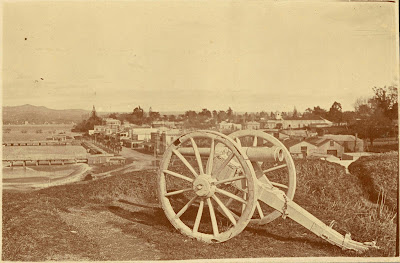
Tawakeheimoa cannon, Taumatakahawai Pā (Monmouth Redoubt) c. 1920s.
Collection of Te Ao Mārama - Tauranga City Libraries, Pae Korokī ref 09-082

Last month we talked about a letter written by Colonel G. Arnold Ward, Former Mayor of Tauranga, regarding the unknown origins of the old guns in the Monmouth Redoubt. If you haven't read it already, you can check it out here. In this month's blog post we will delve deeper into the intriguing history of the two Napoleonic era carronades - Tawakeheimoa and Te Tapihana.

Tawakeheimoa, the larger of the two cannons (pictured above), is believed to have once belonged to the early Danish trader Phillip Tapsell (Kean, 2018, p. 20). Tapsell was famous for his battery of twelve 'big guns,' which he used to defend his trading station at Maketū Pā - though this defense was short-lived. In 1836, an attack by Ngāti Hauā and Ngāi Te Rangi led to the successful capture of the pā and the destruction of Tapsell's trading station (Matheson, 1989, p. 2).

Phillip Tapsell and daughter Kataraina, c. 1870s.
Image courtesy of Alexander Turnbull Library, Steffano Webb Collection (PA-Group-00370),
ref: 1/1-008958-G.

As for the fate of Tapsell's battery following the attack, we are provided with varying accounts. In his memoirs, Tapsell states that following the fall of Maketū Pā, the victors spiked the guns and threw them into the Kaituna River (Adams, 2021, p. 154).

Sketch map of country around Waihī Estuary and Maketū Pā (A), shows location of Tapsell's store (B), Kaituna River, and Te Tumu Pā (I). Creator unknown, 1840. 
Image courtesy of  Alexander Turnbull Library, ref MapColl-832.16a/[187-?]/Acc.1848


Interestingly, an alternate version of events reported by the Daily Southern Cross claims that six of the guns were taken by Ngāi Te Rangi to fortify Te Tumu Pā. However, they were soon recaptured by Te Arawa, except for one gun, which had already been taken to Tauranga (Daily Southern Cross, 12 May 1864, p. 4).

One of twelve 'Tapsell' guns 'Te Haupapa', Wreck of the Falcon Memorial, Maketu.
Image courtesy of Ministry for Culture and Heritage, credit Lynton Diggle, 2009.

While we might initially be more inclined to accept Tapsell's first-hand account over any other, the second version of events does seem to have some credibility to it, owing to an altercation which occurred in 1864.

According to the Daily Southern Cross, the sale of two big guns to a Mr. Black of Tauranga (likely early trader Thomas Black) by Retreat Tapsell (eldest son of Phillip Tapsell) had prompted complaints from Ngāti Kererū, who considered the guns to be taonga, and their property (for further explanation see Bentley, 2013, p. 23-4). One of these guns was reportedly "Tawake hei moa", the other was one which had been found "lying in the water" (Daily Southern Cross, 12 May 1864, p. 4). A meeting was called to discuss the sale; however Black sailed off with the guns before the situation was able to be resolved.

Tawakeheimoa after it was relocated to the Tauranga Historic Village and District Museum, 1986.
Image courtesy of Tauranga Heritage Collection, ref 0460/08

At some point thereafter, Tawakeheimoa came into the possession of A. W. Burrows, who likely purchased it from Mr. Black. Burrows kept the gun in his private collection until his death in 1899, after which it was gifted to the Tauranga Borough Council for public exhibition in the redoubt (Tauranga District Council, 2004, p. 9).

But what about the other Monmouth cannon?

Te Tapihana cannon, Taumatakahawai Pā (Monmouth Redoubt) c. 1956-57.
Collection of Te Ao Mārama - Tauranga City Libraries, Pae Korokī ref 09-075

The smaller carronade donated by Captain A. C. Turner, locally known as Te Tapihana, has also been attributed to Tapsell's battery due to its similarity to the other Tapsell guns (Matheson, 1989, p. 9); however this identification is much less certain. In fact, evidence points more towards a military provenance. A note published in the Bay of Plenty Times in 1914 mentions that Captain Turner received the gun from a military officer in Ōpōtiki during "the Māori War period" (BOPT, April 6th, 1914, p. 4). Additionally, the crown stamp on the cannon's barrel indicates that it was produced for military use (Ward, 1914).

Te Tapihana, Monmouth Redoubt, 2024.
Private Collection, Te Ao Mārama - Tauranga City Libraries.

Of course, these details do not exclude the possibility that Te Tapihana once belonged to the early Danish trader, and the evidence has only raised further questions. Unfortunately, we may never know for sure.

Bethlehem School pupils at Redoubt, 1961.
Collection of Te Ao Mārama - Tauranga City Libraries, Pae Korokī ref gca-2396

For more background on Tapsell's battery and the whereabouts of the other guns, check out this article by Alister Matheson here. 

Sources:

    Adams, J. (2021). Events in the Life of Phillip Tapsell. Oratia Books.

    Bentley, T. (2013). Tribal Guns and Tribal Gunners: The Story of Māori Artillery in 19th Century New Zealand. Willsonscott Publishing International.

    
Matheson, A. (May 1989). Tapsell’s Big Guns. Journal of Tauranga Historical Society, No 37. Pp. 1-11.

    'Maketu. (From our own Correspondent.) May 5'. (published 1864, 12 May). Daily Southern Cross, p. 4.

    'Local and General'. (1914, 6 April). Bay of Plenty Times, 42(6097), p. 4.

    Tauranga District Council. (2004). Tauranga Historic Village Museum, Tauranga, New Zealand: Souvenir Book: Take a Walk in Living History. Tauranga District Council Publisher.

    Ward, G. A. (21 March, 1914). "Old guns in redoubt". [Letter from Colonel G. Arnold Ward to the Town Clerk, Tauranga]. Collection of Te Ao Mārama - Tauranga City Libraries, VF CCR. 

Tuesday, 7 May 2024

The Mystery of the Monmouth Cannons: Part 1

From Tauranga City Library’s archives

A monthly blog about interesting items in our collections.

Postcard, Taumatakahawai Pā (Monmouth Redoubt) c. 1910s.
Collection of Te Ao Mārama - Tauranga City Libraries, Pae Korokī ref 06-519

While sorting through our files relating to the 1990 Monmouth Redoubt restoration project, we came across this original letter dated 21st of March 1914 (also published in the Bay of Plenty Times) from Colonel G. Arnold Ward, Former Mayor of Tauranga, regarding the origin of the old guns in the Monmouth Redoubt.

Letter from Colonel Arnold G. Ward to the Tauranga Town Clerk, 1914.
Collection of Te Ao Mārama - Tauranga City Libraries, VF CCR.

In his letter to the Tauranga Town Clerk, Ward recounts the history of the six guns displayed in the redoubt, comprising of four field guns that “had done good service here in the Maori war”, as well as two much older cast muzzleloader guns.

The four “field guns” were 6-pounder rifled breech-loading Armstrong guns, two of which may have been present at the Battle of Pukehinahina (Gate Pā) (Osborne, 2014, para. 5). Following their years of service with the militia and later the Armed Constabulary (whose headquarters had been located on the redoubt), the guns had been made obsolete and placed into storage by the Defence Department - until 1899 when Mayor Ward requested that they be returned to Tauranga and displayed in the Monmouth Redoubt, as part of an initiative to convert the site into a public reserve (Kean, 2019, p. 13-15).

Print, Photographic, Armstrong Gun, Monmouth Redoubt, Tauranga, c. 1910s.
Image courtesy of Tauranga Heritage Collection, ref 0488/08

The two older guns mentioned by Ward were cast iron Napoleonic war cannons (more specifically carronades) dating to the early 1800s, which had been gifted to the Tauranga Borough Council in 1899 by Captain A. C. Turner and Mr. A. W. Burrows, in order to “add interest to the redoubt”. However, Ward admits, “their history I do not know and do not think their former owners knew it either”. 

Munitions on display at Taumatakahawai Pā (Monmouth Redoubt), Tauranga c. 1910s.
Collection of Te Ao Mārama - Tauranga City Libraries, Pae Korokī ref 10-161

Unlike the Armstrong guns, neither of the cannons had any known connections to the redoubt. The Burrows cannon, named Tawakeheimoa (named after the eldest son of Ngāti Kererū), is now confirmed to be one of early trader Phillip Tapsell’s twelve “big guns” used to protect his trading station at Maketu Pā, until it's capture in 1836 (Kean, 2018, p. 20). Indeed, in his letter Ward points to Tapsell as a possible original source of the Burrows gun (Ward, 1914).
Cannon, Tawakeheimoa.
Image courtesy of Tauranga Heritage Collection, ref 0017/99

The cannon donated by Captain Turner, known today as Te Tapihana, is also suspected to have come from Tapsell’s battery due to its similarity to the other Tapsell cannons (Matheson, 1989, p. 9). However, its provenance is by no means certain, since accounts about what happened to Tapsell's battery following the capture of Maketū Pā vary, making it difficult for us to verify the history of the guns (see Matheson, 1989, for a full discussion). 

One of the other cannons from Tapsell's battery, Maketū, c. 1970s.
Collection of Te Ao Mārama - Tauranga City Libraries, Pae Korokī ref 06-137 

During restoration efforts at the redoubt in the 1990s there was some discussion as to whether the cannons ought to remain in Tauranga or be sent back to Maketū (Hansen, 1998, letter). In the end the council opted to keep the cannons, as by that point in time they had become an important part of Tauranga's history (Matheson, n.d., personal communications).

Te Tapihana Cannon, Monmouth Redoubt, 2024.
Private Collection, Te Ao Mārama - Tauranga City Libraries. 

These days only Te Tapihana remains on display in the redoubt. Tawakeheimoa now resides in the care of the Tauranga Heritage Collection, as do three of the Armstrong guns – the remaining Armstrong gun can be found on display at the National Army Museum in Waiouru.

6-Pounder 3-cwt Armstrong RBL Gun Barrel, carriage is a modern reconstruction.
Display depicts a scene from the Battle of Pukehinahina (Gate Pā).
Image courtesy of National Army Museum, Waiouru.

Stay tuned! The mysterious history of the Tapsell cannons will continue in next month's blog post.

For more images of the Monmouth cannons in the Library Archives click here. 

Sources:

    Hansen, N. G. (30 January 1998). Letter to Tauranga District Council. Old Carronades at the Domain and on Monmouth Redoubt. Tauranga City Council Records (unpublished).

    Kean, F. (2018). Illustrated Historical Overview, Monmouth Redoubt, Lot 247, Section 1, Tauranga Town. Tauranga Heritage Collection (unpublished).


    Matheson, A. (n.d.). Personal communication. Old Carronades in the Domain & Redoubt (and Historic Village). Tauranga City Council Records (unpublished).

Ward, G. A. (21 March, 1914). "Old guns in redoubt". [Letter from Colonel G. Arnold Ward to the Town Clerk, Tauranga]. Collection of Te Ao Mārama - Tauranga City Libraries, VF CCR. 

Friday, 15 December 2023

Tauranga Heritage Collection web site

Landing page of the Tauranga Heritage Collection browser, where you can search the collection in a variety of ways. Image courtesy of Tauranga Museum

Tauranga Museum team are working hard to make the Tauranga Heritage Collection accessible to as many people as possible. The digitisation of the collection is an important part of this goal. The project started a few years ago and we now have close to 16,000 objects available to view online at https://view.taurangaheritagecollection.co.nz/explore

Objects are uploaded nearly every day and we encourage visitors to keep checking in to see what is new. Our photographer, Michal Pinkerton, takes photographs of the highest quality which ensures that the objects are represented as accurately as possible and can be viewed from all angles. Here is a selection of objects which have been added to the website in the last few weeks.

Tobacco cutter 4450/84. Image courtesy of Tauranga Museum

Used for cutting plugs for pipe smokers, this McMillan’s Rotary Tobacco Cutter had more chopping power than was needed for domestic purposes and is likely to have been owned by a grocer or tobacco shop. By the 1920s this instrument was largely obsolete as cigarette sales dominated the market.

Marine Compass, MV Rena 0188/16. Image courtesy of Tauranga Museum

On October 5, 2011, the MV Rena, a container vessel, carrying a mixed cargo from Napier to Tauranga ran aground on Ōtāiti (Astrolabe Reef), 12 nautical miles off the Bay of Plenty coast. What ensued was New Zealand’s worst maritime environmental disaster. This compass was salvaged from the wreck. An investigation found that it was not used by the crew when they took the Rena off course, and this was a contributing factor in the disaster.

Beer advertisement 0585/86. Image courtesy of Tauranga Museum

Founded by W. Joseph Coutts and his three sons, The Waitemata Brewery Co. (later known as Dominion Breweries) began production in Otahuhu in 1929, which is still in operation today. It was the following year that the revolutionary Waitemata Sparkling Ale was produced and only quite recently, in 1999, was it discontinued. Marketing for the beer often made grand claims that it was “a tonic” and “good for you” with one series of advertising promoting the ale as a drink that could prolong one’s life!