Showing posts with label Family History. Show all posts

Tuesday, 5 August 2025

Family History Month 2025

From Tauranga City Library’s archives

A monthly blog about interesting items in our collection

This month libraries and archives across the motu (country) will be hosting events and displays for Family History Month, including Tauranga, Rotorua and Whakatāne. For those searching online, Pae Korokī has some great resources to add social context and images to family stories.

You can search Pae Korokī by name, street, organisation, iwi and more. It is good to start broad e.g. just the surname, and then add more keywords depending on the results (the how to guides have some good search tips). You can browse through the results, or use the filters to refine your selection.

Some of the collections that will show in your results include:

Tauranga Photo News. Described by a librarian as 'the Instagram of that generation', between 1962 and 1970 Renwood Studios and other contractors would capture local events, celebrations, weddings, arts, theatre and sports events, and people at work for.  

Front cover of Tauranga Photo News No. 17, October 1963.

Although the covers were brightly covered the pages inside were black and white newsprint, now with a slight yellow tinge (print copies are viewable in the reference section at He Puna Manawa - Tauranga City Library). Gatherings of all sizes were shared, including these photos of Tauranga Rovers basketball team celebrating the end-of-season at Mrs M. Scott's Ōtūmoetai home.

Page 58 of Tauranga Photo News No. 17, October 1963.

For those looking for people photographed between February 1969 and September 1979, Tony A'Hern, local editor and photographer, donated a set of Photo News negatives. Logan Publishing Tauranga and Bay of Plenty Photo News Collection Many of these weren't published and don't yet have names in the metadata. If you recognise anyone do let the Heritage & Research Team know.

Audience at Western Music, December 1969.

Te Ao Mārama - Tauranga City Libraries, Logan Publishing, Tauranga and Bay of Plenty Photo News Collection Photo pn-5558

Gifford-Cross Photographic Collection is another wonderful source of high-quality images of local people, places and events. Donated by the owners of the Bay of Plenty Times in 1992, there is an ongoing project to share online the approximately 140,000 - 180,000 images.

Sometimes family research involves looking through lots of items to find the few that are of your family. The image below is one that there are no names associated with the photograph, but someone might recognise a parent or aunt or uncle or tīpuna.

Children on board Japanese ship, July 1966.

Te Ao Mārama - Tauranga City Libraries Photo gcc-14892

You might also see relations in our Audio visual  collections. Particularly in footage of city events captured by local film-makers such as Norman Blackie, Roy Pilkington and Jack and Rene Fenn. Maybe someone in your family was on an Orange Festival float or competing in an apple eating contest in the 1960s and 70s, or at the opening of Taurua Marae in Rotoiti (1960)?

Or perhaps you can hear their voice sharing memories in an early 2000s oral history recording, a project by Max AveryJinty Rorke  and others.

The archive collections are a treasure trove, containing all sorts of items and ephemera, including family scrapbooks, like Ms 102, compiled by Annette Tootell, whose mother Gertrude Hunt, was the accompanist for renown singer Te Rangi Pai (Fanny Rose Porter, Poata):

Page 1 from the scrapbook of photographs and copies of newspaper articles about Te Rangi Pai's career as a singer.

Te Ao Mārama - Tauranga City Libraries Ms 102/3

Minute books from local organisations can contain comments from an ancestor, and a snaphot of their interests, hobbies and public service. They may test your manuscript reading skills, but like Papers Past, can quickly go from seemingly dry text to fascinating glimpses of societal values and conversations.

Snippet from the Tauranga Combined Māori Women's Welfare League discussion in November 1972 about possible sponsorship of a contestant for the Tauranga Orange Festival Queen.

Te Ao Mārama - Tauranga City Libraries Ams 35/3/1

If you know of a business a relation was employed by, there may be a relevant collection in the archives, like this record of Miss Bunker receiving a gold watch for 10 years' service at Rainster House.

Page from the Rainster House Album, part of Rainster House papers and photographs, 1945-2005.

Te Ao Mārama - Tauranga City Libraries Ams 308

Maps can help determine old streets that might have since changed name or numbering or even location. Aerial photographs 'maps' allow you to zoom in from above and trace paths previously walked.

Tauranga City Centre from Matapihi Rail Bridge, by Aero Surveys (NZ) Ltd, June 1965.

Te Ao Mārama - Tauranga City Libraries Map 23-136

If you use the 'Zoom to 100%' icon in Pae Korokī (from the tools menu on the left of the image), you will see the detail much clearer and crisper, than just 'zooming' in with your mouse or fingers on the screen.

Tales of the streets and clubs and people, are also told in local history publications, such as the early issues of the Journal of the Tauranga Historical Society.

There is a lot to explore in Pae Korokī to help provide context and detail to your family tree, and maybe one day you can publish it in a book, like local historian Robert Craig Scott, or share as a story in Pae Korokī.

National Library have an online guide for family researchers, and Te Ao Mārama Tauranga Library hosts drop-in genealogy sessions the second Tuesday of the month between 10am and 12noon.
 
Enjoy exploring online, or in person at He Puna Wānanga, the Heritage & Research room in Te Ao Mārama - Tauranga City Library, discovering and adding colourful leaves and story branches to your family tree.


Written by Kate Charteris, Heritage Specialist at Te Ao Mārama - Tauranga City Libraries

Tuesday, 1 July 2025

The Hewlett Legacy: From Aviation to Viticulture in Tauranga - Ms 67

From Tauranga City Library’s archives

A monthly blog about interesting items in our collection:

Next time you find yourself sipping a glass of wine or port, spare a thought for an individual who, by all accounts, established the first commercial vineyard in Tauranga, Air Commodore Francis Esme Theodore Hewlett.
Ms 67/15 - Photograph of Totara Casks

Hewletts – Mother and Son: 
Hilda Hewlett interpretation panel - Fourth Avenue, Tauranga

Much has been written previously in the Journals of the Tauranga Historical Society about the aviation exploits of Hilda Beatrice Hewlett (HR 41:Vol 2, p76-82 by HL Whitehead) and her son F.E.T. Hewlett (Journal of the Tauranga Historical Society No. 8:1957 and No. 35:1968). This blog will, therefore, focus on a recently digitised collection in Tauranga Library’s archive: Ms 67 - Papers relating to Maungatapu Vineyard and their creator, Air Commodore Francis Hewlett.
Hilda Hewlett, 1911 flying licence and picture, with awesome hat - Women Who Meant Business

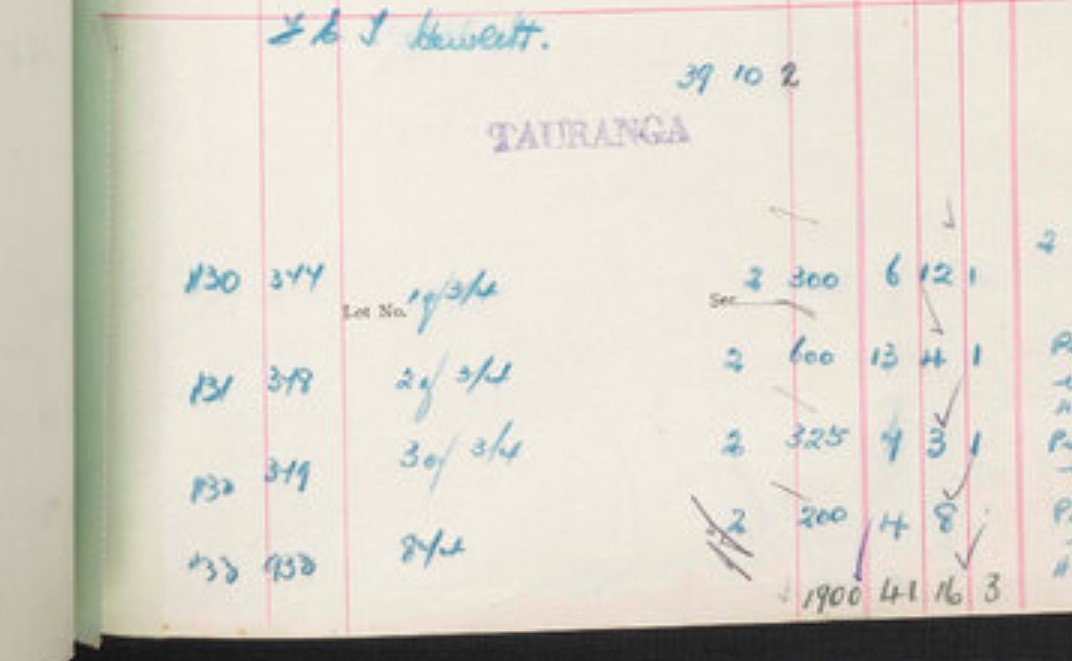
In 1926, Hilda, the first English woman to gain a pilot's licence, relocated to Tauranga, as did her daughter Pia Richards and Pia’s family.  Hilda bought various sections, including property on the corner of Eleventh Avenue and Edgecumbe Road - as well as a section at Devonport Road in Tauranga.  Tauranga rate book, 1937-1938 shows us Hilda owned property at Lots 231/2 Sec. 1 and 485/7 & 489 Sec. 2.

Map 24-047 - Section 2 - Tauranga

It must have been an idyllic location, overlooking the Waikareao tidal estuary, which had served as the town's flying field for eight years. 

Air Commodore F.E.T. Hewlett - Auckland War Memorial Museum

F.E.T. (Francis) Hewlett, following in his mother’s footsteps as a pilot, had a distinguished military career. During WWI he earned a Distinguished Service Order in 1915 and rose to the rank of Group Captain.  He retired from the Royal Air Force in 1934 and followed his mother and sister to live in Tauranga.  

The rate books show Hilda Hewlett owning lot 231/2 on Devonport road and this is where Francis Hewlett first set up business with a motor garage.
Bay of Plenty Times, Volume LXXI, Issue 13056, 26 January 1943, Page 3 Papers Past

The rate book 1937-1938 also shows that Francis Hewlett owned a section next to Hilda’s, on the edge of the Waikareao Estuary, lot 874, Section 2. (See above image: Map 24-047).
Ams 463/1/38 - Rate book, 1937-1938

In an address to the THS years later (1957) he talks of having “…a small house overlooking the Waikareao Estuary, we had a bank and half an acre of swampy land covered with gorse, blackberry and weeds. This was such an eyesore that we determined to tame it and drain the swamp; but we should have to cultivate it and plant something more interesting than the existing rubbish. Someone suggested grapes, so we set about finding how and why and where grapes were grown in New Zealand."

Te Ao Mārama - Tauranga City Libraries - 2025

We do not have any images of this property, however, a present-day photograph has been taken of the area, above the current archery field, that gives a very good idea of where the first vines were cultivated.  The work involved to continuously clear the weeds eventually became too much and the Hewletts searched for a site more suitable for grape growing commercially.

The Hewletts moved to Maungatapu, where they bought 12 acres of land and transported the vines from Waikareao to the new site. Current day Vine Street in Maungatapu is one of the streets originally part of this farm and was named after the Hewletts' vineyard.
Ms 67/18 - Maungatapu Vineyard - looking south-east towards Welcome Bay


When WWII broke out, Francis (F.E.T.) Hewlett enlisted as Wing Commander in the Royal New Zealand Air Force (RNZAF).  He progressed his military career and became Air Commodore, January 1945. Whilst he was away, not much progress was made with the winemaking, however, Francis Hewlett picked up from where he left off when he returned.
F.E.T. (Francis) Hewlett on his spraying tractor - Ms 67/18

The Papers relating to the Maungatapu Vineyard (Ms 67) contain the original speech delivered to the THS in 1957, photographs, wine labels, prize certificates and an essay titled "The suitability of Tauranga for outdoor grapes for wine making".  This must have been like a vintner's handbook back in 1957, but still provides interesting insight for today.  Some interesting points he makes are:
  • Henderson and Hawkes Bay identified as specialty grape-growing regions
  • The "American Invasion" during the war influenced the market for selling cheap, inferior wines where the main factor was the “kick” it gave
  • When men and women returned from WWII they had more of a discerning taste for quality wine and this in turn increased the demand for higher quality winemaking
  • Tauranga has the same climate as the northern Germany region of “Rotor Traminer”, and can grow exact replica Moselle vines
  • Some of the preferred winemaking grapes for Tauranga are Siebel varieties, which produce dry wines, sherries, port and Rosē.
Wine Bottle Label - Ms 67/7


Further reading...
For those interested in delving deeper into their stories, the Pae Korokī collection offers a treasure trove of resources, including the Papers relating to Maungatapu Vineyard (Ms 67) and the Journals of the Tauranga Historical Society The reference section has a biography of Hilda Hewlett, written by F.E.T. Hewlett’s daughter-in-law, Gail Hewlett: "Old Bird: the irrepressible Mrs Hewlett".

Sources
Hewlett, Gail. (c.2010). Old Bird - The irrepressible Mrs Hewlett. Leicester : Matador.
Women Who Mean Business website: https://womenwhomeantbusiness.com/2021/05/27/hilda-hewlett-1864-1943/
Auckland War Memorial Museum - Online Cenotaph 
Ams 463 - Tauranga Borough Council rate books, valuation rolls and related material
Bay of Plenty Times, Volume LXXI, Issue 13056, 26 January 1943, Page 3 - Papers Past - https://paperspast.natlib.govt.nz/ 

Tuesday, 6 May 2025

Bunka embroidery and a book by Rata Roden

From Tauranga City Library’s archives

A monthly blog about interesting items in our collection

One of the items recently digitised by the Heritage & Research Team is this framed embroidery mountain scene, worked by Rata Roden when she was 84.

'Japanese Punch' embroidery by Rata Roden, 1992  (Te Ao Mārama - Tauranga City Libraries Ams 457/4/9)

Japanese punch embroidery, or bunka embroidery, bunka shishu, uses a specialised hollow needle to weave rayon thread from the front of the fabric, through to the back. The effect is often likened to oil paintings or watercolours. As finished pieces tend to be fragile, they tend to be displayed as art, rather than onto clothing.


Rata was born 'Bessie Rata Lever', and the Lever family papers in our archives include her workbox and pincushions.

Workbox and contents (Te Ao Mārama - Tauranga City Libraries Ams 406/1)

 
Also in the workbox was a copy of her autobiography 'Here, there and most places'. Published in Tauranga in 1973, Rata acknowledged the assistance of Miss Joan Mirrielees, Kathleen Stratford and Gaye Rendell. The jacket blurb describes her story:
 
...Rata Roden has made an interesting record of her experiences in a variety of occupations in a variety of countries. It is the biography of a New Zealander, a farmer’s daughter, who, through dogged persistence realised her two main ambitions – to become a nurse, and to travel to foreign places. It is an absorbing account covering backblock farming days, nursing in the slums of London, living in many parts of Africa, the World War II in Egypt and England, travel to Japan, the Orient, Iceland, Greenland, Russia and Scandinavia. Altogether Mrs Roden has made eleven trips out of New Zealand and in her story she takes us with her."
 
Inside dust jacket and back cover of 'Here There and Most Places', published 1973.
 
Writing was in the family, as it's Rata's cousin Arthur Gray who wrote 'An Ulster Plantation'. Copies of both books are in the reference collection at Te Ao Mārama - Tauranga City Library.

  
Sources

Clasper-Torch, Micah. (2021, April 27). The history of punch needle. Sister Magazine, (61). sister-mag.com/en/magazine/sistermag-no-61-may-2021/the-history-of-punch-needle

Roden, Rata. (1973). Here, there and most places. Ashford-Kent Ltd.

Tokyo Bunka Art. (2007, May). Japanese Bunka Embroidery - The art of thread. tokyo-bunka-art.blogspot.com/2007/05

Victoria's Custom Framing & Stitchery. (2024, December 3). Bunka embroidery. facebook.com/story.php


Written by Kate Charteris, Heritage Specialist at Te Ao Mārama - Tauranga City Libraries

Friday, 31 May 2024

Maihi Te Poria and the Wairoa Road

It’s easy to assume, at this distance of time, that in the years after raupatu [1] land ownership was steadily and seamlessly transferred to pākehā settlers. Certainly the end result is confronting.

Wairoa Road, 2024

As well as the large parcels of land permanently and actually confiscated, there were, particularly in Tauranga Moana, areas returned (ie. initially confiscated and then given back) and reserved (ie. put aside from the start as allocations to support the local Māori population).  And yet, by the turn of the twenty-first century, of those returned or reserved areas of Māori land, 80 percent had been alienated [2].

Your writer makes absolutely no claim to any expertise in the field of Māori land law [3]. But I do know a bit about Te Puna. This is the story of how Maihi te Poria stood up for himself in, it has to be said, somewhat mysterious circumstances. How did he persuade the Tauranga County Council to pay him a levy of £2 a year for the use of his land for a road from 1907 until at least 1910?

I tell this from a pākehā perspective.  Although I have been in touch with some of Maihi te Poria’s whānau, and they have seen this account, my sources are confined to the public record, narrow, but authentic [4] except for one excursion into the unconfirmed space of FamilySearch, “a service provided by the Jesus Christ Church of Latter Day Saints”, all rights reserved.  Out of respect for the family as well as a careful reading of the website’s terms of use, I do not quote from its content.  I do however offer the link [5] in case my small contribution encourages others to explore the personal history of the Maihi, also known as Marsh, family.

There could be many others in the story. We were unable to identify any Māori ratepayer names at all in the 1909 rating records for Tauranga County. But it is clear that those Māori with interests in such land as was left to them after raupatu were not only wary of officialdom. They were also willing to take it on. At a Council meeting held on 5 April 1910 correspondence was tabled from (if I have read the handwriting correctly) one Riripete Piahana, “re road through Section 116A to 116B Judea”.  The response was, to say the least, testy:  “It was resolved that the Native be informed that the Council has no idea of taking the land referred to.”  The Council moved on to deal with (either) Tinii or Tinui Waata Ririnui’s letter “re rates” and resolved to refer the matter to the District Valuer [6].  Nevertheless, Messrs Piahana and Ririnui thought it at least worthwhile to try. Maihi te Poria, of the Ngāti Pango hapū, similarly tried. And he won.

Map of Ngati Pango lands, Figure 24, Kahotea, D

Ngati Pango, along with Ngai Te Rangi, “lands extend on the west side of the Wairoa River, to Poripori, Te Irihanga and Te Whakamarama with the Pirirakau [7]”. Under the Tauranga District Lands Act 1867, Commissioners determined Lot 182, on the bend of the river and including the mill pond, to be Ngati Pango (shown in the 1867 map as allocated to one Hori Ngatai [8]). But by 1919 a Maori Land Court notice in the New Zealand Gazette [9] records Maihi te Poria making “application for partition” of that lot, which has to be [10] the land that was traversed by an informal road (or track) used by the Wairoa settlers.

Presumably they had acquired their land on the presumption that there was access to it by way of the river, readily navigable as far inland as Ruahihi. But roads, as every colonial administration came to appreciate, were much more convenient than waterways. The Wairoa been bridged for decades by 1907. It’s not hard to imagine that the casual assumption [11] that trespass was permissible across Maori land, to use a modern idiom, ground Maihi’s gears. We know he became familiar with the law of trespass because of a 1909 notice placed in the Bay of Plenty Times [12], warning “any person trespassing upon my land at Poripori, with or without dog or gun will be prosecuted”.

So we know that Maihi te Poria was willing to tangle with the colony’s institutions of land tenure. The patient reader, having been served a hefty dose of context, surely now deserves to know the mystery at the heart of this essay.

At the County Councillors’ meeting held 1 October 1907 [13], almost straight after the vigilantly critical George Vesey Stewart had asked, with urgency, for a report on “the necessary repairs to be made on the Wairoa Bridge”…

The Chairman reported that he had made arrangements with a native named Maihi te Poria agreeing to allow the Public to use the road through his property from the Wairoa Bridge to the road leading to Settlers properties on the Wairoa river for the sum of £2 per annum.”

We are not told how this was received. It’s easy to imagine some consternation in the Council Chamber. But this is yet another piece in the uneven jigsaw of Māori land appropriation post-raupatu. The political climate was just a bit more constrained at the time. For whatever reason – memories of the 1886 Barton inquiry, the current influence of the Stout-Ngata Commission [14] - there was a significant fall-off in Māori land alienation around Tauranga in the first decade of the twentieth century [15]. 

All we know is that Councillor McEwen proposed, incorporating a shrewd nod in the direction of Councillor Stewart, who seconded, “that the Chairman’s actions be approved and that the Engineer be requested to inspect the road with a view to its acquisition under the Public Works Act.” [16]

The approval lasted until 1910, when Maihi, for reasons undisclosed, advised the Council that he intended to close the road through his property. For reasons also undisclosed, the Council resolved to leave the matter “in the hands of the Chairman” [17].

The County Chairman, J.A.M. Davidson, must have known Maihi te Poria quite well. They were near-neighbours, Davidson holding an extensive property just over the hill, along the Hakao [18]. And, as my reading of the Minute Books made clear, there were many instances when the Council trusted his personal capabilities to smooth conflicts and find practical solutions. At any rate, the matter at this point fades from the record. I wish I knew if Maihi te Poria’s toll earned him more than £6, and how, eventually, the road connection between the bridge and “Mr Perston’s property[19]” was formalised.  Semi-acquiescent takings under the Public Works Act were, and indeed are still, not unknown to officialdom.

However it happened, the public road still winds up the hill from the bank of the Wairoa River. And Maihi te Poria had other, more extensive, land to make a go of, behind the Minden hill at Poripori. For a long time, the only way he could get to it was over the land on which he had once successfully charged a toll.

References

Belgrave, M., Young, Heinz and Belgrave, D., A: Report to the Waitangi Tribunal WAI 215 #T16a.  Tauranga Māori Land Alienation, A Quantitative Overview, 1886-2006, Final Report
https://forms.justice.govt.nz/search/Documents/WT/wt_DOC_93401142/Wai%20215%2C%20T016%20(a).pdf

Kahotea, Des Tatana: Report to the Waitangi Tribunal commissioned for Wai 42A, a claim lodged by Ngāti Kahu in 1986 (Wai 27)
https://forms.justice.govt.nz/search/Documents/WT/wt_DOC_94031141/Wai%20215%2C%20A037%20(a).pdf

O’Malley, V: The Aftermath of the Tauranga Raupatu, 1864-1981, an overview report commissioned by the Crown Forestry Rental Trust, June 1995
https://www.academia.edu/2993300/The_Aftermath_of_the_Tauranga_Raupatu_1864_1981_Crown_Forestry_Rental_Trust_June_1995_222pp

Notes


[1] For these purposes, “raupatu” encompasses both the consequences of the Katikati and Te Puna purchase up to 1886, and the post-1886 acquisitions under a number of statutory measures including the Public Works Act in its various iterations.

[2] Belgrave et al, p 12

[3] In this blog I have relied on the far greater scholarship in the sources listed at the end of the essay.

[4] My thanks to Glenda McDell and the team at Western Bay of Plenty District Council for providing desk space and access to the Minute Books and rating records of the Tauranga County Council.

[6] The correspondence is minuted at pages 357 and 358 of the Minute Book recording proceedings of the Tauranga County Council for 1907-1911.

[7] Kahotea, D., p. 9.  This detailed study of the three hapū of Ngāti Kahu, Ngāti Rangi and Ngāti Pango has been invaluable, as has the input from the Maihi Te Poria whanu, whose whakapapa is quite distinct from that of Maihi Haki.

[8] Hori Ngatai’s role in the Ngati Pango story is a compromised one, too complicated for a place in this story.  Readers are referred to Des Kahotea’s report for further particulars.

[10] Based on the writer’s personal knowledge of the area.  For instance, I know just where the Perston property was (adjacent to the present Oliver Road).

[11] Or assumptions based on usual terms of  Court orders?  See O’Malley, p. 190: “The right to run roads through Maori lands was included in grants made pursuant to the decisions of the [Native Land] Court…”

[13] Page 240 of the Minute Book recording proceedings of the Tauranga County Council for 1907-1911.

[14] O’Malley, Part B, section 3; p94 and p.194, citing ‘Native Lands and Native -Land Tenure: Interim report of Native Land Commission, on Native Lands in the County of Tauranga, AJHR 1908, G-1K https://paperspast.natlib.govt.nz/parliamentary/AJHR1908-I.2.4.3.15   .

[15] Belgrave et al, p 30

[16] Page 240 of the Minute Book recording proceedings of the Tauranga County Council for 1907-1911.

[17] P. 351 of the Minute Book recording proceedings of the Tauranga County Council for 1907-1911.

[18] Readers may be interested in the essay on the Hakao, Friday 14 January 2022, https://taurangahistorical.blogspot.com/2022/01/te-punas-lost-watercourse.html