Sunday, 23 March 2025

The Otūmoetai Beachfront Pathway - Four Early Walkers

A map of the Otūmoetai Peninsula by the late Tauranga historian Alistair Matheson

Otūmoetai Peninsula’s beachfront path has been a major thoroughfare for Māori visitors and residents for centuries.  Walkers traversed a level and pleasant path of approximately two miles – often through groves of ngaio trees - from the Wairoa River entrance to the Waikareao Estuary entrance, just as they do today. Tauranga is a region of peninsulas and estuaries and accessing the peninsula path was not always an easy task.

Before the 1860s and the Tauranga War (1864) and Bush War (1867), Māori and Pākehā overlanders walking south through Waihi and Katikati or over the Kaimai Ranges from the Waikato would, from the Te Puna Peninsula, walk or canoe across the Wairoa River to access the walkway. Travellers trekking northwards from locations like Lake Taupō and the East Coast/Western Bay of Plenty, would first visit the Te Papa mission station before crossing the Waikareao Estuary to access the path.

Travellers in both directions often overnighted at Otūmoetai Pā, the district's Māori and Pākehā-Māori commercial hub. Also known as ‘The Capital of Tauranga’ before the 1860s, the pā was located approximately half-way along the path from the long abandoned Matuaiwi Pā. Early Pākehā travellers who trod the beachfront path included Rev. Henry Williams (1828-1832), Bishop Pompallier (1840 and 1841), Treaty of Waitangi official Thomas Bunbury (1840) and Captain Byron Drury of HMS Pandora, who surveyed the harbour in November 1852. The recollections of four additional walkers are described below.

John Carne Bidwill, Botanist,  1838.

On 3 July 1838, travelling English botanist John Carne Bidwell and his party of Māori porters crossed the Kaimai range to the Te Puna peninsula, from where he was carried at low tide ‘half a mile’ over the Wairoa Rivers dangerous outer crossing ‘on the shoulders of one of the natives’. During his walk to Otūmoetai Pā, he said:  ‘a mob of slaves and boys began to twitch my clothes and gun as I passed along, and make all kinds of impertinent remarks; however, I walked on as fast as I could... and after about a mile got rid of all but the most determined of my persecutors’.1

From Otūmoetai Pā, Bidwill observed a visiting taua (Maori war party) ‘perfectly friendly with the Tawranga tribe’, leave the fortress for the Waikareao crossing at first light ‘as did they not leave at the time of low water, they would have about a dozen miles further to march’. He also noted that when any allied war parties traversed the Otūmoetai walkway, Tauranga’s resident traders, including those along the path like James Farrow and later, John Lees Faulkner, ‘took all possible precautions to prevent robbery, even to the locking of their stockades, and securing in them such bulky articles as canoes and boats, which would otherwise have been very probably taken away or destroyed’.2 Unfortunately, no images of John Carne Bidwill have survived.

Lady Mary Ann Martin, 1846

Lady Mary Ann Martin, c1860s

Another early beachfront traveller was the intrepid semi-invalid, Lady Mary Ann Martin, author of Our Māoris (1884), a New Zealand best seller in its day. During October 1846, she accompanied her husband William - New Zealand’s first Chief Justice, on a journey from Auckland to Rotorua via Tauranga. During their crossing of the Kaimai Range by way of the Wairere Track, Mary Ann  Martin was carried by Māori bearers while lying on a stretcher. She recorded that after, finding herself in a vertical position on several occasions during the ascent, with sheer drops below, she instructed her bearers to tie her to the stretcher:

By one p.m. we had passed through the forest, and came out on a wide plain, from which we saw the sea and coast, stretching far away, and a mountain at the entrance of the harbour standing out against the blue sky; but our fatigues were not over: we knocked about till dark in a whale-boat on a rough sea, and when we landed the first sight that greeted us was a raging fire in the pah [Otūmoetai]. My bearers put me down on the beach, and rushed off to help extinguish the flames.

A kind Maori woman, whose English husband was away, received us into her house, and gave us bread and coffee, and when, after stumbling along [the walkway] in the dark to the crossing-place and shouting across [the Waikareao Estuary to the Te Papa Mission Station] in vain for a boat, we returned to her, she brought out a pile of new blankets and made a bed for us on the floor. About midnight, however, our host, Archdeacon Brown, arrived, and soon after we reached his comfortable Mission-house. After ten nights in the bush, an English bedroom seemed a great luxury.

I stayed for three weeks at Tauranga, while my husband went on to the hot springs. The house was all of native workmanship; the outer walls were of raupo, and the inner walls and ceilings reeded after the best Maori pattern. The windows of the bedroom were overhung with roses.3

The house where Lady Martin and her husband found temporary refuge, was that of the trader and shipwright John Lees Faulkner - the ‘kind Maori woman’ being his wife Ruawahine. Their house, store and shipyard were located on her land at Okorore, a one acre property located about a half mile east of Otūmoetai Pā on what is today’s Beach Road. The Martins and their Maori porters were returned to the Te Puna Peninsula on Rev Alfred Brown’s whaleboat, from where they retraced their route to Auckland. The Faulkner house has been relocated at Tauranga’s Historic Village).4

An Anonymous Walker, 1859

Appearing in the newspaper New Zealander in April 1859 - one month before Ferdinand Von Hochstetter and Ernest Dieffenbach’s scientific expedition visited Tauranga – the following article was written by an unidentified overland traveller.

Leaving the Mission Station and proceeding westward for Otumoiti village, you have to be ferried over the other boat channel [the Waikareao Estuary], and, in making for the village, cross a sandy plain on which is a large, but for the present deserted, native settlement. At Otumoiti there is a considerable settlement, and the Roman Catholic Church, of native structure, is elaborately decorated in the most artistic native manner.

On the beach are the house and stores of Mr. Faulkner, who has resided here for many years, and from whom and Mrs. Faulkner the travellers receive'd a hearty welcome. A short distance further on is the store of Mr. Farrow, and on the opposite side of the harbour is the residence of Captain Sellers (of the cutter “Comet,") who trades along the East Coast. No other Europeans, that we are aware, are regular residents at Tauranga at present; but it is to be hoped that their numbers will soon have an increase, and that they will have the " White Swan" steaming into this noble harbour, and affording them the means of speedy communication with Auckland.5

Ferdinand Von Hochstetter, 1859

Ferdinand Von Hochstetter

A noted geologist and writer, Von Hochstetter was appointed to the Austrian round the world scientific expedition in 1857. Arriving at Auckland on the frigate Novara  in December 1858, he, the naturalist Ernest Dieffenbach (who had previously visited Tauranga in 1841), and his scientific party visited many central North Island locations including Taupō and Rotorua. Returning overland to Auckland via Maketu and Tauranga, Von Hochstetter and his companions were welcomed at the Te Papa Mission Station by the Rev Karl Volkner and his wife Emma. Departing after a two day stay he recorded on 12 May 1859:

Kind Mrs. Voelkner had baked some fresh bread and prepared an excellent roast-pork for our benefit on the road; and thus most liberally provided with food, we again parted from a Mission house, the kind and hospitable inhabitants of which I shall never forget. We crossed the Waikareao Creek in a boat, and thence passed over a sandy plain through a deserted Pah in a north-westerly direction along the shores of the harbour, which presents the character of a shallow estuary with, many inlets and studded with numerous islands, separated from the sea only by a row of sandhills, and extends, at an average breadth of two to three miles, in a N.W. direction, as far as the Katikati river, a distance of 15 miles.

After a short hour's walk we reached the Otumoetai Pah (others spell it Otumoiti), one of the principal settlements on Tauranga Harbour, at the same time the seat of a Roman Catholic mission. The church of the place is of a very neat construction; there are also some Europeans settled here. On the beach lay a number of beautiful war-canoes; and next to them a schooner, belonging to the Maoris, which they had bought for £500, leaving it afterwards to rot and decay.

From Otumoetai we came over excellent, fertile alluvial plains to the Wairoa Bay. The Bay is very shallow, and the sandy rather than muddy ground so firm, that, although the tide had already half set in, we could without danger wade through to Peterehema (Bethlehem)... How very different everything here will look in after-years, when a European City shall rise on the Tauranga Harbour, and the beautiful country round about be dotted with flourishing farms.6

References

1 Bidwill, John, Rambles in New Zealand, W.S. Orr and Co. London, 1841: Capper Reprint 1974:  79-81.

2 Ibid.

3Martin, Mary Ann, Our Maoris, E. and J. B. Young, London, 1884: 98-99.

4 Matheson, A. H; ‘Otumoetai Pa and the Early Days in Tauranga’, Journal of the Tauranga Historical Society (Inc.), August - September 1975, No. 54: 14.

5 New Zealander, 2 April 1859: 3.

6 Von Hochstetter, Ferdinand, New Zealand: Its Physical Geography, Geology and Natural History, J.G. Cotta, Stuttgart, 1867: 445-446.

Images

Matheson, Alistair, ‘Otumoetai Pa and the Early traders in Tauranga, Part II’, Journal of the Tauranga Historical Society (Inc.), August-September 1975, No.54. OT (2) 3.

Bartlett & Co. (Auckland): Lady Mary Ann Martin (1817-1884) PA2-0195. National Library, Wellington New Zealand

Dauthage, Adolf, 1825-1883. Dauthage, Adolf, 1825-1883 :Ferdinand R. Hochstetter 1859, aged 28.. Haast, Julius von: In memoriam. Ferdinand R. Hochstetter. Dunedin, J. McKay, 1884. Ref: PUBL-0135-front. Alexander Turnbull Library, Wellington, New Zealand. /records/23162756

Saturday, 15 March 2025

Sharing a verandah with ‘King Dick’

A large format print taken at Hillsdene the home of the Wrigley family recording the visit of Premier R.J. Seddon to Tauranga 18-19 March 1905. Image courtesy of Tauranga Museum, 0557/08. Photo by T.E. Price

Premier Richard Seddon’s visit to Tauranga on 18-19 March 1905 is immortalised in this posed group photograph.[i] Several notable citizens, wearing their finery, surround Seddon who is larger than life at just under six feet and nearly 20 stone. Canon Jordan, Mayor of Tauranga, appears on the path second from left and his wife Mrs Eleanor Jordan, the town’s matriarch, stands next to the Premier also on his left. Colonel Ward is wearing his Tauranga Mounted Rifles uniform, and handwriting on the image indicates that Mr T. E. Price (the photographer), Mr & Mrs Howell, Mr & Mrs Spooner, and Mr Asher are also present. The Honourable Mr William Herries, MP for the Bay of Plenty, looms at the back to the right of Seddon. Intriguingly, he appears to have been caught in a wry smile, perhaps revealing how he felt about sharing a verandah with ‘King Dick’.  

A close-up of William Herries taken from the image above - 0557/08

Below:

 
Seddon and Herries were well acquainted foes. By 1905 Seddon, the leader of the Liberal Party, was nearing the end of his 13-year reign as Premier or Prime Minister of New Zealand[ii]. Seddon’s nickname ‘King Dick’ speaks volumes about his personality and leadership style.[iii] Herries, as the Independent MP for the Bay of Plenty since 1896, built his reputation on campaigning against Seddon and the Liberal government, frequently calling into question the actions of the Premier.[iv] Both men were accustomed to verbally sparring with each other, as the run up to the 1899 General Election illustrates.

The Late Rt. Hon. R. J. Seddon. Image: Tauranga Museum, 0075/23

Below: David Lundon the Liberal Party candidate for the Bay of Plenty for the 1899 election
Lundon was the Mayor of Tauranga from 15 December 1887 to 28 November 1888
Image:


In May 1899 Herries spoke at a public meeting held in the Theatre Royal, Harington Street, to an estimated crowd of 150 to 200 people.[v] At the gathering Herries described himself as an ‘Opposition man’ and Seddon as ‘the greatest autocrat that ever lived’.[vi] This was the opening salvo in what became a war of words between the two men.[vii] Herries’ election campaign officially began in November, with public meetings held in Katikati, Greerton and Tauranga.[viii] The Bay of Plenty Times reported that at the Tauranga meeting Herries questioned the legitimacy of Seddon’s salary and expense claims. He objected that Seddon would claim a travel allowance for his proposed visit to Tauranga at which Seddon would ‘endeavour to do as much damage as he could to his [Mr Herries] candidature.’[ix]

During Seddon’s visit to support David Lundon, the Liberal Party’s local candidate for Bay of Plenty electorate, as predicted he gave a speech to a large audience which attacked Herries’ reputation:

“He [Seddon] had been asked long ago to come to the district, even by Mr Herries himself, and he was glad to be able to meet them that night. It was said that wherever he went he helped the Opposition (laughter), and if that was so nobody could object to his travelling about. He believed he was the best abused man in the Colony; their present Member Mr Herries, had said a good many unpleasant things about him, if the newspaper reports of his speeches were correct. All he would say of Mr Herries was that he was a cultured gentleman but one whose utterances must not be taken too seriously.”[x]

These remarks did not go down well and two weeks later Herries doubled down on the claims of wasteful spending:

“He [Mr Herries] considered that an injustice was done not only to him but to the people of the Colony by the Premier thus travelling about at the country's expense for merely partisan purposes … The Premier had told his audience that their Member was a cultured gentleman but one whose utterances must not be taken too seriously. It was strange, if the Premier held this view himself that he took him, [Mr Herries] so seriously and thought it necessary to travel around the electorate to try and keep him from getting into the House again.”[i] 

The main reason for Seddon’s visit to Tauranga in 1905 was to celebrate the opening of the King’s esplanade – two years after completion. The excitement generated by the prospect of his visit saw the town go into planning hyperdrive. Seddon, who arrived in Tauranga with Herries in tow, found himself part of a military procession that travelled from the Star Hotel, along Willow Street and down Harington Street and along The Strand to the Town Wharf. Following speeches Seddon was returned to his carriage and was taken to Hillsdene for lunch.

“On arrival at Hillsdene Mr Seddon was met by Mrs Wrigley and sat down to a recherche [exquisite] luncheon with a party of friends, including the Mayor and Mayoress, at the conclusion of which a couple of group photographs were taken in the grounds.”[ii]

Clearly for the purposes of ensuring festivities were successful, both men put aside their differences and took part with good grace and humour.

[i] Thank you to Steve Vergeest for supplying information that confirmed that this photo was taken at Hillsdene - the home of Mr and Mrs Ellis Wrigley. Steve was able to make the identification by examining the homestead’s architectural features with other images available online at Tauranga City Libraries Pae Koroki.

[ii] Seddon is New Zealand's longest-serving prime minister.

[v] The general election was held on Wednesday 6 December with the Maori electorates voting on Tuesday 19 December.

[vi] Bay of Plenty Times, Volume XXIV, Issue 3853, 31 May 1899, page 2.

[vii] Reports suggest neither Herries nor Lundon had much to say about each other. Herries preferred to attack the Liberal Party and Seddon directly. Lundon spoke at length about his party’s polices and challenged Herries’ misinformation. Bay of Plenty Times, Volume XXIV, Issue 3895, 6 September 1899, page 2.

[viii] Bay of Plenty Times, Volume XXIV, Issue 3921, 6 November 1899, page 2.

[ix] Bay of Plenty Times, Volume XXIV, Issue 3924, 13 November 1899, page 2.

[x] Bay of Plenty Times, Volume XXIV, Issue 3928, 22 November 1899, page 2.

[xi] Bay of Plenty Times, Volume XXIV, Issue 3934, 6 December 1899, page 2.

[xii] Bay of Plenty Times, Volume XXXI, Issue 4725, 20 March 1905, page 2.

Tuesday, 4 March 2025

Miripekapeka


Miripekapeka, a stern piece of a great waka, is a remarkable taonga offering a vital connection to times of early occupation of tangata whenua in Tauranga Moana. Due to its grandeur in size and intricate detailing of whakairo (carving), it’s an embodiment of the mana of those who once navigated our local waters within the safety of its hull.

The piece itself is referred to in Māori as a taurapa and takes up its towering position to the rear of a waka taua, a war canoe. Built for speed, it is a waka fit for the purpose of hastily transporting warriors in the pursuit of battle across stretches of coastal or inland water. Apart from its physical role in supporting steerage and mitigating the inertia of movement once in motion, the taurapa also embodies the cultural and spiritual element of the waka, providing guidance to its passengers during their voyages. To some local iwi, Miripekapeka waka has even been referred to as ‘one of the fastest waka of its time in the Bay of Plenty’.

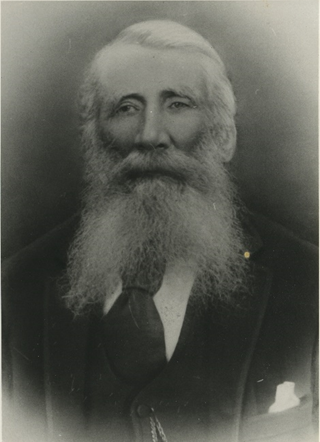
The taurapa was discovered in the late 1800s by a local settler, Frenchman Louis Bidois, whilst stabbing his stick into mudflats not far out from his homestead between Ōmokoroa and Te Puna, Western Bay of Plenty. He was guided towards this area during a conversation between himself and a local kuia who knew about the taurapa’s whereabouts from her own elders. 


David Borrell, in the Journal of the Tauranga Historical Society would note that it became the point of conversation for all who stepped into Louis Bidois’ homestead, where it took pride of place propped up in the living room. 
Here it stayed until in later years Mr F. Crossley Mappin, who purchased it, donated it to the Auckland Museum. Early correspondence tells us of its journey up to Auckland, arranged by his son, Louis Heke Bidois along with a carved statue of what was referred to as the atua of kumara, found on the shores of Motuhoa, just a few of the many taonga found along the shorelines of the area in the late 19th century. 

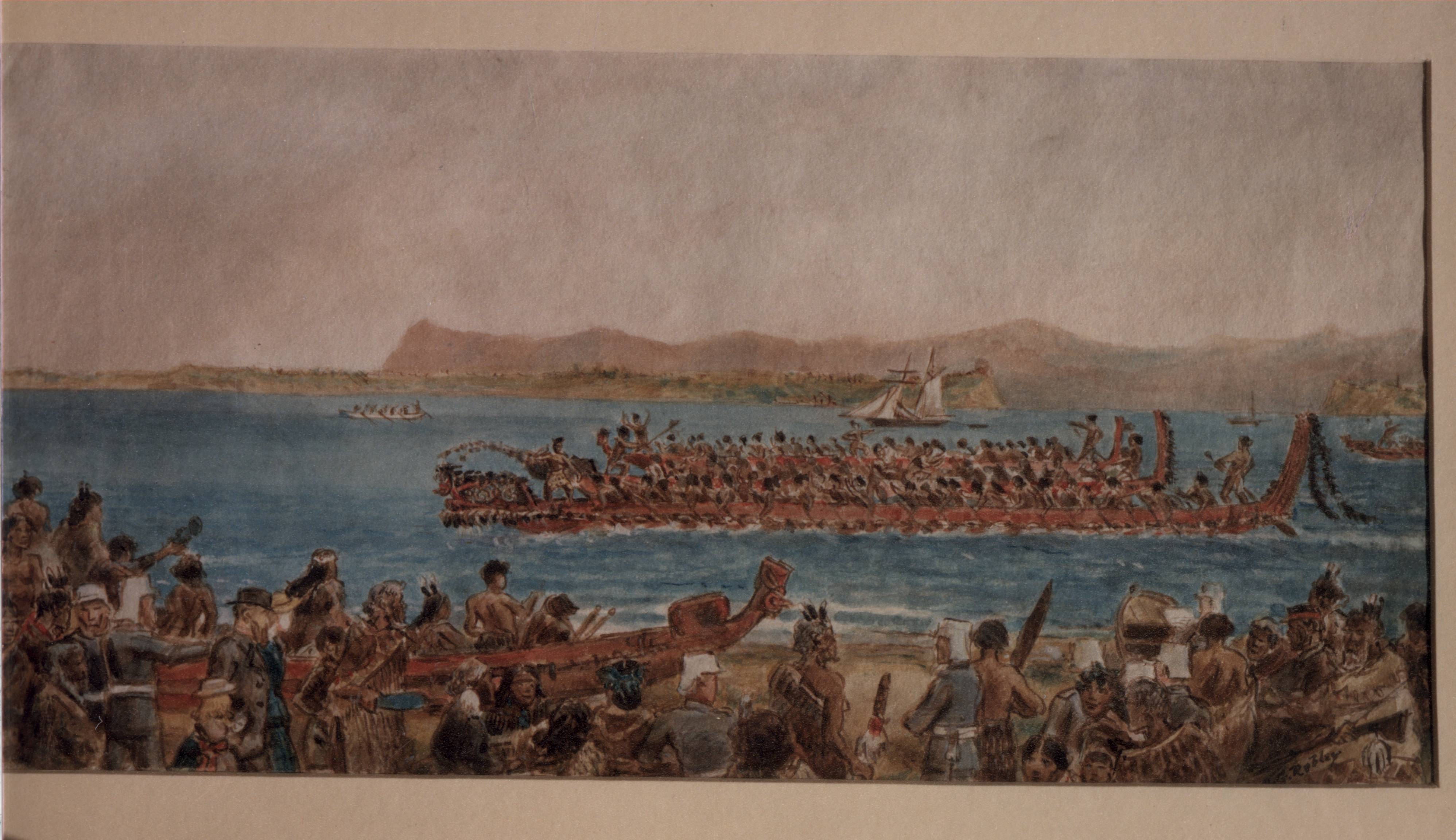
Having this taonga reemerge has provided an opportunity to reflect on other material that depicts earlier times, offering clues to the waka’s background story. Horatio Robley, a soldier-settler with a natural gift for art, was a significant figure in the mid-1800s, residing in the area and witnessing some of Tauranga’s most pivotal post-European historical events. One, was the Christmas Day waka race here in the harbour between the inner shores of Te Papa, Maungatapu and Matapihi. There were four prominent waka, each vying for first place in front of a mass crowd of both Māori and Pākeha- settlers, a contrasting scene to the events which occurred the year prior at Pukehinahina and Te Ranga. 

Photo 05-022

Despite the haste, Robley accurately captured this extraordinary spectacle in his drawing as it unfolded before him. He notes in his artwork index that the waka which finished first in the race, belonged to the people of Ōtumoetai (and chief Tupaea) and with the taurapa bearing the same carved figure at its base as that of Miripekapeka, it raises a tantalising question: could it be the same waka that Robley sketched in his artwork? Is there a deeper connection between Tupaea's victorious waka and the storied taonga of Miripekapeka?

Art 21-010

The narrative around Miripekapeka invites reflection on other significant waka in the region. The great waka of the past, carved with ancestral knowledge and used for both warfare and migration, highlight the deep seafaring traditions of Tauranga Moana. These vessels were not just modes of transport but living embodiments of whakapapa, carrying iwi across vast waters and connecting generations through their journeys.

References: 

Auckland Museum 22203 (ethnology), 468 (Taonga Database) and correspondence between Heke Bidois and the Director of Auckland Museum 1933 - 1935. https://www.aucklandmuseum.com/collection/object/100605

Pirirākau Hapū Management Plan 2017,  https://www.westernbay.govt.nz/repository/libraries/id:25p4fe6mo17q9stw0v5w/hierarchy/council/working-with-maori/hapu-iwi-management-plans/documents/Pirirakau%20Hapu%20Management%20Plan%202017%20FINAL.pdf

Index to Waka Race Illustration, Te Ao Mārama - Tauranga City Libraries Art 21-010.  https://paekoroki.tauranga.govt.nz/nodes/view/56936

Journal of the Tauranga Historical Society, no. 21 (September 1964), Te Ao Mārama - Tauranga City Libraries. https://paekoroki.tauranga.govt.nz/nodes/view/23963

Louis Bidois, Photo 16-043, Te Ao Mārama - Tauranga City Libraries.  https://paekoroki.tauranga.govt.nz/nodes/view/4930

Christmas Day waka race by Horatio Robley. Photo 05-022, Te Ao Mārama - Tauranga City Libraries.  https://paekoroki.tauranga.govt.nz/nodes/view/78560